Have you ever filled out a direct deposit form, linked your bank account to PayPal, or sent money electronically and been asked for an ABA routing number?
If so, you’re not alone.
Millions of Americans use ABA routing numbers every day without fully understanding what they are or why they’re so important. In fact, many people don’t realize there’s a difference between an ABA routing number, an account number, a SWIFT code, and a wire routing number until a payment is delayed or rejected.
That confusion can lead to costly mistakes.
Entering the wrong routing number could delay your paycheck, cause a direct deposit to fail, or prevent an important payment from reaching its destination on time. Fortunately, once you understand how ABA routing numbers work, they’re surprisingly easy to use correctly.
In this guide, you’ll learn exactly what an ABA routing number is, why banks use it, where to find yours, how it differs from other banking numbers, and the situations where you’ll need it. You’ll also discover common mistakes to avoid and practical examples that make the entire process easy to understand—even if you’re completely new to banking.
By the time you finish reading, you’ll know exactly what an ABA routing number does and how to use it with confidence.
Table of Contents
Quick Answer
An ABA routing number is a unique nine-digit code that identifies a financial institution in the United States during electronic and paper banking transactions. Banks use it to route money to the correct institution for direct deposits, ACH transfers, check processing, bill payments, payroll, and many other financial transactions.
Think of it as your bank’s mailing address.
Your routing number identifies which bank should receive the money.
Your account number identifies which customer at that bank should receive it.
Both numbers work together to ensure payments arrive safely and accurately.
What Is an ABA Routing Number?
An ABA routing number is a nine-digit identification number assigned to banks and credit unions operating in the United States. It helps financial institutions recognize one another whenever money moves through the U.S. banking system.
Without routing numbers, banks wouldn’t know where electronic payments should be delivered.
Whenever you:
- Receive your salary
- Set up direct deposit
- Pay bills online
- Transfer money between banks
- Deposit a check
- Receive a government benefit
- Receive a tax refund
your routing number helps direct the payment to the correct financial institution before your account number identifies the final recipient.
Although customers usually think of routing numbers as something only banks use, they are actually one of the foundations of the entire U.S. payment system.
Why Does an ABA Routing Number Exist?
Imagine trying to mail a letter without writing the city or postal code.
Even if you include the recipient’s name and street address, the postal service would struggle to determine where the letter belongs.
Banking works in much the same way.
Before money reaches your personal account, the banking system first needs to know which financial institution should receive the payment.
That’s exactly what an ABA routing number does.
It directs the payment to the correct bank before your account number directs it to your specific account.
Without routing numbers, electronic banking as we know it simply wouldn’t function efficiently.
Why Every Bank Has One
Every financial institution participating in the U.S. banking system must be uniquely identifiable.
If two banks shared the same routing number, payments could easily be sent to the wrong institution.
Instead, each participating bank receives one or more unique routing numbers that help distinguish it from every other financial institution in the country.
Large banks often have multiple routing numbers because they:
- Operate in several states
- Offer different banking services
- Process different transaction types
- Have grown through mergers and acquisitions
This explains why two customers at the same bank may legitimately have different routing numbers.
What Does ABA Stand For?
The letters ABA stand for the American Bankers Association.
The American Bankers Association developed the routing number system more than a century ago to improve the way banks processed checks and moved money between financial institutions.
Although banking technology has changed dramatically since then, the routing number system remains an essential part of the modern U.S. financial system.
Today, ABA routing numbers are used for far more than paper checks.
They also support:
- Direct deposits
- ACH transfers
- Payroll
- Government payments
- Electronic bill payments
- Online banking
- Mobile banking
- Business transactions
A Brief History
Long before online banking existed, banks exchanged enormous numbers of paper checks every day.
Sorting those checks manually was slow, expensive, and prone to errors.
To solve this problem, the American Bankers Association introduced a standardized numbering system that allowed banks to identify one another quickly and accurately.
That innovation eventually became what we now know as the ABA routing number.
While today’s payments are largely electronic, the same identification system continues to play a critical role in helping money move efficiently throughout the U.S. banking network.
How Does an ABA Routing Number Work?
Every time you send or receive money electronically, your routing number quietly works behind the scenes.
Here’s a simplified example.
Sarah starts a new job.
Her employer asks her to complete a direct deposit form.
She provides:
- Her name
- Her routing number
- Her account number
- Her account type
On payday, here’s what happens.
Step 1: The Employer Sends the Payment
The payroll system prepares Sarah’s salary for electronic transfer.
Step 2: The Routing Number Identifies the Bank
The routing number tells the banking network exactly which financial institution should receive the payment.
Step 3: The Account Number Identifies Sarah
Once the payment reaches the correct bank, Sarah’s account number tells the bank which specific account should receive the funds.
Step 4: The Money Is Deposited
The salary is credited to Sarah’s account, and she receives her paycheck through direct deposit.
Notice something important.
The routing number never identifies Sarah personally.
It only identifies her bank.
That’s why thousands—or even millions—of customers can share the same routing number while maintaining completely different bank accounts.
Why Are ABA Routing Numbers Always Nine Digits?
One question many people never think to ask is:
Why exactly nine digits?
The answer lies in standardization.
The U.S. banking system processes billions of transactions every year. Using a fixed nine-digit format allows banks, payment processors, employers, and government agencies to identify financial institutions quickly and consistently.
Each routing number follows a standardized structure.
While customers don’t need to memorize how every digit is assigned, it’s helpful to know that the digits aren’t random.
They contain information that helps payment systems verify and route transactions correctly.
Even the final digit serves a purpose.
It acts as a checksum, a mathematical validation digit that helps detect typing mistakes before transactions are processed.
This built-in verification is one reason many payment systems immediately reject routing numbers containing obvious errors.
ABA Routing Number Example
Suppose your bank uses the routing number:
021000021
To you, it may simply look like nine random digits.
To the banking system, however, that number immediately identifies a specific financial institution and tells payment networks where the money should be delivered.
The same principle applies to every valid ABA routing number in the United States.
No matter which bank you use, the routing number acts like the bank’s unique address within the financial system.
At the same time, your account number acts like your personal apartment number inside that address.
Without both pieces of information working together, electronic payments couldn’t reliably reach the intended recipient.
Where Is an ABA Routing Number Used?
You may never notice your ABA routing number during everyday banking, but behind the scenes it helps process millions of financial transactions every day.
Whenever money needs to move accurately from one financial institution to another within the United States, the routing number helps guide that payment to the correct bank.
Let’s look at the situations where you’ll most commonly use it.
Direct Deposit
One of the most common uses of an ABA routing number is direct deposit.
Instead of issuing paper checks, employers, government agencies, and retirement providers can deposit money directly into your bank account.
Common examples include:
- Employee salaries
- Bonuses
- Pension payments
- Social Security benefits
- Veterans benefits
- Unemployment benefits
- Tax refunds
To set up direct deposit, you’ll usually provide:
- Your full name
- Your ABA routing number
- Your account number
- Your account type (checking or savings)
Once your information is verified, future payments are deposited automatically into your account.
Direct deposit is faster, safer, and more convenient than receiving paper checks.
ACH Transfers
The Automated Clearing House (ACH) network relies heavily on ABA routing numbers.
Whenever you send or receive an ACH payment, your routing number identifies the financial institution responsible for processing the transaction.
ACH transfers are commonly used for:
- Payroll
- Automatic bill payments
- Mortgage payments
- Utility bills
- Insurance premiums
- Subscription services
- Person-to-person bank transfers
- Business payments
Because ACH payments are processed in batches, they’re usually less expensive than wire transfers, making them ideal for recurring transactions.
If you’re unsure whether your payment should be sent through the ACH network or as a wire transfer, we’ve created a detailed comparison that explains the differences in speed, cost, security, and typical use cases.
👉 Related guide: ACH Transfer vs. Wire Transfer: What’s the Difference and Which Should You Use?
Wire Transfers
Wire transfers also use routing information, but the routing number required may differ depending on the financial institution and the type of wire transfer being sent.
Unlike ACH payments, wire transfers are processed individually rather than in batches.
This makes them well suited for:
- Real estate purchases
- Emergency payments
- Large business transactions
- Time-sensitive transfers
Because wire instructions can vary from standard ACH routing information, it’s always important to confirm the correct routing number with your bank before sending a wire transfer.
Never assume that the routing number used for direct deposit is automatically the correct one for wire transfers.
Check Processing
Although paper checks are less common than they once were, millions are still processed every year.
When someone deposits or cashes your check, the ABA routing number printed along the bottom helps identify the bank responsible for honoring that payment.
Without routing numbers, banks would struggle to determine where each check should be sent for processing.
Even today, routing numbers remain an essential part of the check-clearing process.
Online Banking
Modern online banking allows customers to complete many financial tasks without visiting a branch.
Depending on your bank, your ABA routing number may be required when you:
- Link an external bank account
- Set up electronic transfers
- Verify ownership of an account
- Receive external deposits
- Authorize recurring payments
Many online banking platforms display your routing number alongside your account number to make these tasks easier.
Mobile Banking
Mobile banking apps have made managing money more convenient than ever.
Although most transfers happen behind the scenes, your routing number may still be needed when:
- Linking another bank account
- Receiving direct deposits
- Setting up external transfers
- Connecting payment services
If you’re ever unsure which routing number belongs to your account, your bank’s official mobile app is one of the safest places to verify it.
Government Payments
Federal and state agencies use ABA routing numbers to send billions of dollars every year.
These payments include:
- IRS tax refunds
- Social Security benefits
- Veterans benefits
- Federal retirement payments
- State unemployment benefits
Choosing direct deposit with the correct routing number usually allows recipients to receive funds faster than waiting for paper checks.
Business Banking
Businesses rely on ABA routing numbers every day.
Some of the most common business uses include:
- Employee payroll
- Vendor payments
- Supplier invoices
- Tax payments
- Insurance premiums
- Commercial banking transactions
Large organizations often process hundreds—or even thousands—of electronic payments each month.
Without routing numbers, this level of automation wouldn’t be possible.
ABA Routing Number vs. Account Number
One of the most common banking questions is:
“Are my routing number and account number the same thing?”
The answer is no.
Although both numbers appear together on checks and banking forms, they perform completely different jobs.
Here’s an easy comparison.
| ABA Routing Number | Account Number |
|---|---|
| Identifies the financial institution | Identifies your individual bank account |
| Assigned by the bank | Assigned to each customer |
| Usually nine digits | Length varies by bank |
| Shared by many customers | Unique to each account |
| Used to route payments to the correct bank | Used to route payments to the correct customer |
Think of it like mailing a package.
The routing number is similar to the city and ZIP code.
The account number is like the exact street address.
You need both for the package to reach the correct destination.
If you’d like a more detailed comparison, including examples and illustrations, we’ve published a complete guide explaining the differences.
👉 Related guide: Routing Number vs. Account Number: What’s the Difference?
ABA Routing Number vs. SWIFT Code
People often confuse ABA routing numbers with SWIFT codes because both help banks move money.
However, they’re used for different purposes.
| ABA Routing Number | SWIFT Code |
|---|---|
| Used primarily in the United States | Used for international banking |
| Nine-digit numerical code | Combination of letters and numbers |
| Identifies U.S. financial institutions | Identifies financial institutions worldwide |
| Commonly used for ACH payments, direct deposits, and checks | Commonly used for international wire transfers |
Here’s a simple way to remember the difference.
If the payment stays within the United States, you’ll usually need an ABA routing number.
If the money is crossing international borders, you’ll typically need a SWIFT code.
Understanding this distinction can help prevent rejected international transfers and unnecessary delays.
If you’re interested in learning exactly when each banking identifier is required, we’ve created a complete comparison guide.
👉 Related guide: Routing Number vs. SWIFT Code Explained
ABA Routing Number vs. Routing Transit Number (RTN)
Another question many people ask is whether an ABA routing number and a routing transit number are different.
In most situations, they’re actually the same thing.
The terms:
- ABA Routing Number
- Routing Transit Number (RTN)
- Bank Routing Number
- Routing Number
are commonly used interchangeably.
All refer to the nine-digit number used to identify a financial institution in the United States.
The terminology varies depending on the bank, payment form, or financial institution, but the purpose remains the same.
So if a banking form asks for your RTN instead of your ABA routing number, you’ll generally provide the same nine-digit routing number associated with your account.
Real-Life Example
Let’s see how everything works together.
Michael starts a new job.
His employer asks him to complete a direct deposit authorization form.
He enters:
- His ABA routing number
- His checking account number
- His account type
On payday, the payroll system first uses the ABA routing number to identify Michael’s bank.
Once the payment reaches the correct financial institution, the account number directs the funds into Michael’s personal checking account.
Within minutes, Michael receives a notification from his banking app confirming that his salary has been deposited successfully.
Without the ABA routing number, the payroll system wouldn’t know where to send the payment.
Without the account number, the bank wouldn’t know which customer should receive it.
Together, these two numbers make modern electronic banking possible.
How to Find Your ABA Routing Number
If you’ve ever completed a direct deposit form or linked your bank account to a payment app, you’ve probably been asked for your ABA routing number.
The good news is that finding it is usually quick and straightforward.
The safest approach is to obtain it directly from your bank rather than relying on information from unofficial websites.
Here are the most reliable ways to find your ABA routing number.
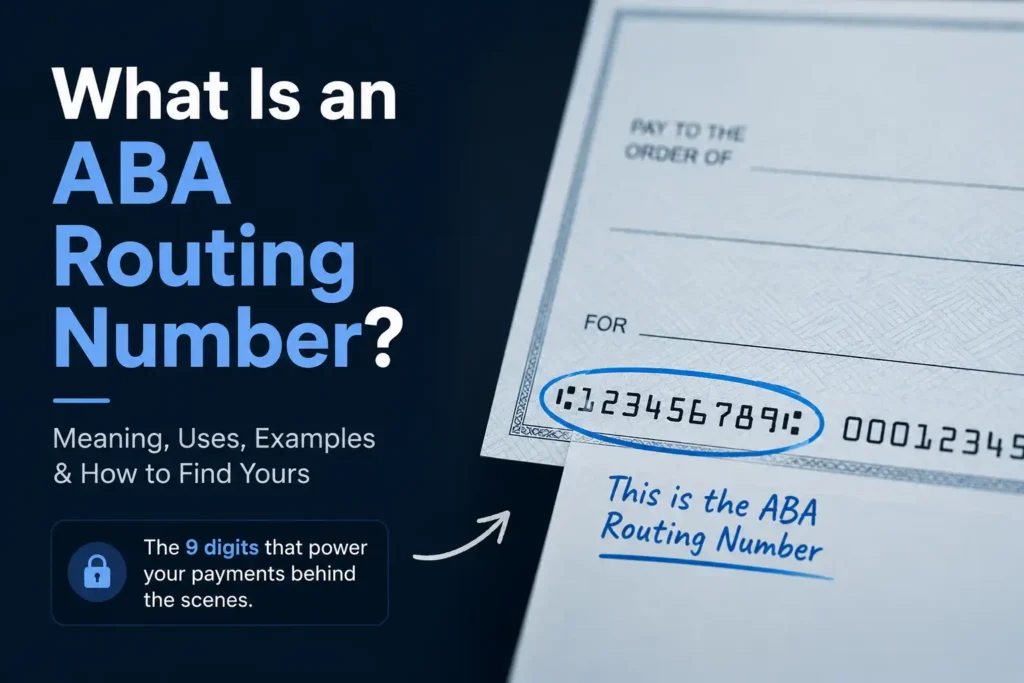
Look at Your Checks
If you have a paper check, you’ll usually find your ABA routing number printed along the bottom.
Most checks contain three groups of numbers.
- The first group is the ABA routing number.
- The second group is your account number.
- The third group is the check number.
Here’s an example.
| Number Group | Purpose |
|---|---|
| First | ABA Routing Number |
| Second | Account Number |
| Third | Check Number |
Although this layout is common, it’s always worth confirming with your bank if you’re unsure.
Check Your Online Banking Account
Online banking is one of the easiest places to verify your routing number.
After signing in, navigate to your account details or account information page.
Many banks display:
- ABA routing number
- Account number
- Account type
- Available balance
- Direct deposit information
Because the information comes directly from your financial institution, it’s one of the most reliable sources available.
Use Your Bank’s Mobile App
Most banks now provide routing information through their official mobile apps.
This can be especially useful if you need your routing number while completing an online form or setting up a payment from your smartphone.
Using your bank’s official app also reduces the risk of copying outdated information from third-party websites.
Review Your Bank Statement
Your monthly bank statement may also include your routing number.
Although statements vary by financial institution, many display routing information near your account details.
If you receive electronic statements, you can usually access them through your online banking account.
Contact Customer Support
If you’re still uncertain, contacting your bank directly is often the safest option.
A customer service representative can confirm:
- Your ABA routing number
- Whether it’s correct for your transaction
- Whether another routing number is required for specific payment types
This is particularly helpful before sending large payments or completing important financial documents.
Can a Bank Have More Than One ABA Routing Number?
Yes.
This is one of the biggest misconceptions about routing numbers.
Many people assume each bank has only one ABA routing number.
In reality, large financial institutions often have dozens of routing numbers.
Banks may assign different routing numbers based on:
- The state where the account was opened
- The type of transaction
- Internal processing requirements
- Historical bank mergers
- Business banking services
For example, a customer who opened an account in California may have a different routing number than someone who opened an account in New York, even though both bank with the same financial institution.
This doesn’t mean either routing number is wrong.
They’re simply assigned for different banking purposes.
Why Do Some Banks Have So Many Routing Numbers?
As banks expand across the country, processing millions of transactions becomes more complex.
Multiple routing numbers help financial institutions:
- Process payments more efficiently
- Support regional banking operations
- Separate business and consumer services
- Manage historical acquisitions
- Improve payment processing speed
For example, when one bank acquires another, it may continue using existing routing numbers for many years to avoid disrupting customers’ direct deposits and automatic payments.
That’s why two neighboring branches of the same bank may sometimes use different routing numbers.
Do ABA Routing Numbers Ever Change?
Yes, but not very often.
Most customers keep the same routing number for years.
However, routing numbers can change under certain circumstances.
Examples include:
- Bank mergers
- Acquisitions
- Major operational changes
- Account conversions
- Changes in payment processing systems
If your bank updates its routing information, it will usually notify affected customers well before the change takes effect.
This gives you enough time to update:
- Payroll information
- Direct deposits
- Automatic bill payments
- Linked payment apps
- Subscription services
If you’re ever notified of a routing number change, don’t ignore it.
Updating your banking information promptly helps prevent future payment delays.
Common Mistakes People Make
Most routing number problems are surprisingly easy to avoid.
Unfortunately, many people make the same mistakes over and over again.
Here are some of the most common ones.
Confusing the Routing Number With the Account Number
This is easily the most common mistake.
Remember:
- The routing number identifies your bank.
- The account number identifies your personal account.
Entering one in place of the other will usually cause the payment to fail.
Using Outdated Banking Information
Some people continue using routing numbers saved years earlier without checking whether they’re still correct.
While routing numbers don’t change often, they can change.
Always verify your routing number before completing important financial transactions.
Copying Information From Unofficial Websites
The internet contains thousands of routing number databases.
Unfortunately, not all of them are accurate or up to date.
Whenever possible, verify your routing number using:
- Your bank’s website
- Online banking
- Mobile banking
- Customer support
- Official account documents
Rushing Through Banking Forms
Typing mistakes happen more often than people think.
A single incorrect digit can delay:
- Payroll
- Tax refunds
- Bill payments
- Direct deposits
- Electronic transfers
Taking thirty extra seconds to review your information can save days of unnecessary frustration.
Security Tips When Using Your ABA Routing Number
An ABA routing number by itself isn’t considered highly sensitive because thousands—or even millions—of customers at the same bank may share it.
However, you should still handle your banking information responsibly.
Here are a few best practices.
- Never share your full banking information with people you don’t trust.
- Verify payment instructions before sending money.
- Watch for phishing emails requesting banking details.
- Use secure internet connections when accessing online banking.
- Enable multi-factor authentication on your banking accounts.
- Monitor your account regularly for unauthorized transactions.
Scammers rarely rely on routing numbers alone.
Instead, they try to collect multiple pieces of banking information through phishing emails, fake websites, or phone scams.
Being cautious with your financial information is one of the simplest ways to protect yourself.
Before You Submit Any Banking Form
Whether you’re setting up direct deposit, linking a payment app, or authorizing an electronic transfer, review this checklist before clicking Submit.
✔ Confirm your ABA routing number.
✔ Verify your account number.
✔ Make sure you’ve selected the correct account type.
✔ Confirm the recipient’s name.
✔ Double-check the payment amount.
✔ Review every digit before submitting.
This simple habit takes less than a minute but can prevent many of the banking mistakes that lead to rejected payments and delayed deposits.
Banking Terms You Should Know
If you’re new to electronic banking, you’ll often see several terms used together.
Understanding them makes banking much less confusing.
| Banking Term | Meaning |
|---|---|
| ABA Routing Number | Identifies a financial institution in the United States. |
| Account Number | Identifies your personal bank account. |
| ACH | Electronic payment network used for many domestic transactions. |
| Wire Transfer | Individual electronic transfer designed for speed. |
| SWIFT Code | International bank identifier used for global transfers. |
| Direct Deposit | Electronic payment sent directly into your bank account. |
| Mobile Banking | Banking services provided through a smartphone app. |
| Online Banking | Banking services accessed through a web browser. |
Once you understand these terms, completing banking forms becomes much easier because you’ll know exactly what information each field requires.
This knowledge also helps you avoid common mistakes when sending or receiving money electronically.
Frequently Asked Questions About ABA Routing Numbers
Understanding ABA routing numbers becomes much easier once you know what they do and where they’re used. Below are answers to some of the most common questions people ask before setting up direct deposits, sending money, or linking a bank account.
Is an ABA Routing Number the Same as a Routing Number?
Yes. In most situations, the terms ABA routing number, routing number, bank routing number, and routing transit number (RTN) all refer to the same nine-digit number that identifies a financial institution in the United States. Different banks and payment forms may use different names, but they’re generally referring to the same banking identifier.
Is an ABA Routing Number the Same as an Account Number?
No. An ABA routing number identifies your financial institution, while your account number identifies your personal bank account. Think of the routing number as the bank’s address and the account number as your specific mailbox. Both are required for many electronic banking transactions.
Can Two People Have the Same ABA Routing Number?
Yes. Thousands—or even millions—of customers at the same bank may share the same ABA routing number. That’s because the routing number identifies the bank, not the individual customer. Your account number is what makes your bank account unique.
Is an ABA Routing Number Unique to Every Bank?
Generally, yes. Every participating financial institution receives one or more ABA routing numbers. However, large banks often have multiple routing numbers because they operate in different states or process different types of transactions.
Why Do Some Banks Have Multiple ABA Routing Numbers?
Large banks may use multiple routing numbers because they serve customers across different states, process different payment types, or have acquired other financial institutions through mergers. Having multiple routing numbers helps banks manage payments more efficiently without disrupting existing customer accounts.
Do Credit Unions Have ABA Routing Numbers?
Yes. Most credit unions that participate in the U.S. banking system have their own ABA routing numbers. They function the same way as routing numbers issued to commercial banks and are used for direct deposits, ACH payments, checks, and many other financial transactions.
Can an ABA Routing Number Change?
Yes, but it doesn’t happen often. Routing numbers may change after bank mergers, acquisitions, operational restructuring, or certain account conversions. If your bank updates its routing number, it will usually notify affected customers well before the change takes effect.
Does Moving to Another State Change My ABA Routing Number?
Not necessarily. If you keep the same bank account, your routing number often remains the same even after you move. However, if you open a new account in another state, your bank may assign a different routing number.
Can I Use Any Routing Number From My Bank?
No. Even if two routing numbers belong to the same bank, they may not be interchangeable. The correct routing number depends on factors such as where your account was opened and the type of transaction you’re completing. Always verify the routing number associated with your account.
Where Can I Verify My ABA Routing Number?
The safest places include:
- Your online banking account
- Your bank’s mobile app
- Your paper checks
- Your monthly bank statement
- Official customer support
These sources provide the most accurate and up-to-date information.
Is My ABA Routing Number Printed on My Debit Card?
No. Debit cards usually display your card number, expiration date, and security information. They do not display your ABA routing number. To find your routing number, check your bank account information instead.
Is My ABA Routing Number Printed on My Credit Card?
No. Credit cards do not display ABA routing numbers because they use an entirely different payment system. Routing numbers are associated with bank accounts rather than credit card accounts.
Can I Find My ABA Routing Number Online?
Yes. Most banks display routing numbers within their secure online banking portals and mobile banking apps. You can also find them on many banks’ official websites. Avoid relying solely on unofficial routing number directories because they may contain outdated information.
Is It Safe to Share My ABA Routing Number?
Sharing your routing number by itself is generally considered low risk because routing numbers identify banks rather than individual customers. However, you should still avoid sharing your complete banking information with people or organizations you don’t trust.
Can Someone Steal Money Using Only My ABA Routing Number?
An ABA routing number alone is usually not enough for someone to access your account. However, when combined with your account number and other personal information, it may increase the risk of unauthorized transactions. Always protect your complete banking details.
What Happens If I Enter the Wrong ABA Routing Number?
If you enter the wrong routing number, your payment may be rejected, delayed, or returned by the banking system. In some cases, the receiving bank may reject the transaction immediately. If you notice an error, contact your bank as soon as possible.
Is an ABA Routing Number Required for Direct Deposit?
Yes. Employers and government agencies generally require both your ABA routing number and your account number to send direct deposits. Providing accurate banking information helps ensure your payments arrive without delays.
Is an ABA Routing Number Required for ACH Transfers?
Yes. The ACH network relies on ABA routing numbers to identify the receiving and sending financial institutions. Without a valid routing number, ACH payments cannot be processed correctly.
Is an ABA Routing Number Used for Wire Transfers?
Sometimes. Domestic wire transfers often require routing information, but the routing number used for wire transfers may differ from the one used for ACH payments or direct deposits. Always confirm the correct routing number with your bank before sending a wire transfer.
Does Every Country Use ABA Routing Numbers?
No. ABA routing numbers are specific to the United States. Other countries use different banking identification systems. For example, many international transfers rely on SWIFT codes or IBANs rather than ABA routing numbers.
Conclusion
An ABA routing number may seem like a small detail, but it plays a vital role in the U.S. banking system. Whether you’re receiving a paycheck, setting up direct deposit, paying bills online, or transferring money between banks, this nine-digit number helps ensure your payment reaches the correct financial institution.
Understanding how ABA routing numbers work can help you avoid common banking mistakes, reduce the risk of rejected payments, and complete electronic transactions with greater confidence. More importantly, knowing when and where to use your routing number can save you time, money, and unnecessary frustration.
Before submitting any banking form, take a moment to verify your routing number through your bank’s official website, online banking portal, mobile app, or customer service. A simple verification today can prevent payment problems tomorrow.
If you’d like to deepen your understanding of everyday banking, these guides are excellent next reads:
- ACH Transfer vs. Wire Transfer: What’s the Difference and Which Should You Use?
- Routing Number vs. Account Number: What’s the Difference?
- ACH Transfer vs. Wire Transfer: What’s the Difference and Which Should You Use?
- How to Find Your Bank Routing Number
- Why Do Banks Have Different Routing Numbers?
- 121000248 Routing Number: Which Bank Uses It and How to Avoid Costly Transfer Mistakes
Together, these resources will help you build a solid understanding of modern banking and make more informed decisions whenever you send, receive, or manage money electronically.

