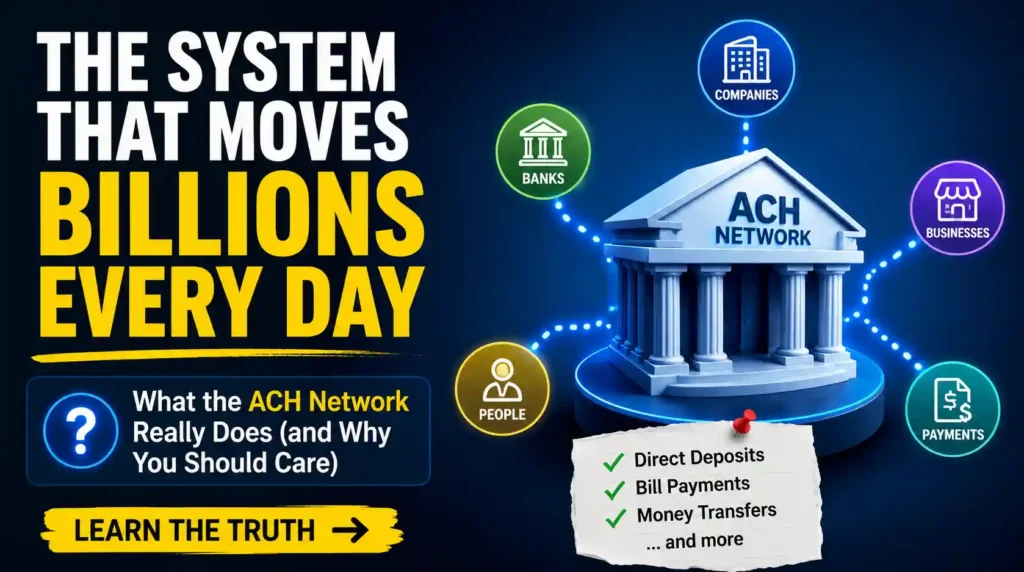
If you’ve ever received your salary through direct deposit, paid a utility bill online, or transferred money between your bank accounts, you’ve probably used the Automated Clearing House (ACH) Network without even realizing it.
The ACH Network is one of the most important payment systems in the United States. It processes billions of electronic payments every year, making it possible for individuals, businesses, employers, and government agencies to send and receive money securely and efficiently.
In this guide, you’ll learn exactly what the Automated Clearing House (ACH) Network is, how it works, the different types of ACH transactions, its benefits and limitations, and how it compares with other payment methods like wire transfers.
Table of Contents
What Is the Automated Clearing House (ACH) Network?
The Automated Clearing House (ACH) Network is an electronic payment network that moves money directly between bank accounts in the United States.
Instead of using paper checks, cash, or credit cards, the ACH Network allows financial institutions to process electronic payments in batches.
The network is widely used for:
- Direct deposit of salaries
- Social Security and government benefits
- Tax refunds
- Online bill payments
- Mortgage payments
- Utility bills
- Insurance premiums
- Business payroll
- Bank-to-bank transfers
- Subscription payments
Because it handles such a large volume of transactions at relatively low cost, the ACH Network has become one of the most widely used electronic payment systems in the U.S.
Why Was My ACH Transfer Delayed or Rejected? 15 Common Reasons and How to Fix Them
How Does the ACH Network Work?
Although an ACH payment may appear instant from a user’s perspective, it goes through several steps before the money reaches its destination.
Step 1: A Payment Is Initiated
Someone authorizes an electronic payment.
Examples include:
- An employer sends payroll.
- A customer pays an electricity bill.
- A person transfers money between two bank accounts.
- A business collects a monthly subscription fee.
Step 2: The Bank Collects the Payment
The sender’s bank gathers ACH payment requests throughout the day.
Rather than sending each payment individually, the bank groups multiple transactions together.
Step 3: Transactions Enter the ACH Network
The batch of payments is sent to the ACH operator.
In the United States, ACH transactions are processed through two primary operators:
- The Federal Reserve
- The Electronic Payments Network (EPN)
The operator sorts each transaction according to the receiving financial institution.
Step 4: The Receiving Bank Processes the Payment
The receiving bank receives the transaction and credits or debits the customer’s account.
Once completed, the payment is considered settled.
Types of ACH Transactions
There are two primary categories of ACH payments.
ACH Credit
With an ACH Credit, the sender pushes money into another account.
Common examples include:
- Direct deposit payroll
- Tax refunds
- Government benefit payments
- Person-to-person bank transfers
- Business payments
The sender initiates the transfer.
ACH Debit
With an ACH Debit, the recipient pulls money from the payer’s account after receiving authorization.
Examples include:
- Utility bills
- Mortgage payments
- Car loan payments
- Streaming subscriptions
- Gym memberships
- Insurance premiums
The recipient initiates the payment based on prior authorization.
Common Examples of ACH Payments
Most Americans use ACH payments regularly, even if they don’t recognize the term.
Examples include:
- Receiving a paycheck through direct deposit
- Paying electricity or water bills automatically
- Paying a credit card bill from a checking account
- Receiving a federal tax refund
- Paying rent electronically
- Making recurring insurance payments
- Sending money between personal bank accounts
- Receiving Social Security benefits
Who Uses the ACH Network?
The ACH Network serves nearly every part of the U.S. financial system.
Common users include:
Individuals
Consumers use ACH for:
- Direct deposit
- Automatic bill payments
- Online banking transfers
- Subscription services
Businesses
Companies use ACH to:
- Pay employees
- Pay vendors
- Collect customer payments
- Process recurring subscriptions
- Issue refunds
Government Agencies
Federal, state, and local governments use ACH for:
- Social Security benefits
- Veterans benefits
- Tax refunds
- Tax collections
- Unemployment benefits
Banks and Credit Unions
Financial institutions rely on the ACH Network to process millions of electronic transfers every day.
Advantages of the ACH Network
The ACH Network offers several important benefits.
Lower Costs
ACH payments generally cost much less than wire transfers or credit card transactions.
This makes ACH especially attractive for businesses handling a high volume of payments.
Convenience
Payments can be scheduled automatically, reducing the need to remember monthly due dates.
Security
ACH payments travel through regulated banking systems with multiple security measures and authentication procedures.
Reduced Paperwork
Electronic payments eliminate the need for paper checks and manual processing.
Reliable Payroll
Millions of workers receive salaries through ACH direct deposit every pay period.
Disadvantages of the ACH Network
Although ACH is highly efficient, it has some limitations.
Slower Than Wire Transfers
ACH payments often take one to three business days, although many now settle on the same day.
Wire transfers are generally faster.
Processing Delays
Payments initiated late in the day or before weekends and holidays may not process until the next business day.
Authorization Requirements
ACH debits require proper customer authorization before funds can be withdrawn.
ACH Network vs Wire Transfer
Many people confuse ACH payments with wire transfers, but they serve different purposes.
| Feature | ACH Network | Wire Transfer |
|---|---|---|
| Speed | Same day to 3 business days | Usually same day |
| Cost | Low or free | Higher fees |
| Processing | Batch processing | Individual processing |
| Best For | Payroll, bills, recurring payments | Urgent or large-value transfers |
| Reversibility | Some transactions may be returned under specific rules | Generally difficult to reverse |
If speed is the highest priority, a wire transfer is often the better choice.
If cost savings and recurring payments matter more, ACH is usually the preferred option.
Is the ACH Network Safe?
Yes. The ACH Network is considered highly secure.
Banks use multiple security measures, including:
- Encryption
- Authentication
- Fraud monitoring
- Transaction verification
- Banking regulations
- Customer authorization requirements
Consumers can further protect themselves by:
- Monitoring bank statements regularly
- Using strong online banking passwords
- Enabling multi-factor authentication
- Reporting unauthorized transactions immediately
How Long Do ACH Payments Take?
The timing depends on several factors.
Many ACH payments now qualify for Same-Day ACH, while others may take one to three business days.
Processing time can vary based on:
- The bank’s cutoff times
- Weekends
- Federal holidays
- Payment type
- Whether additional verification is required
Can an ACH Payment Be Reversed?
In certain situations, yes.
ACH transactions may be returned or reversed if:
- There were insufficient funds.
- The account number was incorrect.
- The payment was unauthorized.
- A duplicate payment occurred.
- A processing error happened.
However, reversals must follow strict banking rules and deadlines.
Why the ACH Network Is Important
The ACH Network supports much of the U.S. economy by allowing money to move efficiently between bank accounts.
Without it, employers would have difficulty paying workers electronically, businesses would face higher payment costs, and consumers would rely much more heavily on paper checks.
Because it combines affordability, security, and convenience, the ACH Network remains one of the most essential payment systems in American banking.
Frequently Asked Questions About the Automated Clearing House (ACH) Network
High-quality payment systems can seem complex at first. These answers explain the most common questions people have about the Automated Clearing House (ACH) Network.
What Does ACH Stand For?
ACH stands for Automated Clearing House, an electronic network that processes bank-to-bank payments in the United States.
What Is the ACH Network Used For?
It is used for direct deposits, bill payments, payroll, tax refunds, government benefits, recurring subscriptions, and bank transfers.
Is ACH the Same as a Wire Transfer?
No. ACH payments are generally less expensive but slower than wire transfers.
How Long Does an ACH Transfer Take?
Most ACH transfers take one to three business days, although many qualify for same-day processing.
Are ACH Payments Safe?
Yes. ACH transactions are processed through regulated financial institutions using multiple security measures.
What Is an ACH Credit?
An ACH credit is a payment where the sender pushes money into another bank account.
What Is an ACH Debit?
An ACH debit allows an approved business or organization to pull money from a customer’s account.
Can ACH Payments Be Cancelled?
Sometimes. Whether a payment can be cancelled depends on when the request is made and the status of the transaction.
Does ACH Work Internationally?
No. The ACH Network is designed primarily for domestic U.S. bank transfers.
Do Banks Charge for ACH Transfers?
Many banks offer ACH transfers for free, while some may charge a small fee depending on the type of transaction.
Why Do Businesses Prefer ACH Payments?
Businesses often choose ACH because it reduces payment processing costs, simplifies payroll, and supports recurring billing.
Can ACH Payments Bounce?
Yes. ACH payments may fail if there are insufficient funds, incorrect account details, or other processing issues.
Is Direct Deposit an ACH Payment?
Yes. Most employer payroll direct deposits are processed through the ACH Network.
Are ACH Payments Faster Than Checks?
Yes. ACH payments are generally faster, more secure, and more convenient than paper checks.
Can I Track an ACH Payment?
Many banks allow customers to monitor the status of ACH transfers through online or mobile banking.
Conclusion
The Automated Clearing House (ACH) Network is the backbone of electronic bank-to-bank payments in the United States. From direct deposits and bill payments to tax refunds and recurring subscriptions, it enables billions of secure transactions every year.
Although ACH payments are not always as fast as wire transfers, they are typically more affordable, reliable, and well suited for everyday financial activities. Understanding how the ACH Network works can help you choose the right payment method, manage your finances more effectively, and make informed decisions about moving money electronically.
Why Was My ACH Transfer Delayed or Rejected? 15 Common Reasons and How to Fix Them

