Applying for a credit card only to receive a rejection can be frustrating. It wastes time, creates uncertainty, and often leaves you wondering what went wrong.
That’s why understanding the requirements before you apply is so important.
The Yendo Credit Card is different from most traditional credit cards. Instead of relying primarily on your credit score or asking for a refundable cash deposit, it uses an eligible vehicle to help support your application. That unique approach opens the door for many people who may struggle to qualify elsewhere—but it also means there are additional eligibility requirements that applicants need to meet.
Owning a vehicle alone isn’t enough.
Likewise, having a good income doesn’t automatically guarantee approval.
Yendo looks at several factors together, including your vehicle, financial profile, identity, and ability to manage a revolving line of credit responsibly.
Understanding those requirements before submitting an application can improve your chances of approval and help you avoid unnecessary delays.
In this guide, you’ll learn:
- Who can apply for the Yendo Credit Card.
- The basic eligibility requirements.
- Which vehicles qualify.
- Whether you can apply if you’re still making car payments.
- What documents you’ll need.
- The most common reasons applications are declined.
- Practical steps you can take to improve your approval chances.
By the end, you’ll have a clear understanding of whether you’re likely to qualify and what you can do before submitting your application.
Table of Contents
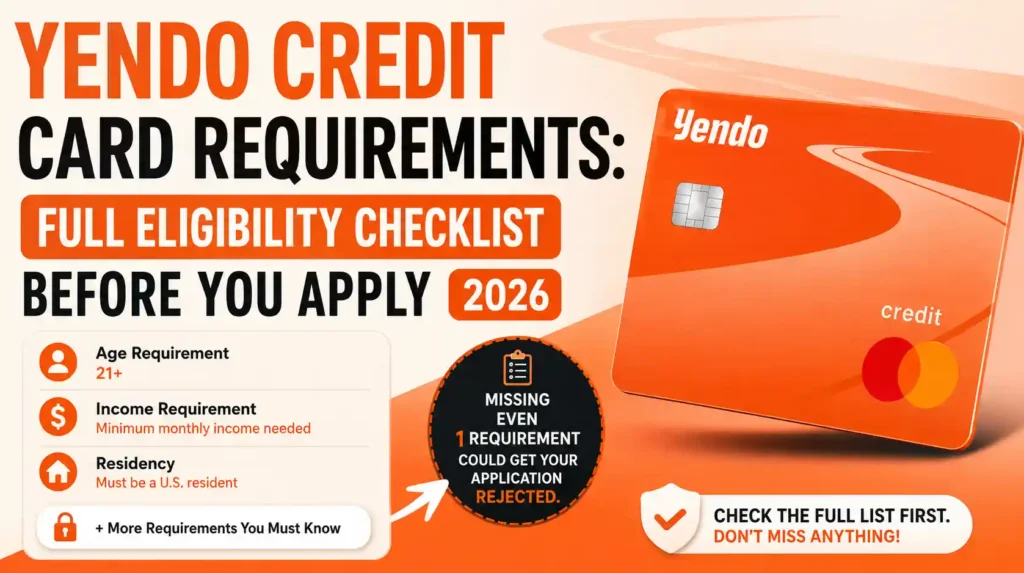
Yendo Credit Card Requirements at a Glance
Before exploring each requirement in detail, here’s a quick overview of what Yendo generally looks for during the application process.
Most successful applicants typically have:
- An eligible vehicle.
- Sufficient vehicle equity.
- Valid government-issued identification.
- A verifiable residential address.
- A reliable source of income.
- The ability to meet monthly repayment obligations.
- A financial profile that supports responsible borrowing.
Meeting these basic requirements doesn’t automatically guarantee approval.
Instead, they form the starting point of the overall evaluation.
Every application is reviewed individually, and the final decision depends on the complete picture rather than one single requirement.
Check Your Eligibility in Minutes
Think you meet the basic requirements? You can check whether you’re eligible for the Yendo Credit Card without committing to the account. If approved, you’ll be able to review your offer before deciding whether to accept it.
👉 Check Your Yendo Eligibility Here
Let’s begin with the most important question.
Who Can Apply for the Yendo Credit Card?
The Yendo Credit Card is designed for adults who own—or in some cases are financing—an eligible vehicle and are looking for access to revolving credit.
Unlike many traditional credit cards that focus heavily on a credit score alone, Yendo evaluates multiple aspects of your financial situation before making a decision.
That means applicants who have experienced credit challenges in the past may still have an opportunity to qualify if they meet the overall eligibility requirements.
However, this shouldn’t be interpreted as “everyone gets approved.”
Approval still depends on whether the application demonstrates that the account can be managed responsibly.
Think of the application as answering three fundamental questions:
- Can your identity be verified?
- Does your vehicle meet the program requirements?
- Does your overall financial situation support responsible borrowing?
If the answer to all three questions is positive, your application has a much stronger chance of moving forward.
Ready to See If You Qualify?
If you own an eligible vehicle and meet the basic requirements, you can start the application online and see whether you qualify.
Now let’s examine each requirement individually.
Basic Eligibility Requirements
Although every application is unique, there are several fundamental requirements that nearly every applicant must satisfy before approval can be considered.
You Must Meet the Minimum Age Requirement
Applicants must be legal adults.
This requirement exists because entering into a revolving credit agreement creates a legally binding financial contract.
If you’re under the legal age required to enter such agreements in your state, you’ll need to wait until you become eligible before applying.
For most readers, this requirement is straightforward.
The more important considerations come later in the application process.
You Must Live in an Eligible State
Before starting your application, the first thing to check is whether the Yendo Credit Card is offered in your state of residence.
Although the card is available across much of the United States, it is not currently offered in every state. If your state isn’t part of Yendo’s service area, you won’t be able to complete the application, regardless of whether you meet the other eligibility requirements.
As of 2026, the Yendo Credit Card is available in 36 U.S. states:
- Alabama (AL)
- Arizona (AZ)
- Arkansas (AR)
- California (CA)
- Colorado (CO)
- Connecticut (CT)
- Delaware (DE)
- Florida (FL)
- Georgia (GA)
- Idaho (ID)
- Illinois (IL)
- Indiana (IN)
- Kansas (KS)
- Kentucky (KY)
- Michigan (MI)
- Mississippi (MS)
- Montana (MT)
- Nebraska (NE)
- Nevada (NV)
- New Hampshire (NH)
- New Mexico (NM)
- North Carolina (NC)
- North Dakota (ND)
- Ohio (OH)
- Oregon (OR)
- Pennsylvania (PA)
- Rhode Island (RI)
- South Carolina (SC)
- Tennessee (TN)
- Texas (TX)
- Utah (UT)
- Vermont (VT)
- Virginia (VA)
- Washington (WA)
- West Virginia (WV)
- Wyoming (WY)
Because financial products often expand into new markets, the list of eligible states may change in the future. It’s worth verifying that your state is still included before submitting your application.
If you’ve recently relocated, make sure the address on your application matches the address on your government-issued identification and any supporting documents. Consistent information helps speed up the verification process and reduces the risk of delays caused by address mismatches or incomplete records.
You Must Have a Valid Government-Issued ID
Every financial institution has an obligation to verify the identity of its customers.
As part of that process, you’ll generally need a current government-issued photo identification.
Examples include:
- Driver’s license.
- State identification card.
- U.S. passport.
- Other accepted government identification.
The document should be:
- Valid.
- Clearly readable.
- Free from damage.
- Consistent with the information entered on your application.
Simple mistakes such as entering a nickname instead of your legal name can sometimes create unnecessary delays during identity verification.
Always complete your application using the same information that appears on your official identification documents.
You Must Be Able to Verify Your Identity
Submitting an ID is only one part of identity verification.
Financial institutions also need to confirm that the person completing the application is genuinely the owner of that identity.
Depending on your application, additional verification may include confirming your:
- Date of birth.
- Residential address.
- Mobile phone number.
- Email address.
- Social Security Number or other accepted taxpayer identification.
Some applicants may also complete additional security checks through their smartphone.
Although these steps may seem time-consuming, they’re designed to protect applicants from identity theft and unauthorized account openings.
Completing identity verification successfully is one of the fastest ways to keep your application moving.
Do You Need Good Credit to Qualify?
This is probably the question asked more than any other.
The short answer is:
Not necessarily.
Many people assume Yendo works like a traditional unsecured credit card where approval depends almost entirely on having an excellent credit score.
That’s not how the program is designed.
Instead of relying on one number alone, Yendo evaluates multiple parts of your financial profile.
Your vehicle, available equity, income, existing obligations, and overall ability to repay all contribute to the final decision.
That means someone with less-than-perfect credit may still qualify if the overall application demonstrates responsible borrowing potential.
At the same time, applicants with higher credit scores shouldn’t assume approval is automatic.
An excellent credit history cannot compensate for an ineligible vehicle or missing documentation.
Approval is based on the complete application—not one isolated factor.
We’ll take a much deeper look at credit scores, income requirements, and approval decisions later in this guide.
Do You Need a Job to Apply?
Many prospective applicants ask whether employment itself is a requirement.
The better question is whether you have a reliable way to repay borrowed money.
Employment is certainly one way to demonstrate that ability, but it isn’t the only one.
Depending on your circumstances, income may come from different legitimate sources.
What’s important is that your financial situation supports responsible repayment.
During the review process, the lender considers whether taking on additional revolving credit appears manageable based on the information provided.
Applicants whose monthly obligations already consume most of their available income may face a more difficult approval process than someone with greater financial flexibility.
This doesn’t mean you need a high income.
It means your overall financial picture should demonstrate that you can reasonably manage the account if approved.
We’ll examine income and affordability in much greater detail in Part 3.
Why Meeting the Requirements Matters
Some people rush through credit card applications hoping everything will work out.
That approach often leads to avoidable frustration.
Taking time to understand the eligibility requirements before applying provides several advantages.
First, it allows you to identify any missing documents ahead of time.
Second, it gives you the opportunity to correct inaccurate information before submitting your application.
Finally, it helps you decide whether now is the right time to apply or whether improving your financial profile first would increase your chances of success.
Preparation won’t guarantee approval.
But it can significantly improve the quality of your application.
Before worrying about credit scores or income, however, there’s one requirement that deserves its own detailed discussion—the vehicle itself.
Not every car qualifies, and understanding those rules can save applicants considerable time.
Vehicle Requirements: Does Your Car Qualify?
This is where the Yendo application differs most from a traditional credit card.
With a conventional credit card, your vehicle usually isn’t part of the conversation.
With Yendo, it’s one of the first things the lender evaluates.
That’s because your vehicle helps support the revolving credit line. As a result, the lender needs to determine whether it meets the program’s eligibility standards before approving the account.
Fortunately, you don’t need to own a luxury vehicle to qualify.
Many everyday cars, SUVs, pickup trucks, and vans may be eligible.
However, not every vehicle will meet the requirements.
Does Your Vehicle Qualify?
If your vehicle appears to meet these requirements, you can check your eligibility and view your available offer online.
👉 See If Your Vehicle Qualifies
Understanding what the lender looks for before applying can save you time and reduce the chances of your application being delayed or declined.
What Makes a Vehicle Eligible?
There isn’t a single checklist that guarantees approval because every application is reviewed individually.
Instead, the lender considers several characteristics together when evaluating a vehicle.
These commonly include:
- Vehicle age
- Make and model
- Overall condition
- Current mileage
- Estimated market value
- Available equity
- Ownership status
- Existing liens or loans
- Vehicle history
Think of your vehicle as part of your overall financial profile.
Just as income and repayment ability matter, the vehicle itself must provide enough value to support the requested credit line.
A newer vehicle with lower mileage and good market value generally presents less risk than an older vehicle with extensive wear and very little remaining value.
That doesn’t mean older vehicles are automatically rejected.
It simply means every vehicle is evaluated on its own merits.
What Types of Vehicles Usually Qualify?
Many applicants are surprised to learn that Yendo isn’t limited to one specific type of vehicle.
Eligible vehicles commonly include:
- Sedans
- SUVs
- Pickup trucks
- Crossovers
- Minivans
In many cases, these are simply the vehicles people drive every day.
Whether you own a family SUV, a compact sedan, or a pickup used for work, your vehicle may qualify if it satisfies the program’s eligibility requirements.
However, approval depends on much more than simply choosing the right vehicle category.
The vehicle must also meet standards relating to its value, ownership status, and overall condition.
Can Older Vehicles Qualify?
Age alone doesn’t determine whether your vehicle qualifies.
Many people assume an older vehicle is automatically ineligible.
That’s not necessarily true.
An older vehicle that has been well maintained may still have meaningful value.
Likewise, a relatively new vehicle that’s been heavily damaged may not present the same level of security.
Instead of focusing on the model year alone, it’s more helpful to think about the vehicle as a complete asset.
Questions that may influence eligibility include:
- Is the vehicle in good working condition?
- Does it still have meaningful market value?
- Has it been properly maintained?
- Is the ownership documentation clear?
- Does sufficient equity exist?
These questions often matter more than age by itself.
Does Mileage Matter?
Yes.
Mileage can influence how a vehicle is evaluated.
Generally speaking, vehicles with lower mileage tend to retain more value than similar vehicles with very high mileage.
For example:
A five-year-old vehicle with 45,000 miles will often be viewed differently from an identical vehicle with 240,000 miles.
That doesn’t mean high-mileage vehicles are automatically excluded.
Instead, mileage becomes one factor among many that help determine the vehicle’s estimated value.
It’s the overall picture—not one individual number—that matters.
Does the Vehicle Have to Be in Perfect Condition?
No.
Normal wear and tear is expected.
Small scratches, minor cosmetic imperfections, or everyday signs of use won’t necessarily prevent a vehicle from qualifying.
However, significant damage can affect eligibility.
Examples include:
- Severe collision damage
- Structural frame damage
- Extensive flood damage
- Fire damage
- Vehicles declared a total loss
- Missing major components
If the vehicle’s condition substantially reduces its market value or raises concerns about its long-term reliability, it may affect the approval decision.
Providing accurate information about the vehicle is always the best approach.
Trying to hide visible damage rarely benefits the applicant and can create additional verification requests.
Do You Need to Own the Vehicle?
This is another question that creates confusion.
Many people believe they must have completely paid off their vehicle before applying.
That’s only partly true.
Owning the vehicle outright may simplify the process because there are no existing lenders with legal claims against the title.
However, owning the vehicle free and clear isn’t always required.
Some applicants who are still making monthly car payments may also qualify.
The key consideration isn’t simply ownership.
It’s whether the lender can establish the necessary security interest in the vehicle.
We’ll look at that situation next.
Can You Apply If You’re Still Making Car Payments?
Yes—in some cases.
Having an existing auto loan doesn’t automatically prevent you from applying.
However, the application process may involve additional steps because another lender already has an interest in the vehicle.
The outcome often depends on factors such as:
- Remaining loan balance
- Available vehicle equity
- Current lender
- Vehicle value
- Overall financial profile
Applicants with significant equity may have more options than those whose loan balance is close to—or exceeds—the vehicle’s value.
For example:
Example One
A vehicle is worth approximately $22,000.
The remaining auto loan balance is $6,000.
Because substantial equity exists, the application may proceed if the other eligibility requirements are met.
Example Two
Another vehicle is worth approximately $14,000.
The remaining loan balance is $13,500.
In this situation, available equity is much lower, which could affect the application.
These examples illustrate an important point.
The amount you still owe isn’t the only consideration.
The relationship between the vehicle’s value and the remaining loan balance matters just as much.
What Is Vehicle Equity?
Understanding vehicle equity makes the rest of the application much easier to understand.
Vehicle equity simply refers to the portion of the vehicle that you actually own.
It’s calculated by subtracting the remaining loan balance from the vehicle’s estimated market value.
Here’s a simple illustration.
Vehicle Value: $20,000
Remaining Auto Loan: $7,000
Estimated Equity: $13,000
Now consider another example.
Vehicle Value: $15,000
Remaining Auto Loan: $16,500
In this situation, the vehicle has negative equity because the outstanding loan exceeds its estimated value.
Available equity plays an important role because it helps determine whether the vehicle can adequately support the credit account.
This is one reason applicants should avoid assuming that every financed vehicle qualifies automatically.
Why Accurate Vehicle Information Matters
It can be tempting to estimate details from memory when completing an online application.
Don’t.
Small mistakes can create unnecessary delays.
Always verify information before submitting it.
Pay particular attention to:
- Vehicle Identification Number (VIN)
- Model year
- Make
- Model
- Current mileage
- Ownership information
Even something as simple as entering the wrong model year can require additional verification before the application continues.
Taking five extra minutes to confirm your information is far easier than correcting mistakes after submission.
What Documents Will You Need?
Once your vehicle appears to meet the basic eligibility requirements, you’ll need to support your application with documentation.
Although the exact requirements may vary depending on your situation, applicants should be prepared to provide documents that verify both their identity and their vehicle.
Commonly requested documents include:
- A valid government-issued photo ID.
- Vehicle title or ownership documentation.
- Vehicle registration.
- Proof of insurance, where applicable.
- Recent photographs of the vehicle.
- Information confirming current mileage.
- Documentation relating to an existing auto loan, if applicable.
Submitting clear, accurate documents from the beginning can significantly reduce processing delays.
Blurry photographs, incomplete paperwork, or inconsistent information often lead to follow-up requests that extend the application timeline.
Preparing everything in advance makes the process much smoother.
Does Yendo Have a Minimum Credit Score Requirement?
One of the biggest questions applicants ask is:
“What credit score do I need to qualify?”
The answer surprises many people.
Unlike some traditional credit card issuers that publish recommended credit score ranges, Yendo doesn’t rely on one specific credit score to make its decision.
That doesn’t mean your credit history is ignored.
It simply means approval is based on a broader evaluation of your financial profile.
Instead of focusing on one number, the lender considers several factors together.
These may include:
- Your vehicle and available equity.
- Your income.
- Your existing financial obligations.
- Your repayment capacity.
- Your credit history.
- Your identity verification.
- The overall strength of your application.
This approach means two applicants with similar credit scores can receive completely different outcomes.
One may qualify.
The other may not.
The difference often comes down to the complete financial picture rather than the credit score alone.
Can You Qualify With Bad Credit?
Possibly.
Many people searching for the Yendo Credit Card are rebuilding their credit after financial setbacks.
Some have experienced:
- Missed payments.
- Medical debt.
- Divorce.
- Job loss.
- High credit utilization.
- Collections.
- Previous loan defaults.
Traditional unsecured credit cards often reject these applicants immediately.
Yendo takes a different approach by looking beyond the credit score alone.
However, “bad credit” should never be interpreted as “guaranteed approval.”
If an applicant has serious financial difficulties and no realistic ability to repay new debt, approval becomes less likely regardless of the vehicle.
The goal isn’t simply to extend credit.
The goal is to provide credit that borrowers can realistically manage.
Does Yendo Verify Income?
Yes.
Although applicants often focus on their vehicle, income remains an important part of the application.
Why?
Because collateral alone doesn’t make monthly payments.
Income does.
The lender wants to see that borrowers have a reasonable ability to repay what they borrow.
Income may come from several legitimate sources depending on your circumstances.
Examples include:
- Full-time employment.
- Part-time employment.
- Self-employment.
- Retirement income.
- Disability benefits.
- Military benefits.
- Other verifiable sources of regular income.
What’s most important isn’t necessarily how much you earn.
It’s whether your income supports responsible repayment after considering your existing financial obligations.
For example:
Applicant A earns $4,000 per month and has very little debt.
Applicant B also earns $4,000 per month but already spends nearly all of that income on existing loan payments and credit card balances.
Although their incomes are identical, their financial situations are very different.
That’s why affordability matters just as much as income itself.
Does Debt Affect Your Chances of Approval?
Yes.
When reviewing an application, lenders generally look beyond income alone.
They also consider how much of that income is already committed to other financial obligations.
Existing obligations may include:
- Mortgage payments.
- Auto loans.
- Student loans.
- Personal loans.
- Existing credit cards.
- Child support.
- Other recurring debts.
Someone with moderate income and manageable debt may present lower financial risk than someone earning considerably more but carrying overwhelming monthly obligations.
The goal isn’t to eliminate debt completely.
Most people have some form of debt.
The objective is demonstrating that taking on another revolving credit account remains financially manageable.
Does Employment Status Matter?
Stable employment can strengthen an application because it provides evidence of ongoing income.
However, employment itself isn’t the only consideration.
Some applicants earn reliable income through self-employment, retirement, investments, or other legitimate sources.
Rather than asking:
“Do you have a job?”
A better question is:
“Can you comfortably repay what you borrow?”
Applicants who can clearly demonstrate repayment ability generally present a stronger application than those whose finances already appear heavily stretched.
Why Applications Get Declined
Receiving a decline doesn’t always mean you’ve done something wrong.
Sometimes the application simply doesn’t meet the lender’s current approval criteria.
Some of the more common reasons applications may not move forward include:
The Vehicle Doesn’t Meet the Requirements
Perhaps the vehicle has insufficient equity.
Perhaps its value is too low.
Perhaps title issues still need to be resolved.
In some cases, the vehicle simply doesn’t qualify under the program guidelines.
Identity Verification Couldn’t Be Completed
Financial institutions must verify the identity of every applicant.
If documents don’t match the information entered during the application—or if verification cannot be completed—the application may stop until everything is confirmed.
Incomplete Documentation
Missing paperwork is one of the easiest problems to avoid.
Examples include:
- Missing title information.
- Unclear vehicle photographs.
- Incomplete identification.
- Missing registration documents.
Submitting everything correctly the first time helps keep the process moving.
Financial Profile Doesn’t Support Additional Credit
Even if your vehicle qualifies, approval still depends on your overall financial situation.
If existing debt levels are already high or your available income appears insufficient to support another revolving account, the lender may decide additional borrowing isn’t appropriate at that time.
Inconsistent Information
One of the most overlooked reasons applications are delayed—or declined—is inconsistent information.
For example:
- Different addresses on different documents.
- Incorrect VIN numbers.
- Misspelled legal names.
- Incorrect Social Security Numbers.
- Different dates of birth.
Simple typing errors can create unnecessary complications.
Always review your application carefully before submitting it.
How to Improve Your Chances of Approval
No one can guarantee approval.
However, several practical steps can help strengthen your application before you apply.
Confirm That Your Vehicle Qualifies
Before beginning the application, gather accurate information about your vehicle.
Verify:
- VIN.
- Current mileage.
- Ownership status.
- Loan balance, if financed.
Accurate information helps prevent unnecessary delays later.
Prepare Your Documents
Don’t wait until the application requests documents.
Have everything ready beforehand.
That includes:
- Government-issued ID.
- Vehicle documentation.
- Registration.
- Insurance information.
- Any documents relating to an existing auto loan.
Being prepared often speeds up the verification process.
Review Your Credit Reports
You don’t need a perfect credit history.
But you should make sure your credit reports are accurate.
Look for:
- Incorrect personal information.
- Accounts that don’t belong to you.
- Duplicate balances.
- Incorrect payment history.
Correcting reporting errors before applying can strengthen your overall financial profile.
Reduce Existing Credit Card Balances
If possible, paying down existing revolving debt before applying may improve your financial picture.
Lower balances can reduce overall financial pressure and demonstrate responsible credit management.
Apply Only When You’re Ready
Many applicants rush into the process because they need money immediately.
Instead, spend a little time preparing first.
A well-prepared application has a much better chance of moving smoothly than one submitted with missing information and unanswered questions.
Taking an extra day to organize your documents is often worth far more than rushing to apply.
By the time you’ve reached this point, you should have a clear understanding of what Yendo looks for during the approval process and the steps you can take to present the strongest possible application.
In the final part of this guide, we’ll answer the most common questions applicants ask about Yendo’s requirements, clear up several common misconceptions, and help you decide whether you’re truly ready to apply.
Before you apply, you may also find these guides helpful:
- Yendo Credit Card Review — Learn the card’s biggest advantages, disadvantages, and whether it’s the right choice for your financial goals.
- How Does the Yendo Credit Card Work? — Understand the application process, approval, card usage, and repayment.
- Yendo APR, Fees & Interest Explained — Learn how interest charges and fees work so you know what to expect if you carry a balance.
This guide should give readers everything they need to understand how Yendo credit limits work while naturally leading qualified applicants toward checking their personalized off