Every year, millions of investors spend countless hours searching for the next stock that could double or even triple in value. Financial news, social media, and YouTube are filled with bold predictions about artificial intelligence, cryptocurrency, and the latest market trends. The message is often the same: move fast or risk missing out.
Yet the world’s most successful long-term investor has been giving the exact opposite advice for years.
Instead of encouraging people to chase the next big winner, Warren Buffett believes that most investors should keep things remarkably simple. His recommendation isn’t an obscure investment strategy or a secret portfolio hidden from the public. In fact, it’s an investment that almost anyone can buy in just a few minutes.
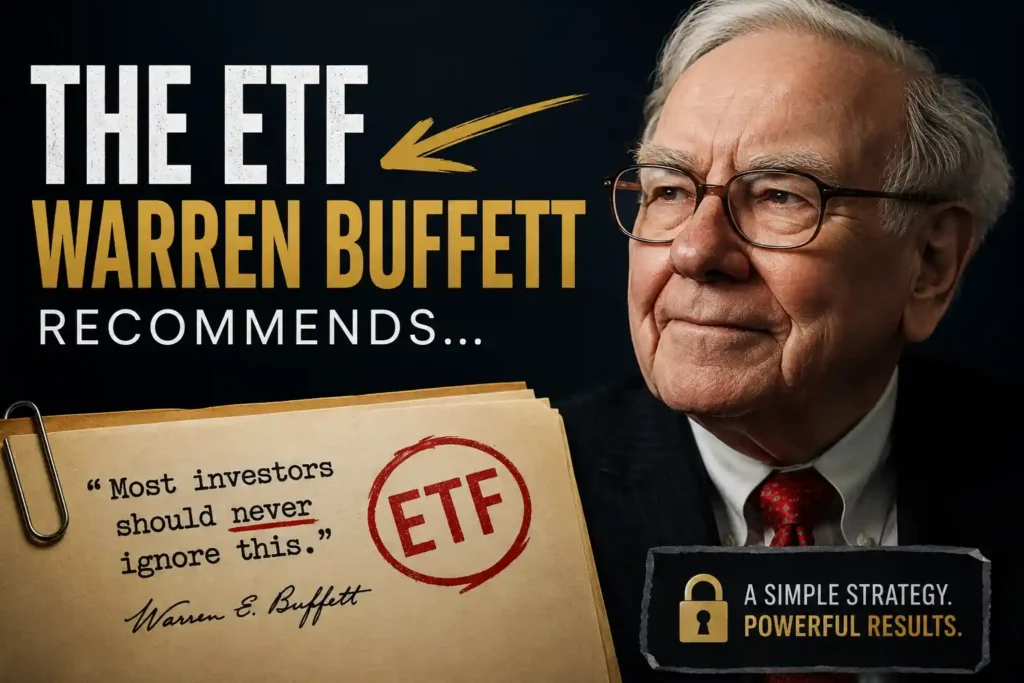
That recommendation is a low-cost S&P 500 exchange-traded fund (ETF).
At first glance, the advice may seem almost too basic. After all, Buffett built one of the greatest investing records in history by carefully selecting individual companies. So why would someone with that level of expertise tell ordinary investors not to do the same?
The answer lies in something many people overlook: investing success is not just about finding great businesses. It’s also about avoiding costly mistakes.
History has shown that many investors struggle to consistently beat the market. They buy when excitement is high, sell when fear takes over, chase fashionable stocks after they’ve already soared, and often pay unnecessary management fees along the way. Over time, these decisions can significantly reduce long-term returns.
Buffett believes there is a better path.
Rather than trying to predict which company will dominate next year, he encourages investors to own hundreds of America’s leading businesses through one diversified, low-cost ETF. This approach removes much of the emotion from investing while allowing long-term market growth and the power of compounding to work in an investor’s favor.
Perhaps the most convincing part is that Buffett trusts this strategy enough to recommend it not only to the public but also as part of the investment instructions for his own family’s future wealth. That speaks volumes about how strongly he believes in its effectiveness.
In this comprehensive guide, you’ll discover exactly what Warren Buffett’s ETF recommendation is, why he continues to stand behind it despite changing market conditions, how it has performed over time, and whether this simple strategy could be the right foundation for your own long-term investment plan. Along the way, you’ll also learn the common investing mistakes Buffett warns against—and why keeping things simple may be one of the smartest financial decisions you ever make.
Table of Contents
What Is Warren Buffett’s ETF Recommendation?
The phrase “Warren Buffett ETF recommendation” has become one of the most searched investing topics because it seems almost contradictory.
After all, Buffett became one of the wealthiest investors in history by buying outstanding individual businesses. So why would someone with his track record tell ordinary people to buy an ETF instead of trying to find the next Apple, Amazon, or Nvidia?
The answer comes down to probability.
Buffett understands something that many investors learn the hard way: consistently beating the stock market is incredibly difficult. Even professionals with large research teams, sophisticated tools, and years of experience often fail to outperform the broader market over long periods. If experts struggle to do it, the average investor faces an even greater challenge.
That’s why Buffett has repeatedly recommended that most people invest in a low-cost S&P 500 index ETF rather than attempting to build a portfolio of individual stocks.
This recommendation isn’t based on convenience alone. It’s based on decades of evidence showing that broad-market investing has rewarded patient investors while helping them avoid many of the mistakes that come with active trading.
Instead of spending hours analyzing earnings reports, following market rumors, or worrying about whether one company will succeed or fail, an S&P 500 ETF gives investors exposure to hundreds of America’s largest publicly traded businesses through a single investment.
In other words, you’re not betting your future on one company.
You’re investing in the long-term growth of the U.S. economy.
That difference is significant.
When one company struggles, another may thrive. Industries evolve, market leaders change, and new businesses emerge. An index ETF naturally adjusts over time, allowing investors to benefit from these changes without constantly buying and selling individual stocks.
For Buffett, that’s one of the greatest advantages of index investing.
Buffett’s Advice Has Stayed Remarkably Consistent
One reason investors continue to trust Buffett’s recommendation is that he hasn’t changed his message every time the market changes.
Whether markets were booming or crashing…
Whether technology stocks were soaring…
Whether inflation, interest rates, or recessions dominated the headlines…
His core advice remained remarkably consistent:
- Invest in a low-cost S&P 500 ETF.
- Keep your investment costs as low as possible.
- Stay invested for the long term.
- Ignore short-term market noise.
- Let compound growth work over time.
While countless market commentators constantly change their predictions, Buffett has built his reputation by sticking to principles that have stood the test of time.
Why an S&P 500 ETF?
The S&P 500 is widely regarded as one of the best representations of the U.S. stock market.
It includes approximately 500 of the largest publicly traded American companies across a wide range of industries, including:
- Technology
- Healthcare
- Financial services
- Consumer goods
- Energy
- Industrial companies
- Communication services
- Consumer discretionary businesses
- Utilities
- Real estate
These companies collectively represent a significant portion of the total value of the U.S. stock market.
When these businesses grow their profits, innovate, hire employees, and expand around the world, long-term investors benefit alongside them.
Instead of trying to predict which single company will become tomorrow’s winner, Buffett’s recommended approach allows investors to own many of today’s strongest businesses—and tomorrow’s future leaders as they enter the index.
It’s Not About Finding the Perfect ETF
Many beginners spend weeks comparing one S&P 500 ETF with another.
While choosing a reputable, low-cost fund is important, Buffett’s bigger message goes beyond selecting a specific ticker.
His philosophy focuses on the characteristics of the investment.
The ideal ETF should:
- Track the S&P 500 index closely.
- Have very low annual expenses.
- Be easy to buy and hold.
- Offer broad diversification.
- Allow investors to stay invested for decades.
Notice that none of these qualities depend on predicting which company will outperform next year.
Instead, they focus on creating a simple system that investors can stick with regardless of what the market is doing.
That’s one of Buffett’s greatest investing lessons.
A strategy only works if people can follow it consistently.
Many sophisticated investment plans fail because they require perfect timing, constant monitoring, or emotional discipline that most people simply don’t have.
An S&P 500 ETF removes much of that complexity, making it easier to stay focused on what truly matters: building wealth steadily over the long term.
Why Warren Buffett Doesn’t Believe Most People Should Pick Individual Stocks
One of the biggest misconceptions about Buffett is that he believes everyone should invest the way he does.
He doesn’t.
In fact, Buffett has openly acknowledged that his success comes from decades of studying businesses, reading financial statements, meeting management teams, and making investment decisions with extraordinary patience.
Most investors simply don’t have the time—or the desire—to do that.
And that’s perfectly okay.
Rather than encouraging people to imitate his stock-picking strategy, Buffett encourages them to choose an approach with a much higher chance of success.
For most people, that’s exactly what a low-cost S&P 500 ETF provides.
Why Warren Buffett Believes Simplicity Beats Complexity
Walk into almost any investment seminar, browse financial social media, or watch market commentators on television, and you’ll notice a common theme: investing is often made to sound incredibly complicated.
You’ll hear about technical indicators, market timing, sector rotation, options strategies, leverage, and dozens of other techniques that promise to generate higher returns.
Warren Buffett sees things differently.
He believes that many investors don’t lose money because they lack intelligence. They lose money because they make investing more complicated than it needs to be.
The more decisions investors have to make, the more opportunities they have to make costly mistakes.
Should they buy now?
Should they sell?
Should they switch sectors?
Should they move to cash?
Should they chase the latest market trend?
These questions often lead investors to act emotionally instead of rationally.
Buffett’s ETF recommendation eliminates many of these unnecessary decisions.
Instead of constantly wondering what to buy next, investors simply continue owning a diversified portfolio of America’s largest businesses while allowing time to do the heavy lifting.
That simplicity is one of the strategy’s greatest strengths.
The Four Reasons Buffett Loves Low-Cost S&P 500 ETFs
Although Buffett’s advice is straightforward, the reasoning behind it is surprisingly powerful.
Let’s break down the four major advantages.
1. You Instantly Own Hundreds of Great Companies
Buying individual stocks means your success depends heavily on selecting the right companies.
Choose wisely, and your portfolio may perform well.
Choose poorly, and one bad investment can erase years of gains.
An S&P 500 ETF changes that equation.
Instead of relying on one business, your investment is spread across hundreds of America’s largest publicly traded companies.
These businesses operate in different industries, serve different customers, and generate revenue from around the world.
For example, your investment may include companies involved in:
- Artificial intelligence
- Cloud computing
- Healthcare innovation
- Consumer products
- Banking
- Manufacturing
- Energy production
- Retail
- Pharmaceuticals
- Digital communications
If one company experiences temporary difficulties, dozens—or even hundreds—of others continue generating profits.
That’s the power of diversification.
2. Low Fees Leave More Money Working for You
One lesson Buffett has emphasized for years is that costs matter.
Imagine two investors earning exactly the same market return over 30 years.
One pays very low annual fees.
The other pays significantly higher management costs every single year.
At first, the difference may seem insignificant.
But investing isn’t a one-year game.
Over decades, those fees continue reducing the amount of money available to compound.
Eventually, the gap between the two portfolios can become surprisingly large.
That’s why Buffett consistently encourages investors to keep costs as low as possible.
Every dollar saved in fees remains invested instead of going to someone else.
3. You Don’t Need to Predict the Future
This may be Buffett’s most underrated lesson.
Many investors believe success depends on correctly predicting:
- Which stock will double next year.
- When the next recession will begin.
- How interest rates will change.
- Which technology will dominate the future.
Buffett has never built his investing philosophy around making short-term predictions.
Instead, he believes productive businesses tend to create wealth over long periods.
An S&P 500 ETF reflects that belief.
Rather than guessing tomorrow’s winners, investors simply own a broad collection of successful companies and allow the economy to evolve naturally.
As companies grow, merge, decline, or disappear, the index adjusts over time.
Investors don’t need to constantly make those decisions themselves.
4. It Helps Investors Stay Calm During Market Volatility
Perhaps the greatest enemy of investing isn’t inflation.
It isn’t recessions.
It isn’t even stock market crashes.
For many people, the greatest threat is their own emotions.
When markets are rising rapidly, investors often become overconfident.
They buy more after prices have already climbed significantly.
Then, when markets fall sharply, fear takes over.
Instead of seeing lower prices as temporary declines, many investors panic and sell near the bottom.
History shows this pattern repeating again and again.
Buffett’s ETF strategy helps reduce emotional decision-making because the focus shifts away from daily price movements.
Instead of asking, “Should I sell everything today?”
Long-term investors ask a different question:
“Will America’s leading businesses likely be worth more 20 years from now than they are today?”
That mindset completely changes how market downturns are viewed.
The Secret Behind Buffett’s Long-Term Success Isn’t Stock Picking
People often assume Buffett became wealthy because he always chose the perfect stock.
That’s only part of the story.
His real advantage has been something much harder to copy:
Patience.
Buffett has repeatedly allowed his best investments to compound for decades instead of constantly buying and selling.
Compounding is one of the most powerful forces in finance.
Here’s why.
Imagine earning a return during your first year.
The following year, you’re no longer earning returns only on your original investment.
You’re also earning returns on last year’s gains.
Year after year, that snowball keeps growing.
Eventually, the growth becomes exponential rather than linear.
This is why Buffett often reminds investors that time is one of the greatest assets an investor can own.
The earlier someone starts investing—and the longer they stay invested—the more powerful compounding becomes.
That’s another reason he prefers simple, long-term investing over frequent trading.
Time does most of the work.
Investors simply need the discipline to stay invested long enough for compounding to produce meaningful results.
Why Buffett’s Advice Matters Even More Today
Today’s investors face something Buffett didn’t experience when he began investing decades ago.
Information overload.
Every day, there are:
- Breaking financial news.
- Viral investment videos.
- Social media predictions.
- Market rumors.
- AI stock forecasts.
- Economic headlines.
- Interest rate speculation.
Each headline encourages investors to react.
Buy now.
Sell immediately.
Don’t miss this opportunity.
Buffett’s advice cuts through all that noise.
Instead of reacting to every headline, he encourages investors to focus on what actually builds wealth:
- Buying quality businesses.
- Keeping investment costs low.
- Staying diversified.
- Remaining patient.
- Allowing decades—not days—to determine success.
Ironically, in an age where investing has become more complicated than ever, Buffett’s recommendation has become even more relevant.
Warren Buffett’s Famous 90/10 Portfolio Strategy Explained
If there were ever any doubt about how strongly Warren Buffett believes in index investing, one detail removes it completely.
When discussing how his own family’s money should be invested after he’s gone, Buffett didn’t recommend a complicated portfolio filled with dozens of actively managed funds or individual stocks.
Instead, he outlined an incredibly simple approach.
He suggested placing:
- 90% of the portfolio in a low-cost S&P 500 index fund or ETF
- 10% in short-term U.S. Treasury securities
That recommendation has become known as the 90/10 Buffett Portfolio.
What’s remarkable isn’t just how simple it is—it’s that Buffett trusts this strategy with the financial future of the people closest to him.
For many investors, that says more than any interview or investing quote ever could.
Why 90% in Stocks?
Buffett has always believed that stocks represent ownership in real businesses.
When companies innovate, expand, increase profits, and create value over time, shareholders benefit alongside them.
Although stock prices fluctuate in the short term, history has shown that broad ownership of successful businesses has generally rewarded patient investors over long periods.
By placing most of the portfolio in an S&P 500 ETF, investors gain exposure to hundreds of large companies without needing to choose individual winners.
Instead of betting on one business, they’re participating in the long-term growth of corporate America.
Why Keep 10% in Treasury Securities?
No investment strategy should ignore risk.
While Buffett strongly believes in long-term stock investing, he also understands that investors sometimes need stability.
Short-term U.S. Treasury securities help provide that balance.
They can:
- Reduce overall portfolio volatility.
- Offer liquidity during market downturns.
- Help investors avoid selling stocks during temporary declines.
- Provide a relatively stable portion of the portfolio.
The result is a portfolio designed for long-term growth without exposing investors to unnecessary financial stress.
Why Buffett Doesn’t Recommend Chasing the “Next Big Thing”
Every market cycle creates a new investment craze.
At different times, investors have rushed into:
- Dot-com companies.
- Meme stocks.
- Cryptocurrency.
- Artificial intelligence stocks.
- Electric vehicle companies.
- Clean energy trends.
Some of these investments have produced incredible returns.
Others have collapsed just as quickly.
Buffett rarely builds his investment philosophy around excitement.
Instead, he focuses on something much more predictable:
Businesses that create lasting value over many years.
That’s why his ETF recommendation doesn’t depend on identifying tomorrow’s hottest industry.
An S&P 500 ETF naturally evolves.
As the economy changes, new companies enter the index while weaker companies leave.
This means investors automatically gain exposure to many of tomorrow’s leading businesses without constantly trying to predict which trend will dominate next.
Rather than chasing headlines, Buffett’s strategy allows investors to benefit from innovation as it happens.
Does Buffett’s Strategy Actually Beat Professional Investors?
This may be the biggest surprise for many beginners.
People often assume professional fund managers consistently outperform the market because investing is their full-time job.
In reality, long-term results tell a different story.
Over extended periods, many actively managed funds have struggled to beat the S&P 500 after accounting for management fees and operating costs.
That doesn’t mean professional managers lack skill.
Instead, it highlights how difficult it is to consistently outperform a broadly diversified market index year after year.
Buffett has pointed to this reality for decades.
In fact, one of the most famous demonstrations of his philosophy involved a long-running challenge that compared a simple S&P 500 index investment with a collection of professionally managed hedge funds.
After ten years, the low-cost index investment came out ahead.
The lesson wasn’t that professional investors are incapable.
It was that keeping costs low and staying invested can be surprisingly difficult to beat.
For ordinary investors, that’s encouraging.
Building wealth doesn’t necessarily require finding secret investments or paying expensive management fees.
Sometimes the simplest strategy proves to be the strongest.
Common Myths About Warren Buffett’s ETF Recommendation
As Buffett’s advice has become more popular, several myths have also emerged.
Let’s clear up some of the biggest misunderstandings.
Myth 1: Buffett Says Never Buy Individual Stocks
Not at all.
Buffett has spent his entire career buying individual businesses.
His point is simply that most people don’t have the time, knowledge, or interest to analyze companies the way he does.
For those investors, a diversified ETF usually offers a better balance between risk and reward.
Myth 2: An ETF Guarantees Profits
No investment comes with guarantees.
An S&P 500 ETF can decline during bear markets, recessions, and periods of economic uncertainty.
The difference is that Buffett encourages investors to think in decades rather than months.
Temporary declines have historically been part of long-term investing.
Myth 3: You Need a Large Amount of Money to Follow Buffett’s Advice
One reason Buffett’s recommendation appeals to so many investors is its accessibility.
Many brokers allow investors to start with relatively small amounts of money.
Some even support fractional investing, making it possible to invest consistently regardless of portfolio size.
The important part isn’t starting with a fortune.
It’s starting.
Myth 4: Buffett’s Strategy Is Outdated
Every few years, someone claims index investing no longer works.
Yet Buffett has maintained essentially the same message through multiple recessions, financial crises, technology revolutions, and bull markets.
Markets evolve.
Companies change.
Technology advances.
But the principles of diversification, patience, and low costs continue to remain relevant.
Mistakes That Can Ruin an Otherwise Great ETF Strategy
Buying the right ETF is only the first step.
How investors behave afterward often matters even more.
Here are some of the biggest mistakes Buffett’s philosophy encourages people to avoid.
Trying to Time the Market
Many investors wait for the “perfect” time to invest.
The problem is that perfect moments are only obvious in hindsight.
Waiting too long can mean missing years of market growth.
Selling During Market Crashes
Sharp declines can be uncomfortable.
However, selling simply because prices fall often turns temporary losses into permanent ones.
Buffett has long encouraged investors to remain focused on long-term business value rather than short-term price movements.
Constantly Switching Investments
Jumping from one popular investment to another usually creates more activity than results.
Successful investing often rewards consistency more than constant change.
Ignoring Investment Costs
Expense ratios may appear small on paper, but over decades they can significantly reduce portfolio growth.
Choosing low-cost investments allows more money to remain invested and continue compounding.
Forgetting the Long-Term Goal
Perhaps the biggest mistake is becoming distracted by daily market headlines.
Buffett’s philosophy isn’t designed to make investors wealthy next month.
It’s designed to help build wealth steadily over many years through discipline, patience, and consistent investing.
That may not sound exciting.
But history suggests it has been one of the most effective approaches ever developed for long-term investors.

