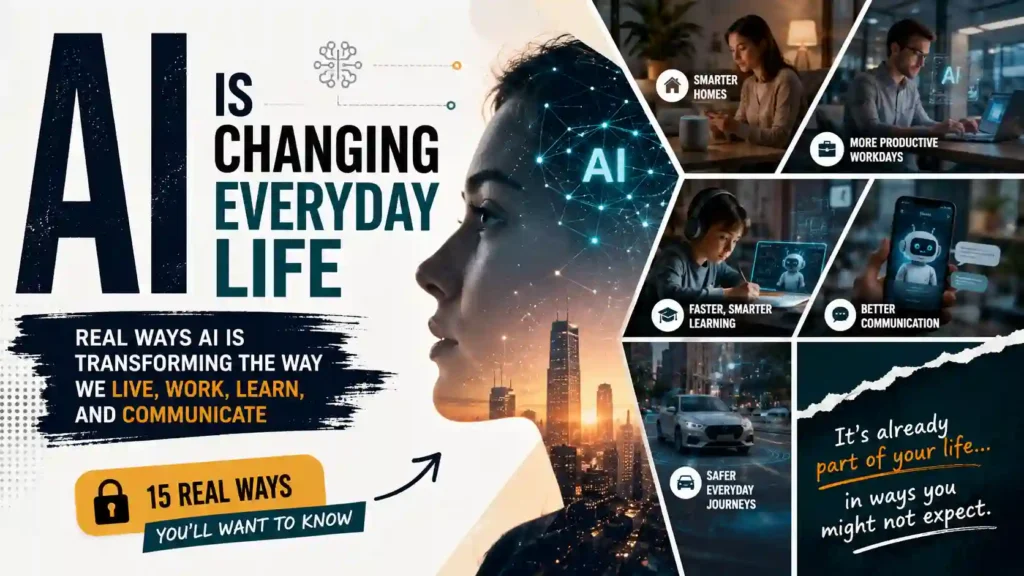
A few years ago, artificial intelligence sounded like something from a science fiction movie. Today, it has quietly become part of everyday life.
Whether you’re unlocking your phone with your face, asking a virtual assistant for tomorrow’s weather, receiving personalized recommendations while shopping online, or using a chatbot to answer questions, artificial intelligence is already working behind the scenes.
The remarkable part is that most people don’t even realize how often they interact with AI.
Every day, billions of AI-powered decisions happen in seconds. Streaming platforms recommend the next movie you’ll probably enjoy. Navigation apps find the fastest route around traffic. Banks detect suspicious transactions before fraud occurs. Hospitals use AI to assist doctors in identifying diseases earlier, while businesses rely on intelligent systems to improve customer service and make better decisions.
Agentic AI Examples: 21 Real-World Use Cases That Show How Autonomous AI Is Changing Everything
Artificial intelligence is no longer a technology of the future.
It is the technology shaping the present.
At the same time, AI is evolving at an astonishing pace. New breakthroughs appear almost weekly, changing how people work, communicate, learn, create content, and solve problems. While this rapid progress creates exciting opportunities, it also raises important questions about privacy, employment, ethics, and the future of human creativity.
So, how exactly is artificial intelligence changing everyday life?
This comprehensive guide explores the practical ways AI is transforming homes, workplaces, schools, healthcare, entertainment, transportation, finance, and countless other aspects of modern living. Whether you’re simply curious about AI or want to understand why it has become one of the most influential technologies of our generation, this article will give you a clear, practical understanding of its growing impact.
Table of Contents
What Is Artificial Intelligence?
Artificial intelligence (AI) refers to computer systems that can perform tasks that normally require human intelligence.
Instead of following only fixed instructions, AI systems can learn from data, recognize patterns, solve problems, understand language, identify images, make predictions, and improve their performance over time.
Think of AI as software that becomes smarter through experience.
Unlike traditional computer programs that perform exactly the same task every time, many AI systems analyze enormous amounts of information to produce better results as they process more data.
This ability allows AI to perform tasks that once seemed impossible for computers.
Some common examples include:
- Understanding spoken language
- Translating between languages
- Recognizing faces in photos
- Recommending products
- Detecting fraud
- Generating text
- Creating images
- Assisting medical diagnoses
- Driving autonomous vehicles
Although these applications appear very different, they all rely on artificial intelligence in one form or another.
Why Artificial Intelligence Is Growing So Quickly
Artificial intelligence has existed as a research field for decades.
So why has it suddenly become part of everyday life?
Several major developments have accelerated its growth.
More Powerful Computers
Modern computers can process enormous amounts of information far faster than previous generations.
This computing power allows AI models to solve increasingly complex problems.
Massive Amounts of Data
Artificial intelligence learns from data.
Today, people generate enormous quantities of digital information through smartphones, websites, online shopping, social media, wearable devices, connected vehicles, and smart home technology.
That data provides AI with opportunities to improve continuously.
Cloud Computing
Cloud platforms have made powerful computing resources available to businesses of every size.
Instead of purchasing expensive infrastructure, organizations can access advanced AI tools through cloud services.
This has dramatically lowered the cost of developing intelligent applications.
Better Algorithms
Researchers have developed increasingly sophisticated machine learning techniques capable of solving problems that older AI systems could not handle effectively.
Together, these advances have moved artificial intelligence from research laboratories into everyday life.
How Artificial Intelligence Is Changing Everyday Life
Many people imagine robots when they hear the term artificial intelligence.
The reality is much more practical.
AI is already integrated into products and services that millions of people use every single day.
Often, its presence goes completely unnoticed.
Let’s explore some of the most common examples.
Artificial Intelligence in Smartphones
Smartphones have become some of the most advanced AI-powered devices people own.
Every day, artificial intelligence helps them perform countless tasks more efficiently.
Facial Recognition
Unlocking a phone by simply looking at it feels almost effortless today.
Behind that convenience is sophisticated AI capable of recognizing facial features while distinguishing the owner’s face from photographs or other people.
Voice Assistants
Digital assistants understand spoken questions and provide helpful responses.
They can:
- Set reminders
- Send messages
- Make phone calls
- Answer questions
- Control smart home devices
- Schedule appointments
Natural language processing allows these assistants to understand conversational speech more accurately than ever before.
Camera Improvements
Modern smartphone cameras rely heavily on AI.
Instead of simply capturing images, AI automatically adjusts:
- Lighting
- Exposure
- Focus
- Color balance
- Portrait effects
- Night photography
As a result, people can capture professional-looking photos without understanding advanced photography techniques.
Predictive Text
When your smartphone predicts the next word you’re likely to type, artificial intelligence is analyzing language patterns to improve typing speed and accuracy.
Over time, these systems learn your writing habits and become increasingly personalized.
Artificial Intelligence in Search Engines
Searching the internet has become dramatically more intelligent because of AI.
Years ago, search engines primarily matched keywords.
Today’s systems attempt to understand the meaning behind each search.
Instead of simply identifying matching words, AI evaluates:
- Search intent
- Context
- User behavior
- Content quality
- Relevance
- Freshness
This allows search engines to deliver more accurate results even when users phrase questions differently.
AI also powers features such as:
- Voice search
- Image search
- Instant answers
- Predictive suggestions
- AI-generated summaries
Finding information online has become faster and more intuitive largely because artificial intelligence continues improving how search works.
Artificial Intelligence in Social Media
Social media platforms process enormous amounts of information every second.
Artificial intelligence helps organize that information into personalized experiences.
Personalized Feeds
No two users see exactly the same content.
AI analyzes interactions such as:
- Likes
- Shares
- Comments
- Viewing time
- Interests
- Followed accounts
Based on those signals, platforms recommend posts that users are most likely to engage with.
Content Recommendations
Artificial intelligence continuously suggests:
- New creators
- Videos
- Communities
- Articles
- Advertisements
These recommendations become increasingly accurate as users spend more time on each platform.
Content Moderation
AI also helps identify spam, hate speech, fake accounts, violent material, and other content that violates platform policies.
Although human moderators remain essential, artificial intelligence allows platforms to review billions of pieces of content far more efficiently.
Artificial Intelligence in Online Shopping
Online shopping has become significantly more personalized thanks to AI.
Every visit to an e-commerce website generates valuable information.
Artificial intelligence analyzes that information to improve the shopping experience.
Personalized Recommendations
Ever wondered why an online store seems to know what you might want next?
AI studies browsing history, previous purchases, search behavior, and customer preferences to recommend relevant products.
These personalized suggestions often help customers discover products they may never have found otherwise.
Dynamic Pricing
Some retailers use AI to adjust prices based on demand, inventory levels, seasonal trends, and market conditions.
This allows businesses to remain competitive while responding quickly to changing conditions.
Customer Service Chatbots
Many businesses now provide instant customer support using AI-powered chatbots.
These systems answer common questions, track orders, process returns, and resolve simple issues without requiring customers to wait for human representatives.
When necessary, conversations can be transferred to human support agents.
Artificial Intelligence in Streaming Services
Watching movies and listening to music has become much more personalized because of artificial intelligence.
Streaming platforms analyze viewing and listening habits to recommend content tailored to each individual.
Rather than displaying identical recommendations to everyone, AI considers factors such as:
- Watch history
- Favorite genres
- Viewing time
- Ratings
- Search behavior
- Similar users
This increases the likelihood that users will quickly find content they enjoy.
The more people use these platforms, the better their recommendations become.
Artificial Intelligence in Navigation and Travel
Few people realize how much AI contributes to modern transportation.
Every time someone opens a navigation app, artificial intelligence begins analyzing enormous amounts of information.
It evaluates:
- Traffic conditions
- Road closures
- Construction zones
- Accidents
- Historical traffic patterns
- Weather conditions
- Estimated travel times
Using this information, AI recommends the fastest or most efficient route.
Ride-sharing services also rely heavily on artificial intelligence to:
- Match passengers with drivers
- Estimate arrival times
- Optimize routes
- Predict demand
- Improve pricing models
Without artificial intelligence, many transportation services would operate far less efficiently.
A few years ago, artificial intelligence sounded like something from a science fiction movie. Today, it has quietly become part of everyday life.
Whether you’re unlocking your phone with your face, asking a virtual assistant for tomorrow’s weather, receiving personalized recommendations while shopping online, or using a chatbot to answer questions, artificial intelligence is already working behind the scenes.
The remarkable part is that most people don’t even realize how often they interact with AI.
Every day, billions of AI-powered decisions happen in seconds. Streaming platforms recommend the next movie you’ll probably enjoy. Navigation apps find the fastest route around traffic. Banks detect suspicious transactions before fraud occurs. Hospitals use AI to assist doctors in identifying diseases earlier, while businesses rely on intelligent systems to improve customer service and make better decisions.
Artificial intelligence is no longer a technology of the future.
It is the technology shaping the present.
At the same time, AI is evolving at an astonishing pace. New breakthroughs appear almost weekly, changing how people work, communicate, learn, create content, and solve problems. While this rapid progress creates exciting opportunities, it also raises important questions about privacy, employment, ethics, and the future of human creativity.
So, how exactly is artificial intelligence changing everyday life?
This comprehensive guide explores the practical ways AI is transforming homes, workplaces, schools, healthcare, entertainment, transportation, finance, and countless other aspects of modern living. Whether you’re simply curious about AI or want to understand why it has become one of the most influential technologies of our generation, this article will give you a clear, practical understanding of its growing impact.
What Is Artificial Intelligence?
Artificial intelligence (AI) refers to computer systems that can perform tasks that normally require human intelligence.
Instead of following only fixed instructions, AI systems can learn from data, recognize patterns, solve problems, understand language, identify images, make predictions, and improve their performance over time.
Think of AI as software that becomes smarter through experience.
Unlike traditional computer programs that perform exactly the same task every time, many AI systems analyze enormous amounts of information to produce better results as they process more data.
This ability allows AI to perform tasks that once seemed impossible for computers.
Some common examples include:
- Understanding spoken language
- Translating between languages
- Recognizing faces in photos
- Recommending products
- Detecting fraud
- Generating text
- Creating images
- Assisting medical diagnoses
- Driving autonomous vehicles
Although these applications appear very different, they all rely on artificial intelligence in one form or another.
Why Artificial Intelligence Is Growing So Quickly
Artificial intelligence has existed as a research field for decades.
So why has it suddenly become part of everyday life?
Several major developments have accelerated its growth.
More Powerful Computers
Modern computers can process enormous amounts of information far faster than previous generations.
This computing power allows AI models to solve increasingly complex problems.
Massive Amounts of Data
Artificial intelligence learns from data.
Today, people generate enormous quantities of digital information through smartphones, websites, online shopping, social media, wearable devices, connected vehicles, and smart home technology.
That data provides AI with opportunities to improve continuously.
Cloud Computing
Cloud platforms have made powerful computing resources available to businesses of every size.
Instead of purchasing expensive infrastructure, organizations can access advanced AI tools through cloud services.
This has dramatically lowered the cost of developing intelligent applications.
Better Algorithms
Researchers have developed increasingly sophisticated machine learning techniques capable of solving problems that older AI systems could not handle effectively.
Together, these advances have moved artificial intelligence from research laboratories into everyday life.
How Artificial Intelligence Is Changing Everyday Life
Many people imagine robots when they hear the term artificial intelligence.
The reality is much more practical.
AI is already integrated into products and services that millions of people use every single day.
Often, its presence goes completely unnoticed.
Let’s explore some of the most common examples.
Artificial Intelligence in Smartphones
Smartphones have become some of the most advanced AI-powered devices people own.
Every day, artificial intelligence helps them perform countless tasks more efficiently.
Facial Recognition
Unlocking a phone by simply looking at it feels almost effortless today.
Behind that convenience is sophisticated AI capable of recognizing facial features while distinguishing the owner’s face from photographs or other people.
Voice Assistants
Digital assistants understand spoken questions and provide helpful responses.
They can:
- Set reminders
- Send messages
- Make phone calls
- Answer questions
- Control smart home devices
- Schedule appointments
Natural language processing allows these assistants to understand conversational speech more accurately than ever before.
Camera Improvements
Modern smartphone cameras rely heavily on AI.
Instead of simply capturing images, AI automatically adjusts:
- Lighting
- Exposure
- Focus
- Color balance
- Portrait effects
- Night photography
As a result, people can capture professional-looking photos without understanding advanced photography techniques.
Predictive Text
When your smartphone predicts the next word you’re likely to type, artificial intelligence is analyzing language patterns to improve typing speed and accuracy.
Over time, these systems learn your writing habits and become increasingly personalized.
Artificial Intelligence in Search Engines
Searching the internet has become dramatically more intelligent because of AI.
Years ago, search engines primarily matched keywords.
Today’s systems attempt to understand the meaning behind each search.
Instead of simply identifying matching words, AI evaluates:
- Search intent
- Context
- User behavior
- Content quality
- Relevance
- Freshness
This allows search engines to deliver more accurate results even when users phrase questions differently.
AI also powers features such as:
- Voice search
- Image search
- Instant answers
- Predictive suggestions
- AI-generated summaries
Finding information online has become faster and more intuitive largely because artificial intelligence continues improving how search works.
Artificial Intelligence in Social Media
Social media platforms process enormous amounts of information every second.
Artificial intelligence helps organize that information into personalized experiences.
Personalized Feeds
No two users see exactly the same content.
AI analyzes interactions such as:
- Likes
- Shares
- Comments
- Viewing time
- Interests
- Followed accounts
Based on those signals, platforms recommend posts that users are most likely to engage with.
Content Recommendations
Artificial intelligence continuously suggests:
- New creators
- Videos
- Communities
- Articles
- Advertisements
These recommendations become increasingly accurate as users spend more time on each platform.
Content Moderation
AI also helps identify spam, hate speech, fake accounts, violent material, and other content that violates platform policies.
Although human moderators remain essential, artificial intelligence allows platforms to review billions of pieces of content far more efficiently.
Artificial Intelligence in Online Shopping
Online shopping has become significantly more personalized thanks to AI.
Every visit to an e-commerce website generates valuable information.
Artificial intelligence analyzes that information to improve the shopping experience.
Personalized Recommendations
Ever wondered why an online store seems to know what you might want next?
AI studies browsing history, previous purchases, search behavior, and customer preferences to recommend relevant products.
These personalized suggestions often help customers discover products they may never have found otherwise.
Dynamic Pricing
Some retailers use AI to adjust prices based on demand, inventory levels, seasonal trends, and market conditions.
This allows businesses to remain competitive while responding quickly to changing conditions.
Customer Service Chatbots
Many businesses now provide instant customer support using AI-powered chatbots.
These systems answer common questions, track orders, process returns, and resolve simple issues without requiring customers to wait for human representatives.
When necessary, conversations can be transferred to human support agents.
Artificial Intelligence in Streaming Services
Watching movies and listening to music has become much more personalized because of artificial intelligence.
Streaming platforms analyze viewing and listening habits to recommend content tailored to each individual.
Rather than displaying identical recommendations to everyone, AI considers factors such as:
- Watch history
- Favorite genres
- Viewing time
- Ratings
- Search behavior
- Similar users
This increases the likelihood that users will quickly find content they enjoy.
The more people use these platforms, the better their recommendations become.
Artificial Intelligence in Navigation and Travel
Few people realize how much AI contributes to modern transportation.
Every time someone opens a navigation app, artificial intelligence begins analyzing enormous amounts of information.
It evaluates:
- Traffic conditions
- Road closures
- Construction zones
- Accidents
- Historical traffic patterns
- Weather conditions
- Estimated travel times
Using this information, AI recommends the fastest or most efficient route.
Ride-sharing services also rely heavily on artificial intelligence to:
- Match passengers with drivers
- Estimate arrival times
- Optimize routes
- Predict demand
- Improve pricing models
Without artificial intelligence, many transportation services would operate far less efficiently.Artificial Intelligence in Cybersecurity
As more of our lives move online, protecting personal information has become more important than ever. Cybercriminals are constantly developing new ways to steal data, spread malware, and exploit security weaknesses.
Artificial intelligence has become one of the most effective tools for defending against these evolving threats.
Unlike traditional security software that relies mainly on known threat signatures, AI can identify unusual behavior and detect suspicious activity in real time.
Detecting Threats Faster
AI-powered cybersecurity systems continuously monitor networks, devices, and user activity.
If something unusual happens—such as an employee logging in from an unfamiliar location or a sudden surge in file downloads—the system can immediately flag the activity for investigation.
This rapid detection helps organizations respond before attackers cause significant damage.
Fighting Phishing Attacks
Phishing remains one of the most common cyber threats.
Artificial intelligence helps identify fraudulent emails by analyzing factors such as:
- Suspicious links
- Unusual sender behavior
- Writing patterns
- Malicious attachments
- Fake websites
As attackers become more sophisticated, AI continues evolving to recognize increasingly complex scams.
Protecting Businesses Around the Clock
Cyberattacks don’t stop at the end of the workday.
AI systems operate 24 hours a day, monitoring networks continuously without fatigue.
This constant vigilance has become essential for organizations that depend on digital infrastructure.
Artificial Intelligence in Agriculture
Food production may not be the first industry that comes to mind when thinking about AI, but farmers are increasingly using intelligent technologies to improve efficiency and sustainability.
Precision Farming
Artificial intelligence helps farmers determine:
- When crops need water
- Which areas require fertilizer
- Where pests are spreading
- When crops are ready for harvest
Rather than treating an entire field the same way, AI allows farmers to manage different areas according to their specific needs.
This reduces waste while increasing productivity.
Monitoring Crop Health
Drones and satellite imagery powered by AI can detect signs of disease, nutrient deficiencies, and water stress long before they become visible to the human eye.
Early intervention helps reduce crop losses and improve harvest quality.
Artificial Intelligence in Manufacturing
Modern factories increasingly rely on AI to improve production, reduce waste, and maintain quality.
Predictive Maintenance
Unexpected equipment failures can be extremely expensive.
Artificial intelligence analyzes data from machines to predict when maintenance will likely be needed.
Instead of waiting for equipment to break down, manufacturers can perform repairs before major failures occur.
Quality Control
AI-powered cameras inspect products at incredible speed.
They can identify tiny defects that would be difficult for humans to detect consistently.
This improves product quality while reducing waste.
Smarter Production Planning
Artificial intelligence also helps manufacturers optimize:
- Inventory levels
- Production schedules
- Supply chains
- Resource allocation
These improvements increase efficiency while lowering operating costs.
Artificial Intelligence in Transportation
Transportation is becoming safer, smarter, and more efficient because of AI.
While fully autonomous vehicles are still developing, artificial intelligence already supports many driving and logistics functions.
Driver Assistance
Modern vehicles use AI for features such as:
- Lane-keeping assistance
- Adaptive cruise control
- Automatic emergency braking
- Parking assistance
- Driver fatigue detection
These technologies help reduce accidents by assisting drivers in critical situations.
Smarter Logistics
Shipping companies use AI to optimize delivery routes, reduce fuel consumption, and improve delivery times.
Artificial intelligence analyzes:
- Traffic conditions
- Weather forecasts
- Delivery priorities
- Fuel efficiency
- Vehicle availability
The result is faster deliveries and lower transportation costs.
The Benefits of Artificial Intelligence
Artificial intelligence has created opportunities that would have seemed impossible only a few years ago.
Some of its biggest advantages include:
Increased Productivity
AI automates repetitive tasks, allowing people to focus on work that requires creativity, critical thinking, and human interaction.
Better Decision-Making
By analyzing enormous amounts of data, AI helps individuals and organizations make more informed decisions.
Improved Personalization
From shopping recommendations to educational content, AI tailors experiences to individual preferences.
Faster Problem Solving
AI processes information much faster than humans in many situations, helping solve complex problems more efficiently.
Greater Accessibility
Speech recognition, real-time translation, image descriptions, and assistive technologies are making digital services more accessible for people with disabilities.
The Challenges of Artificial Intelligence
Although AI offers enormous benefits, it also presents important challenges that society must address.
Privacy Concerns
Many AI systems rely on large amounts of data.
Organizations must handle personal information responsibly while respecting privacy and complying with data protection laws.
Job Transformation
Artificial intelligence will automate certain tasks, changing the nature of many jobs.
While some roles may decline, new opportunities are emerging in AI development, cybersecurity, cloud computing, data science, and digital transformation.
For many workers, continuous learning will become increasingly important.
Bias in AI
Artificial intelligence learns from data.
If that data contains biases, AI systems may produce unfair or inaccurate results.
Developers continue working to improve fairness, transparency, and accountability.
Misinformation
AI can generate highly realistic text, images, audio, and video.
While this creates exciting creative opportunities, it also increases the risk of misinformation and manipulated content.
Learning to verify information will become even more important in the years ahead.
What Does the Future of Artificial Intelligence Look Like?
Artificial intelligence is still evolving.
In the coming years, AI is expected to become even more integrated into everyday life.
Future developments may include:
- More advanced personal assistants
- Smarter healthcare systems
- Safer transportation
- More efficient energy management
- Improved scientific research
- Personalized education
- Faster drug discovery
- More capable household robots
At the same time, governments, businesses, researchers, and technology companies will continue working on regulations and ethical standards to ensure AI is developed responsibly.
The goal isn’t simply to make machines smarter.
It’s to use artificial intelligence to improve people’s lives while minimizing risks.
As AI becomes more capable, the most successful individuals and businesses won’t necessarily be those who fear the technology.
They’ll be the ones who learn how to use it wisely.
If you enjoyed this article, you may also find these guides helpful:
- How Amazon Web Services (AWS) Changed the Internet Forever
- The Business Lessons Every Entrepreneur Can Learn From Jeff Bezos
- Jeff Bezos: From Amazon Founder to Billionaire Bunker—The Complete Story Behind His Success, Wealth, and Latest Headlines
Frequently Asked Questions About How Artificial Intelligence Is Changing Everyday Life
What is artificial intelligence?
Artificial intelligence is technology that enables computers to perform tasks that normally require human intelligence, such as learning, problem-solving, language understanding, and pattern recognition.
How is artificial intelligence changing everyday life?
AI is improving healthcare, education, transportation, banking, shopping, communication, entertainment, and countless other daily activities through automation and intelligent decision-making.
Is artificial intelligence already part of everyday life?
Yes. Most people interact with AI daily through smartphones, search engines, streaming services, navigation apps, online shopping, and banking.
How does AI improve smartphones?
AI powers facial recognition, voice assistants, camera enhancements, predictive text, spam filtering, and battery optimization.
How does AI help healthcare?
AI assists doctors with disease detection, medical imaging, personalized treatment planning, hospital management, and medical research.
Can artificial intelligence replace doctors?
No. AI is designed to support healthcare professionals by providing insights and improving efficiency, not replace their expertise.
How is AI changing education?
AI personalizes learning, provides instant feedback, supports language learning, and helps teachers automate routine administrative tasks.
How does AI improve online shopping?
It recommends products, personalizes offers, powers chatbots, detects fraud, and helps retailers manage inventory more efficiently.
How does AI help banks?
Banks use AI to detect fraud, improve customer service, analyze financial risks, and provide personalized financial insights.
What is AI used for at work?
AI automates repetitive tasks, analyzes data, improves customer service, and supports better business decision-making.
How does AI improve cybersecurity?
It detects suspicious activity, identifies cyber threats, analyzes network behavior, and helps stop attacks more quickly.
Can AI make driving safer?
Yes. AI powers advanced driver assistance systems such as automatic emergency braking, lane-keeping assistance, and adaptive cruise control.
How does AI help farmers?
AI supports crop monitoring, irrigation management, pest detection, weather analysis, and precision farming.
Does AI improve manufacturing?
Yes. AI helps predict equipment failures, improve quality control, optimize production, and reduce operational costs.
How does AI affect entertainment?
AI recommends movies, television shows, music, games, and other content based on individual preferences.
Can AI translate languages?
Yes. AI-powered translation tools can translate text, speech, and conversations in real time.
Is artificial intelligence safe?
AI can be very beneficial when developed and used responsibly. However, privacy, bias, cybersecurity, and misinformation remain important challenges.
Will AI eliminate jobs?
AI will automate some tasks while creating new opportunities in technology, healthcare, cybersecurity, engineering, and other fields.
Why is AI growing so quickly?
Advances in computing power, cloud technology, data availability, and machine learning algorithms have accelerated AI development.
What industries benefit most from AI?
Healthcare, finance, education, retail, manufacturing, transportation, agriculture, entertainment, logistics, and cybersecurity all benefit significantly.
Can small businesses use artificial intelligence?
Absolutely. Many affordable AI tools help small businesses improve productivity, customer service, marketing, and decision-making.
What are the biggest benefits of AI?
Greater efficiency, better personalization, improved decision-making, increased productivity, enhanced accessibility, and faster innovation.
What are the biggest risks of AI?
Privacy concerns, biased algorithms, misinformation, cybersecurity threats, and workforce disruption are among the key challenges.
What skills will become more valuable in an AI-driven world?
Critical thinking, creativity, emotional intelligence, adaptability, problem-solving, leadership, and AI literacy will become increasingly important.
How will artificial intelligence shape the future?
AI is expected to transform nearly every industry, making technology more intelligent, personalized, and efficient while creating new opportunities for innovation.
Conclusion
Artificial intelligence is no longer an emerging technology waiting for widespread adoption—it has already become part of everyday life. From the moment people wake up and check their smartphones to the time they stream a movie, navigate traffic, shop online, or manage their finances, AI is quietly working in the background.
Its impact goes far beyond convenience. Artificial intelligence is helping doctors diagnose diseases earlier, enabling teachers to personalize learning, allowing businesses to make smarter decisions, improving cybersecurity, supporting scientific research, and opening new possibilities that were once unimaginable.
Like every transformative technology, AI brings both opportunities and challenges. Privacy, ethics, transparency, and responsible development will remain essential as these systems become more capable. At the same time, those who understand how AI works and learn to use it effectively will be better prepared for the future.
The question is no longer whether artificial intelligence will change everyday life.
It already has.
The more important question is how individuals, businesses, and society will choose to harness its extraordinary potential in the years ahead.
Agentic AI Examples: 21 Real-World Use Cases That Show How Autonomous AI Is Changing Everything