Many people download Cash App expecting to start sending and receiving money immediately, only to pause when they’re asked to link a bank account or debit card.
That raises an important question:
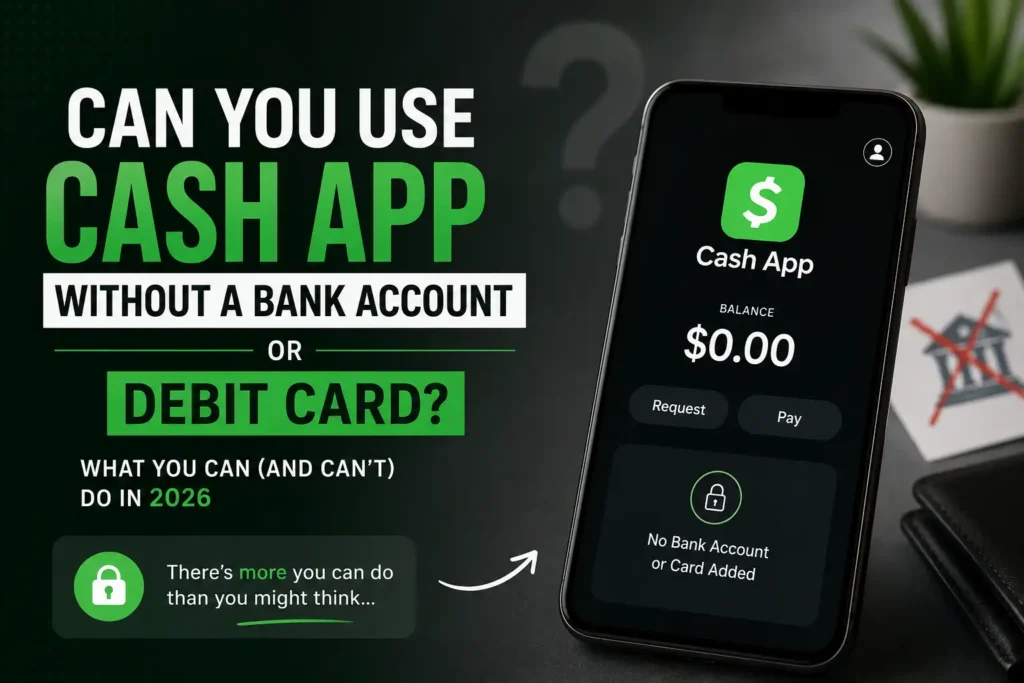
Can Cash App actually be used without connecting a bank account or debit card?
The short answer is yes—but there are important limitations.
This is where many online guides become confusing. Some claim you can’t use Cash App at all without linking a payment method, while others suggest you can access every feature without one. Neither tells the full story.
The truth lies somewhere in the middle.
Depending on what you’re trying to do, you may be able to create an account, receive money, verify your identity, and even use certain Cash App features without ever linking a bank account or debit card. However, other features simply won’t work until a payment method is connected.
Understanding those differences can save hours of frustration.
Instead of repeatedly encountering error messages or wondering why certain buttons are unavailable, it’s far better to know exactly which features require a bank account, which require a debit card, and which can be used without either.
This guide goes far beyond answering a simple yes-or-no question.
It explains exactly what Cash App allows without a linked bank account or debit card, the limitations you’ll encounter, the features you’ll miss, alternative ways to fund your account, common misconceptions, and the smartest setup for different types of users.
By the end of this guide, readers will know whether they actually need to link a bank account or debit card—or whether Cash App can meet their needs without them.
Before exploring every feature, here’s the quick answer.
Table of Contents
Quick Answer: Can You Use Cash App Without a Bank Account or Debit Card?
Yes.
It is possible to use Cash App without linking a bank account or debit card.
However, your account will have limited functionality until at least one payment method is connected.
Here’s a quick overview.
| Feature | Without Bank Account or Debit Card |
|---|---|
| Create a Cash App account | ✅ Yes |
| Choose a Cashtag | ✅ Yes |
| Receive money | ✅ Yes (subject to account status and applicable limits) |
| Verify your identity | ✅ Yes |
| Link a bank account later | ✅ Yes |
| Link a debit card later | ✅ Yes |
| Send money using a linked payment method | ❌ Not until an eligible funding source is available |
| Add money from a personal bank account | ❌ Requires a linked bank account or supported payment method |
| Cash out to a bank | ❌ Requires a linked bank account or eligible debit card |
| Use certain banking features | ❌ Some features require additional setup |
In other words, Cash App can still be useful without connecting financial accounts—but the experience won’t be the same as a fully configured account.
Before explaining those limitations, it’s helpful to understand why many people choose not to link a payment method in the first place.
Why Do People Want to Use Cash App Without a Bank Account or Debit Card?
Not everyone who downloads Cash App has a traditional bank account.
Others simply aren’t comfortable connecting their financial information immediately.
Some of the most common reasons include:
- They don’t have a bank account yet.
- They recently opened a Cash App account.
- They don’t currently have a debit card.
- Their debit card expired.
- They’re waiting for a replacement card.
- They want to explore Cash App before linking financial accounts.
- They have privacy concerns.
- They want to receive money first before deciding whether to connect a bank.
These situations are more common than many people realize.
Fortunately, Cash App allows users to get started before completing every part of the setup process.
Can You Create a Cash App Account Without a Bank Account?
Yes.
Creating a Cash App account does not require a bank account.
The registration process is separate from linking financial accounts.
A new user can typically:
- Download the Cash App.
- Create an account.
- Verify a phone number or email address.
- Choose a Cashtag.
- Complete the initial setup.
A bank account can usually be linked later if needed.
Readers creating a new account should also read How to Create a Cash App Account: Complete Step-by-Step Guide.
Can You Create a Cash App Account Without a Debit Card?
Yes.
A debit card is also not required during the initial account creation process.
Many people assume Cash App immediately requires card information.
It doesn’t.
Instead, users can create an account first and decide later whether to connect a debit card.
If they eventually choose to do so, the process is explained in How to Link a Debit Card to Cash App: Complete Step-by-Step Guide.
What Can You Do Without a Bank Account or Debit Card?
This is where many articles stop too early.
Instead of simply saying “yes” or “no,” it’s important to understand exactly which features remain available.
Depending on your account status and any applicable verification requirements, you can generally:
- Create a Cash App account.
- Personalize your profile.
- Choose or change your Cashtag (subject to availability and applicable limits).
- Receive payments from other Cash App users.
- Explore the app’s features.
- Verify your identity when requested.
- Connect payment methods later.
This makes Cash App useful even during the initial setup phase.
However, there are also several important limitations.
What Can’t You Do Without a Bank Account or Debit Card?
Although Cash App works to some extent without linked financial accounts, some features depend on having an eligible funding source.
Depending on your account and the feature involved, you may not be able to:
- Add money from a personal bank account.
- Transfer funds to your bank.
- Use certain payment methods.
- Complete some types of transactions.
- Access specific banking-related features.
These restrictions exist because Cash App needs a way to move money between your account and the traditional banking system.
Bank Account vs. Debit Card: Do You Need Both?
This is another area that often causes confusion.
The answer is:
Not necessarily.
A bank account and a debit card perform different roles.
Here’s an easy comparison.
| Bank Account | Debit Card |
|---|---|
| Holds your deposited money | Gives access to money in your bank account |
| Uses routing and account numbers | Uses a card number, expiration date, and CVV |
| Supports bank transfers | Supports eligible card-funded transactions |
| Often used for cashing out | Often used to fund payments more quickly |
Many experienced Cash App users eventually link both because doing so provides greater flexibility.
Readers who haven’t connected either payment method yet should also read:
- How to Link a Bank Account to Cash App: Complete Step-by-Step Guide
- How to Link a Debit Card to Cash App: Complete Step-by-Step Guide
Do You Need to Verify Your Identity?
Identity verification is a separate process from linking payment methods.
Some users assume that verifying their identity automatically connects a bank account.
It doesn’t.
Likewise, linking a debit card doesn’t automatically verify identity.
These are different account setup steps that serve different purposes.
Identity verification helps Cash App comply with financial regulations and may be required before accessing certain features or higher account limits.
Readers who haven’t completed this step should continue with How to Verify Your Identity on Cash App: Requirements, Time, and Common Problems.
Before Deciding Whether to Link a Payment Method
There isn’t a single answer that’s right for everyone.
Instead, ask these questions:
Will You Mainly Receive Money?
If so, creating a Cash App account first may be enough while you decide whether to connect financial accounts later.
Will You Frequently Send Money?
If you’ll be making regular payments, linking an eligible payment method usually creates a smoother experience.
Will You Transfer Money Between Cash App and Your Bank?
If that’s your goal, you’ll eventually need to connect a bank account.
Do You Plan to Use Cash App Regularly?
Frequent users generally benefit from completing their account setup by linking eligible payment methods and verifying their identity.
Common Misconceptions About Using Cash App Without a Bank Account
Many people receive incorrect information from friends or social media.
Let’s clear up some of the biggest myths.
Myth: Cash App Doesn’t Work Without a Bank Account
False.
Cash App can still be used for several functions without a linked bank account.
Myth: A Debit Card Is Required Before Creating an Account
False.
Users can create a Cash App account before linking a debit card.
Myth: Linking a Debit Card Automatically Links Your Bank Account
Not true.
Although they’re related, they’re separate payment methods and must be managed individually.
Furthermore, understanding how each Cash App feature works without a linked bank account or debit card helps set realistic expectations. Some features remain available immediately, while others require additional setup before they can be used.
Can You Receive Money Without a Bank Account or Debit Card?
Yes.
One of the biggest advantages of Cash App is that receiving money doesn’t automatically require a linked bank account or debit card.
If another Cash App user sends money to your Cashtag or account, you can generally receive it, provided your account is in good standing and complies with any applicable verification requirements.
This makes Cash App useful for people who:
- Are waiting for a new debit card
- Recently opened a bank account
- Haven’t decided which bank they want to connect
- Simply want to receive money before completing their account setup
However, receiving money is only one part of the experience.
The next question is what you can actually do with that money afterward.
Can You Send Money Without a Bank Account or Debit Card?
This is where many users become confused.
Receiving money and sending money are not exactly the same.
To send money, Cash App generally needs an eligible funding source.
Without one, sending payments may be limited because Cash App needs somewhere to draw the money from.
Depending on your account and available balance, your ability to send money without a linked payment method may vary.
If you plan to make regular payments, linking a debit card or bank account usually provides a much smoother experience.
What Happens to Money You Receive?
When someone sends money to your Cash App account, the funds don’t disappear simply because you haven’t linked a bank account.
Instead, they remain associated with your Cash App account.
The important question becomes:
How will you use or move those funds?
Without a linked bank account or eligible debit card, some options for accessing or transferring your balance may be unavailable until additional setup is completed.
This is one of the main reasons experienced users eventually connect at least one payment method.
Can You Add Money Without a Bank Account or Debit Card?
Generally, no.
Adding money to your Cash App balance from your own financial institution typically requires an eligible linked payment method.
Without one, you may not see the option to add funds from your personal bank account.
This is because Cash App needs a verified source from which to pull the money.
Readers planning to connect one later should continue with:
- How to Link a Bank Account to Cash App: Complete Step-by-Step Guide
- How to Link a Debit Card to Cash App: Complete Step-by-Step Guide
Both guides explain the setup process step by step.
Can You Cash Out Without Linking a Bank Account?
Eventually, most users want to move money out of Cash App.
This process is commonly called Cash Out.
Without a linked bank account or eligible debit card, cashing out funds to a traditional financial institution generally isn’t possible.
That’s because Cash App needs a destination for the transfer.
If withdrawing funds is important, connecting a bank account or an eligible debit card is usually necessary.
Can You Use Cash App Balance Without a Bank Account?
Many people assume Cash App Balance automatically works like a regular bank account.
That’s not always the case.
Your Cash App Balance is separate from your personal checking or savings account.
Depending on your account status and eligibility, your Cash App Balance may allow certain transactions.
However, some features connected to your balance may still require additional verification or a linked payment method before becoming fully available.
Can You Get the Cash App Card Without Linking a Bank Account?
The Cash App Card is another feature that causes confusion.
Some users believe they must connect a bank account before requesting one.
A linked bank account and the Cash App Card are separate features.
However, eligibility for the Cash App Card depends on your account meeting Cash App’s requirements, which may include completing identity verification.
Readers interested in learning more should also read Cash App Card Explained: How It Works, Benefits, Fees, and How to Get One.
Can You Set Up Direct Deposit Without a Bank Account?
This question surprises many people.
Direct deposit is different from linking an external bank account.
Cash App provides eligible users with account and routing information that can be used for direct deposit.
That means linking an outside bank account isn’t necessarily the same thing as setting up direct deposit.
However, eligibility requirements still apply, and not every account has access to every feature immediately.
Readers planning to receive paychecks through Cash App should continue with Cash App Direct Deposit Explained: Setup, Timing, Limits, and Benefits.
Can You Buy or Sell Bitcoin Without a Linked Bank Account?
Cash App offers Bitcoin features for eligible users, but access depends on several factors, including identity verification and regional availability.
A linked bank account isn’t the only consideration.
Before buying or selling Bitcoin, users should ensure their account meets all applicable requirements.
Can You Invest in Stocks Without Linking a Bank Account?
Cash App Investing is another optional feature available to eligible users.
Like Bitcoin services, investing features may require identity verification and compliance with applicable regulations.
Whether a linked bank account is necessary depends on how funds are being added or withdrawn and the specific transaction involved.
Can Teens Use Cash App Without a Bank Account?
Yes, many teens begin using Cash App before opening their first checking account.
Eligible teen accounts operate differently from standard adult accounts and require sponsorship from a parent or guardian.
A personal bank account is not always the starting point for eligible teen users.
Readers interested in teen accounts should also read How Old Do You Have to Be to Use Cash App? Age Requirements Explained.
Does Identity Verification Replace a Bank Account?
No.
This is one of the biggest misunderstandings surrounding Cash App.
Identity verification proves who you are.
A linked bank account provides a way to move money between Cash App and a traditional financial institution.
They solve two completely different problems.
Think of it this way:
| Identity Verification | Linked Bank Account |
|---|---|
| Confirms your identity | Connects your financial institution |
| Helps unlock eligible features | Enables eligible bank transfers |
| May increase available account capabilities | Allows moving money between accounts |
| Supports regulatory compliance | Supports funding and withdrawals |
Completing one does not automatically complete the other.
What’s the Best Setup for Most Users?
Technically, it’s possible to use Cash App without linking a bank account or debit card.
Practically, most long-term users eventually connect at least one payment method.
For the best overall experience, many users complete four important setup steps:
- Create a Cash App account.
- Verify their identity.
- Link an eligible debit card.
- Link a bank account.
Doing so generally provides access to the widest range of available features while making it easier to send, receive, and manage money.
Common Mistakes People Make When Using Cash App Without a Bank Account or Debit Card
Using Cash App without linking a bank account or debit card is possible, but many users run into problems because they misunderstand how the platform works.
Here are the mistakes that cause the most confusion.
Assuming Every Feature Will Work Immediately
Creating a Cash App account doesn’t automatically unlock every feature.
Some services require:
- Identity verification
- An eligible payment method
- Additional account setup
If a feature isn’t available, it doesn’t necessarily mean something is wrong with your account.
Waiting Until You Need to Cash Out
Many users receive money successfully and only realize later that they can’t transfer it to their bank because no payment method has been linked.
If you expect to move money between Cash App and your bank regularly, linking your bank account before you actually need it can save time and frustration.
Ignoring Identity Verification
Some people avoid verification because they think it’s optional forever.
While it’s possible to use certain Cash App features before verifying your identity, additional verification may eventually be required to access more features or higher account limits.
Completing verification early often results in a smoother experience.
Learn more in How to Verify Your Identity on Cash App: Requirements, Time, and Common Problems.
Believing a Debit Card and a Bank Account Are the Same
Although they’re connected, they perform different jobs.
A debit card:
- Is used for eligible card-funded transactions.
- Has a card number, expiration date, and CVV.
A bank account:
- Holds your money.
- Uses routing and account numbers.
- Supports transfers between Cash App and your financial institution.
Many users eventually link both because they complement each other.
Ignoring Security
Some users delay linking financial accounts because they’re worried about security but forget to protect the Cash App account itself.
Whether or not you connect a payment method, you should always:
- Enable Security Lock.
- Use a strong password.
- Keep your phone updated.
- Turn on transaction notifications.
- Monitor account activity regularly.
Good security habits matter regardless of how you use Cash App.
Should You Eventually Link a Bank Account or Debit Card?
For many people, the answer is yes.
Although Cash App offers useful functionality without either payment method, connecting at least one typically makes the app much more flexible.
Here’s why many experienced users choose to complete their setup.
Benefits of Linking a Debit Card
A linked debit card can make it easier to:
- Fund eligible payments
- Complete supported transactions
- Manage everyday spending
- Replace expired cards when necessary
Readers ready to connect one should continue with How to Link a Debit Card to Cash App: Complete Step-by-Step Guide.
Benefits of Linking a Bank Account
A linked bank account is especially useful for users who want to:
- Transfer money between Cash App and their bank
- Cash out their balance
- Manage funds more efficiently
- Complete their overall account setup
The complete walkthrough is available in How to Link a Bank Account to Cash App: Complete Step-by-Step Guide.
Who Can Benefit From Using Cash App Without a Bank Account?
Although many people eventually connect financial accounts, there are situations where using Cash App without one makes sense.
Examples include people who:
- Recently opened a Cash App account
- Are waiting for a replacement debit card
- Don’t yet have a traditional bank account
- Want to receive money before completing setup
- Prefer exploring the app before connecting financial information
- Plan to decide later which bank they’ll use
Cash App’s flexibility during the early stages is one reason many people choose it over other payment apps.
When Should You Link a Payment Method?
There isn’t one correct answer for everyone.
However, it’s usually a good idea if you:
- Frequently send money
- Regularly receive payments
- Want to cash out funds
- Plan to use Cash App as part of your everyday finances
- Want access to more supported features
Completing your account setup early often reduces problems later.
Cash App Without a Bank Account or Debit Card: Myths vs. Facts
| Myth | Fact |
|---|---|
| Cash App can’t be used without a bank account. | False. You can create an account and use several features without linking a bank account. |
| A debit card is required before creating an account. | False. You can create a Cash App account first and add a debit card later. |
| Linking a debit card automatically links your bank account. | No. These are separate payment methods that must be managed individually. |
| Receiving money requires a linked bank account. | No. Eligible users can generally receive payments without linking a bank account, although using those funds may involve additional requirements. |
| Every feature works without connecting a payment method. | No. Some features require a linked bank account, debit card, or additional verification. |
Frequently Asked Questions
Can I Receive Money Without a Bank Account?
Yes.
Eligible users can generally receive payments from other Cash App users without linking a bank account.
However, moving or withdrawing those funds may require additional setup.
Can I Send Money Without a Debit Card?
It depends on how your account is funded.
Without an eligible funding source, sending payments may be limited.
Can I Cash Out Without Linking My Bank?
Generally, no.
To transfer money from Cash App to a traditional financial institution, you’ll usually need a linked bank account or an eligible debit card.
Can I Verify My Identity Without a Bank Account?
Yes.
Identity verification is separate from linking financial accounts.
Can I Use Cash App With Only a Debit Card?
Yes.
Many users begin by linking only a debit card.
Others later add a bank account for additional flexibility.
Can I Use Cash App With Only a Bank Account?
Yes.
A bank account and debit card are independent payment methods.
Depending on the feature you’re using, one may be sufficient while others work better with both connected.
Is Cash App Still Worth Using Without Linking a Bank Account?
For many people, yes.
If your immediate goal is creating an account, receiving payments, or exploring the platform, Cash App still provides value before you connect financial accounts.
As your needs grow, linking a bank account or debit card becomes increasingly beneficial.
Final Thoughts
Yes, you can use Cash App without a bank account or debit card—but understanding the limitations is essential.
Creating an account, choosing a Cashtag, receiving payments, and completing identity verification are all possible without immediately connecting a financial account. This flexibility makes Cash App a practical option for people who are just getting started, waiting for a replacement card, or don’t yet have a traditional bank account.
However, as you begin using Cash App more frequently, you’ll likely find that certain features work best after linking an eligible payment method. Sending payments, adding money from your own bank, and cashing out funds generally become much more convenient once your account setup is complete.
The good news is that you don’t have to do everything at once. You can create your account first, learn how the platform works, and then decide when it makes sense to connect a debit card or bank account.
If you plan to use Cash App regularly, completing your setup by verifying your identity and linking at least one payment method will usually provide the most flexible and reliable experience.
Continue learning with these guides:
Whether you choose to link a bank account immediately or wait until you need additional features, understanding how Cash App works without a bank account or debit card helps you avoid unnecessary confusion, make informed decisions, and get the most from the app as your financial needs evolve.