Published: May 2026 | Last Updated: May 2026
Author: EffectiveStuffs Finance Team | Category: Personal Finance
This article is for informational purposes only and does not constitute financial, legal, investment, or tax advice. Financial situations vary, so always adjust money decisions to your own income, debt, expenses, and responsibilities.
Most people living paycheck to paycheck are not lazy.
They are financially overwhelmed.
Bills arrive faster than paychecks. Groceries feel heavier every month. Emergencies feel terrifying. And many people quietly feel like they are working constantly without ever truly getting ahead financially.
That pressure changes people emotionally.
It creates stress before payday. Anxiety before bills. Panic after unexpected expenses. And for many households, it creates the exhausting feeling that no matter how hard they work, money disappears too fast to ever create stability.
That is exactly why learning how to stop living paycheck to paycheck matters so much.
Because the paycheck cycle is not just a money problem.
It becomes a mental exhaustion problem too.
The good news is that breaking the cycle is possible.
But it usually does not happen through extreme budgeting, fake motivation, or unrealistic financial advice.
It happens through realistic financial improvements repeated consistently over time.
This guide breaks down a real-world step-by-step plan normal people can actually follow in 2026 to slowly create breathing room financially and finally start getting ahead instead of constantly surviving.
Table of Contents
Key Takeaways
- Most people living paycheck to paycheck are struggling with financial pressure, not irresponsibility
- Breaking the paycheck cycle usually starts with awareness, not extreme budgeting
- Small financial wins create momentum faster than perfection
- Increasing income and reducing expenses often need to happen together
- Emergency savings reduce financial panic dramatically
- Fixed monthly bills quietly trap many people financially
- Financial stability usually improves gradually, not overnight
What Living Paycheck To Paycheck Actually Feels Like
Before talking about solutions, it is important to describe what many people are actually experiencing financially.
Because the emotional side matters.
Living paycheck to paycheck often means:
- checking account balances constantly
- feeling nervous before bills arrive
- relying heavily on payday timing
- struggling to save consistently
- using credit cards for emergencies
- avoiding checking bank statements
- feeling financially trapped
Even small unexpected expenses can feel overwhelming.
A flat tire suddenly feels catastrophic.
A medical bill creates panic.
A delayed paycheck creates immediate stress.
That constant financial pressure slowly drains people emotionally.
Why So Many People Feel Financially Stuck
Now that you understand the emotional reality, let’s talk about why the paycheck cycle feels so difficult to escape.
Because the issue is usually bigger than “bad spending habits.”
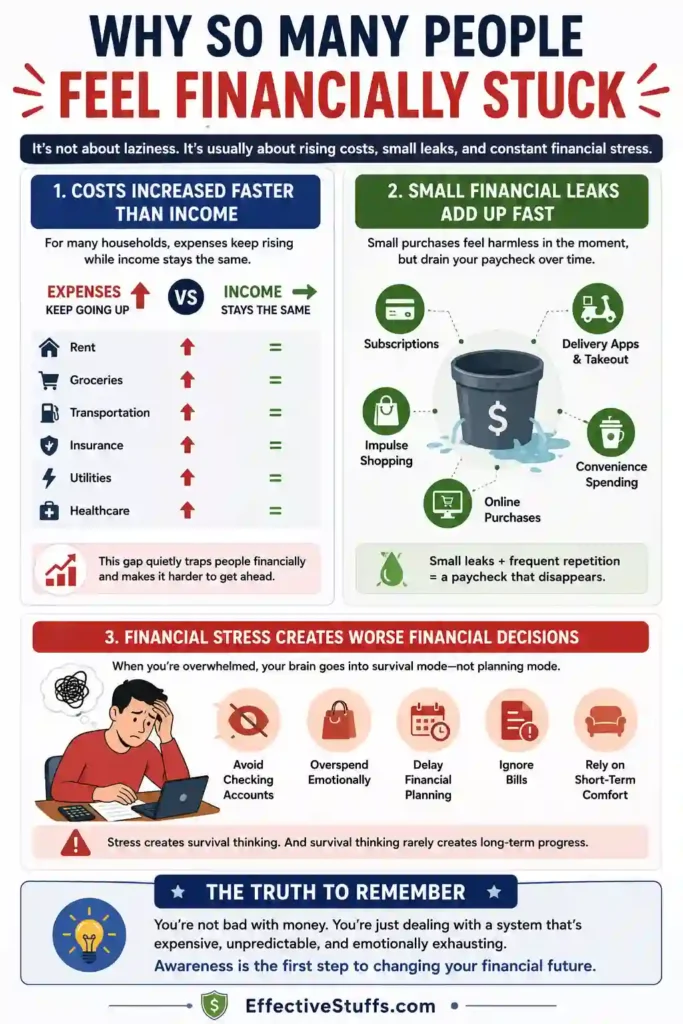
Costs Increased Faster Than Income
This is one of the biggest reasons.
For many households:
- rent increased
- groceries increased
- transportation costs increased
- insurance increased
- utilities increased
But income did not rise at the same speed.
That gap quietly traps people financially.
Small Financial Leaks Add Up Fast
Another major problem is invisible spending.
Small purchases feel harmless individually:
- subscriptions
- delivery apps
- convenience spending
- impulse shopping
- online purchases
But repeated constantly, they quietly destroy financial breathing room.
If you are not fully sure where your money keeps disappearing every month, our guide on the best free budgeting apps that actually change how you handle money can help expose spending patterns most people completely overlook.
Financial Stress Creates Worse Financial Decisions
This matters more than most people realize.
When people feel financially overwhelmed, they often:
- avoid checking accounts
- overspend emotionally
- delay financial planning
- ignore bills
- rely on short-term comfort
Stress creates survival thinking.
And survival thinking rarely creates long-term financial progress.
The Real Plan To Stop Living Paycheck To Paycheck
Now let’s get practical.
Because escaping the paycheck cycle usually happens through small repeated financial improvements — not giant overnight changes.
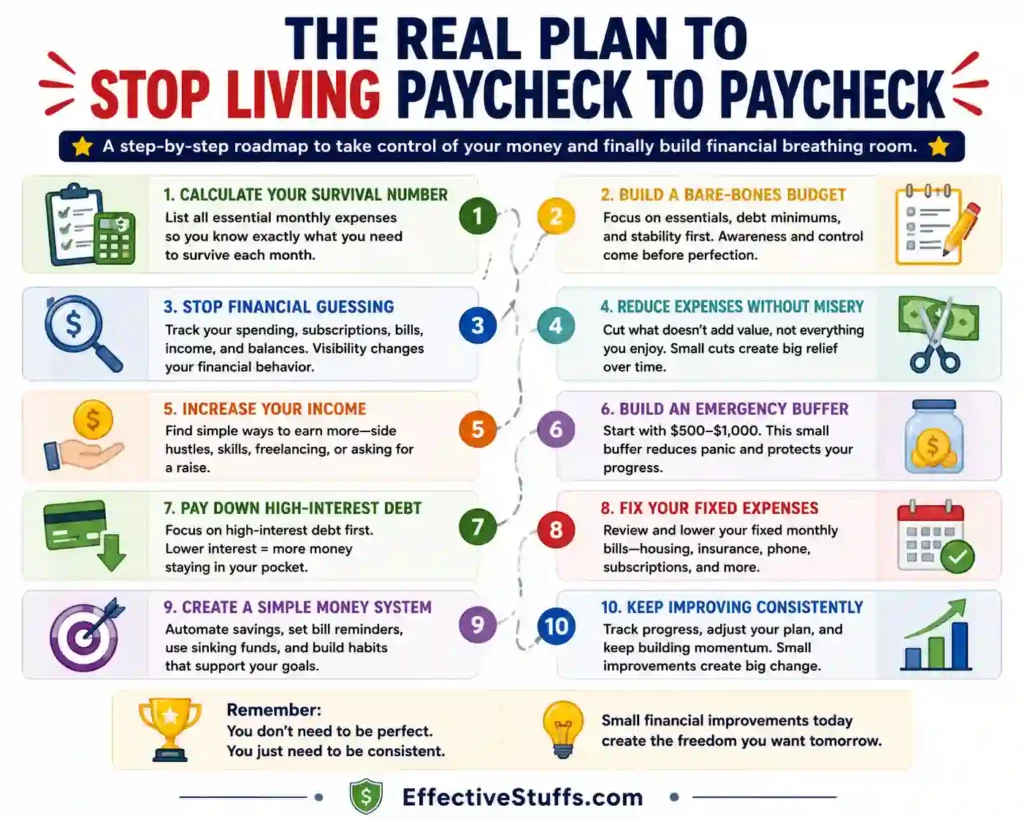
Step 1 — Calculate Your Survival Number
Before fixing anything, calculate your true essential monthly expenses.
This includes:
- rent
- utilities
- groceries
- transportation
- insurance
- minimum debt payments
- essential bills
This number matters because it shows:
- what you truly need monthly
- how close you are to financial stability
- where your biggest pressure points exist
Most people never calculate this clearly.
Example Survival Budget
| Expense | Monthly Cost |
|---|---|
| Rent | $1,500 |
| Groceries | $500 |
| Transportation | $300 |
| Insurance | $250 |
| Utilities | $250 |
| Minimum Debt Payments | $400 |
| Phone Bill | $100 |
Total Survival Number = $3,300
That number becomes your starting point.
Not your dream lifestyle.
Your financial baseline.
Step 2 — Build A Bare-Bones Budget First
Do not start with a fantasy budget.
Start with a survival-level budget first.
The goal initially is awareness and control — not perfection.
A bare-bones budget focuses temporarily on:
- essentials
- debt minimums
- stability
- stopping financial bleeding
If budgeting already feels emotionally exhausting right now, our guide on the simplest budget system that actually works for real people explains a much easier budgeting approach that feels realistic instead of overwhelming.
Step 3 — Stop Financial Guessing
Guessing destroys financial progress.
You need visibility.
Track:
- spending
- subscriptions
- debt minimums
- bills
- income
- account balances
Why Visibility Changes Behavior
Most people naturally spend differently once they clearly see where money actually goes.
Awareness alone creates improvement surprisingly often.
Step 4 — Reduce One Financial Leak At A Time
Most people fail because they try fixing everything simultaneously.
That creates burnout.
Instead:
- cancel one unused subscription
- reduce one spending category
- lower one bill
- cut one financial leak
Small wins build momentum psychologically.
The Most Common Financial Leaks
Most people quietly overspend on:
- food delivery
- impulse shopping
- subscriptions
- convenience spending
- random online purchases
These habits matter more than people realize.
Step 5 — Lower Fixed Monthly Bills
This is one of the most underrated financial moves.
Most people focus only on cutting small purchases while ignoring larger recurring expenses.
That is backwards.
Bills That Usually Have Negotiation Potential
| Bill Type | Possible Savings |
|---|---|
| Internet | $20–$50 monthly |
| Insurance | $30–$100 monthly |
| Phone Plan | $20–$60 monthly |
| Streaming Services | $20–$80 monthly |
| Gym Membership | $20–$70 monthly |
Even small monthly reductions compound heavily over time.
Step 6 — Build A Small Emergency Buffer First
Most people aggressively attack debt first.
But emergencies keep resetting progress.
That is why a small emergency fund matters psychologically.
Start Smaller Than You Think
Do not obsess over six months immediately.
Focus first on:
- $250
- then $500
- then $1,000
That first emergency buffer changes everything emotionally.
Unexpected expenses stop becoming instant disasters.
If your goal is creating real financial protection instead of constantly restarting after emergencies, our guide on how to build an emergency fund explains how normal people gradually build financial stability without feeling financially trapped.
Step 7 — Increase Income Gradually
This section matters.
Because budgeting alone does not solve everything.
Sometimes the real issue is insufficient income.
You Can Only Cut Expenses So Far
There is a realistic limit to how much spending people can reduce.
Especially when:
- housing is expensive
- wages feel stagnant
- groceries keep rising
At some point, increasing income matters.
Side Hustles Can Create Breathing Room
Even an extra:
- $200 monthly
- $500 monthly
- or $1,000 monthly
Can dramatically reduce financial pressure.
That extra income can help:
- build savings
- reduce debt
- stop overdrafts
- create stability
If you are looking for realistic ways to increase income without huge startup costs, our guide on side hustles with no money: 15 weekend ideas you can start fast breaks down practical opportunities normal people are actually using right now.
Step 8 — Automate Small Savings
Automation removes emotional decision-making.
Even:
- $10 weekly
- $25 every paycheck
- round-up savings
Still creates progress.
Most people fail because they try saving “whatever is left.”
Usually nothing is left.
Step 9 — Stop Using Debt For Survival
This is one of the hardest but most important shifts.
When people repeatedly rely on:
- credit cards
- payday loans
- overdrafts
To survive normal life, the paycheck cycle becomes even harder to escape.
Focus On Breaking Emergency Dependence
The goal is creating enough breathing room that emergencies stop immediately creating new debt.
That changes financial psychology dramatically.
A Realistic 30-60-90 Day Plan
Now that you understand the strategy, let’s simplify the process into a realistic timeline.
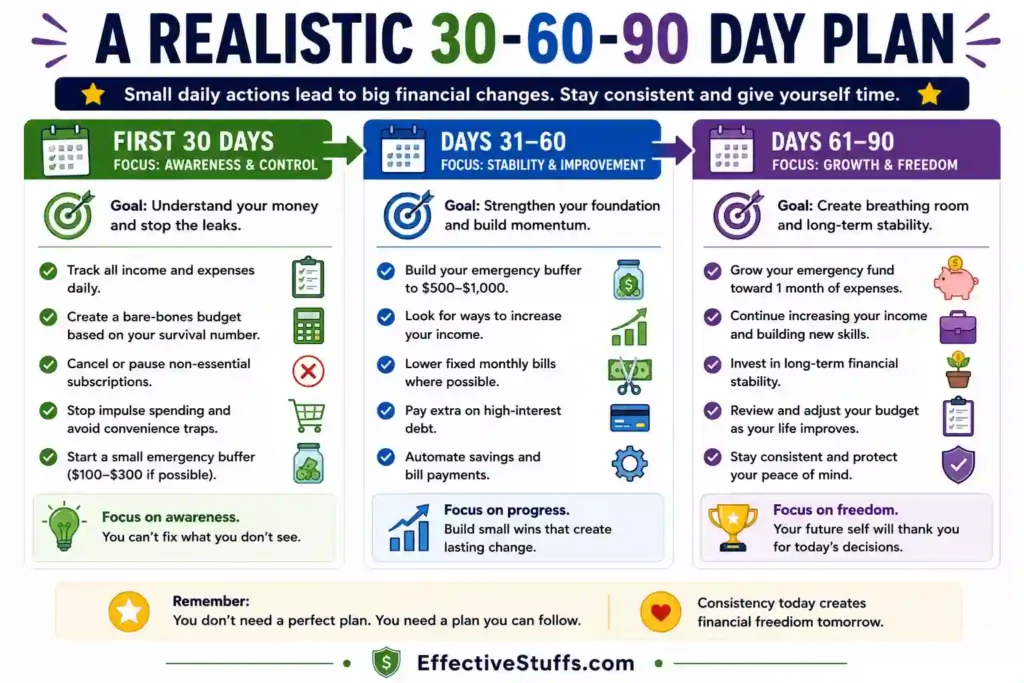
First 30 Days
Focus on:
- calculating your survival number
- tracking spending
- identifying subscriptions
- building awareness
- creating a bare-bones budget
Main goal:
Stop financial guessing.
Days 31–60
Focus on:
- reducing one or two financial leaks
- lowering fixed bills
- starting emergency savings
- automating small savings
Main goal:
Create breathing room.
Days 61–90
Focus on:
- increasing income
- stabilizing spending habits
- reducing emergency debt dependence
- strengthening savings consistency
Main goal:
Build momentum.
The Biggest Mistakes People Make When Trying To Get Ahead Financially
Before improving your finances, you need to avoid the mistakes that quietly keep people trapped.
Mistake 1 — Trying To Change Everything Overnight
Extreme budgeting usually fails quickly.
Sustainable habits work better long term.
Mistake 2 — Ignoring Small Purchases Completely
Tiny repeated expenses quietly destroy financial breathing room over time.
Mistake 3 — Avoiding Financial Reality
Many people avoid:
- checking balances
- reviewing debt
- calculating expenses
Because financial stress feels emotionally heavy.
But avoidance usually worsens the situation.
Mistake 4 — Comparing Yourself Financially To Others
Many people online exaggerate financial success heavily.
Focus on improving your own financial situation gradually instead.
Mistake 5 — Assuming Financial Stability Happens Fast
Most financial improvement feels slow initially.
That is normal.
Consistency matters more than speed.
What Financial Stability Actually Looks Like
Many people imagine financial stability incorrectly.
It usually does not mean luxury immediately.
It often means:
- not panicking over bills
- handling emergencies calmly
- having savings
- sleeping better financially
- feeling less trapped
That emotional shift matters enormously.
Questions People Actually Ask About Living Paycheck To Paycheck
Now that you understand the paycheck cycle more clearly, let’s answer the questions most people search for before trying to improve their finances seriously.
Why Am I Living Paycheck To Paycheck Even With A Job?
For many households, rising living costs increased faster than wages, creating constant financial pressure despite working consistently.
How Do You Stop Living Paycheck To Paycheck Fast?
Most people improve finances gradually through spending awareness, reducing financial leaks, increasing income, and building emergency savings.
What Is The Biggest Reason People Stay Financially Stuck?
Financial stress often creates survival thinking, emotional spending, and avoidance behaviors that slow long-term progress.
Can Budgeting Alone Fix Financial Problems?
Sometimes budgeting helps significantly, but many people also need income growth to create breathing room.
Should You Save Money Or Pay Debt First?
Many people build a small emergency fund first so unexpected expenses stop immediately creating more debt.
How Much Emergency Savings Should You Have?
Many financial experts recommend eventually saving three to six months of essential expenses.
What Spending Habits Quietly Keep People Broke?
Subscription overload, food delivery, impulse shopping, and convenience spending are common financial leaks.
How Can Side Hustles Help Financial Stability?
Extra income can help build savings, reduce debt, and lower financial pressure significantly.
Why Does Financial Stress Feel So Exhausting?
Constant money pressure creates emotional fatigue because survival uncertainty affects mental health heavily.
Is Living Paycheck To Paycheck Common?
Yes. Many households quietly struggle financially even while working full-time.
What Is A Bare-Bones Budget?
A bare-bones budget focuses only on essential survival expenses temporarily.
Can Small Savings Really Matter?
Absolutely. Small consistent savings gradually create financial breathing room and emergency protection.
Why Do Most Budgets Fail?
Many budgets fail because they are too restrictive or unrealistic for everyday life.
How Long Does It Take To Improve Financial Stability?
That depends on income, debt, expenses, and consistency, but most financial improvement happens gradually over time.
What Bills Should You Lower First?
Internet, insurance, streaming subscriptions, phone plans, and convenience spending are usually strong starting points.
What Is Lifestyle Inflation?
Lifestyle inflation happens when spending automatically increases every time income increases.
Can You Escape Paycheck To Paycheck Without A Side Hustle?
Sometimes yes, but increasing income often accelerates financial progress dramatically.
Why Does Financial Progress Feel Slow?
Because most financial improvement compounds gradually before becoming noticeable.
What Should You Focus On First Financially?
Most people benefit from:
- awareness
- spending clarity
- emergency savings
- reducing financial leaks
Before chasing advanced investing strategies.
What Is The First Sign Financial Stability Is Improving?
Usually reduced panic around bills and emergencies.
How Much Extra Income Makes The Biggest Difference?
Even a few hundred dollars monthly can dramatically improve breathing room financially.
Should Couples Budget Together?
Many couples benefit from shared financial planning and expense awareness.
Can Financial Stress Affect Mental Health?
Absolutely. Constant financial pressure heavily affects anxiety, sleep, and emotional wellbeing.
Why Do Emergencies Keep Resetting Financial Progress?
Because many households lack emergency savings buffers.
What Is The Biggest Financial Goal At First?
Creating breathing room financially so life stops feeling like constant survival mode.
Final Thoughts
Learning how to stop living paycheck to paycheck is really about creating breathing room financially.
That is the real goal.
Not perfection.
Not overnight wealth.
Just stability.
Every avoided overdraft matters.
Every extra savings contribution matters.
Every lowered bill matters.
Every financial habit compounds over time.
Start smaller than you think you need to.
Focus on consistency instead of perfection.
Because once emergencies stop feeling financially catastrophic every month, your entire relationship with money begins changing for the better.

