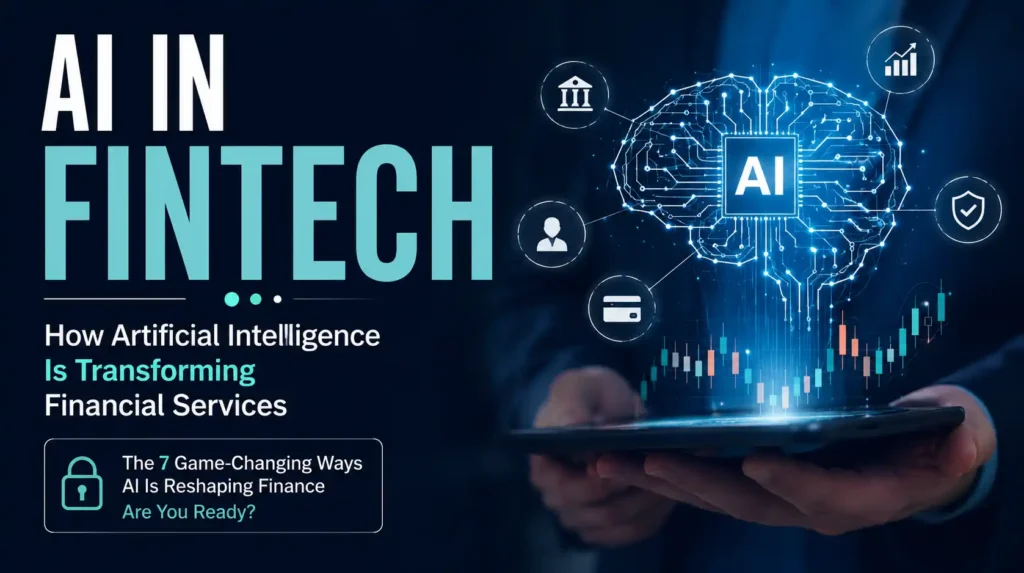
Artificial intelligence is no longer a futuristic concept in the financial industry. It has become one of the biggest forces driving innovation across banking, payments, insurance, investing, and financial technology.
Whether you’re applying for a loan, detecting fraudulent transactions, chatting with a virtual banking assistant, or receiving personalized investment recommendations, there’s a good chance artificial intelligence is working behind the scenes.
The rapid growth of AI in fintech is changing how financial institutions operate and how customers manage their money. Instead of relying solely on manual processes and traditional software, fintech companies are using AI to automate decisions, improve customer experiences, strengthen security, and process enormous amounts of financial data in real time.
As competition increases and customer expectations continue to evolve, AI is becoming less of a competitive advantage and more of a necessity.
In this guide, you’ll learn how AI fintech automation works, where it’s being used today, the benefits and challenges it brings, and the major fintech AI trends 2026 that are expected to shape the future of financial services.
Table of Contents
What Is AI in Fintech?
AI in fintech refers to the use of artificial intelligence technologies to improve financial products, services, and operations.
Instead of relying entirely on predefined rules, AI systems analyze large amounts of data, recognize patterns, learn from experience, and make intelligent recommendations or decisions.
Financial institutions use AI to:
- Detect fraud
- Process loans
- Analyze customer behavior
- Automate customer support
- Monitor financial risks
- Personalize financial advice
- Improve cybersecurity
- Optimize investments
Unlike traditional software that follows fixed instructions, AI continuously improves as it processes more information.
Why AI Is Becoming Essential in Financial Services
Financial institutions process millions of transactions every day.
Manually reviewing every payment, loan application, investment opportunity, or fraud alert is no longer practical.
AI helps solve this challenge by analyzing data at a speed and scale that humans cannot match.
Financial companies are investing heavily in AI because it enables them to:
- Reduce operational costs
- Improve decision-making
- Detect fraud faster
- Deliver personalized services
- Increase efficiency
- Improve customer satisfaction
- Strengthen regulatory compliance
These advantages explain why AI in banking and fintech continues to grow rapidly.
AI in Banking
Banks have become some of the biggest adopters of artificial intelligence.
AI is helping financial institutions modernize services while improving operational efficiency.
Intelligent Customer Support
Many banks now use AI-powered virtual assistants to answer customer questions 24 hours a day.
These assistants can help customers:
- Check account balances
- Locate transactions
- Explain banking products
- Reset passwords
- Schedule appointments
- Report lost cards
Complex issues can still be transferred to human representatives when necessary.
Loan Processing
Traditional loan approvals often require extensive manual reviews.
AI speeds up this process by analyzing:
- Income
- Credit history
- Debt levels
- Employment information
- Financial behavior
The result is faster loan decisions while maintaining responsible risk management.
Personalized Banking
AI helps banks recommend products based on each customer’s financial profile.
Instead of generic offers, customers receive personalized suggestions for:
- Savings accounts
- Credit cards
- Mortgages
- Investment products
- Insurance
This creates a better customer experience.
AI Fintech Automation in Payments
Payment systems generate enormous volumes of data every second.
AI fintech automation helps payment providers process these transactions more efficiently.
Applications include:
Payment Verification
AI identifies unusual payment behavior before transactions are approved.
This helps reduce fraudulent activity without unnecessarily blocking legitimate purchases.
Transaction Routing
Some payment systems use AI to determine the fastest or most efficient processing route.
This improves transaction speed while reducing processing costs.
Payment Forecasting
Businesses can use AI to predict incoming payments, manage cash flow, and prepare for seasonal demand.
AI in Fraud Detection
Fraud detection is one of the most valuable uses of artificial intelligence in financial services.
Traditional fraud systems often relied on simple rules.
For example:
- Flag purchases above a certain amount.
- Block transactions from unfamiliar countries.
Modern AI systems analyze hundreds of factors simultaneously.
These include:
- Purchase location
- Device information
- Transaction timing
- Spending patterns
- Historical behavior
- Merchant characteristics
If something appears unusual, the system can request additional verification before approving the transaction.
Because AI continuously learns from new fraud patterns, it often detects threats much faster than traditional methods.
AI in Investment Management
Investment firms increasingly use AI to support financial analysis.
Applications include:
Portfolio Analysis
AI evaluates market data and investment performance to identify opportunities and risks.
Risk Assessment
Machine learning models estimate how investments may perform under different market conditions.
Personalized Recommendations
AI helps investors receive recommendations that align with their financial goals and risk tolerance.
Human financial advisors still play an important role, but AI provides valuable decision support.
AI in Lending
Lenders process thousands of applications every day.
AI helps automate much of the review process.
Instead of relying only on traditional credit scores, AI may analyze additional information such as:
- Income consistency
- Employment history
- Existing debt
- Spending behavior
- Financial stability
This can improve lending decisions while reducing processing time.
AI in Insurance
Insurance companies are also benefiting from AI.
Applications include:
- Claims processing
- Fraud detection
- Risk assessment
- Customer service
- Premium calculation
- Damage estimation
AI helps insurers process claims faster while improving customer satisfaction.
Benefits of AI in Fintech
Faster Decisions
AI analyzes financial information within seconds, allowing institutions to respond much more quickly.
Lower Costs
Automation reduces repetitive manual work, lowering operational expenses.
Better Customer Experience
Customers receive faster responses, personalized recommendations, and improved digital services.
Improved Security
AI continuously monitors financial activity, helping detect fraud and cyber threats earlier.
Better Data Analysis
Financial institutions collect enormous amounts of information.
AI transforms this data into useful insights that support better decision-making.
Challenges Facing AI in Fintech
Although AI offers tremendous advantages, it also presents several challenges.
Data Privacy
Financial organizations handle highly sensitive customer information.
Protecting this data remains a top priority.
Bias
AI systems are only as good as the data used to train them.
Poor-quality data may produce unfair or inaccurate decisions.
Financial institutions must regularly evaluate AI models for fairness and accuracy.
Cybersecurity
As AI adoption increases, cybercriminals are developing more sophisticated attacks.
Organizations must continuously strengthen their security measures.
Regulatory Compliance
Financial regulations continue evolving as governments respond to rapid advances in artificial intelligence.
Companies must ensure AI systems comply with applicable laws and consumer protection standards.
Fintech AI Trends 2026
Several important developments are expected to shape the next generation of financial technology.
AI Agents
Instead of simply answering questions, AI agents will complete financial tasks such as:
- Paying bills
- Monitoring spending
- Managing subscriptions
- Scheduling transfers
Hyper-Personalization
Financial services will become increasingly tailored to each customer’s individual needs and behavior.
Predictive Finance
AI will forecast future expenses, cash flow, and savings opportunities with greater accuracy.
Embedded AI
Artificial intelligence will become integrated directly into payment systems, banking apps, and financial platforms instead of operating as separate tools.
Smarter Fraud Prevention
Machine learning models will identify increasingly sophisticated fraud techniques before financial losses occur.
How Businesses Can Prepare
Businesses should begin preparing for greater AI adoption today.
Recommended steps include:
- Invest in high-quality data management.
- Strengthen cybersecurity.
- Train employees to work alongside AI systems.
- Evaluate opportunities for automation.
- Monitor regulatory developments.
- Focus on responsible AI governance.
Organizations that prepare early will be better positioned as AI capabilities continue expanding.
What Consumers Should Expect
Consumers are likely to experience:
- Faster banking services
- Better fraud protection
- More personalized financial advice
- Improved budgeting tools
- Smarter investment recommendations
- Better customer support
- More automated financial management
Most people will interact with AI daily without even realizing it.
Conclusion
The growth of AI in fintech is fundamentally changing how financial services operate. From banking and lending to fraud detection and investment management, artificial intelligence is helping financial institutions become faster, smarter, and more efficient.
As AI fintech automation continues expanding, customers will benefit from improved security, better personalization, and more convenient financial services. Businesses, meanwhile, will gain powerful tools for reducing costs, improving decision-making, and serving customers more effectively.
While challenges related to privacy, regulation, and cybersecurity remain, the long-term direction is clear. Artificial intelligence is becoming one of the defining technologies of modern finance, and the fintech AI trends 2026 suggest its influence will only continue to grow in the years ahead.
Frequently Asked Questions About AI in Fintech
As artificial intelligence continues to reshape financial services, many people have questions about how the technology works and what it means for consumers and businesses. Here are clear answers to some of the most common questions about AI in fintech.
What is AI in fintech?
AI in fintech refers to the use of artificial intelligence to improve financial services such as banking, payments, lending, investing, insurance, and fraud detection. It helps automate processes, analyze data, and provide better customer experiences.
How is AI used in banking?
Banks use AI to power virtual assistants, detect fraudulent transactions, process loans faster, personalize financial products, monitor cybersecurity threats, and improve customer service through automation.
What are the biggest benefits of AI fintech automation?
AI fintech automation improves efficiency, reduces operational costs, speeds up financial decisions, strengthens fraud detection, enhances customer experiences, and helps financial institutions analyze large volumes of data more effectively.
Can AI replace financial professionals?
AI can automate many routine tasks and provide valuable insights, but it is unlikely to replace financial professionals entirely. Human expertise remains essential for complex financial planning, regulatory oversight, and strategic decision-making.
What are the top fintech AI trends for 2026?
Some of the most important trends include AI agents that perform financial tasks, hyper-personalized banking experiences, predictive financial planning, embedded AI within financial platforms, and increasingly advanced fraud detection powered by machine learning.