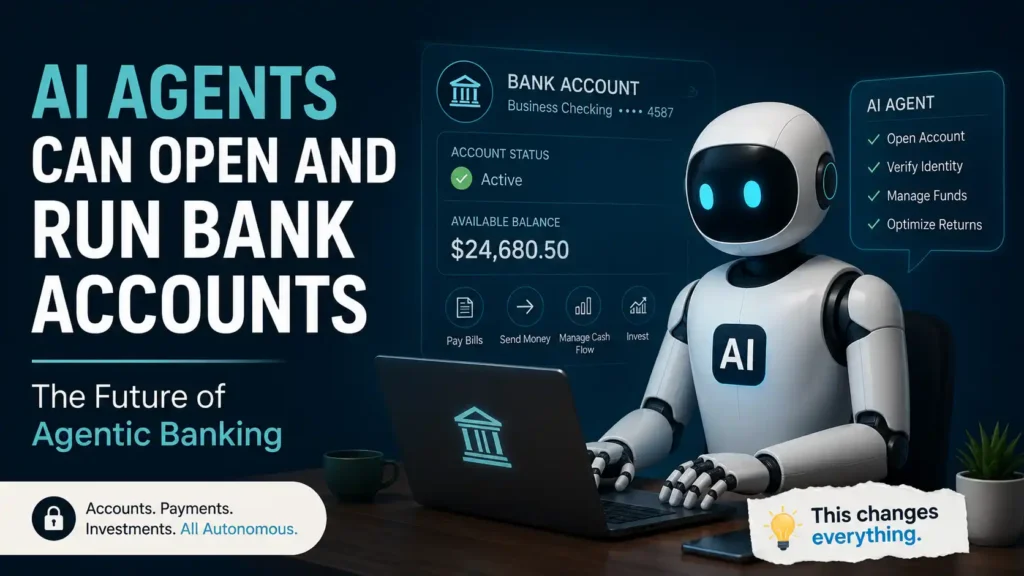
Artificial intelligence is entering a new era. Instead of simply answering questions or generating text, AI is beginning to complete real-world tasks on behalf of users—including financial ones.
Imagine telling an AI assistant:
“Pay my electricity bill before the due date.”
Or:
“Transfer 20% of my salary into my savings account every payday.”
Rather than explaining how to do it, the AI completes the task securely after receiving your permission.
This shift is driving interest in AI agents bank account technology, also known as agentic banking. Banks, fintech companies, payment providers, and AI developers are working toward systems where intelligent AI agents can access financial accounts, send payments, manage budgets, detect fraud, and even open bank accounts with user approval.
Although fully autonomous banking is still developing, many of the technologies that make it possible already exist. Open banking APIs, secure authentication, AI-powered automation, and digital identity verification are laying the foundation for a future where financial management becomes faster, smarter, and more personalized.
In this guide, you’ll learn what AI agents are, how they interact with bank accounts, how AI agent banking works, the benefits and risks involved, and why many experts believe agentic banking could become one of the biggest transformations in financial services over the next decade.
Table of Contents
What Is an AI Agent?
An AI agent is much more than a chatbot.
Traditional AI assistants respond to individual prompts. They answer questions, summarize documents, or generate content, but they typically stop once they’ve completed the requested task.
AI agents are different.
They can understand an objective, create a plan, use connected software tools, make decisions based on changing information, and continue working until the goal has been achieved.
For example, instead of asking:
“What’s the cheapest flight to London?”
You might simply say:
“Book the most convenient flight to London under $700, reserve a hotel within walking distance of my conference, add everything to my calendar, and email me the itinerary.”
An AI agent could complete each of those steps automatically after receiving the necessary permissions.
The same concept is now extending to banking.
Instead of simply checking your account balance, an AI agent could eventually manage many everyday financial activities on your behalf.
What Is Agentic Banking?
Agentic banking refers to banking services powered by AI agents that can perform financial tasks with the customer’s authorization.
Instead of manually opening banking apps every day, users can delegate routine financial work to trusted AI systems while remaining in control of what those systems are allowed to do.
Depending on the permissions granted, an AI agent may be able to:
- Check account balances
- Monitor transactions
- Pay bills
- Send money
- Schedule recurring transfers
- Move funds into savings
- Compare financial products
- Track subscriptions
- Analyze spending habits
- Detect suspicious transactions
- Prepare financial reports
The goal isn’t to replace people. It’s to automate repetitive financial tasks so people can spend less time managing money and more time making important financial decisions.
How AI Agents Access Bank Accounts
Many people wonder whether AI agents simply log into banking websites using passwords.
That’s generally not how modern financial technology works.
Most banks are increasingly relying on secure technologies called APIs (Application Programming Interfaces), which allow approved applications to communicate with banking systems without exposing customer passwords.
A typical process looks like this.
The User Grants Permission
The customer decides exactly what access the AI agent should receive.
Permissions may include:
- Viewing account balances
- Reading transaction history
- Monitoring spending
- Scheduling bill payments
- Initiating transfers
- Receiving fraud alerts
No legitimate AI should access financial information without explicit authorization.
Identity Verification
Before granting access, banks verify both the customer and the connected application.
Security measures often include:
- Multi-factor authentication
- Device verification
- Biometric authentication
- Security tokens
- Digital certificates
These checks help prevent unauthorized access.
Limited Permissions
One of the most important security features is permission control.
For example:
A budgeting AI may only receive permission to read transactions.
An expense management AI may categorize spending but never move money.
A payment assistant may only transfer funds below a user-defined limit.
Instead of unlimited access, AI agents typically receive only the permissions necessary to perform their assigned tasks.
Continuous Monitoring
Banks continue monitoring every transaction after access is granted.
If unusual activity occurs, the bank can:
- Block transactions
- Request additional verification
- Notify the customer
- Temporarily suspend AI access
- Launch fraud investigations
These safeguards reduce the risk of unauthorized financial activity.
Can AI Agents Open Bank Accounts?
One of the fastest-growing areas of AI agent banking is account opening.
Opening a bank account traditionally involves several repetitive steps:
- Comparing banks
- Completing lengthy forms
- Uploading identification
- Providing proof of address
- Reviewing disclosures
- Completing identity verification
- Signing agreements
AI agents are increasingly capable of handling much of this administrative work.
For example, a customer could instruct an AI agent to:
“Find a checking account with no monthly fees, a high mobile banking rating, and free international transfers.”
The AI could:
- Compare available banks
- Explain account features
- Complete application forms
- Upload required documents
- Schedule identity verification
- Monitor application status
Legal approval and final signatures would still remain with the customer where regulations require them.
This dramatically reduces the time spent completing paperwork.
AI Agents Can Send Money
Another major development is allowing AI agents can send money on behalf of authorized users.
Imagine saying:
“Pay my rent on the first day of every month.”
The AI agent could automatically:
- Verify available funds
- Confirm the recipient
- Schedule the payment
- Complete the transfer
- Save the receipt
- Notify the customer
Businesses could use similar systems to automate supplier payments while maintaining approval workflows for larger transactions.
The result is fewer missed payments and less manual administration.
Everyday Banking Tasks AI Agents Can Handle
As AI technology improves, the number of banking activities that can be automated continues growing.
Paying Bills
Instead of tracking due dates manually, AI agents can:
- Monitor upcoming bills
- Schedule payments
- Prevent late fees
- Alert users about unusually high charges
Budget Management
AI continuously analyzes spending patterns.
Rather than relying on a fixed monthly budget, it adjusts recommendations based on changing expenses and income.
For example, if grocery costs increase unexpectedly, the AI may recommend reducing discretionary spending elsewhere.
Savings Automation
Saving money consistently is difficult for many people.
AI agents can analyze cash flow and automatically transfer affordable amounts into savings without affecting essential expenses.
Savings goals become easier to achieve because adjustments happen automatically.
Subscription Monitoring
Many consumers continue paying for services they rarely use.
AI agents can identify recurring subscriptions, estimate their annual cost, and recommend which ones should be canceled.
Some platforms may even handle the cancellation process.
Spending Insights
Instead of reviewing bank statements manually, users receive personalized insights such as:
- Largest monthly expenses
- Spending trends
- Opportunities to reduce costs
- Categories with increasing expenses
- Financial habits that need improvement
Why Banks Are Investing in AI
Banks face increasing pressure to improve customer experience while reducing operational costs.
AI offers opportunities to achieve both.
Financial institutions can use AI to:
- Reduce customer support workloads
- Improve fraud detection
- Speed up loan processing
- Automate compliance tasks
- Personalize financial recommendations
- Improve operational efficiency
- Provide faster customer service
Rather than replacing banking professionals, AI handles repetitive work while employees focus on more complex customer needs.
Benefits of AI Agents for Consumers
Significant Time Savings
Routine financial administration can consume several hours every month.
AI agents automate many repetitive tasks, giving users more time for higher-value activities.
Smarter Financial Decisions
AI continuously analyzes spending behavior and financial trends.
It may recommend:
- Better savings accounts
- Lower-cost banking services
- Spending reductions
- Debt repayment strategies
- Improved budgeting plans
Fewer Late Payments
Automatic scheduling helps ensure bills are paid before deadlines.
This reduces:
- Late fees
- Interest charges
- Credit score damage
- Service interruptions
Better Fraud Protection
AI never sleeps.
It monitors financial activity around the clock and can detect suspicious behavior much faster than manual account reviews.
Personalized Financial Management
Unlike generic financial advice, AI recommendations are based on each customer’s income, expenses, goals, and financial habits.
Benefits for Businesses
Businesses often handle thousands of financial transactions every month.
AI agents can automate:
- Invoice processing
- Vendor payments
- Expense approvals
- Payroll preparation
- Cash flow forecasting
- Financial reporting
- Tax preparation support
Finance teams spend less time on administrative work and more time analyzing business performance.
Security Challenges of Agentic Banking
Although the benefits are significant, AI-powered banking also introduces new risks.
Unauthorized Access
If an attacker gains control of an AI agent, they may attempt to misuse its permissions.
Strong authentication remains essential.
Excessive Permissions
Some applications request more banking access than necessary.
Users should carefully review every permission before granting access.
Prompt Manipulation
Future AI systems could potentially be tricked into performing unintended actions through malicious instructions.
Developers are actively building safeguards against these attacks.
Privacy Risks
Financial data is among the most sensitive personal information.
Banks and AI providers must protect:
- Account balances
- Transaction history
- Income records
- Investment portfolios
- Payment behavior
Encryption, secure infrastructure, and strict privacy controls are critical.
How Regulation Will Shape AI Banking
Financial regulators around the world are paying close attention to AI in banking.
Future regulations are expected to focus on:
- Customer consent
- Data privacy
- AI transparency
- Liability for financial mistakes
- Fraud prevention
- Cybersecurity standards
- Consumer protection
Banks that adopt AI responsibly are likely to earn greater customer trust.
What the Future Looks Like
The capabilities of AI agents will continue expanding over the next several years.
Future systems may be able to:
- Compare mortgage offers automatically
- Refinance loans when interest rates fall
- Optimize investment portfolios
- Negotiate insurance premiums
- Monitor multiple bank accounts simultaneously
- Recommend tax-saving opportunities
- Manage business cash flow
- Coordinate financial decisions across different institutions
Instead of using several banking apps every day, consumers may simply instruct one trusted AI agent to manage many of their routine financial activities.
The emphasis, however, will remain on user control. AI agents will work best when customers can define exactly what actions are permitted and when additional approval is required.
Should You Trust AI With Your Bank Account?
For many people, the answer will depend on how the technology is implemented.
Trustworthy AI banking systems should provide:
- Transparent permissions
- Strong authentication
- End-to-end encryption
- Real-time notifications
- Easy access revocation
- Human approval for sensitive transactions
- Complete transaction history
Consumers should never grant broad financial access without understanding exactly what the AI is authorized to do.
As security standards continue improving, AI agents are likely to become trusted financial assistants rather than replacements for human judgment.
Conclusion
The idea that AI agents can open and run bank accounts is quickly moving from concept to reality. Advances in AI, open banking, secure APIs, and digital identity verification are making it possible for intelligent software to handle many everyday financial tasks with greater speed and accuracy.
From paying bills and managing savings to monitoring fraud and opening new accounts, AI agents bank account technology has the potential to transform how consumers and businesses interact with financial institutions.
While challenges around security, privacy, and regulation remain, the direction is clear. Agentic banking is no longer a futuristic idea—it is becoming the next major evolution of digital finance. Those who understand how it works today will be better prepared to benefit from the smarter, more automated banking experiences of tomorrow.
Frequently Asked Questions About AI Agents Bank Account
Can AI agents legally access bank accounts?
Yes. AI agents can access bank accounts only after receiving the customer’s permission through secure banking technologies such as APIs and authenticated connections. Legitimate systems cannot legally access financial information without user authorization.
Can AI agents open bank accounts by themselves?
AI agents can automate much of the account-opening process, including completing forms and uploading documents. However, many banks still require the customer to approve legal agreements and complete identity verification before an account is officially opened.
Can AI agents send money automatically?
Yes. If the customer grants permission and the bank supports payment initiation, AI agents can schedule or send payments automatically while following spending limits and security rules defined by the user.
Is agentic banking already available?
Many elements of agentic banking already exist through AI-powered budgeting tools, payment automation, fraud detection systems, and open banking platforms. Fully autonomous banking is still evolving but is expected to become more common over the coming years.
Is it safe to connect AI to a bank account?
It can be safe when using trusted financial institutions and reputable AI providers that implement strong encryption, multi-factor authentication, permission controls, and continuous fraud monitoring. Users should regularly review account permissions and only authorize access that is genuinely needed.

