A single wrong number can delay your salary, interrupt an automatic payment or send a large transfer into weeks of investigation.
The frustrating part is that you may enter a valid routing number and still use the wrong one.
That can happen because some banks use one routing number for ACH payments and a different routing number for domestic wire transfers. Other banks use the same number for both. Unless you check the payment method first, the nine digits printed on your check may not be the nine digits your transaction requires.
So, which one should you use?
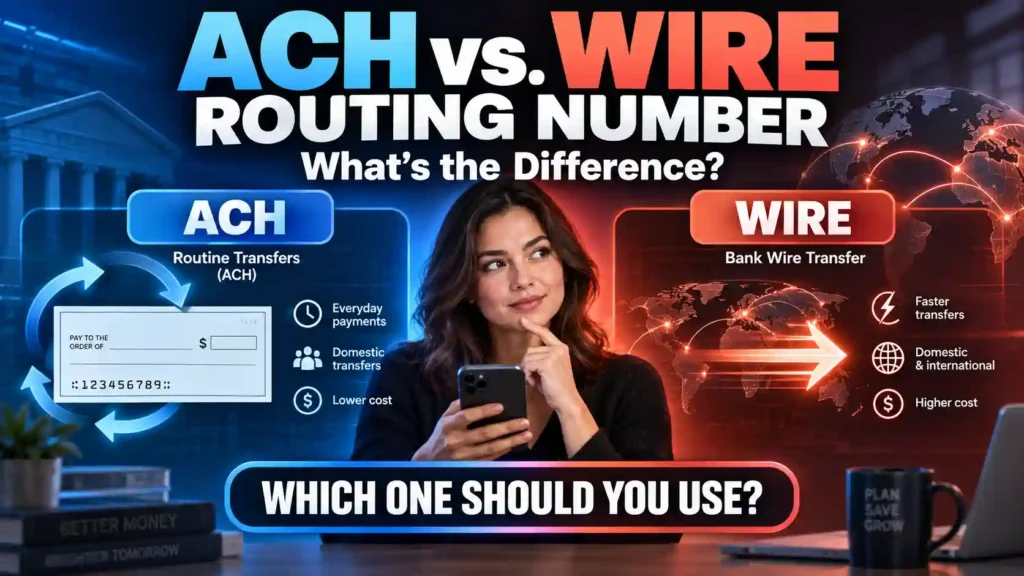
An ACH routing number is generally used for direct deposits, automatic bill payments, tax refunds and standard electronic bank transfers. A wire routing number is used for domestic wire transfers. If you are sending money internationally, you may also need a SWIFT or BIC code and additional banking information.
This guide explains the difference between an ACH routing number and a wire routing number, how to find the correct number and what to do if you accidentally use the wrong one.
Table of Contents
ACH Routing Number vs. Wire Routing Number: The Quick Answer
An ACH routing number is used for electronic payments processed through the Automated Clearing House network, including direct deposits, payroll, tax refunds and automatic bills. A wire routing number is used for domestic wire transfers. Some banks use the same nine-digit number for both, while others use different numbers. Always confirm the required number with the receiving bank before sending money.
The correct number depends on the transaction—not simply the bank.
Use this table when you need a fast answer:
| Transaction | Number or code usually required |
|---|---|
| Direct deposit | ACH routing number |
| Payroll deposit | ACH routing number |
| Social Security payment | ACH routing number |
| Tax refund | ACH routing number |
| Automatic bill payment | ACH routing number |
| Mortgage or insurance autopay | ACH routing number |
| Standard bank-to-bank transfer | Usually an ACH routing number |
| Domestic wire transfer | Domestic wire routing number |
| International wire transfer | SWIFT/BIC and other bank instructions |
| Check processing | Routing number printed on the check |
| Unsure how the money is being sent | Stop and confirm the transfer method |
The word “electronic” does not automatically mean ACH. Both ACH payments and wires move money electronically, but they travel through different systems.
What Is an ACH Routing Number?
An ACH routing number is a nine-digit code that identifies a U.S. bank or credit union when money moves through the Automated Clearing House network.
The routing number directs the payment to the correct financial institution. The account number identifies the individual checking or savings account that should receive or send the money.
Imagine sending a package to an apartment building. The routing number is the building address, while the account number is the specific apartment. You normally need both to deliver the payment correctly.
What Is an ACH Routing Number Used For?
ACH routing numbers support many of the electronic transactions Americans use every day, including:
- Employer direct deposits
- Government benefit payments
- Social Security deposits
- Tax refunds
- Automatic utility payments
- Mortgage payments
- Insurance premiums
- Online bill payments
- Bank-to-bank transfers
- Recurring subscription payments
- Business payroll
- Vendor payments
- ACH credits and ACH debits
An ACH credit pushes money into an account. Your employer depositing your paycheck is a common example.
An ACH debit pulls authorized money from an account. A utility company collecting your monthly bill is an example.
Where Can You Find Your ACH Routing Number?
You can usually find your ACH routing number through:
- Your bank’s official mobile application
- Your secure online banking account
- A personal paper check
- An official direct deposit form
- Your monthly bank statement
- Your bank’s website
- Your credit union’s website
- Customer service
- A local branch
On most personal checks, the routing number is the nine-digit sequence near the bottom-left corner. It normally appears before the account number and check number.
However, avoid copying a number from a deposit slip. Some deposit slips contain internal processing numbers that should not be used for ACH payments.
What Is a Wire Routing Number?
A wire routing number identifies the bank or credit union receiving a domestic wire transfer in the United States.
Domestic wires are processed through a different payment system from ACH transfers. They are commonly used for large, urgent or time-sensitive transactions because they are handled individually instead of being grouped with many other payments.
A domestic wire routing number is generally a nine-digit ABA routing number. However, it may not be the same routing number your bank uses for checks, direct deposits or ACH transfers.
When Is a Wire Routing Number Used?
You may need a domestic wire routing number when:
- Paying for a real estate purchase
- Sending closing funds
- Moving a large sum between banks
- Making an urgent business payment
- Funding certain investment accounts
- Paying a supplier
- Receiving a same-day domestic payment
- Completing a transaction that specifically requires a wire
Do not choose a wire merely because you want the money to arrive quickly. First confirm that the recipient accepts wires and obtain the complete incoming-wire instructions.
What Information Is Needed for a Domestic Wire?
A domestic wire transfer may require:
- The receiving bank’s name
- The bank’s wire routing number
- The bank’s address
- The beneficiary’s full legal name
- The beneficiary’s account number
- The beneficiary’s address
- The account type
- A payment reference
- Further credit instructions
- An intermediary bank, when applicable
Every field matters. A correct routing number will not rescue a transfer sent with the wrong account number or beneficiary information.
Where Can You Find a Wire Routing Number?
The safest places include:
- The receiving bank’s official wire instructions
- Secure online banking
- The bank’s mobile app
- An official incoming-wire document
- Customer service
- A verified bank representative
- A local branch
Do not assume that the routing number printed on a check is correct for a domestic wire. It might be, but only the receiving institution can confirm that.
What Is the Main Difference Between an ACH and Wire Routing Number?
The main difference is the payment network each number is intended to serve.
An ACH routing number directs payments moving through the ACH network. A wire routing number directs domestic wire transfers through a wire-payment system.
Here is a more detailed comparison:
| Feature | ACH routing number | Wire routing number |
|---|---|---|
| Main purpose | Direct deposits and ACH payments | Domestic wire transfers |
| Format | Nine digits | Usually nine digits in the United States |
| Processing network | ACH network | Domestic wire network |
| Typical transactions | Payroll, tax refunds, bills and standard transfers | Large, urgent and time-sensitive payments |
| Processing style | Often processed in batches | Processed individually |
| Typical speed | Same day or several business days | Often the same business day if sent before the cutoff |
| Typical cost | Frequently free or inexpensive | Often carries sending or receiving fees |
| Number printed on checks | Commonly usable for ACH | Not always valid for wires |
| Can the number be the same? | Yes | Yes |
| Can the number be different? | Yes | Yes |
| International use | Generally domestic U.S. payments | International wires require additional information |
| Best verification method | Check official account details | Obtain official incoming-wire instructions |
The crucial lesson is that a routing number can belong to the correct bank but still be incorrect for your chosen transaction.
Are ACH and Wire Routing Numbers Ever the Same?
Yes. Some banks and credit unions use the same nine-digit routing number for ACH transactions and domestic wires.
However, other financial institutions publish separate numbers for:
- ACH payments
- Domestic wire transfers
- International wire transfers
- Different states or regions
- Different account divisions
- Brokerage or investment accounts
Therefore, you cannot determine whether the numbers are identical by looking at them. You must check the receiving bank’s instructions.
Even if you previously sent an ACH payment to an account successfully, that does not prove the same routing number will work for a wire.
Why Do Banks Use Different Routing Numbers?
There is no single explanation that applies to every bank. Several operational and historical factors may be involved.
ACH and Wires Use Different Payment Systems
ACH payments and wire transfers do not follow the same processing path. A bank may use separate routing numbers to direct each transaction to the correct internal operation.
Large Banks Operate Across Several States
Some nationwide banks use different ACH routing numbers according to where an account was opened.
For example, two customers could use the same bank but have different ACH routing numbers because one opened an account in California and the other opened an account in Texas.
Banks Grow Through Mergers
When one financial institution acquires another, older routing numbers may remain active. Keeping them can prevent immediate disruption to checks, direct deposits and automatic payments.
Wires May Be Processed Centrally
A bank might have several regional ACH routing numbers but use one centralized routing number for incoming domestic wires.
Different Divisions May Have Separate Instructions
Consumer accounts, commercial accounts, investment accounts and private banking services may not share the same incoming-transfer instructions.
That is why copying another customer’s routing number—even when that person uses the same bank—can be a serious mistake.
Real Bank Examples: How Routing-Number Requirements Can Differ
Major financial institutions do not all follow one routing-number pattern.
| Banking pattern | What it means for customers |
|---|---|
| Regional ACH numbers with one centralized wire number | The ACH number can depend on where the account was opened, while domestic wires use a separate national number |
| One number for several payment types | The same routing number may work for checks, ACH payments and domestic wires |
| Separate ACH and wire numbers | Customers must select the number that matches the transfer method |
| Different instructions for deposit and investment accounts | A checking account and brokerage account at related companies may require different routing details |
| Additional international-wire instructions | A SWIFT code, bank address or intermediary institution may be required |
Large banks such as Wells Fargo, Chase and Bank of America commonly demonstrate why customers must distinguish between regional ACH information and domestic wire instructions. However, routing information can change, and the correct number may depend on the account.
For that reason, this article does not tell you to copy one universal number from an unofficial list. Verify your exact account and transaction through the receiving bank before transferring money.
Which Routing Number Should You Use?
The safest way to choose is to begin with the transaction, not the number.
For Direct Deposit
Use the ACH routing number associated with your checking or savings account.
Direct deposits normally travel through the ACH network. This applies to:
- Paychecks
- Pensions
- Social Security benefits
- Veterans benefits
- Unemployment payments
- Government benefits
Your employer may also ask for your account number and whether the account is checking or savings.
For a Tax Refund
Use the ACH routing number connected to the account receiving the refund.
Double-check every digit. Incorrect banking information could delay the refund or cause the electronic deposit to be rejected.
For Automatic Bill Payments
Use your ACH routing number unless the biller provides different instructions.
Mortgage payments, utility bills, insurance premiums and recurring subscriptions are usually processed as ACH debits.
For a Standard Bank-to-Bank Transfer
Use the ACH routing number when the transfer is described as an ACH payment, external-account transfer or standard electronic transfer.
Do not judge the payment method only by its expected speed. Same-day ACH payments exist, but they remain ACH transactions.
For a Domestic Wire Transfer
Use the recipient bank’s confirmed domestic wire routing number.
Ask the recipient for the complete incoming-wire instructions. Then verify those instructions independently before sending the payment.
For an International Wire Transfer
Follow the international wire instructions supplied by the receiving bank.
Depending on the country, bank and currency, the transfer may require:
- A SWIFT or BIC code
- An IBAN
- The beneficiary’s account number
- The beneficiary’s full name and address
- The receiving bank’s address
- An intermediary bank
- A payment purpose or reference
- Country-specific banking codes
An ABA routing number is not a replacement for a SWIFT code or IBAN.
Can You Use an ACH Routing Number for a Wire Transfer?
Only if the receiving bank confirms that the same number is approved for domestic wires.
If the institution uses a separate wire transfer routing number, entering its ACH number may cause the wire to be:
- Rejected
- Delayed
- Returned
- Held for investigation
- Sent for manual review
A routing number does not become suitable for wires simply because it is valid and belongs to the correct bank.
Before sending a domestic wire, obtain the receiving bank’s official incoming-wire instructions. This is especially important for large payments and real estate transactions.
Can You Use a Wire Routing Number for an ACH Transfer?
Only when the financial institution confirms that its wire routing number also accepts ACH payments.
A wire routing number may identify the correct bank but not be enabled for ACH processing. If you use it for payroll, direct deposit, tax refunds or automatic payments, the transaction could fail.
When a form asks for a routing number without explaining the payment method, contact the organization and ask:
“Will this payment be sent through ACH or as a wire transfer?”
That simple question can prevent a major mistake.
ACH Routing Number vs. ABA Routing Number
An ABA routing number is a nine-digit identifier assigned to a U.S. financial institution. It is also called a routing transit number or RTN.
An ACH routing number is an ABA routing number used to receive or send payments through the ACH network.
A domestic wire routing number can also be an ABA routing number. However, it must be the number the bank designates for domestic wires.
This is why the terms “ABA number,” “routing number” and “ACH routing number” are sometimes used as though they mean exactly the same thing. In many everyday situations, they do. But when a bank uses different numbers for different payment systems, the distinction becomes critical.
ACH Routing Number vs. Account Number
A routing number identifies the financial institution. An account number identifies a particular customer account within that institution.
| Detail | Routing number | Account number |
|---|---|---|
| Identifies | Bank or credit union | Individual account |
| Typical length | Nine digits | Varies by institution |
| Shared with other customers | Yes | No |
| Printed on checks | Usually | Usually |
| Used for ACH payments | Yes | Yes |
| Used for wires | Usually | Yes |
| Should be protected | Verify before sharing | Treat as sensitive financial information |
If you are unsure which set of digits you are looking at, read the complete guide to routing number vs. account number before completing the transaction.
Do not confuse either number with your:
- Debit card number
- Credit card number
- Check number
- Online banking username
- Membership number
- Customer identification number
ACH Routing Number vs. SWIFT Code
An ACH routing number and a SWIFT code identify financial institutions, but they serve different payment environments.
An ACH routing number is a nine-digit numerical code primarily used within the United States.
A SWIFT code, also called a BIC, is an international banking identifier made from letters and sometimes numbers.
| Feature | ACH routing number | SWIFT/BIC code |
|---|---|---|
| Main use | U.S. ACH transactions | International financial messaging |
| Format | Nine digits | Letters and sometimes numbers |
| Typical payment | Direct deposit or ACH transfer | International wire |
| Identifies | U.S. financial institution | Financial institution internationally |
| Replaces an account number? | No | No |
Some international transfers involving U.S. banks may require both a SWIFT code and an ABA routing number. Follow the bank’s instructions exactly.
How to Find the Correct ACH or Wire Routing Number
Finding a routing number is easy. Finding the correct one for a specific transaction requires more care.
Check Your Bank’s Mobile App
Open the account details section and look for routing information. Some apps display separate numbers for:
- Paper and electronic transactions
- ACH transfers
- Domestic wires
- International wires
Read the labels instead of copying the first nine-digit number you see.
Sign In to Online Banking
Secure online banking may provide routing information tied directly to your account. This is more reliable than copying a number from an unverified directory.
Review a Personal Check
The first nine-digit group along the bottom is generally the routing number used for check processing and ACH transactions.
However, it may not be the correct wire routing number.
Contact Your Financial Institution
Customer service can tell you which number to use for:
- ACH payments
- Direct deposits
- Incoming domestic wires
- Outgoing domestic wires
- International wires
If the transfer is large, ask the representative to confirm the complete instructions.
Request Official Wire Instructions
When receiving a domestic or international wire, ask your bank for an incoming-wire instruction sheet.
This can provide more than the routing number. It may also list the precise bank name, address, SWIFT code, intermediary details and formatting required.
For additional methods, review how to find your routing number without relying on unofficial information.
How to Verify Wire Instructions Without Getting Scammed
Wire-transfer fraud deserves special attention because criminals know that wires can be difficult to recover.
A scammer may break into an email account and replace legitimate payment instructions with fraudulent ones. The message may look completely normal because it appears inside a real conversation.
Before sending a wire:
- Call the recipient using a trusted number you already have.
- Read the routing and account numbers back to the recipient.
- Confirm any last-minute changes independently.
- Do not use the telephone number contained only in the suspicious email.
- Check the recipient’s legal name carefully.
- Question unusual urgency or secrecy.
- Confirm the bank’s location and beneficiary information.
- Ask your bank about additional verification for large transfers.
Treat changed wire instructions as a red flag, especially during a real estate closing or major business transaction.
What Happens If You Use the Wrong Routing Number?
The outcome depends on the payment type, the number entered and how quickly you respond.
The Payment May Be Rejected
If the routing number is invalid or cannot receive that type of payment, the transaction may not be processed.
The Money May Be Returned
The receiving institution may return the funds to the sender. This could take several business days, and the original transfer fee may not be refunded.
The Transfer May Be Delayed
The payment could be placed under manual review while the banks investigate the information.
The Transaction Could Reach the Wrong Destination
A routing number generally points to a financial institution, not a particular person. However, if incorrect banking details align with an existing account, the money could be misdirected.
Your Direct Deposit Could Fail
If you use the wrong routing number for payroll or a tax refund, the deposit may be rejected and returned to the sender.
The safest response is immediate action—not waiting and hoping the transfer corrects itself.
What to Do If You Used the Wrong Routing Number
Contact the Sending Bank Immediately
Explain that you may have used an incorrect routing number. Provide:
- The transfer amount
- The date
- The recipient’s name
- The destination bank
- Your confirmation number
- The routing number entered
- The correct information, if known
Ask Whether the Transaction Is Pending
A transfer that has not been released may be easier to stop or correct.
Request a Trace, Cancellation or Recall
The available option depends on the transaction type and status. A bank may attempt a wire recall, but recovery is not guaranteed.
Contact the Intended Recipient
Tell the recipient about the error and ask them to verify their incoming-transfer instructions directly with their bank.
Save Your Records
Keep:
- Receipts
- Confirmation numbers
- Emails
- Screenshots
- Representative names
- Call dates and times
- Case or investigation numbers
Do Not Immediately Send a Replacement
Confirm what happened to the first payment before sending more money. Otherwise, you could accidentally pay twice.
ACH or Wire Transfer: Which Should You Choose?
The right choice depends on speed, cost, urgency and the recipient’s requirements.
Choose ACH When:
- You are setting up direct deposit.
- You are paying recurring bills.
- The payment is not extremely urgent.
- You want a lower-cost option.
- You are transferring money between your accounts.
- The recipient accepts ACH.
- You are receiving payroll or government benefits.
Choose a Wire Transfer When:
- The payment is urgent.
- The amount is large.
- The recipient specifically requests a wire.
- You are completing a real estate transaction.
- The payment must be processed individually.
- ACH is not available or appropriate.
- You understand the fees and verification requirements.
A wire is not automatically better because it is faster. Its higher cost and limited reversibility can make it a poor choice for routine payments.
Common Routing-Number Mistakes to Avoid
Using a Deposit-Slip Number
Deposit slips may contain internal processing numbers that are unsuitable for ACH or wire transfers.
Assuming Every Bank Has One Routing Number
Large banks may have multiple numbers based on state, transaction type, account history or banking division.
Choosing the Number for Your Current State
Your ACH routing number may be connected to where you opened the account, not where you currently live.
Confusing ACH With a Wire
Both are electronic transfers, but they are processed differently.
Using Domestic Instructions Internationally
An international wire may require a SWIFT code, IBAN, bank address and intermediary details.
Copying Another Customer’s Number
Two customers at the same bank may have different routing numbers.
Ignoring Leading Zeros
A routing number may begin with zero. Do not remove it.
Trusting an Unverified Website
A listed number may be outdated, associated with another state or meant for a different transaction.
Failing to Confirm Changed Instructions
Last-minute changes to wire instructions can indicate fraud.
Entering the Correct Numbers in the Wrong Fields
A routing number entered into the account-number field will normally cause the transaction to fail.
Final Routing-Number Checklist
Before submitting an ACH payment or wire, confirm each item:
- What payment method am I using?
- Is this ACH, domestic wire or international wire?
- Did the receiving bank approve this routing number for that method?
- Is the routing number exactly nine digits?
- Did I preserve any leading zeros?
- Is the account number complete?
- Did I select checking or savings correctly?
- Does the beneficiary’s name match the account?
- Did I obtain the information from a trusted source?
- Have any instructions changed unexpectedly?
- Did I verify a large wire through a separate communication method?
- Did I check the bank’s cutoff time?
- Do I understand the applicable fees?
- Have I reviewed every field before submitting?
Do not press “Send” until every answer is clear.
Frequently Asked Questions
Is an ACH routing number the same as a wire routing number?
Sometimes. Certain banks use the same nine-digit routing number for both, while others use different numbers. Verify the correct number with the receiving institution.
Are ACH and wire routing numbers both nine digits?
U.S. ACH routing numbers contain nine digits. Domestic wire routing numbers are also generally nine-digit ABA routing numbers.
Which routing number should I use for direct deposit?
Use the ACH routing number associated with your checking or savings account.
Which routing number should I use for payroll?
Payroll direct deposits normally require an ACH routing number.
Which routing number should I use for a tax refund?
Use the ACH routing number linked to the account where you want the refund deposited.
Which routing number should I use for automatic bill payments?
Use the ACH routing number unless the biller provides different instructions.
Can I use the routing number on my check for a wire?
Only if your bank confirms that the same number is used for domestic wire transfers. The number on your check is commonly used for checks and ACH transactions.
Can I use my wire routing number for direct deposit?
Only if your bank confirms that the wire number also accepts ACH payments. Otherwise, use the designated ACH routing number.
Is a wire routing number the same as a SWIFT code?
No. A domestic U.S. wire routing number is generally nine digits. A SWIFT code is used for international banking identification.
Do I need an account number with a routing number?
Yes, in most cases. The routing number identifies the bank, while the account number identifies the individual account.
Why does my bank have multiple routing numbers?
The bank may assign different numbers according to state, region, transaction type, account division or previous mergers.
Does moving to another state change my routing number?
Usually not if you keep the same account. The routing number may remain connected to where the account was opened.
Do checking and savings accounts have routing numbers?
Yes. They may use the same routing number, but you should verify the information for your specific account.
Can credit unions have separate ACH and wire routing numbers?
Yes. Credit unions can use the same number for both or publish separate wire instructions.
Can I find my routing number on my debit card?
No. The number on your debit card is a card number, not a bank routing number.
Can a routing number start with zero?
Yes. Leading zeros are part of the routing number and must be entered.
What happens if I use an ACH number for a wire transfer?
The transfer may be rejected, delayed, returned or placed under manual review if the number is not approved for wires.
Can an ACH transfer be reversed?
Certain ACH payments may be returned or reversed under specific circumstances. Contact your bank immediately if you notice an error.
Can a wire transfer be reversed?
A pending wire may sometimes be stopped, but a completed wire can be difficult to reverse. Request a recall immediately, although recovery is not guaranteed.
How long does an ACH transfer take?
Timing varies by institution and transfer type. Some ACH payments can be processed the same day, while others take several business days.
How long does a domestic wire take?
A domestic wire may arrive on the same business day when submitted before the bank’s cutoff. Delays can occur because of reviews, incorrect instructions, weekends or holidays.
Which is cheaper: ACH or wire?
ACH transfers are frequently free or inexpensive. Wire transfers commonly carry sending or receiving fees.
Which is safer: ACH or wire?
Both systems have security controls, but their risks differ. Wire transfers require particular caution because completed payments can be difficult to recover.
What is the safest way to verify a routing number?
Use secure online banking, the official mobile app, an official bank document or customer service. For wires, request complete incoming-wire instructions.
The Bottom Line
An ACH routing number and a wire routing number may look the same, but they do not always serve the same payment system.
Use an ACH routing number for direct deposits, payroll, tax refunds, automatic bills and standard electronic transfers. Use a domestic wire routing number when the transaction is specifically being sent as a wire. For international wires, follow the receiving bank’s instructions for SWIFT codes, account numbers, IBANs and intermediary banks.
Never assume that a valid routing number is automatically correct for every transaction.
First identify the payment method. Next, obtain the official routing information for that method. Finally, verify every digit before releasing the money.
That short process can protect you from rejected deposits, expensive delays and transfers that may be extremely difficult to recover.

