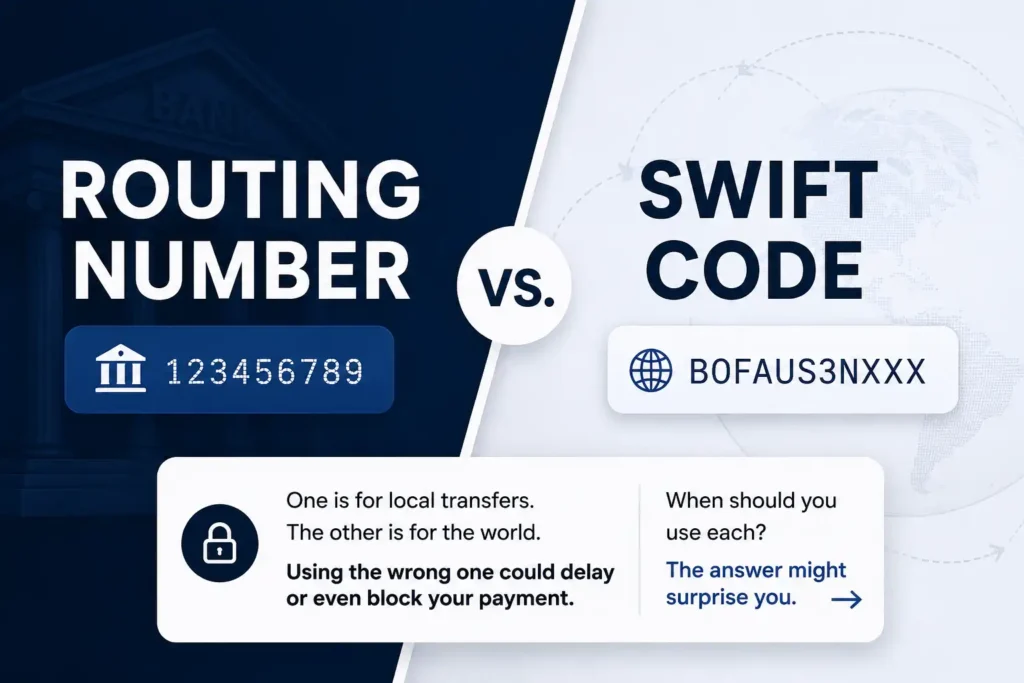
Have you ever tried to send money and been asked for a routing number, only to discover that the recipient actually needed a SWIFT code?
It’s a common source of confusion.
Both routing numbers and SWIFT codes help move money between banks, but they serve very different purposes. Using the wrong one can delay a payment, cause an international transfer to fail, or leave you wondering where your money went.
Imagine you’re sending money to a family member in another country.
You log into your online banking account, enter your bank’s routing number, and submit the transfer. A day later, the bank contacts you to explain that the payment can’t be processed because an international transfer requires a SWIFT code instead.
Situations like this happen every day.
The good news is that once you understand the difference between routing numbers and SWIFT codes, choosing the correct one becomes straightforward.
In this guide, you’ll learn what each identifier does, when you need one instead of the other, where to find them, and how to avoid common banking mistakes when sending money domestically or internationally.
By the end, you’ll know exactly which code to use for your next transfer.
Table of Contents
Quick Answer
A routing number identifies a financial institution within the United States and is mainly used for domestic transactions such as direct deposits, ACH transfers, and many wire transfers.
A SWIFT code identifies a bank anywhere in the world and is primarily used for international wire transfers between financial institutions in different countries.
In simple terms:
- Use a routing number for most domestic U.S. banking transactions.
- Use a SWIFT code when sending or receiving money internationally.
Routing Number vs. SWIFT Code at a Glance
Before diving deeper, here’s a quick comparison.
| Feature | Routing Number | SWIFT Code |
|---|---|---|
| Primary Purpose | Identifies a U.S. financial institution | Identifies a bank worldwide |
| Used For | Domestic banking transactions | International wire transfers |
| Format | 9 digits | 8–11 letters and numbers |
| Geographic Coverage | United States | Worldwide |
| Common Uses | ACH transfers, direct deposits, checks, domestic payments | International transfers between banks |
| Assigned By | American Bankers Association (ABA) | SWIFT organization |
Although both help direct money to the correct bank, they operate in different payment systems and are rarely interchangeable.
What Is a Routing Number?
A routing number—also known as an ABA routing number or routing transit number (RTN)—is a unique nine-digit number assigned to financial institutions in the United States.
Its primary job is to tell the U.S. banking system which bank should receive a payment.
Routing numbers are commonly used for:
- Direct deposits
- ACH transfers
- Payroll
- Electronic bill payments
- Check processing
- Domestic wire transfers
- Tax refunds
- Government benefits
Without routing numbers, domestic electronic banking in the United States wouldn’t function efficiently.
If you’re unfamiliar with how routing numbers work, our complete guide explains everything from where to find yours to how they’re assigned.
👉 Related guide: What Is an ABA Routing Number? Meaning, Uses, Examples & How to Find Yours
What Is a SWIFT Code?
A SWIFT code, sometimes called a BIC (Bank Identifier Code), is an international identifier used to recognize banks participating in cross-border financial transactions.
Unlike routing numbers, which are limited to U.S. banks, SWIFT codes are used by financial institutions around the world.
When money moves from one country to another, banks rely on SWIFT codes to identify the receiving institution accurately.
A SWIFT code typically contains between 8 and 11 characters.
For example:
BOFAUS3N
While this looks very different from a routing number, it serves a similar purpose—identifying a financial institution.
The difference is that SWIFT operates on a global scale.
Why Do Banks Use Two Different Systems?
This is one question many people never think to ask.
The answer is simple.
Domestic banking and international banking developed differently.
Within the United States, the ABA routing number system provides a standardized way to identify financial institutions.
Internationally, banks needed a global identification system that worked across different countries, currencies, and banking regulations.
That’s why the SWIFT network was created.
Instead of replacing routing numbers, it complements them by handling international communication between banks.
How Does a Routing Number Work?
A routing number works like a destination address for your bank.
Whenever money moves electronically within the United States, the routing number tells the banking system which financial institution should receive the payment before it is delivered to an individual customer.
Think of it this way.
If you’re mailing a package:
- The routing number is the city and ZIP code.
- The account number is the street address.
Without the routing number, the payment wouldn’t know which bank to reach.
Here’s a simplified example.
James receives his salary through direct deposit.
His employer’s payroll system uses:
- James’s routing number
- James’s account number
The routing number directs the payment to James’s bank.
Once the payment arrives there, the account number identifies James’s specific checking account.
Within moments, the money is deposited.
This same process occurs millions of times every business day across the United States.
Common Uses of Routing Numbers
Routing numbers are commonly required for:
- Direct deposits
- ACH transfers
- Electronic bill payments
- Domestic wire transfers
- Payroll
- Government benefits
- Tax refunds
- Check processing
- Linking external bank accounts
Although customers rarely think about routing numbers after opening a bank account, they quietly support many everyday financial transactions.
How Does a SWIFT Code Work?
A SWIFT code performs a similar role, but on an international scale.
Instead of identifying a U.S. financial institution, it identifies banks participating in the global SWIFT network.
When someone sends money from one country to another, the sending bank uses the recipient bank’s SWIFT code to determine exactly where the payment should be delivered.
For example:
Emma lives in Canada.
She wants to send money to her brother’s bank account in the United States.
Instead of asking only for a routing number, her bank requests:
- Recipient’s name
- Account number
- Bank name
- SWIFT code
- Additional international banking information, depending on the destination
The SWIFT code ensures the payment reaches the correct financial institution before the receiving bank credits the recipient’s account.
Without this international identification system, global money transfers would be significantly more complicated.
What Does a SWIFT Code Look Like?
Unlike routing numbers, which always contain nine digits, SWIFT codes use a combination of letters and numbers.
A SWIFT code typically contains:
- 8 characters
- or 11 characters
Each section has a specific purpose.
| Section | Meaning |
|---|---|
| First 4 characters | Bank code |
| Next 2 characters | Country code |
| Next 2 characters | Location code |
| Last 3 characters (optional) | Branch code |
Example:
BOFAUS3N
Although customers don’t need to memorize how these characters are assigned, understanding the basic structure helps explain why SWIFT codes look so different from routing numbers.
Domestic Transfers vs. International Transfers
One of the easiest ways to remember the difference between routing numbers and SWIFT codes is to think about where the money is going.
Domestic Transfers
Domestic transfers occur within the same country.
If you’re sending money between banks in the United States, you’ll usually use:
- ABA routing number
- Account number
Examples include:
- Receiving your paycheck
- Paying your mortgage
- Sending money between your own accounts
- Paying utility bills
- Receiving IRS refunds
In most domestic banking situations, you won’t need a SWIFT code.
International Transfers
International transfers move money between banks located in different countries.
For these transactions, banks commonly request:
- SWIFT code
- Account number
- Recipient’s name
- Bank name
- Additional banking information depending on the destination country
Because international banking involves multiple countries, currencies, and financial regulations, routing numbers alone aren’t sufficient.
That’s why the SWIFT network exists.
When Do You Need a Routing Number?
You’ll typically need a routing number whenever you’re completing a domestic banking transaction within the United States.
Common examples include:
Receiving Direct Deposit
Employers request your routing number to send payroll electronically.
Setting Up ACH Payments
Utility companies, lenders, and subscription services use routing numbers for automatic withdrawals.
Receiving Government Benefits
Social Security, veterans benefits, unemployment benefits, and tax refunds are commonly deposited using routing numbers.
Linking Bank Accounts
Financial apps often require your routing number before allowing electronic transfers between banks.
Domestic Wire Transfers
Some domestic wire transfers also require routing numbers, although your bank may use a routing number specifically designated for wire transfers.
Always verify the correct routing information before initiating a wire payment.
When Do You Need a SWIFT Code?
SWIFT codes are mainly required when money crosses international borders.
Common situations include:
- Receiving money from another country
- Sending money overseas
- Paying international suppliers
- Receiving international business payments
- International investment transfers
- Overseas tuition payments
- Foreign property purchases
If you’re unsure whether your payment requires a routing number or a SWIFT code, ask your bank before initiating the transfer.
Using the wrong identifier is one of the most common reasons international payments are delayed.
Can You Need Both a Routing Number and a SWIFT Code?
Yes.
This surprises many people.
Some international transfers involving U.S. banks require both.
For example, a customer receiving an international wire transfer into a U.S. bank account may need to provide:
- SWIFT code
- ABA routing number
- Account number
The SWIFT code helps the international banking network locate the correct U.S. financial institution.
Once the payment reaches the United States, the routing number helps direct it through the domestic banking system.
Your bank will tell you exactly which information is required for your particular transaction.
Where Can You Find Your Routing Number?
Fortunately, routing numbers are easy to locate.
Reliable sources include:
- Online banking
- Mobile banking app
- Paper checks
- Bank statements
- Official bank website
- Customer support
Always verify the routing number directly with your bank before sending important payments.
Where Can You Find Your SWIFT Code?
Your bank can also provide its SWIFT code.
Common places to find it include:
- Official bank website
- Online banking portal
- Customer service
- International wire transfer instructions
- Bank branch
Because some banks use different SWIFT codes for different branches or business units, it’s always safer to confirm the correct code before sending money internationally.
Real-Life Example
Let’s compare two different situations.
Scenario 1
David lives in Texas.
He receives his salary through direct deposit from his employer.
His payroll department asks for:
- Routing number
- Account number
No SWIFT code is needed because the payment stays within the United States.
Scenario 2
Sophia lives in New York.
Her parents send her money from France.
Their bank requests:
- SWIFT code
- Recipient’s account number
- Bank information
Because the payment crosses international borders, the SWIFT network is used.
These two examples illustrate the simplest way to remember the difference:
Domestic payments usually use routing numbers.
International payments usually use SWIFT codes.
Routing Number vs. SWIFT Code: Key Differences
Now that you understand what each banking identifier does, let’s compare them side by side.
Although routing numbers and SWIFT codes both help banks move money, they are designed for different payment systems and should not be used interchangeably.
Understanding these differences can help you avoid rejected transfers, payment delays, and unnecessary banking fees.
Geographic Coverage
The biggest difference is where each system is used.
An ABA routing number is primarily used within the United States.
A SWIFT code is recognized by financial institutions around the world.
Here’s a simple comparison.
| Feature | Routing Number | SWIFT Code |
|---|---|---|
| Geographic Coverage | United States | Worldwide |
| Used By | U.S. banks and credit unions | Banks in more than 200 countries |
| Primary Purpose | Domestic banking | International banking |
If the payment stays inside the United States, you’ll usually need a routing number.
If the payment crosses international borders, you’ll usually need a SWIFT code.
Format
These banking identifiers also look very different.
An ABA routing number always contains exactly nine digits.
Example:
021000021
A SWIFT code contains eight or eleven letters and numbers.
Example:
CHASUS33
The letters in a SWIFT code aren’t random.
They identify:
- The bank
- The country
- The city or location
- Sometimes the specific branch
Because they serve different banking systems, you should never substitute one for the other.
Transactions Supported
Another important difference involves the types of payments each identifier supports.
Routing numbers are commonly used for:
- Direct deposits
- Payroll
- ACH transfers
- Electronic bill payments
- Domestic wire transfers
- Check processing
- Government benefits
- IRS tax refunds
SWIFT codes are commonly used for:
- International wire transfers
- Overseas tuition payments
- Foreign property purchases
- International supplier payments
- Cross-border business transactions
- International investment transfers
One important thing many people overlook is that ACH transfers do not use SWIFT codes.
Likewise, international wire transfers generally do not rely on ABA routing numbers alone.
Speed
Neither routing numbers nor SWIFT codes determine how quickly money moves.
Instead, the payment network determines the processing speed.
For example:
An ACH payment using a routing number may take one to three business days.
A domestic wire transfer using routing information may arrive the same day.
An international transfer using the SWIFT network may take anywhere from one to five business days, depending on:
- The countries involved
- Currency conversion
- Compliance reviews
- Intermediary banks
- Banking holidays
This is why two payments using different identifiers can have very different processing times.
Security
Both systems are considered highly secure.
However, they protect transactions in different ways.
Routing numbers operate within the regulated U.S. banking system.
SWIFT operates one of the world’s largest secure financial messaging networks.
Neither system guarantees protection against fraud if incorrect banking information is provided.
That’s why banks recommend verifying payment instructions before sending large amounts of money.
Common Mistakes to Avoid
Most payment problems involving routing numbers and SWIFT codes happen because people assume they’re interchangeable.
They aren’t.
Here are some of the most common mistakes.
Using a Routing Number for an International Transfer
This is probably the most frequent mistake.
Someone sending money overseas enters only the recipient’s routing number.
The bank then requests a SWIFT code before processing the payment.
Whenever you’re sending money internationally, confirm exactly which banking identifiers your bank requires.
Entering an Incorrect SWIFT Code
A single incorrect character can prevent an international transfer from reaching the correct bank.
Unlike routing numbers, SWIFT codes combine both letters and numbers, making typing mistakes more common.
Always copy the code directly from official bank documentation whenever possible.
Assuming Every Bank Has Only One SWIFT Code
Large international banks may use different SWIFT codes for different countries, cities, business units, or branches.
Never assume the first SWIFT code you find online is automatically the correct one.
Verify it directly with the receiving bank.
Confusing ACH Transfers With International Transfers
Many first-time customers assume ACH transfers work worldwide.
They don’t.
The ACH network is designed primarily for domestic electronic payments within the United States.
If you’re sending money abroad, your bank will usually recommend an international wire transfer using the SWIFT network.
Which One Should You Use?
The answer depends entirely on where the money is going.
Ask yourself one simple question.
Is the payment staying inside the United States?
If the answer is yes, you’ll usually need:
- ABA routing number
- Account number
If the answer is no, you’ll usually need:
- SWIFT code
- Account number or IBAN (depending on the destination country)
- Recipient bank information
This simple decision can prevent many transfer problems before they happen.
Before Sending Money Internationally
International transfers often involve larger amounts of money and more banking requirements than domestic payments.
Before submitting your transfer, verify the following.
✔ Recipient’s full legal name.
✔ Bank name.
✔ SWIFT code.
✔ Account number or IBAN.
✔ Currency.
✔ Transfer amount.
✔ Any applicable fees.
✔ Exchange rate, if currency conversion is required.
Taking a few extra minutes to review these details can prevent costly delays and help ensure your money reaches the correct destination.
Real-World Banking Scenarios
Sometimes the easiest way to understand the difference between routing numbers and SWIFT codes is through real examples.
Scenario 1: Receiving Your Paycheck
Jacob works for a software company in California.
His employer asks him to complete a direct deposit form.
He provides:
- ABA routing number
- Account number
His salary is deposited through the ACH network.
No SWIFT code is required because the payment remains within the United States.
Scenario 2: Buying Property Overseas
Amanda is purchasing an apartment in Spain.
Her attorney instructs her to send the payment by international wire transfer.
Her bank requests:
- SWIFT code
- Recipient’s account information
- Beneficiary name
- Bank address
A routing number alone would not be sufficient because the payment is leaving the United States.
Scenario 3: Receiving Payment From an Overseas Client
Michael is a freelance graphic designer living in Florida.
A client in Australia needs to pay him for completed work.
Michael contacts his U.S. bank and receives the international wire instructions, including the bank’s SWIFT code and any additional information required for incoming international transfers.
His client uses those details to send the payment successfully.
These examples demonstrate a simple rule that’s easy to remember:
Routing numbers help move money within the United States.
SWIFT codes help move money across international borders.
Frequently Asked Questions About Routing Numbers and SWIFT Codes
If you’re sending money domestically or internationally, it’s normal to have questions about routing numbers and SWIFT codes. The answers below address many of the situations people encounter when transferring money, receiving payments, or setting up bank accounts.
Is a Routing Number the Same as a SWIFT Code?
No. A routing number identifies a financial institution within the United States, while a SWIFT code identifies banks participating in international financial transactions. Although both help direct money to the correct bank, they are designed for different payment systems and are not interchangeable.
Can I Use a Routing Number Instead of a SWIFT Code?
No. If your bank requests a SWIFT code for an international transfer, a routing number cannot replace it. The payment may be rejected or delayed because international banks rely on the SWIFT network to identify financial institutions across different countries.
Can I Use a SWIFT Code Instead of a Routing Number?
No. Domestic banking transactions within the United States generally require an ABA routing number. A SWIFT code is not designed to replace a routing number for ACH transfers, direct deposits, or most domestic payments.
Do All Banks Have a SWIFT Code?
Not necessarily. Many large banks that send or receive international wire transfers have SWIFT codes, but smaller community banks and credit unions may not participate directly in the SWIFT network. In those cases, they often work with correspondent banks to process international transfers.
Do All U.S. Banks Have Routing Numbers?
Yes. Financial institutions that participate in the U.S. banking system have one or more ABA routing numbers. These routing numbers are used for domestic banking transactions such as direct deposits, ACH transfers, and check processing.
Can One Bank Have Multiple Routing Numbers?
Yes. Large financial institutions often use multiple routing numbers based on the state where the account was opened, transaction type, or historical mergers. This is why two customers of the same bank may legitimately have different routing numbers.
Can One Bank Have Multiple SWIFT Codes?
Yes. International banks may assign different SWIFT codes to different branches, divisions, or business units. Always verify the correct SWIFT code for the specific transaction you’re completing.
How Do I Find My Bank’s Routing Number?
You can usually find your routing number by checking:
- Your online banking account
- Your bank’s mobile app
- Your paper checks
- Your monthly bank statement
- Your bank’s official website
- Customer support
Always verify the routing number directly with your financial institution before completing an important transaction.
How Do I Find My Bank’s SWIFT Code?
Most banks publish their SWIFT codes on their official websites. You can also obtain the correct code by:
- Contacting customer service
- Visiting your local branch
- Reviewing your international wire transfer instructions
- Logging into online banking, if available
If you’re sending a large international payment, it’s always worth confirming the SWIFT code directly with the receiving bank.
Can I Receive International Money Without a SWIFT Code?
In many cases, no. International wire transfers generally require a SWIFT code to identify the receiving financial institution. Some transfers may also require an IBAN or other country-specific banking identifiers.
What Is an IBAN?
An International Bank Account Number (IBAN) is a standardized account number used in many countries outside the United States. While routing numbers identify U.S. banks and SWIFT codes identify financial institutions globally, an IBAN identifies a specific bank account for international transactions. The United States does not use the IBAN system.
Why Doesn’t the United States Use IBAN?
The U.S. banking system relies primarily on ABA routing numbers and account numbers for domestic transactions. Because of this established system, American banks generally don’t issue IBANs. Instead, international transfers to U.S. banks usually require a SWIFT code along with the recipient’s routing number and account number when applicable.
Are SWIFT Transfers Safe?
Yes. The SWIFT network is one of the most trusted financial messaging systems in the world. However, like any payment system, mistakes or fraud can occur if incorrect banking information is provided. Always verify the recipient’s banking details before sending money internationally.
Are Routing Numbers Confidential?
Routing numbers are not considered confidential because they identify financial institutions rather than individual customers. However, when combined with your account number and other personal information, they should still be protected and shared only with trusted organizations.
Can I Receive My Salary Using a SWIFT Code?
Generally, no. Most employers in the United States pay salaries through direct deposit using the ACH network, which relies on routing numbers rather than SWIFT codes. A SWIFT code is primarily used for international transfers.
Can I Receive an IRS Tax Refund Using a SWIFT Code?
No. IRS tax refunds sent by direct deposit typically require your routing number and account number. If you’re receiving a refund into a U.S. bank account, a SWIFT code is generally not required.
Can Businesses Use Both Routing Numbers and SWIFT Codes?
Yes. Businesses that operate internationally often use both systems. Routing numbers are used for domestic payroll, vendor payments, and ACH transfers, while SWIFT codes are used when sending or receiving international wire transfers.
What Happens If I Enter the Wrong SWIFT Code?
An incorrect SWIFT code may cause your international transfer to be delayed, rejected, or returned. Depending on the circumstances, additional bank fees may also apply. Always verify the code before authorizing an international payment.
What Happens If I Enter the Wrong Routing Number?
An incorrect routing number may prevent a domestic payment from reaching the intended bank. The transaction may be rejected, delayed, or returned, depending on the payment system and the information entered.
Which One Should I Use?
The easiest way to decide is to ask where the money is going.
If the payment is staying within the United States, you’ll usually need a routing number.
If the payment is crossing international borders, you’ll generally need a SWIFT code and, depending on the destination country, additional information such as an IBAN or the recipient’s account number.
When in doubt, contact your bank before initiating the transfer. Confirming the required banking information in advance can save time, prevent delays, and reduce the risk of costly mistakes.
Conclusion
Although routing numbers and SWIFT codes both help banks move money, they serve different purposes and operate within different banking systems.
A routing number is primarily used for domestic banking transactions within the United States, including direct deposits, ACH transfers, payroll, and many domestic wire transfers. A SWIFT code, on the other hand, is used to identify financial institutions during international wire transfers, making it essential for sending or receiving money across borders.
Knowing which identifier to use can help you avoid rejected payments, transfer delays, and unnecessary banking fees. Before sending money, always verify the recipient’s banking details with your financial institution or the receiving bank, especially if the transaction involves another country.
If you want to build a stronger understanding of banking and electronic payments, these guides are excellent next reads:
- What Is an ABA Routing Number? Meaning, Uses, Examples & How to Find Yours
- Routing Number vs. Account Number: What’s the Difference?
- ACH Transfer vs. Wire Transfer: What’s the Difference and Which Should You Use?
- How to Find Your Bank Routing Number
- Why Do Banks Have Different Routing Numbers?
- 121000248 Routing Number: Which Bank Uses It and How to Avoid Costly Transfer Mistakes
The more you understand these banking tools, the easier it becomes to send money confidently, complete financial transactions accurately, and avoid common payment errors.

