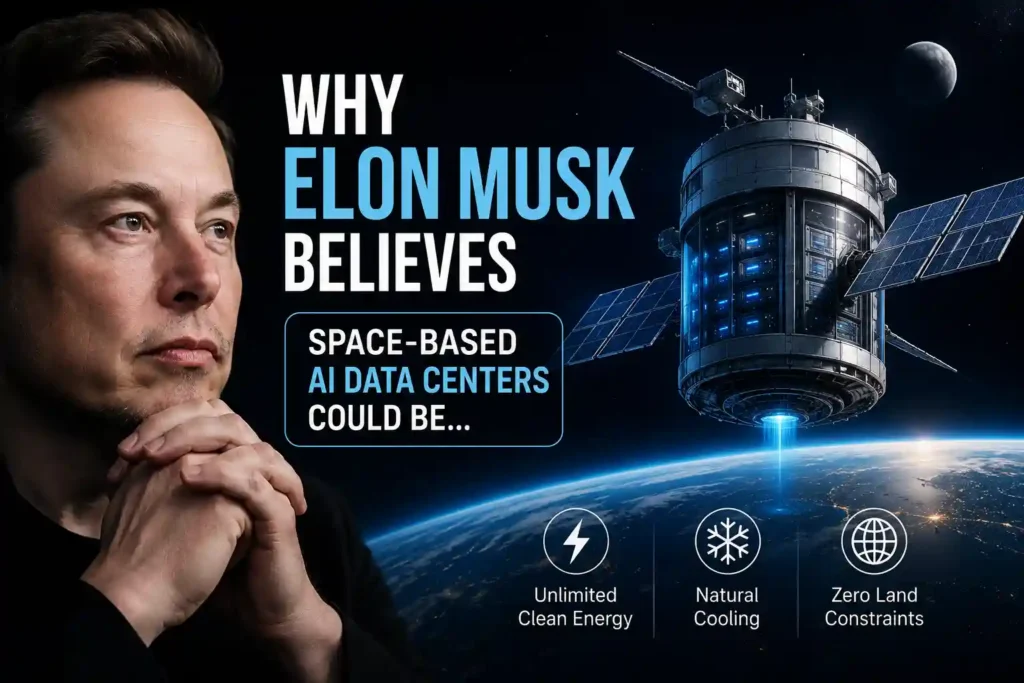
The artificial intelligence boom has created a problem that is becoming increasingly difficult to ignore.
AI needs enormous amounts of computing power.
Computing requires data centers.
Data centers require electricity.
And the more powerful artificial intelligence becomes, the more electricity, chips, cooling systems and physical infrastructure the industry needs.
Elon Musk believes part of the answer may eventually be above Earth.
Rather than continuing to build every massive AI computing facility on the ground, Musk has promoted an extraordinarily ambitious idea: move significant amounts of AI computing infrastructure into space.
At first, the concept sounds like science fiction.
Why launch expensive computers into orbit when enormous data centers can already be built in Texas, Virginia, Nevada or other locations on Earth?
The answer becomes more interesting when looking at the long-term limitations facing terrestrial AI infrastructure.
Electricity demand is increasing. Power-grid connections can take years. Communities are becoming concerned about data-center energy and water consumption. Suitable land near major power infrastructure is valuable. Meanwhile, AI companies expect their computing requirements to continue expanding.
Space offers a radically different possibility.
There is abundant solar energy above Earth’s atmosphere. Vast orbital areas do not compete with cities for land. SpaceX already operates a huge satellite network, while Starship is intended to dramatically reduce the cost of placing massive amounts of equipment into orbit.
Musk’s argument is essentially that once AI computing becomes large enough, economics could eventually favor moving some of it away from Earth.
Understanding why Elon Musk believes space-based AI data centers could be the next computing frontier requires looking at the collision between three technologies: artificial intelligence, reusable rockets and satellite infrastructure.
If all three continue advancing, the location of the world’s biggest computers may eventually become an open question.
Table of Contents
What Are Space-Based AI Data Centers?
A space-based AI data center would place significant computing infrastructure in orbit rather than housing all of it inside conventional buildings on Earth.
The basic purpose would remain familiar.
Processors would perform calculations.
AI models would process information.
Data would move through networks.
Power systems would provide electricity.
But instead of racks of servers sitting inside a giant warehouse, the computing hardware would operate aboard satellites or larger orbital platforms.
This Would Go Far Beyond Ordinary Satellites
Satellites already contain computers.
However, their computing systems are generally tiny compared with modern terrestrial AI data centers.
A frontier AI data center can contain enormous numbers of high-performance processors consuming tremendous amounts of electricity.
Turning orbital infrastructure into something comparable would require a completely different scale of deployment.
That means much larger power systems.
More advanced thermal management.
High-speed communications.
Radiation-resistant computing.
Frequent launches.
Maintenance strategies.
And potentially enormous constellations of computing satellites working together.
That is why the idea represents a new computing frontier rather than simply another satellite application.
Why AI’s Electricity Problem Is Driving Interest in Space
The strongest argument for orbital AI computing starts with electricity.
AI infrastructure is becoming extraordinarily power-hungry.
Training advanced models requires enormous computing clusters.
Serving those models to hundreds of millions of people requires additional infrastructure.
Video generation, AI agents, scientific computing, robotics and other applications could increase demand further.
Data Centers Are Becoming Power Projects
The old mental picture of a data center as a building filled with computers is becoming outdated.
Large AI facilities increasingly resemble energy infrastructure projects that happen to contain computers.
Developers need access to:
large quantities of electricity,
transmission infrastructure,
transformers,
backup generation,
cooling,
water or alternative cooling systems,
network connections,
and enough land to accommodate everything.
In some regions, getting the electricity required for a massive new data center can take years.
That creates a bottleneck.
An AI company can have money.
It can have processors.
It can have land.
But without electricity, those processors cannot operate.
Space potentially changes that equation.
Space Has Access to Enormous Amounts of Solar Energy
One of the most attractive features of orbital computing is solar power.
Solar panels on Earth have obvious limitations.
Night arrives.
Clouds reduce generation.
The atmosphere affects incoming sunlight.
Seasons change.
Energy storage or alternative generation is needed when solar output drops.
Orbital solar systems can potentially avoid some of those constraints depending on their orbit.
Solar Panels Can Produce Energy More Consistently in Space
Above the atmosphere, solar panels can receive intense sunlight without clouds or weather interfering.
Certain orbital configurations could provide long periods of solar exposure.
That makes space interesting for energy-intensive computing.
Instead of building enormous terrestrial power plants solely to support AI data centers, future computing satellites could generate much of their electricity directly from sunlight.
This is central to Musk’s argument.
If AI ultimately requires extraordinary amounts of electricity, moving computing closer to an abundant energy source could make economic sense.
But Space Does Not Provide Unlimited 24-Hour Solar Power Automatically
This is where the idea needs some realism.
Putting a satellite in orbit does not mean it receives sunlight continuously.
Satellites can pass through Earth’s shadow depending on their orbit.
That means orbital data centers may still require batteries or other energy-storage systems.
The orbital architecture would therefore matter enormously.
Engineers would need to optimize the relationship between sunlight, communications, radiation exposure, thermal management and orbital mechanics.
So while solar energy is a major advantage, it is not free electricity without engineering complications.
Starship Could Be the Technology That Changes the Economics
Space-based data centers would make little economic sense if launching hardware remained extremely expensive.
That is where SpaceX’s Starship becomes crucial.
Musk’s broader strategy depends heavily on dramatically reducing the cost of placing payloads into orbit.
Traditional launch economics make sending thousands of tons of computing hardware into space prohibitively expensive.
A fully reusable heavy-lift rocket could change the calculation.
Reusability Is Essential
Imagine throwing away an airplane after every flight.
Air travel would become extraordinarily expensive.
Historically, rockets operated somewhat like that.
Large portions of launch vehicles were discarded after missions.
SpaceX has already changed part of that model through reusable Falcon 9 boosters.
Starship aims to take reusability much further.
If both stages can eventually be reused rapidly and reliably, the cost of launching large payloads could fall substantially.
That could make projects economically imaginable that currently look absurd.
Orbital AI computing is one of them.
Launch Capacity Matters Just as Much as Launch Price
Cheap launches alone are not enough.
AI data centers are heavy.
Servers are heavy.
Solar panels have mass.
Radiators have mass.
Structural components have mass.
Batteries have mass.
Communications equipment has mass.
Protective systems have mass.
A meaningful orbital computing network could therefore require enormous launch capacity.
Starship is being designed as a heavy-lift transportation system capable of carrying large payloads.
If SpaceX eventually launches Starships frequently, the company could theoretically move vast quantities of computing infrastructure into orbit.
That would represent a fundamental change in what can economically be built in space.
Starlink Provides Another Piece of Musk’s Strategy
SpaceX is not beginning from zero.
Starlink has already forced the company to learn how to manufacture, launch and operate satellites at extraordinary scale.
That experience matters.
Building a handful of satellites is one challenge.
Managing thousands of spacecraft simultaneously is another.
Starlink has required SpaceX to develop expertise in:
mass satellite manufacturing,
orbital deployment,
communications,
collision avoidance,
ground infrastructure,
network management,
and frequent launches.
A future space-based computing network could build upon parts of that infrastructure and knowledge.
Communications Are Essential for Orbital Computing
A computer in space is useless if data cannot move to and from it efficiently.
Space-based AI infrastructure would require extremely high-capacity communications networks.
Satellites might communicate with one another using optical links.
Ground stations could transmit information between terrestrial networks and orbital computing platforms.
Starlink provides SpaceX with experience building precisely this type of interconnected orbital network.
That could give the company a unique advantage if orbital computing becomes viable.
Musk’s AI Businesses Could Create Their Own Demand
Another reason the idea deserves attention is that Musk controls companies with enormous potential computing requirements.
Tesla is developing autonomous driving and humanoid robots.
xAI is building increasingly powerful artificial intelligence systems.
SpaceX operates Starlink and continues developing space infrastructure.
Future AI systems across these businesses could consume extraordinary computing capacity.
Musk therefore has both a potential infrastructure provider and potential customers.
Vertical Integration Could Become Powerful
Imagine a future ecosystem where SpaceX launches computing satellites.
Starlink provides communications.
Specialized chips process AI workloads.
Solar arrays provide electricity.
Musk-controlled AI systems consume part of the computing capacity.
That level of vertical integration could potentially reduce dependence on outside infrastructure providers.
However, achieving it would require solving some extraordinarily difficult engineering problems.
Space Could Reduce Competition for Terrestrial Land
Large data centers occupy significant physical space.
But the building itself is only part of the footprint.
Power infrastructure requires land.
Transmission systems require land.
Backup generation requires land.
Cooling equipment requires space.
As AI infrastructure expands, communities increasingly face questions about whether giant data centers are the best use of local resources.
Orbital computing would avoid some of those conflicts.
There are no residential neighborhoods next to an orbital data center.
There are no local zoning battles in space.
There are no communities complaining about the physical appearance of enormous server buildings.
But space creates its own environmental and regulatory problems, including orbital debris and launch impacts.
The trade-offs simply change.
Space-Based Computing Could Reduce Some Water Demands
Many terrestrial data centers use water as part of their cooling systems.
As facilities grow, their water consumption can become controversial, particularly in regions experiencing shortages.
Space-based computing would not require conventional water-based cooling towers.
That sounds like a major advantage.
Unfortunately, cooling computers in space introduces a different and extremely difficult problem.
Cooling May Be One of the Biggest Obstacles
Space is cold, right?
Therefore, cooling computers in space should be easy.
Unfortunately, that assumption is misleading.
On Earth, data centers can move heat into air or water.
In the vacuum of space, there is no surrounding air to carry heat away.
Heat Must Be Radiated Away
Computers convert electricity into heat.
An AI processor consuming enormous amounts of power produces significant heat.
That heat must go somewhere.
In space, thermal energy ultimately needs to be radiated away.
That requires large radiator systems.
The more computing power an orbital platform uses, the more waste heat engineers must manage.
At very large scales, radiator size could become one of the biggest constraints on space-based AI infrastructure.
This is a crucial challenge because increasing computing density increases heat density too.
A satellite may have abundant solar energy available and still be limited by how quickly it can reject heat.
Radiation Is Another Serious Problem
Earth protects terrestrial data centers from much of the radiation present in space.
Computers in orbit do not receive the same protection.
High-energy particles can interfere with electronics.
They can cause errors.
They can degrade components.
In severe cases, they can damage hardware.
AI Chips Are Not Naturally Designed for Space
Modern high-performance processors are optimized primarily for terrestrial data centers.
They are designed around performance, efficiency and manufacturing economics.
Operating them reliably in a radiation environment introduces additional engineering requirements.
Possible solutions include:
physical shielding,
radiation-tolerant designs,
error-correction systems,
redundant computing,
and software capable of detecting hardware failures.
All of these add complexity, weight or cost.
Semiconductor Design Could Need to Change
If orbital AI computing becomes a serious industry, processors may eventually be designed specifically for space.
Those chips would need to balance several requirements.
High performance.
Energy efficiency.
Radiation tolerance.
Thermal efficiency.
Reliability.
Low mass.
This could create an entirely new category of AI semiconductor.
The best terrestrial data-center chip may not necessarily be the best orbital computing chip.
That distinction could become increasingly important if space computing expands.
Latency Could Limit Which AI Tasks Move Into Space
Distance matters in computing.
Signals cannot travel instantly.
Even at the speed of light, transmitting information between Earth and satellites creates delay.
For some applications, that delay may be acceptable.
For others, it could be problematic.
Not Every AI Workload Needs Extremely Low Latency
AI model training is one possible candidate for orbital computing because much of the workload can potentially occur without constant interaction with individual users.
Large batch-processing jobs could also be attractive.
Scientific computing could potentially tolerate certain communications delays.
Some AI inference workloads might also work depending on the orbital architecture.
However, applications requiring extremely rapid responses may remain better suited to terrestrial infrastructure located close to users.
This suggests space-based AI data centers may complement Earth-based facilities rather than replace them.
Training AI Models Could Be an Early Use Case
Training frontier AI systems requires huge amounts of computing power.
But once the necessary data is available to the computing cluster, much of the calculation happens internally.
That makes training an interesting candidate for future orbital infrastructure.
A large dataset could be transmitted to an orbital computing network.
The processors could perform training operations.
Results could then be transmitted back to Earth.
Whether this becomes economically attractive depends on communications capacity, launch costs, chip efficiency and thermal management.
AI Inference Presents Different Challenges
Inference happens when people actually use trained AI models.
Ask an AI assistant a question and the model performs inference.
Generate an image and inference occurs.
Request a video and substantial computing may be required.
These applications often benefit from low latency.
Terrestrial data centers located near major population centers have a natural advantage.
However, orbital networks could potentially serve some inference workloads if communications become fast and efficient enough.
The optimal AI infrastructure of the future may therefore be hybrid.
Some computing remains on Earth.
Some moves into orbit.
Different workloads go wherever they can be processed most efficiently.
Space-Based Data Centers Could Eventually Scale Differently
Terrestrial data centers face local limitations.
A particular location may run out of available power.
Transmission capacity may become constrained.
Water supplies may become controversial.
Permitting may slow expansion.
Space has different constraints.
Instead of expanding one enormous building, companies could potentially launch additional computing modules.
Need more capacity?
Launch more hardware.
In theory, that creates a modular scaling model.
In practice, every launch would still require manufacturing, rockets, orbital coordination and enormous capital.
But the concept is powerful.
Computing capacity could become something deployed into orbit incrementally.
Maintenance Is a Huge Unanswered Question
Data-center hardware fails.
Drives fail.
Power supplies fail.
Networking equipment fails.
Fans fail.
Processors fail.
Technicians can walk into terrestrial data centers and replace defective components.
That is considerably harder in orbit.
Orbital Hardware May Need to Be Disposable or Highly Autonomous
One approach would be designing computing satellites to operate without physical maintenance for their expected lifespan.
When hardware fails or becomes obsolete, the spacecraft could eventually be deorbited and replaced.
Another possibility involves future robotic servicing.
Robots could inspect, repair or replace orbital computing modules.
But that introduces another layer of technological complexity.
Maintenance economics will therefore play a major role in determining whether orbital computing can compete with terrestrial alternatives.
Hardware Obsolescence Creates Another Problem
AI chips improve rapidly.
A processor launched today may look inefficient compared with hardware available several years later.
Terrestrial data centers can replace servers relatively easily.
Orbital hardware cannot.
This means space-based computing platforms would need carefully planned lifecycles.
If launch costs become extremely low, replacing older satellites may become economically reasonable.
If launches remain expensive, rapid semiconductor improvement could undermine the economics.
Orbital Debris Cannot Be Ignored
Thousands of additional computing satellites would create another challenge.
Earth orbit is already becoming crowded.
Defunct satellites, rocket components and fragments travel at extremely high speeds.
Even small debris can damage spacecraft.
Massive orbital computing constellations would therefore require sophisticated collision avoidance and end-of-life management.
Space Cannot Become an Unlimited Technology Dump
If companies launch computing hardware at massive scale, they must also remove obsolete equipment responsibly.
Controlled deorbiting could become essential.
Regulators would likely impose increasingly strict requirements as orbital activity expands.
The sustainability of space itself could become part of the economics of orbital computing.
Regulation Could Become Complicated
Data centers on Earth operate within national jurisdictions.
Space creates unusual legal questions.
Which country regulates an orbital AI data center?
The launching state?
The company owner’s country?
The country receiving the service?
What happens when data is processed above multiple countries?
Which privacy laws apply?
Which cybersecurity requirements apply?
Could governments restrict certain AI chips from being launched?
These questions may sound premature.
But if orbital computing becomes economically meaningful, regulators will need answers.
Cybersecurity Would Become Critical
An orbital AI data center would be a valuable target.
Attackers might attempt to compromise communications.
Disrupt satellite networks.
Steal data.
Manipulate computing workloads.
Or interfere with spacecraft operations.
Security would therefore need to be built into every layer of the system.
Encryption.
Authentication.
Network isolation.
Hardware security.
Redundant communications.
Autonomous threat detection.
The consequences of a cyberattack become particularly serious when technicians cannot simply walk into the facility and disconnect compromised hardware.
Could Space-Based AI Computing Actually Be Cheaper?
This is the question that ultimately matters.
Technological possibility does not guarantee economic success.
For orbital computing to become a major industry, the total cost of performing useful calculations in space must eventually compete with the cost of performing them on Earth.
That calculation includes far more than electricity.
Companies would need to consider:
hardware,
launch costs,
satellite manufacturing,
solar arrays,
batteries,
radiators,
communications,
radiation protection,
insurance,
replacement,
orbital operations,
and decommissioning.
Terrestrial data centers have disadvantages, but they also benefit from mature infrastructure.
Electric grids already exist.
Fiber networks already exist.
Technicians can access equipment.
Replacement hardware arrives by truck rather than rocket.
Space therefore has a high economic hurdle to overcome.
Falling Launch Costs Could Change Everything
This is why Musk’s argument depends so heavily on Starship.
At today’s traditional launch economics, gigantic orbital data centers are extremely difficult to justify.
If launch costs fall by an order of magnitude or more while launch frequency rises dramatically, the calculation changes.
Suddenly, mass becomes less expensive to put into orbit.
Larger solar arrays become practical.
Bigger radiators become practical.
More computing hardware becomes practical.
Replacement becomes cheaper.
The central question is therefore not simply:
“Can we build a data center in space?”
We already know computers can operate in space.
The important question is:
“Can computing in space become cheaper or strategically more valuable than computing on Earth?”
That remains unproven.
The Economics Could Improve as Terrestrial AI Becomes More Expensive
Orbital computing does not necessarily need to become dramatically cheaper on its own.
Terrestrial computing could become more expensive.
Imagine AI electricity demand continues rising rapidly.
Grid connections become harder to obtain.
Communities restrict data-center construction.
Power prices increase.
Water restrictions tighten.
Land near major transmission infrastructure becomes more expensive.
Under those circumstances, alternatives that look uneconomical today could become attractive.
Technology competition is often determined by relative economics.
Space computing only needs to become better than the alternatives available at the time.
Why Musk Is Positioned Differently From Most AI Executives
Most AI companies would need to hire another company to launch orbital infrastructure.
Musk controls SpaceX.
That changes the strategic calculation.
SpaceX manufactures rockets.
It launches satellites.
It operates Starlink.
It is developing Starship.
Musk also controls companies with enormous potential demand for AI computing.
That creates unusual vertical integration.
If orbital computing becomes practical, Musk’s companies could potentially control much of the infrastructure required to deploy it.
That does not guarantee success.
But it makes experimenting with the concept more realistic.
Space-Based Computing Fits Musk’s Larger Philosophy
There is a pattern across many Musk businesses.
Identify a bottleneck.
Then attempt to control it.
Electric vehicles need batteries.
Build enormous battery capacity.
Rockets are expensive because they are discarded.
Make them reusable.
Satellite internet requires thousands of satellites.
Mass-produce them.
AI requires enormous computing infrastructure.
Secure more chips and power.
If Earth eventually becomes the bottleneck, move some computing into space.
Whether every step succeeds is another question.
But the strategic logic is consistent.
Could Orbital AI Eventually Support Mars?
There is also a much longer-term dimension.
Musk’s ultimate SpaceX ambition remains building a civilization beyond Earth.
A future settlement on Mars would need significant computing infrastructure.
Communication delays between Earth and Mars make dependence on terrestrial cloud computing impractical for many applications.
Martian settlements would need local computing.
AI could become particularly valuable where human labor and expertise are scarce.
Autonomous systems could help manage:
construction,
resource extraction,
scientific research,
maintenance,
manufacturing,
agriculture,
and logistics.
Developing reliable space-based computing near Earth could therefore create technologies relevant to future deep-space operations.
That remains highly speculative, but it fits the broader SpaceX roadmap.
Why Space-Based Data Centers Probably Won’t Replace Earth-Based Data Centers
The most realistic future is not one where every data center leaves Earth.
Terrestrial computing has too many advantages.
Existing power infrastructure.
Easy maintenance.
Low-latency connections.
Established supply chains.
Physical security.
Rapid hardware replacement.
Instead, orbital computing could emerge as another layer of global computing infrastructure.
Think about cloud computing today.
Different workloads operate in different locations.
Some run near users.
Others run in massive centralized facilities.
Some happen directly on smartphones or vehicles.
Space could eventually become another location in that architecture.
The question is which workloads benefit enough to justify going there.
What Needs to Happen Before Space-Based AI Data Centers Become Practical?
Several major breakthroughs or improvements are still required.
Starship Must Achieve Reliable Reusability
Frequent low-cost heavy launches are central to the economics.
Launch Costs Must Fall Dramatically
Orbital computing cannot scale if transportation remains prohibitively expensive.
AI Chips Must Become More Energy Efficient
More calculations per watt would reduce solar-panel and radiator requirements.
Thermal Management Must Improve
Waste heat remains one of the hardest engineering constraints.
High-Speed Space Communications Must Scale
Enormous quantities of data must move efficiently between satellites and Earth.
Orbital Hardware Must Become Highly Reliable
Maintenance opportunities will be limited.
Regulation Must Catch Up
Governments need frameworks covering orbital computing, data security and environmental responsibility.
None of these problems is trivial.
The Most Important Number Could Be Compute Per Watt
When people discuss AI processors, performance usually gets attention.
For space computing, energy efficiency may become even more important.
Every watt consumed must first be generated.
Then the resulting heat must be rejected.
An inefficient chip therefore creates two problems simultaneously.
It requires more solar infrastructure and more cooling infrastructure.
Processors capable of delivering dramatically more AI computation per watt could make orbital data centers much more practical.
That means improvements in semiconductor efficiency could matter as much as improvements in rockets.
FAQs About Elon Musk and Space-Based AI Data Centers
Space-based computing combines AI, rockets, satellites and energy infrastructure, so it naturally raises many questions. Here are answers to 25 of the most important ones.
1. What is a space-based AI data center?
A space-based AI data center is computing infrastructure placed in orbit to perform artificial intelligence or other high-performance computing workloads rather than processing everything inside terrestrial facilities.
2. Why does Elon Musk want AI data centers in space?
The idea could eventually provide access to abundant solar energy while reducing some constraints involving terrestrial electricity grids, land and water.
3. Has Elon Musk already built a space-based AI data center?
No. Large-scale orbital AI computing remains an emerging concept rather than an established replacement for terrestrial AI data centers.
4. Why would anyone put a data center in space?
Potential advantages include solar energy, modular expansion and reduced dependence on constrained terrestrial power infrastructure.
5. Would space-based data centers use solar power?
Solar energy would likely be central because spacecraft can generate electricity directly from sunlight using large photovoltaic arrays.
6. Is solar power available 24 hours a day in space?
Not automatically. Solar availability depends on the orbit, and satellites can pass through Earth’s shadow. Energy storage may therefore still be necessary.
7. What does Starship have to do with AI data centers?
Starship is intended to carry very large payloads into space while eventually becoming rapidly reusable. Lower launch costs could make large-scale orbital computing more economically realistic.
8. Could Starlink support space-based AI computing?
Starlink’s satellite communications technology and optical links could provide useful experience and infrastructure for moving information through future orbital computing networks.
9. How would computers stay cool in space?
They would need to transfer waste heat into radiator systems that release thermal energy through radiation because space lacks air for conventional cooling.
10. Isn’t space naturally cold?
Space has very low background temperatures, but a vacuum does not conduct heat like air or water. Removing heat from powerful computers can therefore be surprisingly difficult.
11. Would radiation damage AI chips?
Radiation can cause errors and damage electronic components, so orbital computers would require shielding, error correction, radiation-tolerant hardware or other protective measures.
12. Would normal AI chips work in space?
Some terrestrial hardware could potentially operate with appropriate protection, but large-scale orbital computing may eventually require processors optimized for radiation, energy efficiency and thermal performance.
13. Would space AI be slower because of latency?
Some applications could experience additional latency because data must travel between Earth and orbit. The impact would depend heavily on orbital altitude, network architecture and workload.
14. Could AI models be trained in space?
Potentially. AI training could be one of the workloads considered for orbital computing if power, cooling, communications and launch economics become favorable.
15. Could ChatGPT-like AI systems run from space?
Technically, AI inference could occur in orbital infrastructure, but whether it would be economical or provide acceptable latency compared with terrestrial data centers remains uncertain.
16. Could space data centers eliminate Earth’s AI electricity problem?
No. Terrestrial computing would still require enormous amounts of electricity. Orbital infrastructure could eventually supplement rather than completely replace Earth-based data centers.
17. Would space data centers use water for cooling?
They would not use conventional terrestrial cooling towers, but they would face the difficult challenge of rejecting heat through radiators.
18. How would broken servers be repaired in space?
Future systems might use redundant hardware, replace entire satellites, employ robotic servicing or design platforms that can operate without physical maintenance for their intended lifetimes.
19. What happens when orbital computers become outdated?
They could potentially be deorbited and replaced with newer hardware, although replacement economics would depend heavily on launch costs.
20. Could orbital AI data centers create space debris?
Yes. Large-scale deployment could increase orbital congestion unless spacecraft are designed with reliable collision avoidance and end-of-life deorbiting systems.
21. Who would regulate AI data centers in space?
Existing space law and national regulations would provide part of the framework, but large-scale orbital computing could create new legal questions involving data, cybersecurity and jurisdiction.
22. Are space-based data centers cheaper than Earth data centers?
Not currently at massive AI-data-center scale. Their future competitiveness depends on launch costs, energy efficiency, thermal management, hardware reliability and terrestrial electricity costs.
23. When could space-based AI data centers become practical?
There is no reliable date. Their viability depends on technological and economic milestones that have not yet been demonstrated at the required scale.
24. Will AI data centers eventually move entirely into space?
That appears unlikely. A more plausible scenario is a hybrid computing system where certain workloads operate in orbit while others remain in terrestrial data centers.
25. What is the biggest obstacle to space-based AI data centers?
There is no single obstacle. Launch economics, waste-heat management, radiation, communications, maintenance and hardware replacement all need to become economically manageable.
Conclusion
Elon Musk’s interest in space-based AI data centers makes more sense when viewed as an infrastructure problem rather than a science-fiction project.
Artificial intelligence is consuming increasing amounts of computing power.
That computing requires chips.
Those chips require electricity.
And terrestrial electricity infrastructure cannot expand instantly.
Space offers a radically different environment with enormous solar-energy potential and far fewer constraints involving land and local water consumption.
Meanwhile, SpaceX is attempting to build the transportation system that could make moving huge amounts of equipment into orbit dramatically cheaper.
Combine reusable Starships, mass-produced satellites, optical communications, increasingly efficient AI chips and enormous solar arrays, and orbital computing begins to look less absurd.
But it remains extraordinarily difficult.
Heat has to be removed.
Radiation has to be managed.
Hardware failures have to be handled without conventional technicians.
Data must travel rapidly between Earth and orbit.
Old computers must be replaced.
Orbital debris must be controlled.
And above all, the economics have to work.
That final point matters most.
The question is not whether humans can put powerful computers in space.
They can.
The question is whether those computers can perform useful AI calculations more economically than the increasingly enormous data centers being built on Earth.
If reusable rockets dramatically reduce launch costs while AI’s demand for electricity continues exploding, the answer could eventually change.
And if that happens, the next great expansion of cloud computing may have very little to do with clouds.
Some of it could happen hundreds or thousands of kilometers above them.
Why AI Companies Are Racing to Secure Their Own Semiconductor Supply Chains