Last updated: September 16, 2026
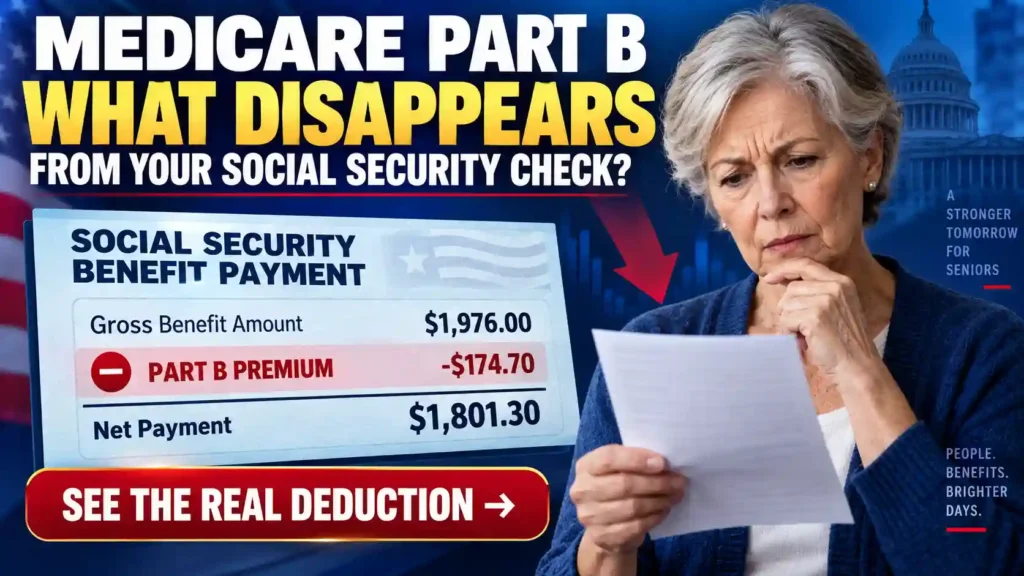
Medicare Part B premiums usually reduce the amount of Social Security deposited into your bank account.
In 2026, the standard Part B premium is $202.90 per month. For most beneficiaries, that amount is deducted automatically from their Social Security payment before the remaining money is deposited.
The premium increased by $17.90 from 2025, while Social Security benefits received a 2.8% cost-of-living adjustment. Therefore, Medicare consumed part of the COLA for millions of beneficiaries.
For example, a $2,000 Social Security benefit increased by $56 under the 2026 COLA. After accounting for the $17.90 increase in the standard Part B premium, the beneficiary’s approximate net improvement was $38.10 before taxes and other deductions.
However, $202.90 is not what everyone pays. Higher-income beneficiaries can pay up to $689.90 per month in 2026. People with late-enrollment penalties may also pay more, while eligible low-income beneficiaries could receive help paying the premium.
Here is exactly how Medicare Part B premiums affect Social Security benefits, why your deposited payment may be smaller than expected and what you can do if the deduction appears incorrect.
Table of Contents
Medicare Part B and Social Security: The Quick Answer
These are the most important numbers and rules for 2026:
| Question | 2026 answer |
|---|---|
| Standard Part B premium | $202.90 per month |
| Increase from 2025 | $17.90 per month |
| Annual Part B deductible | $283 |
| Lowest standard premium | $202.90 |
| Highest income-adjusted premium | $689.90 per month |
| How the premium is usually paid | Deducted automatically from Social Security |
| Does Part B reduce the gross benefit? | No, it generally reduces the net payment |
| Can it consume part of a COLA? | Yes |
| Can it consume the entire COLA? | Yes, in some cases |
| Can low-income beneficiaries get help? | Yes, if they qualify |
| Does hold harmless protect everyone? | No |
The federal government confirmed the standard premium, deductible and income-adjusted charges in its 2026 Medicare cost announcement.
How Medicare Part B Premiums Affect Social Security Benefits
Social Security begins with your gross benefit and subtracts Medicare premiums and any other authorized deductions.
The basic calculation is:
Gross Social Security benefit − Medicare premiums − other deductions = net payment
Suppose your gross monthly benefit is $2,200 and you pay the standard Part B premium.
The calculation would be:
$2,200 − $202.90 = $1,997.10
If you also have $100 withheld for federal taxes, the approximate deposit would become:
$1,997.10 − $100 = $1,897.10
Your official gross Social Security benefit would still be $2,200. Medicare and tax deductions reduce the amount sent to your bank, not the underlying benefit on which your entitlement is based.
That distinction matters when estimating a COLA. You should apply the COLA percentage to your gross benefit, not the amount deposited after deductions.
What Medicare Part B Covers
Medicare Part B is medical insurance. It generally helps pay for medically necessary and preventive outpatient care.
Covered services may include:
- Doctor visits
- Outpatient hospital care
- Ambulance services
- Laboratory tests
- Diagnostic imaging
- Mental health care
- Durable medical equipment
- Certain home health services
- Preventive screenings
- Some vaccines
- Certain medications administered by a medical professional
Part B is different from Part A, which primarily covers inpatient hospital services, skilled nursing facility care, hospice and certain home health services.
It is also different from Part D, which generally covers outpatient prescription drugs.
You can have deductions connected to more than one part of Medicare. Therefore, a deduction larger than $202.90 does not automatically mean your Part B premium is wrong.
What Is the Medicare Part B Premium in 2026?
The standard Part B premium is $202.90 per month in 2026, up from $185 in 2025.
That is an increase of $17.90 per month or $214.80 across the year.
The annual Part B deductible is $283 in 2026, up from $257 in 2025.
| Medicare Part B cost | 2025 | 2026 | Increase |
|---|---|---|---|
| Standard monthly premium | $185.00 | $202.90 | $17.90 |
| Annual deductible | $257.00 | $283.00 | $26.00 |
| Annual standard premiums | $2,220.00 | $2,434.80 | $214.80 |
The premium and deductible are different expenses.
You pay the premium to maintain Part B coverage. The deductible is the amount you generally pay for covered Part B services before Original Medicare begins paying its share.
After meeting the deductible, beneficiaries usually remain responsible for applicable coinsurance or copayments.
How the Part B Deduction Appears on a Social Security Payment
Looking only at your bank account will not tell you what happened to your benefit.
You need to compare the gross benefit with every deduction.
Here is a simplified benefit-statement example:
| Payment detail | Monthly amount |
|---|---|
| Gross Social Security benefit | $2,350.00 |
| Medicare Part B premium | −$202.90 |
| Federal tax withholding | −$100.00 |
| Other deductions | −$25.00 |
| Estimated net deposit | $2,022.10 |
The person is entitled to a $2,350 gross Social Security benefit, even though only $2,022.10 reaches the bank account.
If the deposited amount changes, compare every line instead of assuming that Social Security reduced your benefit.
How Medicare Part B Reduced the 2026 Social Security COLA
Social Security benefits increased by 2.8% in 2026. However, the standard Part B premium increased by $17.90.
For someone receiving $2,000 before the COLA:
$2,000 × 2.8% = $56 gross increase
The new gross benefit becomes:
$2,000 + $56 = $2,056
But the person must also account for the additional $17.90 charged for the standard Part B premium.
The approximate net improvement is:
$56 − $17.90 = $38.10
The following table shows how the premium increase affected different benefit amounts.
| Previous gross benefit | 2.8% COLA | Part B premium increase | Approximate net improvement |
|---|---|---|---|
| $800 | $22.40 | $17.90 | $4.50 |
| $1,000 | $28.00 | $17.90 | $10.10 |
| $1,200 | $33.60 | $17.90 | $15.70 |
| $1,500 | $42.00 | $17.90 | $24.10 |
| $1,800 | $50.40 | $17.90 | $32.50 |
| $2,000 | $56.00 | $17.90 | $38.10 |
| $2,500 | $70.00 | $17.90 | $52.10 |
| $3,000 | $84.00 | $17.90 | $66.10 |
| $4,000 | $112.00 | $17.90 | $94.10 |
These examples assume the beneficiary:
- Paid the standard premium in both years
- Had no IRMAA surcharge
- Had no late-enrollment penalty
- Did not receive premium assistance
- Experienced no change in other deductions
Could Medicare Reduce the 2027 Social Security COLA?
Yes. Medicare could consume part of the 2027 increase because the Social Security COLA and Medicare premiums are calculated separately.
The current 2027 COLA forecast points to an increase of approximately 3.5% to 3.6%. However, the official COLA and 2027 Part B premium had not been announced as of September 16, 2026.
Suppose your gross Social Security benefit is $2,000 and the COLA finishes at 3.5%.
Your estimated gross increase would be:
$2,000 × 3.5% = $70
If the standard Part B premium hypothetically rose by $15, the approximate improvement remaining from the COLA would be:
$70 − $15 = $55
The $15 premium increase is only an example. It is not an official 2027 Medicare projection.
For accurate budgeting, beneficiaries need both numbers:
- The official Social Security COLA
- The official Medicare Part B premium
Until both are released, no one can accurately calculate the portion of the 2027 COLA that will reach an individual beneficiary’s bank account.
For updated estimates, read Social Security COLA 2027 Forecast: See Your Estimated Increase.
Who Pays the Standard $202.90 Premium?
Most Medicare Part B beneficiaries pay the standard monthly premium.
You generally pay the standard amount in 2026 if:
- Your applicable income does not exceed the IRMAA threshold
- You do not owe a late-enrollment penalty
- You are enrolling in Part B for the first time
- You are directly billed for Part B
- You do not receive Social Security benefits
- Medicaid pays the standard premium on your behalf
Even when Medicaid pays the premium, the standard amount still applies. The difference is that an assistance program—not the beneficiary—pays it.
Why Some Beneficiaries Pay More Than $202.90
Three major issues can cause someone to pay more:
- Income-related surcharges
- A late-enrollment penalty
- Past-due Medicare premiums or billing adjustments
The most common source of a dramatically higher premium is the income-related monthly adjustment amount, commonly called IRMAA.
2026 Medicare Part B IRMAA Brackets
IRMAA is an additional amount paid by higher-income Medicare beneficiaries.
For 2026 premiums, Social Security generally uses modified adjusted gross income reported on the beneficiary’s 2024 federal income tax return.
Modified adjusted gross income for this purpose generally consists of adjusted gross income plus tax-exempt interest.
The following table applies to most people filing individual or joint federal tax returns.
| 2024 MAGI for individual filers | 2024 MAGI for joint filers | IRMAA surcharge | Total 2026 Part B premium |
|---|---|---|---|
| $109,000 or less | $218,000 or less | $0 | $202.90 |
| Above $109,000 up to $137,000 | Above $218,000 up to $274,000 | $81.20 | $284.10 |
| Above $137,000 up to $171,000 | Above $274,000 up to $342,000 | $202.90 | $405.80 |
| Above $171,000 up to $205,000 | Above $342,000 up to $410,000 | $324.60 | $527.50 |
| Above $205,000 but below $500,000 | Above $410,000 but below $750,000 | $446.30 | $649.20 |
| $500,000 or more | $750,000 or more | $487.00 | $689.90 |
The official 2026 premium table also includes separate brackets for married beneficiaries who lived with a spouse during the tax year but filed separately.
How IRMAA Changes a Social Security Payment
Assume your gross Social Security benefit is $3,000 per month.
Your remaining benefit after Part B would differ significantly depending on your premium tier.
| Premium situation | Monthly Part B premium | Amount remaining from $3,000 |
|---|---|---|
| Standard premium | $202.90 | $2,797.10 |
| First IRMAA tier | $284.10 | $2,715.90 |
| Second IRMAA tier | $405.80 | $2,594.20 |
| Third IRMAA tier | $527.50 | $2,472.50 |
| Fourth IRMAA tier | $649.20 | $2,350.80 |
| Highest IRMAA tier | $689.90 | $2,310.10 |
These figures do not include federal tax withholding, Part D charges or other deductions.
A beneficiary in the highest tier pays $487 more per month than someone paying the standard premium. That equals $5,844 in additional annual Part B costs.
Why Medicare Uses Income From Two Years Earlier
Medicare generally uses tax information from two years before the premium year because that is usually the latest complete federal tax return available when premium determinations are made.
For example:
- 2026 Medicare premiums generally use 2024 income.
- 2027 Medicare premiums will generally use 2025 income.
This creates a common problem for new retirees.
Someone may have earned a high salary in 2024 but retired in 2025. If 2024 income is used for the 2026 premium, the beneficiary may receive an IRMAA notice even though current income is much lower.
Fortunately, certain life-changing events can support a request for a new determination.
Can You Appeal an IRMAA Surcharge?
Yes. You can challenge an IRMAA decision if the tax information is incorrect or request a new determination after certain life-changing events reduce your income.
Recognized events can include:
- Marriage
- Divorce or annulment
- Death of a spouse
- Work stoppage
- Work reduction
- Loss of income-producing property
- Loss of certain pension income
- Receipt of an employer settlement payment
Form SSA-44 is used to report a qualifying life-changing event and request that more recent income information be considered.
You will need documents supporting the event and the income reduction. Depending on the circumstances, evidence could include:
- A signed tax return
- An IRS transcript
- An employer statement
- Pay stubs
- A marriage certificate
- A divorce decree
- A death certificate
- Pension documents
A normal investment loss or voluntary reduction in withdrawals is not automatically a qualifying life-changing event.
If Social Security used incorrect tax information, correcting the information may require contacting the IRS in addition to challenging the premium determination.
What Is the Medicare Hold-Harmless Provision?
The hold-harmless provision prevents an increase in the standard Part B premium from reducing the net Social Security payment of qualifying beneficiaries.
In simple terms, the applicable Part B premium increase generally cannot exceed the dollar amount of the person’s Social Security COLA.
Suppose your COLA adds $12 per month, but the standard Part B premium rises by $17.90.
If you qualify for hold-harmless protection, your premium increase may be limited to $12. Your net Social Security payment would remain approximately unchanged instead of falling by $5.90.
That does not mean you keep the $12 COLA. The entire increase may be absorbed by Medicare.
Conditions generally required for hold-harmless protection
Eligibility is technical, but the protection generally requires that:
- You are entitled to Social Security benefits for November and December.
- You receive cash benefits for those months.
- The applicable December and January Part B premiums are deducted from your Social Security benefits.
- You are not paying an income-related premium surcharge.
- A state Medicaid program is not paying your premium.
The exact determination depends on how benefits and premiums are handled for the required months.
What hold harmless protects
The rule can:
- Limit the increase in the standard Part B premium
- Prevent that premium increase from lowering a qualifying person’s net Social Security payment
- Allow a beneficiary to pay less than the full new standard premium temporarily
What hold harmless does not protect
The rule does not:
- Guarantee that you keep your entire COLA
- Freeze every Medicare expense
- Prevent the Part B deductible from increasing
- Protect against Part D premium increases
- Eliminate IRMAA
- Remove a late-enrollment penalty
- Stop federal tax withholding
- Prevent overpayment recovery
- Stop court-ordered deductions
- Guarantee that every beneficiary’s deposit increases
The protection is valuable, but much narrower than its name suggests.
Who Is Not Protected by Hold Harmless?
The provision generally does not protect beneficiaries in the same way if they:
- Enroll in Part B for the first time
- Do not receive Social Security benefits
- Pay Part B directly instead of through Social Security
- Pay an IRMAA surcharge
- Have Medicaid pay the premium
- Do not meet the required benefit-entitlement and deduction conditions
A new Medicare beneficiary should not assume that a small Social Security payment automatically limits the standard premium.
Can Medicare Take the Entire Social Security COLA?
Yes.
Hold-harmless protection may prevent the standard Part B premium increase from making a qualifying person’s net Social Security payment smaller. However, it can still allow Medicare to consume the entire COLA.
For example:
- Monthly COLA increase: $10
- Standard Part B premium increase: $17.90
- Allowed premium increase under hold harmless: potentially limited to $10
- Net improvement: $0
The person’s net payment may remain unchanged even though the gross Social Security benefit increased.
This is why calling a COLA a “raise” can be misleading. A beneficiary may receive a higher gross benefit without gaining additional spendable income.
Can Medicare Take an Entire Social Security Check?
It can consume a substantial part of a small check, particularly when the beneficiary owes IRMAA or a late-enrollment penalty.
If the benefit is not large enough to cover the full premium, Medicare may bill the beneficiary for the remaining amount.
Ignoring the bill is dangerous. Unpaid premiums can eventually jeopardize coverage.
Anyone struggling to pay Part B should immediately investigate Medicare Savings Programs instead of simply allowing the debt to grow.
Medicare Part B Premium Scenarios Compared
The following table shows how different situations can affect Social Security.
| Situation | 2026 Part B cost | Effect on Social Security |
|---|---|---|
| Standard premium | $202.90 | Usually deducted automatically |
| First IRMAA tier | $284.10 | Larger deduction |
| Second IRMAA tier | $405.80 | Larger deduction |
| Highest IRMAA tier | $689.90 | Can consume a substantial part of the benefit |
| Late-enrollment penalty | More than applicable premium | Higher recurring deduction |
| Medicare Savings Program | Potentially paid by the state | Social Security deposit may increase |
| Direct billing | Premium not deducted from Social Security | Beneficiary pays Medicare separately |
| Hold-harmless protection | Varies | May limit the standard premium increase |
How the Part B Late-Enrollment Penalty Affects Social Security
If you delay Part B without qualifying coverage or a Special Enrollment Period, you may owe a late-enrollment penalty.
The penalty is generally 10% of the standard Part B premium for every full 12-month period you could have had Part B but did not enroll.
In most cases, the penalty continues for as long as you have Part B.
Suppose you owe a 20% penalty in 2026:
$202.90 × 20% = $40.58
Your estimated total monthly premium would be:
$202.90 + $40.58 = $243.48
Because the penalty is calculated from the standard premium, its dollar value can rise when Part B premiums increase.
COBRA and retiree coverage warning
COBRA and retiree health insurance generally are not treated as coverage based on current employment for the Part B Special Enrollment Period.
That means relying on COBRA or retiree coverage after becoming eligible for Medicare can leave you exposed to:
- A Part B coverage gap
- A late-enrollment penalty
- Months of waiting before coverage begins
- Unexpected medical bills
Do not delay Part B based on COBRA or retiree coverage without verifying the rules that apply to your exact situation.
Coverage through your or your spouse’s current employment may support a Special Enrollment Period, but the employer’s size and the nature of the coverage can also matter.
How Medicare Part B Premiums Are Paid
The payment method depends primarily on whether you receive Social Security or another federal benefit.
Automatic deduction from Social Security
If you receive Social Security, the Part B premium is generally deducted automatically.
You do not usually need to send a separate monthly payment.
Deduction from another federal benefit
Premiums may also be deducted from certain Railroad Retirement Board or federal retirement payments.
Direct Medicare billing
You may receive a Medicare Premium Bill if the premium is not deducted automatically.
This can happen when you:
- Have Medicare but have not started Social Security
- Receive a benefit too small to cover the premium
- Have a billing issue requiring direct payment
- Are not receiving another benefit that supports automatic withholding
Do not ignore a legitimate bill. Review the coverage period, due date and amount immediately.
What Happens If You Start Medicare Before Social Security?
Many people enroll in Medicare at 65 but delay Social Security to earn a larger retirement benefit.
During that period, they generally pay Medicare premiums directly.
After Social Security payments begin, the Part B premium may switch to automatic deduction.
Because Medicare and Social Security operate on different payment cycles, the transition can create confusing notices or adjustments. Review the dates carefully before concluding that you were charged twice.
If a direct payment and automatic deduction appear to cover the same month, contact the appropriate agency for an explanation.
Can Medicaid Pay Your Part B Premium?
Yes. People with limited income and resources may qualify for a Medicare Savings Program administered through their state.
Depending on the program, assistance may help pay:
- The Part B premium
- Part A premiums in certain cases
- Deductibles
- Coinsurance
- Copayments
The main programs include:
- Qualified Medicare Beneficiary
- Specified Low-Income Medicare Beneficiary
- Qualifying Individual
- Qualified Disabled and Working Individual
Eligibility limits and resource rules can change and may vary by state.
If an assistance program begins paying your Part B premium, the deduction may disappear from your Social Security payment. Your bank deposit could then increase even though your gross Social Security benefit remained unchanged.
Learn more in Medicare Savings Programs That Can Help Pay Your Part B Premium.
Why Did Your Social Security Deposit Suddenly Increase?
A larger bank deposit does not always mean you received a higher gross benefit.
Possible explanations include:
- A Medicare Savings Program began paying your premium.
- An IRMAA surcharge ended.
- Your IRMAA appeal succeeded.
- An overpayment was fully recovered.
- Federal tax withholding decreased.
- A Part B billing error was corrected.
- Social Security recalculated your earnings record.
- A temporary deduction stopped.
- A COLA became effective.
Compare the old and new benefit notices to identify the actual change.
Why Did Your Social Security Deposit Suddenly Decrease?
A smaller payment can result from:
- A higher Part B premium
- A new IRMAA surcharge
- A late-enrollment penalty
- Higher Part D charges
- Increased tax withholding
- Social Security overpayment recovery
- Court-ordered garnishment
- A correction to an earlier payment
- Loss of premium assistance
- A change in another benefit
Do not automatically blame the standard Part B premium. Check every line of the notice.
How to Check the Medicare Deduction From Your Benefit
Use this step-by-step process:
- Find your latest Social Security benefit notice.
- Identify your gross monthly benefit.
- Locate the Medicare Part B deduction.
- Check for Part D or other Medicare deductions.
- Look for federal tax withholding.
- Check for overpayment recovery or other deductions.
- Compare the final net amount with your bank deposit.
- Review your Medicare premium notice.
- Review any IRMAA decision.
- Contact Social Security if the deduction or income information appears incorrect.
Do not calculate the premium by subtracting your bank deposit from your gross benefit unless you have confirmed that no other deductions apply.
What to Do If the Deduction Looks Wrong
Start by identifying the type of problem.
The standard premium appears incorrect
Confirm whether you have:
- An IRMAA surcharge
- A late-enrollment penalty
- Past-due premiums
- A retroactive adjustment
- More than one Medicare deduction
The IRMAA income is incorrect
Compare the income and tax year listed in the notice with your tax records.
If the tax information itself is wrong, you may need to correct it with the IRS.
Your income recently dropped
Determine whether the reduction resulted from a qualifying life-changing event. If it did, consider requesting a new decision with Form SSA-44 and supporting evidence.
Medicaid should be paying the premium
Contact the state Medicaid office or Medicare Savings Program administrator to confirm:
- Approval date
- Effective date
- Whether payment information was transmitted
- Whether reimbursement is owed
Do not assume the agencies have already corrected the deduction simply because your application was approved.
Frequently Asked Questions About Medicare Part B and Social Security Benefits
The answers below address the most important questions about Part B premiums and Social Security payments.
1. Is Medicare Part B automatically deducted from Social Security?
It usually is when you receive Social Security and have Part B. People not receiving Social Security may be billed directly.
2. How much is the Medicare Part B deduction in 2026?
The standard premium is $202.90 per month. IRMAA, late penalties and billing adjustments can make the deduction higher.
3. Does everyone pay $202.90 for Medicare Part B?
No. Higher-income beneficiaries and people with late-enrollment penalties pay more. Assistance programs may pay the premium for eligible low-income beneficiaries.
4. Does Medicare reduce my gross Social Security benefit?
It generally reduces the net payment deposited after deductions, not the underlying gross benefit.
5. Why did I not receive my entire Social Security COLA?
A higher Part B premium, Part D charges, taxes or another deduction may have consumed part of the COLA.
6. Can Medicare take my entire COLA?
Yes. The Part B premium increase can absorb the entire COLA, particularly for someone receiving a relatively small Social Security benefit.
7. Can my net Social Security payment decrease because of Medicare?
Yes, especially if you are not protected by hold harmless or if the decrease results from IRMAA, Part D, a penalty or another deduction.
8. What is the 2026 Part B deductible?
The annual Part B deductible is $283 in 2026.
9. Is the Part B deductible taken monthly from Social Security?
No. It is separate from the premium and generally applies when you receive covered medical services.
10. What is the hold-harmless provision?
It limits the standard Part B premium increase for qualifying beneficiaries so that the increase alone does not reduce their net Social Security payment.
11. Does hold harmless let me keep my entire COLA?
Not necessarily. Medicare can consume part or all of the COLA while leaving your net payment unchanged.
12. Are new Medicare beneficiaries protected by hold harmless?
New Part B enrollees generally are not protected in the same way during their first year.
13. Does hold harmless protect higher-income beneficiaries paying IRMAA?
No. Beneficiaries paying income-related premiums generally do not receive this protection.
14. What is IRMAA?
IRMAA is an additional amount higher-income beneficiaries pay for Medicare Part B and Part D.
15. Which income determines 2026 IRMAA?
Social Security generally uses modified adjusted gross income from the beneficiary’s 2024 federal tax return.
16. Does tax-exempt interest count toward IRMAA?
Yes. Tax-exempt interest is included in the modified adjusted gross income calculation used for Medicare premiums.
17. Can I appeal IRMAA after retiring?
You may request a new decision if retirement reduced your income and you provide the required evidence.
18. Can a one-time financial event trigger IRMAA?
Yes. A large retirement-account withdrawal, investment gain or other taxable income can push modified adjusted gross income into a higher bracket.
19. How long does a Part B late-enrollment penalty last?
In most cases, the penalty continues for as long as you have Part B.
20. Does COBRA protect me from a Part B late penalty?
COBRA generally does not count as current-employment coverage for the Part B Special Enrollment Period. Do not rely on it without confirming your Medicare deadline.
21. Can Medicaid pay the Part B premium?
Yes. Eligible beneficiaries may receive help through a state Medicare Savings Program.
22. Why did my Social Security deposit increase after receiving Medicaid?
A state program may have started paying your Part B premium, removing the deduction from your Social Security payment.
23. Will the Part B premium increase in 2027?
It could, but the official 2027 amount had not been announced as of September 16, 2026.
24. Can I cancel Part B to receive a larger Social Security payment?
Part B is voluntary, but canceling it can create serious coverage gaps, medical costs and future penalties. Do not cancel it solely to increase your deposit without understanding the consequences.
25. Who should I contact about an incorrect Medicare deduction?
Contact Social Security about Part B premium deductions, IRMAA and benefit withholding. Contact Medicare about coverage and Medicare billing questions.
Conclusion
Medicare Part B premiums affect Social Security benefits by reducing the amount that reaches your bank account after deductions.
In 2026, the standard premium is $202.90 per month—$17.90 higher than in 2025. That increase consumed part of the 2.8% Social Security COLA for millions of beneficiaries.
However, the effect is not the same for everyone.
Higher-income beneficiaries can pay as much as $689.90 per month. People with late-enrollment penalties may pay more than the standard premium. Qualifying low-income beneficiaries may have the cost paid through a Medicare Savings Program.
Meanwhile, the hold-harmless provision can protect certain beneficiaries from having a standard Part B premium increase reduce their net Social Security payment. It does not protect everyone, and it can still allow Medicare to consume the entire COLA.
The mistake is looking only at your bank deposit. Compare your gross benefit, Part B premium, IRMAA, Part D charges, tax withholding and other deductions separately.
That is how you determine what you earned, what Medicare deducted and why your final Social Security payment changed.