Artificial intelligence has evolved far beyond answering questions and generating content. Today’s most advanced AI systems can plan projects, use software tools, make decisions, adapt to new information, and complete complex tasks with minimal human guidance. This new approach is known as Agentic AI, and it’s quickly becoming one of the most important developments in artificial intelligence.
But understanding how Agentic AI works can be confusing. Terms like reasoning, planning, memory, tool calling, and autonomous agents often sound highly technical, leaving many people wondering what actually happens behind the scenes.
The good news is that the core idea is surprisingly straightforward.
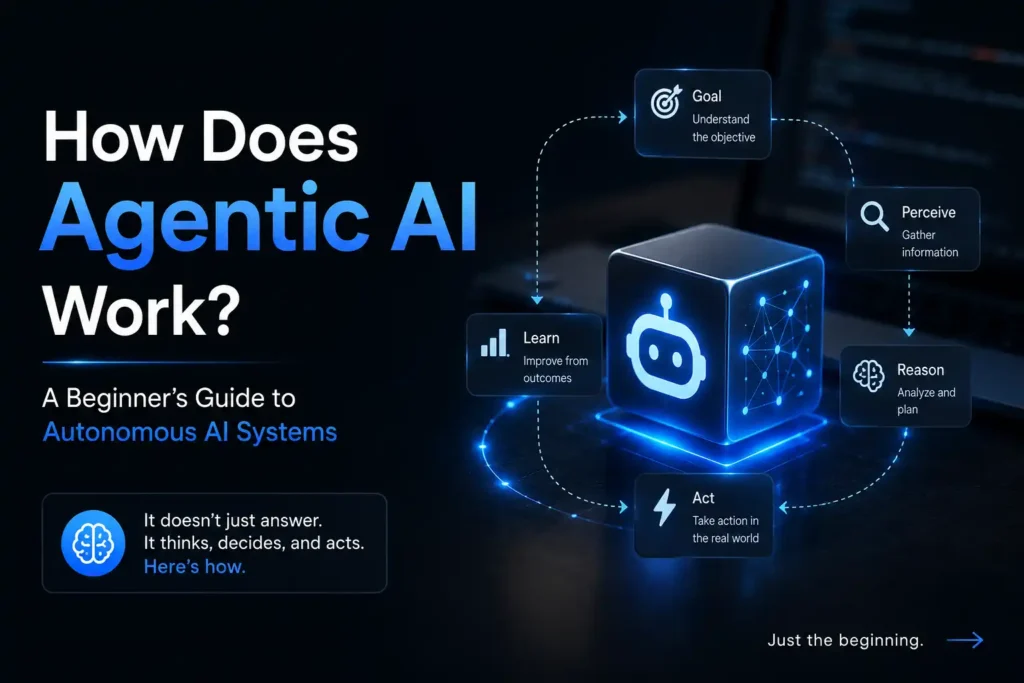
Instead of responding to one prompt at a time like a traditional chatbot, Agentic AI follows a continuous cycle of understanding a goal, creating a plan, choosing the right tools, taking action, evaluating the results, and improving its approach until the objective is achieved.
In this guide, you’ll learn exactly how Agentic AI works, the technologies that make it possible, the stages involved in every workflow, real-world examples, benefits, challenges, and why this technology is expected to transform the way businesses and individuals use AI.
Table of Contents
What Is Agentic AI?
Before exploring how it works, let’s briefly review what Agentic AI is.
Agentic AI is an artificial intelligence system that can independently plan, reason, make decisions, use external tools, and execute multiple tasks to achieve a defined goal with minimal human supervision.
Unlike traditional AI assistants that simply generate responses to prompts, Agentic AI actively works toward completing an objective.
For a complete introduction, see our guide on What Is Agentic AI? Definition, Key Concepts, How It Works & Real-World Examples.
Why Understanding How Agentic AI Works Matters
Knowing how Agentic AI works helps you understand why it’s considered a major advancement over traditional AI systems.
Instead of asking an AI to complete one task after another, businesses can assign a larger objective, such as:
- Plan a marketing campaign.
- Build a website.
- Analyze financial data.
- Organize a conference.
- Automate customer support.
The AI then determines the steps required to accomplish that goal, making it much more efficient for complex workflows.
How Does Agentic AI Work? The Agentic AI Workflow
At its core, nearly every Agentic AI system follows the same continuous workflow.
Rather than acting randomly, it cycles through a structured process that allows it to solve problems, adapt to changes, and improve results over time.
The workflow typically includes the following stages:
- Receive a goal
- Understand the objective
- Create a plan
- Break the goal into tasks
- Select the appropriate tools
- Execute actions
- Evaluate outcomes
- Adjust the strategy
- Repeat until the goal is completed
Let’s examine each stage in detail.
Step 1: Receiving A Goal
Everything begins with a clearly defined objective.
Unlike traditional chatbots that respond to individual prompts, Agentic AI starts with a broader mission.
Examples include:
- Increase online sales by 15%.
- Create a complete business plan.
- Schedule next month’s appointments.
- Build a content marketing strategy.
- Organize company financial reports.
The goal acts as the destination for everything that follows.
Step 2: Understanding The Goal
Once the objective is received, the AI analyzes it to understand exactly what is being requested.
It identifies:
- Desired outcome
- Available information
- Missing information
- Constraints
- Deadlines
- Budget limitations
- Success criteria
This stage resembles how a human project manager first studies a project before beginning work.
Without properly understanding the objective, the AI cannot create an effective strategy.
Step 3: Planning The Work
Planning is one of the defining characteristics of Agentic AI.
Instead of immediately taking action, the AI develops a roadmap.
Suppose the goal is:
“Launch a new online course.”
Rather than jumping directly into content creation, the AI may create a plan like this:
- Research competitors
- Identify target audience
- Outline course modules
- Develop lesson content
- Create promotional materials
- Build a landing page
- Set up email automation
- Schedule launch activities
- Monitor performance
Each step contributes to the larger objective.
This planning ability is one of the biggest differences between Agentic AI and Generative AI.
Step 4: Breaking Large Tasks Into Smaller Tasks
Large projects are rarely completed in one step.
Agentic AI divides complex work into manageable subtasks.
For example:
Goal:
Publish an SEO article.
Subtasks:
- Research keywords
- Analyze competing pages
- Build an outline
- Write the introduction
- Write each section
- Optimize headings
- Generate FAQs
- Create a meta description
- Recommend internal links
Breaking work into smaller pieces improves efficiency and accuracy.
Step 5: Choosing The Right Tools
Once the plan is ready, Agentic AI determines which tools it needs.
This stage is often called tool selection or tool calling.
Depending on the task, the AI may use:
- Web search
- Databases
- APIs
- Email platforms
- Calendars
- CRM software
- Accounting software
- Cloud storage
- Spreadsheet applications
- Project management tools
For example, if the goal is to organize a business trip, the AI might search for flights, compare hotel prices, access your calendar, and prepare an itinerary using multiple tools.
The ability to use external tools transforms Agentic AI from a conversational assistant into an active problem solver.
Step 6: Taking Action
After selecting the necessary tools, the AI begins executing the planned tasks.
Examples include:
- Sending emails
- Creating reports
- Updating databases
- Scheduling meetings
- Writing documents
- Running calculations
- Generating code
- Searching for information
- Summarizing research
Unlike traditional AI, it doesn’t stop after completing one task. Instead, it continues progressing toward the overall objective.
Step 7: Evaluating Results
Once a task is completed, Agentic AI evaluates the outcome.
It asks questions such as:
- Was the task successful?
- Did the result meet the objective?
- Is additional work needed?
- Should the plan change?
This evaluation stage prevents the AI from blindly following a plan when circumstances change.
For example, if a preferred supplier is unavailable, the AI can identify alternative options instead of stopping altogether.
Step 8: Learning And Adapting
One of the strengths of Agentic AI is its ability to adjust its strategy as new information becomes available.
For instance, if an advertising campaign isn’t performing well, the AI may:
- Analyze campaign data
- Identify weak-performing ads
- Recommend budget adjustments
- Rewrite ad copy
- Test alternative audiences
- Monitor the revised campaign
Rather than waiting for new instructions, it continuously works to improve outcomes.
Step 9: Completing The Goal
Once every task has been completed successfully, the AI delivers the final result.
Depending on the application, it may also:
- Generate a summary
- Recommend future improvements
- Schedule follow-up tasks
- Monitor ongoing performance
The workflow ends only when the original objective has been achieved or when human approval is required.
The Core Components That Make Agentic AI Work
Every Agentic AI system combines several technologies that work together to plan, reason, act, and improve over time. While different platforms use different architectures, most modern Agentic AI systems include the following core components.
Large Language Models (LLMs)
At the heart of most Agentic AI systems is a Large Language Model (LLM).
The LLM acts as the AI’s reasoning engine. It understands instructions, interprets language, analyzes information, generates responses, and helps decide the next action.
Popular LLMs can:
- Understand complex instructions
- Summarize large documents
- Write text
- Generate code
- Translate languages
- Answer questions
- Analyze data
However, an LLM alone is not Agentic AI. It becomes part of an Agentic AI system when combined with planning, memory, tool integration, and autonomous decision-making.
Memory
Memory enables Agentic AI to remember information beyond a single prompt.
There are generally two types of memory:
Short-term memory
This stores information needed during the current task, such as previous actions, completed subtasks, and intermediate results.
Long-term memory
This stores information that can be reused later, including:
- User preferences
- Company policies
- Previous projects
- Customer information
- Historical conversations
Without memory, an AI would have to start from scratch every time it received a new instruction.
Planning Engine
The planning engine determines how to achieve a goal.
Instead of immediately performing tasks, it creates a structured roadmap.
For example, if asked to “Launch a new e-commerce website,” the planning engine may generate tasks such as:
- Research competitors
- Identify target customers
- Select a platform
- Create product pages
- Configure payment systems
- Optimize for SEO
- Test the website
- Launch marketing campaigns
Planning helps ensure that tasks are completed in a logical sequence.
Reasoning Engine
Reasoning allows Agentic AI to evaluate information rather than simply react to prompts.
For example, if two suppliers offer similar products but one has faster delivery and better reviews, the AI can compare the options and recommend the better choice.
Reasoning enables the AI to make informed decisions instead of following rigid instructions.
Tool Integration
One of the biggest advantages of Agentic AI is its ability to use external software and services.
Common tools include:
- Search engines
- Email platforms
- Calendars
- CRM systems
- Databases
- APIs
- Spreadsheet software
- Accounting applications
- Cloud storage
- Project management tools
This allows Agentic AI to perform real work instead of simply discussing it.
Feedback Loop
Every action generates new information.
The AI continuously evaluates:
- Was the task completed successfully?
- Did the outcome meet expectations?
- Should the strategy change?
This constant feedback loop allows Agentic AI to improve throughout the workflow instead of waiting until the end.
Single-Agent Vs Multi-Agent Systems
Not every Agentic AI system works the same way.
Some rely on a single AI agent, while others use multiple specialized agents that collaborate.
Single-Agent Systems
A single AI agent performs every task.
For smaller workflows, this approach is often sufficient.
Examples include:
- Personal assistants
- Email management
- Meeting scheduling
- Document summarization
Multi-Agent Systems
Larger projects often involve multiple AI agents working together.
For example, a marketing campaign could involve:
- A research agent
- An SEO agent
- A writing agent
- An image-generation agent
- A social media agent
- A performance-analysis agent
Each specializes in one area while sharing information with the others.
This approach improves scalability and efficiency.
A Real-World Example Of How Agentic AI Works
Imagine you own an online clothing store and give your AI this goal:
“Increase monthly sales by 20%.”
Instead of asking for more instructions after every step, the AI could:
- Analyze website traffic.
- Identify low-converting pages.
- Research competitors.
- Recommend pricing adjustments.
- Generate new product descriptions.
- Improve SEO content.
- Create email campaigns.
- Schedule promotional posts.
- Monitor campaign performance.
- Recommend further improvements.
Throughout the process, the AI evaluates results and adjusts its strategy until it reaches the objective or requires human approval.
This is what makes Agentic AI fundamentally different from traditional automation.
How Agentic AI Differs From Traditional Automation
Many people confuse Agentic AI with automation software, but they’re not the same.
Traditional automation follows predefined rules.
For example:
“If a customer submits a form, send a confirmation email.”
The workflow never changes unless a human updates it.
Agentic AI, however, can:
- Analyze situations
- Make decisions
- Change priorities
- Select different tools
- Adapt to unexpected problems
Rather than following fixed instructions, it continuously works toward a goal.
Benefits Of Agentic AI
As organizations adopt Agentic AI, several advantages are becoming clear.
Greater Productivity
By automating repetitive tasks, employees can spend more time on strategic work that requires creativity and critical thinking.
Better Decision-Making
Agentic AI can analyze large volumes of information much faster than humans, enabling quicker and more informed decisions.
Improved Efficiency
Because it coordinates multiple tasks automatically, Agentic AI reduces manual effort and streamlines business processes.
Scalability
Organizations can handle growing workloads without increasing staffing at the same rate.
Continuous Operation
Unlike human workers, Agentic AI can monitor systems, process requests, and perform routine tasks 24 hours a day.
Challenges Of Agentic AI
Despite its capabilities, Agentic AI still faces important limitations.
Accuracy
If the AI receives incorrect information or makes faulty assumptions, it may reach poor conclusions.
Human review remains essential for critical decisions.
Security
Agentic AI often connects to business systems and sensitive data.
Strong authentication, permissions, and monitoring are necessary to reduce security risks.
Privacy
Organizations must ensure that customer and employee data is handled responsibly and complies with applicable privacy regulations.
Ethical Concerns
As AI becomes more autonomous, organizations must decide:
- Which decisions should remain under human control?
- How much authority should AI receive?
- Who is accountable when mistakes occur?
These questions will continue to shape the future of Agentic AI.
The Future Of Agentic AI
Agentic AI is expected to become increasingly common over the next decade.
Future systems will likely:
- Collaborate with other AI agents.
- Handle more complex business workflows.
- Improve long-term memory.
- Make better decisions through advanced reasoning.
- Integrate with a wider range of software and services.
- Work more naturally alongside human teams.
Rather than replacing people, Agentic AI is likely to become a powerful productivity partner that helps individuals and organizations accomplish more with less manual effort.
Frequently Asked Questions About How Agentic AI Works
If you’re still exploring this technology, these answers address some of the most common questions.
Does Agentic AI Need Human Instructions For Every Step?
No. Once given a goal, Agentic AI can plan, choose tools, execute tasks, evaluate outcomes, and adjust its strategy without requiring instructions after every action. Human oversight is still recommended for sensitive or high-risk decisions.
Can Agentic AI Learn From Previous Tasks?
Many Agentic AI systems use memory to retain information from previous interactions or ongoing projects. This allows them to remember preferences, completed work, and past decisions, improving efficiency over time.
Does Agentic AI Always Use Large Language Models?
Most modern Agentic AI systems rely on Large Language Models for reasoning and language understanding, but they also combine planning engines, memory, tool integration, and workflow management to operate autonomously.
Can Agentic AI Work Without Internet Access?
Yes, depending on the implementation. Some Agentic AI systems can operate using local data and internal software, while others rely on internet access to search for information, call APIs, or interact with cloud-based applications.
Is Agentic AI Available Today?
Yes. Many AI platforms already offer agentic capabilities such as planning, tool usage, workflow automation, and autonomous task execution. These capabilities are expected to expand rapidly as the technology continues to mature.
Conclusion
Understanding how Agentic AI works makes it easier to see why it represents a significant leap beyond traditional AI systems. Instead of responding to one prompt at a time, Agentic AI follows a continuous cycle of understanding goals, planning actions, selecting tools, executing tasks, evaluating outcomes, and adapting as conditions change.
This combination of reasoning, memory, planning, and autonomous execution allows Agentic AI to tackle complex, multi-step workflows across industries such as finance, healthcare, software development, marketing, and customer service.
As the technology continues to evolve, businesses and individuals who understand its capabilities will be better positioned to automate routine work, improve productivity, and unlock new opportunities.
To continue building your knowledge, explore our related guides on Agentic AI Examples, Agentic Workflows Explained, How to Build Agentic AI, Agentic Automation Explained, Agentic RAG Explained, Agentic Coding Explained, Best Agentic AI Tools, and Agentic AI vs Generative AI. Together, these articles provide a complete roadmap to understanding the rapidly growing world of Agentic AI.