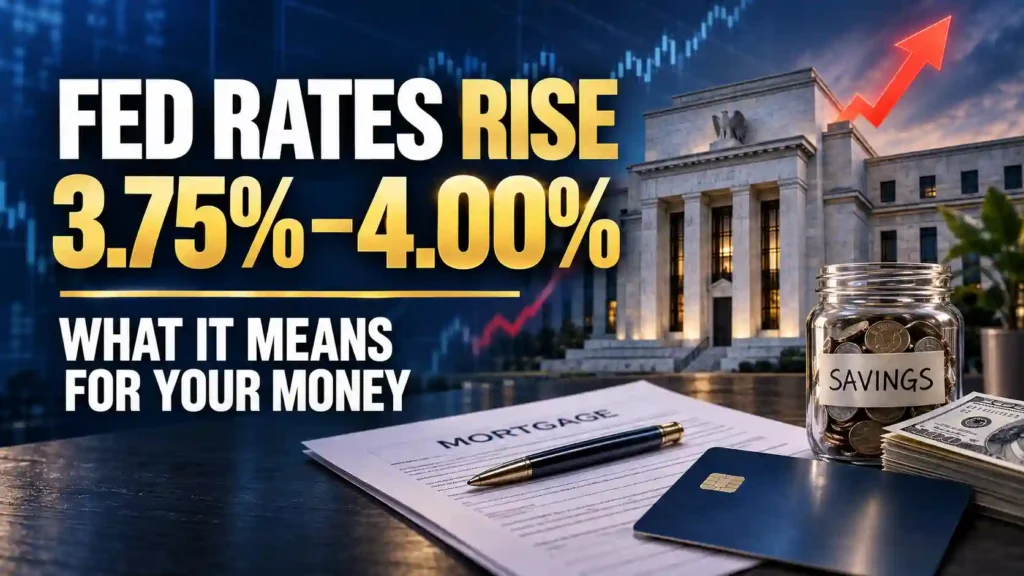
The Federal Reserve just made borrowing more expensive for millions of Americans.
On September 16, 2026, policymakers raised the federal funds target range by 0.25 percentage point, moving it from 3.50%–3.75% to 3.75%–4.00%. The decision was unanimous, and it marked the first Federal Reserve interest-rate increase in three years.
However, the bigger story is what may happen next.
Current projections suggest that another quarter-point increase could arrive before the end of 2026. If that happens, the target range would rise to 4.00%–4.25%.
That possibility matters even if you never follow monetary policy. Federal Reserve interest rates can influence how much you pay on credit cards, home-equity lines of credit, auto financing and business loans. They can also affect mortgage rates, savings yields, certificates of deposit, bonds and stock prices.
So, who wins, who loses and what should you do with your money now?
Here is the complete breakdown.
Table of Contents
Federal Reserve Interest Rates: The Latest Decision at a Glance
If you only want the essential facts, start here:
| Key detail | Latest information |
|---|---|
| Current federal funds target range | 3.75%–4.00% |
| Previous target range | 3.50%–3.75% |
| Size of increase | 0.25 percentage point |
| Date announced | September 16, 2026 |
| Committee vote | 12–0 |
| Inflation target | 2% |
| Possible year-end 2026 range | 4.00%–4.25% |
| Next scheduled Fed meeting | October 27–28, 2026 |
| Final scheduled meeting of 2026 | December 8–9, 2026 |
The increase took effect because policymakers believe inflation is still too high and may not return to the 2% target quickly enough without additional pressure from higher borrowing costs.
The official decision raised the target range to 3.75%–4.00% and cited elevated inflation, resilient domestic spending, strong productivity and robust capital investment. The committee approved the change by a unanimous 12–0 vote. The complete policy decision is available here.
What Is the Federal Funds Rate?
The federal funds rate is the interest rate banks charge one another for overnight loans of reserve balances.
You cannot walk into a bank and request a loan at the federal funds rate. Nevertheless, it acts like a starting point for many borrowing and savings rates throughout the economy.
Changes in Federal Reserve interest rates can influence:
- The prime rate
- Credit-card APRs
- Home-equity lines of credit
- Adjustable-rate mortgages
- Personal loans
- Auto loans
- Small-business financing
- Savings-account yields
- Money market accounts
- CD rates
- Treasury yields
- Bond prices
- Stock valuations
The Fed does not directly set every one of these rates. Banks and financial markets also consider inflation, competition, credit risk, future economic conditions and the expected path of monetary policy.
That explains why your mortgage rate may move before the Fed makes an announcement—or even move in the opposite direction afterward.
Why Did the Federal Reserve Raise Interest Rates?
The simple answer is inflation.
The Fed is responsible for supporting maximum employment and stable prices. Its longer-term inflation goal is 2%, but recent price pressures have remained higher than policymakers want.
At the same time, the economy has shown unexpected strength.
Consumer spending has remained resilient. Business investment has been robust. Productivity has grown, and employment has broadly kept pace with the workforce. Those developments are positive for economic growth, but they can also keep demand strong enough for businesses to continue raising prices.
Several pressures have complicated the inflation fight:
- Higher energy costs
- Tariff-related expenses
- Strong consumer demand
- Continued business investment
- A relatively resilient labor market
- Price increases spreading beyond temporary supply problems
The Fed therefore decided that leaving rates unchanged carried too much risk.
If inflation stays elevated for too long, consumers and businesses may begin to expect continuing price increases. Those expectations can influence wages, contracts and pricing decisions, making inflation more difficult to control.
Raising interest rates is meant to reduce that risk by making borrowing less attractive and saving more rewarding. Over time, slower demand may reduce the pressure on prices.
The trade-off is painful: the same policy that fights inflation can make homes, cars, credit-card balances and business investments more expensive.
Why a 0.25-Point Increase Matters More Than It Appears
A quarter of a percentage point may look insignificant. On a small balance, one increase may produce only a modest change.
However, three factors make it important.
First, the increase is added to borrowing rates that are already high. Credit-card APRs, for example, may already exceed 20%.
Second, many American households carry several forms of debt. A borrower could simultaneously have a credit-card balance, HELOC, auto loan and adjustable-rate mortgage.
Third, the September increase may not be the last one. Current projections point toward a possible 4.00%–4.25% federal funds range by year-end. The latest economic-projection materials were released with the rate decision.
The real threat is not necessarily one quarter-point move. It is the combined effect of repeated increases and rates remaining elevated for longer than borrowers expected.
Federal Reserve Interest Rates: Who Wins and Who Loses?
The rate increase does not affect everyone equally.
| More likely to benefit | More likely to be hurt |
|---|---|
| Savers using competitive high-yield accounts | Credit-card borrowers carrying balances |
| People opening CDs at improved yields | HELOC borrowers with variable rates |
| Buyers of newly issued short-term bonds | Consumers applying for new loans |
| Banks able to earn larger lending margins | Small businesses dependent on variable-rate debt |
| Retirees seeking income from cash and bonds | Homebuyers facing high mortgage rates |
| People with little or no debt | Companies that must refinance large debts |
Even within these groups, outcomes vary. A saver at a major bank paying 0.01% may receive no meaningful benefit. Meanwhile, a borrower with a fixed-rate mortgage will not see the principal-and-interest payment change because of this decision.
The details of your account or loan agreement matter more than the headline alone.
How the Fed Rate Hike Affects Credit Cards
Credit cards are among the financial products most likely to respond quickly.
Most cards have variable APRs connected to the prime rate. The prime rate is commonly set three percentage points above the upper end of the federal funds target range.
With the target range now at 3.75%–4.00%, the prime rate would generally move to approximately 7.00%. A credit-card issuer then adds its own margin to determine your APR.
For example, a card priced at the prime rate plus 16 percentage points could carry an APR of roughly 23%.
What one rate increase could cost
Imagine that you carry a $10,000 credit-card balance for one year without reducing it.
| APR | Approximate annual interest on $10,000 |
|---|---|
| 20.00% | $2,000 |
| 20.25% | $2,025 |
| 21.00% | $2,100 |
| 23.00% | $2,300 |
The September increase alone could add approximately $25 per year to a constant $10,000 balance if your issuer passes along the full 0.25 percentage point.
That amount may appear small, but the calculation understates the damage for borrowers who continue making purchases, incur fees or pay only the minimum. Compounding also increases the cost over time.
What credit-card borrowers should do now
Stop focusing on points and cash-back rewards while carrying an expensive balance. Paying 23% interest to earn 2% cash back is not a reward strategy. It is a guaranteed loss.
Make the following moves:
- Stop adding unnecessary purchases to the card.
- Continue minimum payments on every account.
- Direct extra money toward the card with the highest APR.
- Ask the issuer whether it can lower your rate.
- Compare a 0% balance-transfer offer if you can qualify.
- Include the transfer fee in your calculation.
- Create a repayment deadline before the promotional rate expires.
Do not transfer debt unless you have also fixed the spending problem that created it. Otherwise, you may end up with a new balance-transfer loan and newly filled credit cards.
What Higher Federal Reserve Interest Rates Mean for Mortgages
The Fed does not directly set mortgage rates.
Thirty-year fixed mortgage rates are influenced more closely by longer-term Treasury yields, inflation expectations, economic growth, demand for mortgage-backed securities and investor expectations about future Fed policy.
This produces a result that often confuses consumers: the Fed can raise its overnight rate while mortgage rates fall—or leave rates unchanged while mortgage costs rise.
Financial markets frequently anticipate a Fed decision before the meeting. By the time the announcement arrives, some of the expected change may already be reflected in mortgage offers.
Still, persistent inflation and expectations of additional Fed increases can keep mortgage rates elevated.
How the mortgage rate changes your payment
Consider a $350,000 fixed mortgage with a 30-year term:
| Interest rate | Approximate monthly principal and interest | Approximate total interest over 30 years |
|---|---|---|
| 6.00% | $2,098 | $405,000 |
| 6.50% | $2,212 | $446,000 |
| 7.00% | $2,329 | $488,000 |
| 7.50% | $2,447 | $531,000 |
Moving from 6% to 7% adds approximately $231 to the monthly principal-and-interest payment. Over 30 years, the difference in interest approaches $83,000.
These figures do not include property taxes, homeowners insurance, mortgage insurance, association fees, maintenance or repairs.
Should homebuyers wait for rates to fall?
Waiting is reasonable if today’s payment would stretch your budget. It is not reasonable to assume that refinancing will automatically rescue an unaffordable purchase later.
Refinancing requires:
- A sufficiently lower market rate
- Enough equity
- Acceptable credit and income
- New underwriting approval
- Closing costs
- Enough time in the home to recover those costs
Buy only if the current payment works with your present income and expenses.
A future rate cut should be treated as a possible bonus, not as the foundation of your homebuying plan.
Will Existing Mortgage Payments Increase?
An existing fixed-rate mortgage will not change because the Fed raised interest rates. Your scheduled principal-and-interest payment remains fixed for the loan term.
However, your total housing payment can still rise because of changes in property taxes, homeowners insurance, mortgage insurance or escrow requirements.
Adjustable-rate mortgages are different. Their rates reset according to a specified index plus the lender’s margin. A borrower should review:
- The first adjustment date
- How frequently adjustments occur
- The index used
- The lender’s margin
- The first-adjustment cap
- The annual cap
- The lifetime maximum rate
Do not wait until the payment changes. Ask the servicer to calculate what your payment could become at the next reset and at the maximum permitted rate.
How the Rate Increase Affects HELOCs
Home-equity lines of credit commonly have variable rates tied to the prime rate. That makes them more directly sensitive to Federal Reserve policy than fixed mortgages.
Assume you maintain a $50,000 HELOC balance:
| Rate increase | Approximate additional annual interest |
|---|---|
| 0.25 percentage point | $125 |
| 0.50 percentage point | $250 |
| 1.00 percentage point | $500 |
| 2.00 percentage points | $1,000 |
The exact payment change depends on the lender’s formula, the balance and whether you are in the draw or repayment period.
A fixed-rate home-equity loan generally does not change after closing. Nevertheless, new borrowers could face higher rates.
Remember that home-equity debt is secured by your property. Using it for vacations, electronics or routine expenses converts optional spending into debt that can place your home at risk.
What Higher Rates Mean for Auto Loans
Existing fixed-rate auto loans should remain unchanged. New borrowers, however, may encounter more expensive financing.
The rate you receive depends on:
- Your credit score and history
- Whether the vehicle is new or used
- The down payment
- The loan term
- The lender
- The vehicle’s age and value
- Current market rates
Suppose you finance $40,000 for 60 months:
| Auto-loan APR | Approximate monthly payment | Approximate total interest |
|---|---|---|
| 6% | $773 | $6,400 |
| 8% | $811 | $8,700 |
| 10% | $850 | $11,000 |
| 12% | $890 | $13,400 |
A dealer can make an expensive car appear affordable by stretching the repayment term to 72 or 84 months. That reduces the monthly figure but can substantially increase total interest and the risk of owing more than the car is worth.
Get financing offers before visiting the dealership. Compare APR, total repayment and term—not just the monthly payment.
What the Fed Rate Hike Means for Personal Loans
Existing fixed-rate personal loans generally will not change. New loans may become more expensive as lenders adjust to higher market rates.
Personal loans are frequently marketed as a simple way to consolidate credit-card debt. They can help, but only when all of the following are true:
- The new APR is meaningfully lower.
- The origination fee does not erase the savings.
- The payment fits your budget.
- The repayment term is not unnecessarily extended.
- You stop rebuilding credit-card balances.
A lower monthly payment does not always mean a cheaper loan. Extending repayment from three years to seven years can reduce the payment while increasing the total interest.
Compare the complete cost, not the advertised starting rate.
What Higher Rates Mean for Savings Accounts
Savers are among the clearest potential winners.
When Federal Reserve interest rates rise, banks and credit unions may increase yields on:
- High-yield savings accounts
- Money market deposit accounts
- Certificates of deposit
- Certain cash-management accounts
However, your bank is not required to pass the increase to you.
Traditional banks with large, stable deposit bases may continue offering extremely low yields. Online banks and credit unions may compete more aggressively for deposits.
How much a better savings rate could pay
Consider $25,000 kept for one year:
| APY | Approximate one-year earnings |
|---|---|
| 0.10% | $25 |
| 1.00% | $250 |
| 3.00% | $750 |
| 4.00% | $1,000 |
| 4.50% | $1,125 |
The difference between 0.10% and 4.00% is approximately $975 over one year, assuming the rate and balance remain constant.
Before moving your money, compare:
- APY
- Monthly fees
- Minimum-balance rules
- Transfer times
- Withdrawal access
- Promotional-rate expiration dates
- Deposit-insurance coverage
A flashy yield is useless if large fees or unreasonable conditions erase the earnings.
Should You Open a CD Now or Wait?
A certificate of deposit lets you lock in a fixed yield for a stated period. That can protect your return if market rates later fall.
However, another Fed increase could produce better CD offers. Locking all your available cash into a long-term CD now could prevent you from benefiting.
A CD ladder offers a middle ground.
Instead of placing $20,000 into one long-term CD, you might divide it among several maturity dates. As each portion matures, you can withdraw it or reinvest at the rates available then.
Check these details before opening any CD:
- APY
- Term
- Early-withdrawal penalty
- Automatic-renewal rules
- Maturity grace period
- Minimum opening deposit
- Deposit-insurance protection
Do not lock your entire emergency fund into an account that penalizes early access.
How Federal Reserve Interest Rates Affect Student Loans
Existing federal student loans generally have fixed interest rates. Their rates will not increase because of this Fed decision.
New federal student-loan rates are set annually under a legal formula linked to Treasury yields. Once issued, the rate is fixed for the life of that particular loan.
Private student loans require more attention. They may carry fixed or variable rates. A variable private loan can become more expensive when its underlying benchmark rises.
Borrowers considering refinancing must distinguish between federal and private debt.
Refinancing a federal loan through a private lender may permanently remove federal benefits, including certain income-driven repayment options, discharge protections, deferment choices and forgiveness opportunities.
Do not surrender valuable federal protections merely because a lender advertises a lower starting rate.
What the Rate Increase Means for Small Businesses
Higher rates can place serious pressure on businesses that depend on credit cards, lines of credit or other variable-rate financing.
Consider a company with $250,000 of variable-rate debt:
| Rate increase | Approximate additional annual interest |
|---|---|
| 0.25 percentage point | $625 |
| 0.50 percentage point | $1,250 |
| 1.00 percentage point | $2,500 |
| 2.00 percentage points | $5,000 |
For a healthy company, that may be manageable. For one operating on narrow margins, repeated increases can force difficult decisions about pricing, hiring, inventory and expansion.
Business owners should identify:
- Every variable-rate debt
- Each reset date
- Rate caps
- Personal guarantees
- Loan covenants
- Upcoming refinancing deadlines
- Debt-funded projects that may no longer be profitable
Borrowing to finance an asset that generates predictable profit may remain sensible. Borrowing every month to cover recurring losses is not a financing strategy; it is a warning that the business model needs attention.
How Higher Federal Reserve Interest Rates Affect Stocks
Higher interest rates can pressure stocks in several ways.
First, companies may pay more to finance operations, acquisitions and expansion. Businesses with heavy debt face greater refinancing risk.
Second, consumers spending more on interest may have less money for products and services.
Third, higher yields on cash and bonds give investors alternatives to stocks. Some investors may decide they no longer need to accept as much market risk to pursue an attractive return.
Finally, higher rates can reduce the present value assigned to future corporate earnings. Growth companies whose expected profits lie far in the future may be particularly sensitive.
Still, a Fed rate hike does not guarantee a market crash.
Markets respond to the difference between what happened and what investors expected. If a quarter-point increase was already anticipated, stock prices may have adjusted before the announcement.
Selling an entire retirement portfolio because of one Fed meeting is not a financial plan. It is an emotional reaction to a short-term event.
What Higher Rates Mean for Bonds
Bond prices and market interest rates generally move in opposite directions.
When new bonds offer higher yields, older bonds paying lower rates become less attractive. Their market prices may fall to compensate.
The effect is usually greater for bonds with longer durations. A long-term bond locks investors into its coupon for more years, making its value more sensitive to changing rates.
However, higher yields also create opportunities:
- New bond buyers may receive more income.
- Maturing bonds can be reinvested at higher yields.
- Short-term Treasury securities may become more attractive.
- Retirees may be able to produce income without taking as much stock-market risk.
An individual bond and a bond fund are not the same. An individual bond has a maturity date and promises repayment of principal, assuming the issuer does not default. A bond fund holds many securities and does not mature as a single investment.
Could the Fed Raise Interest Rates Again in 2026?
Yes. Another increase is a realistic possibility.
Current projections show most policymakers anticipating at least one additional quarter-point move before the end of the year. That would take the federal funds target range to 4.00%–4.25%.
Projections are not promises, though. The next decision will depend on economic information released between meetings.
Policymakers will be watching:
- Inflation
- Employment growth
- Unemployment
- Wage pressure
- Consumer spending
- Retail sales
- Business investment
- Energy prices
- Tariff-related costs
- Inflation expectations
- Credit and financial conditions
If inflation cools convincingly, the Fed could pause. If price pressure remains stubborn or becomes broader, another increase becomes more likely.
When Is the Next Federal Reserve Meeting?
The next scheduled Federal Open Market Committee meeting will take place on October 27–28, 2026.
The final scheduled meeting of the year will be held on December 8–9, 2026. That December meeting is scheduled to include updated economic projections.
The FOMC normally holds eight scheduled meetings per year, although additional meetings can be arranged when necessary. The official 2026 calendar confirms the October and December dates. The full meeting calendar is available here.
A rate increase is possible at either remaining meeting. However, consumers should avoid reorganizing their entire financial lives around a prediction.
Build a plan that can survive a hike, pause or eventual cut.
Will the Fed Rate Hike Reduce Inflation?
Higher rates may reduce inflation, but the effect is not immediate.
The policy works through several stages:
- Banks and financial markets adjust their rates.
- Borrowing becomes more expensive.
- Some consumers delay large purchases.
- Some businesses postpone investments.
- Demand cools.
- Companies face more resistance to price increases.
- Inflation may gradually slow.
That process can take months.
The Fed also cannot solve every source of inflation. Higher interest rates cannot produce more oil, build houses, repair a disrupted supply chain or remove an import tariff.
Monetary policy is better at reducing overall demand than fixing shortages. That is one reason policymakers must avoid raising rates too aggressively.
Could Higher Interest Rates Cause a Recession?
They could contribute to one, but a recession is not guaranteed.
Higher borrowing costs can weaken housing, business investment and consumer spending. If demand slows sharply, companies may reduce hiring or cut jobs.
Yet the economy entered the September decision with solid activity, resilient spending and relatively stable unemployment. The Fed is attempting to cool inflation without causing a severe contraction.
That creates two opposing risks:
- Raising rates too little could allow inflation to remain elevated.
- Raising rates too much could unnecessarily damage employment and growth.
Whether the Fed succeeds will depend on the strength of the economy, future inflation data and how households and businesses respond to higher costs.
Seven Moves to Make After the Federal Reserve Rate Increase
1. Attack variable-rate debt first
List every balance, APR and minimum payment. Prioritize the most expensive variable-rate debt while keeping all accounts current.
2. Check what your savings earns
Compare your current APY with competitive insured accounts. Remaining loyal to a bank paying almost nothing can cost hundreds of dollars annually.
3. Review every adjustable loan
Find the next reset date, index, margin and maximum rate on your HELOC, adjustable mortgage or variable private student loan.
4. Obtain several financing quotes
A small APR difference can save thousands of dollars on a mortgage or auto loan. Compare the same loan amount and term across several lenders.
5. Improve your credit before borrowing
Pay bills on time, lower revolving balances and dispute genuine credit-report errors. A stronger credit profile can matter more than a quarter-point Fed move.
6. Stress-test major purchases
Calculate whether you could still manage the payment if insurance, taxes, maintenance or other living expenses increased.
7. Keep investment decisions tied to your goals
Review your risk level and time horizon, but do not chase daily market reactions. A long-term plan should not collapse because of one policy meeting.
Federal Reserve Interest Rates FAQs
These answers address the most important questions consumers are asking following the latest decision.
1. What is the current Federal Reserve interest rate?
The current federal funds target range is 3.75%–4.00% following the September 16, 2026 increase.
2. How much did the Fed raise interest rates?
The Federal Reserve increased its target range by 0.25 percentage point, or 25 basis points.
3. Why did the Federal Reserve raise rates?
Policymakers determined that inflation remained elevated and that higher rates would support a more timely return to the 2% target.
4. Was the rate-hike decision unanimous?
Yes. The committee approved the increase by a 12–0 vote.
5. When was the previous Federal Reserve rate increase?
The September 2026 move was the first Fed rate increase in three years.
6. What is the difference between the federal funds rate and the prime rate?
The federal funds rate applies to overnight lending between banks. The prime rate is a reference rate banks use when pricing certain consumer and business loans.
7. What is the prime rate after the latest Fed hike?
Because the prime rate is commonly three percentage points above the upper end of the Fed’s range, it would generally be approximately 7.00%. Individual lenders publish their own rates.
8. Will the Fed raise rates again in 2026?
It is possible. Current projections point toward at least one additional quarter-point increase, although incoming economic data will determine the actual decision.
9. What could the federal funds rate be at the end of 2026?
The projected year-end target range is 4.00%–4.25%.
10. When is the next Federal Reserve meeting?
The next scheduled FOMC meeting is October 27–28, 2026.
11. When is the final Fed meeting of 2026?
The final scheduled meeting is December 8–9, 2026.
12. Does the Fed directly control mortgage rates?
No. Mortgage rates are influenced more directly by longer-term bond yields, inflation expectations and mortgage-market conditions.
13. Will existing fixed mortgage payments increase?
The principal-and-interest payment will not change. Taxes, insurance and escrow costs can still increase.
14. Could an adjustable-rate mortgage become more expensive?
Yes. Its rate may rise at a scheduled adjustment if the underlying index has increased, subject to the loan’s caps.
15. Will credit-card interest rates rise?
Many variable-rate card APRs may increase because they are linked indirectly to the prime rate.
16. How quickly can a credit-card APR change?
It depends on the card agreement, but an issuer may adjust a variable APR within one or two billing cycles after the benchmark changes.
17. Will an existing auto-loan payment increase?
Not if the loan has a fixed rate. A variable-rate auto loan may respond differently.
18. Will personal-loan payments change?
Existing fixed-rate personal loans generally remain unchanged. New applicants may receive higher rates.
19. Are higher Federal Reserve interest rates good for savers?
They can be. Banks and credit unions may raise savings and CD yields, although they are not required to pass along the entire increase.
20. Should I move to a high-yield savings account?
It may make sense if your present account pays a weak rate. Compare fees, access, minimum balances and deposit-insurance coverage before moving money.
21. Should I open a CD before another possible rate hike?
That depends on when you need the money. Short-term CDs or a CD ladder can reduce the risk of locking all your funds into one rate.
22. Will federal student-loan rates increase immediately?
No. Existing federal student loans have fixed rates. New federal loan rates are determined annually under a separate formula.
23. Can private student-loan rates rise?
A variable private student-loan rate can increase when its underlying benchmark rises. A fixed private-loan rate should not change.
24. Are higher rates always bad for stocks and bonds?
No. Higher rates can pressure existing asset prices, but they also allow newly issued bonds and cash products to offer better yields. Market results depend on expectations and economic conditions.
25. What should I do immediately after the Fed rate hike?
Reduce expensive variable-rate debt, compare savings yields, review adjustable loans and avoid major purchases you cannot comfortably afford at today’s rates.
Conclusion
The September Federal Reserve interest-rate increase changes the financial landscape, but it does not affect everyone in the same way.
Borrowers carrying variable-rate debt face the greatest immediate risk. Credit-card APRs and HELOC rates may adjust relatively quickly, while new personal, auto and business loans could become more expensive.
Homebuyers should not assume that the Fed directly determines mortgage rates. Nevertheless, persistent inflation and expectations of another rate increase could keep home financing costly.
Savers finally have an advantage—but only if they use it. Keeping thousands of dollars in a nearly interest-free account while competitive alternatives pay considerably more is an avoidable loss.
Most importantly, do not build your financial plan around a prediction that rates will soon fall. The Fed could raise rates again, pause or eventually reverse course as economic conditions change.
Pay down costly debt. Make your savings work harder. Compare offers before borrowing. Buy homes and vehicles only when today’s payment fits your budget.
Those moves protect you regardless of what happens at the next Federal Reserve meeting.
Linking Opportunities
- Best High-Yield Savings Accounts After a Federal Reserve Rate Increase
- How Federal Reserve Rate Hikes Affect Stocks, Bonds and Retirement Accounts
Highly Converting Meta Description
Federal Reserve interest rates rose to 3.75%–4.00%. See what the Fed hike means for mortgages, credit cards, savings, loans and your next money move.
Suggested URL Slug
/federal-reserve-interest-rates/