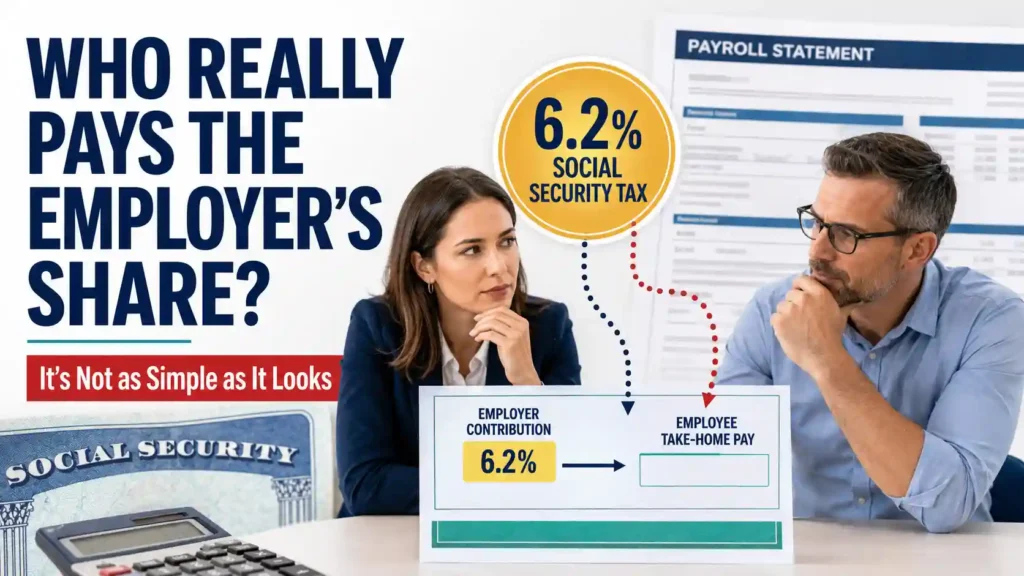
Look at your paycheck and the answer appears obvious.
Your employer deducts 6.2% of your covered wages for Social Security. The company then contributes another 6.2% using its own money.
Therefore, you pay one half and your employer pays the other half—right?
Legally, yes.
Economically, the answer is more complicated.
Your employer sends its 6.2% contribution to the government, and that amount normally does not appear as a deduction from your take-home pay. However, many economists conclude that workers ultimately bear much of the employer’s Social Security tax through lower wages or slower compensation growth.
That does not mean your employer secretly takes an additional 6.2% from your paycheck. It means businesses consider payroll taxes part of the total cost of employing you. Over time, higher employment costs can influence salaries, raises, bonuses, hiring and other benefits.
So, who really pays the employer’s share of Social Security tax?
The employer writes the check and has the legal responsibility. But workers may carry much of the long-term economic cost.
Understanding that difference matters when comparing Social Security taxes with retirement benefits, negotiating compensation, hiring employees or calculating the real cost of self-employment.
🚗💳 Have a car in your name? Don’t overlook what it could unlock. Check what may be available based on your vehicle before settling for a traditional credit card.
Table of Contents
What Is the Employer’s Share of Social Security Tax?
Social Security is funded primarily through payroll taxes collected under the Federal Insurance Contributions Act, commonly called FICA.
In 2026, the Social Security tax rate is:
- 6.2% for employees
- 6.2% for employers
- 12.4% combined
The tax applies to covered earnings up to the 2026 taxable maximum of $184,500. Earnings above that amount are not subject to additional Social Security tax for that year.
An employee earning at least $184,500 in 2026 can pay a maximum of $11,439 in employee Social Security tax. The employer can contribute an additional $11,439, creating a combined maximum of $22,878.
These figures apply specifically to Social Security. Medicare payroll taxes follow different rules.
Employee and Employer Social Security Tax Examples for 2026
The following table shows how the tax applies at different wage levels:
| Annual covered wages | Employee pays 6.2% | Employer pays 6.2% | Combined Social Security tax |
|---|---|---|---|
| $30,000 | $1,860 | $1,860 | $3,720 |
| $50,000 | $3,100 | $3,100 | $6,200 |
| $75,000 | $4,650 | $4,650 | $9,300 |
| $100,000 | $6,200 | $6,200 | $12,400 |
| $150,000 | $9,300 | $9,300 | $18,600 |
| $184,500 | $11,439 | $11,439 | $22,878 |
| $250,000 | $11,439 | $11,439 | $22,878 |
Once an employee reaches $184,500 in covered wages during 2026, additional earnings from that employer are no longer subject to Social Security tax.
The taxable maximum normally changes each year with national wage growth, so employers and workers should not assume the 2026 limit will apply in future years.
Who Legally Pays the Employer’s Share?
The employer does.
An employer cannot deduct its own 6.2% Social Security contribution from an employee’s agreed wages and pretend the worker paid it directly.
The business must:
- Withhold the employee’s 6.2% contribution from covered wages.
- Calculate an equal employer contribution.
- Deposit both amounts with the federal government.
- Report the wages and taxes on the required payroll forms.
- Provide the employee with a Form W-2 showing covered wages and the employee’s withheld Social Security tax.
If the employer fails to deposit the required taxes, the employer can face penalties, interest and collection action.
From a legal and accounting perspective, the division is clear: the employee owes one half, and the employer owes the other half.
However, legal responsibility does not reveal who ultimately experiences the financial burden.
Who Economically Pays the Employer’s Share?
Workers probably bear a substantial portion of the employer payroll tax over the long term.
This happens because employers make hiring and compensation decisions based on the total cost of employing someone—not just the salary displayed in a job offer.
Suppose a company pays an employee a $50,000 salary.
The employer’s costs can include:
- $50,000 in wages
- $3,100 in employer Social Security tax
- $725 in basic employer Medicare tax
- Unemployment taxes
- Health insurance
- Retirement-plan contributions
- Workers’ compensation
- Paid leave
- Equipment and training
Before accounting for several of those additional expenses, the employee already costs more than the advertised $50,000 salary.
When payroll taxes rise, an employer has several possible responses:
- Accept a smaller profit
- Raise prices
- Reduce hiring
- Reduce hours
- Offer smaller raises
- Cut bonuses
- Reduce other benefits
- Hold starting wages lower than they otherwise would have been
Over time, competition and labor-market conditions determine how the cost is divided among workers, employers, customers and business owners.
The broad economic argument is that wages eventually adjust, causing workers to bear much of the employer contribution through lower compensation.
But “workers pay all of it” is too absolute. The burden can vary by industry, location, wage level, bargaining power and economic conditions.
🚗💳 Have a car in your name? Don’t overlook what it could unlock. Check what may be available based on your vehicle before settling for a traditional credit card.
The Difference Between Legal and Economic Incidence
To understand who really pays the employer’s share of Social Security tax, you need to separate legal incidence from economic incidence.
Legal incidence
Legal incidence identifies who is required by law to calculate, report and send the tax.
For the employer’s 6.2% share, that responsibility belongs to the employer.
Economic incidence
Economic incidence identifies who becomes financially worse off because the tax exists.
If the employer responds to its payroll-tax cost by offering a salary of $50,000 instead of $53,100, the worker may indirectly carry the cost through lower wages.
If wages cannot adjust, the employer may absorb more of the cost through lower profits.
If the employer raises prices, customers may pay part of it.
Therefore, the person who submits a tax payment is not always the only person who bears its economic burden.
This distinction also applies to sales taxes, corporate taxes, tariffs and many other government charges.
For a complete explanation, read Legal Tax Incidence Versus Economic Tax Incidence.
Does Your Employer Deduct Its 6.2% Share From Your Paycheck?
No.
Your pay stub should show the Social Security tax withheld from your wages. That amount is normally 6.2% of your covered pay until you reach the annual taxable maximum.
The employer’s separate 6.2% contribution is a business expense. It should not appear as a second Social Security deduction reducing your agreed gross wages.
For example, suppose your gross paycheck is $2,000.
Your employee Social Security withholding would normally be:
$2,000 × 6.2% = $124
Your employer would contribute another $124.
Your paycheck would be reduced by your $124 contribution, along with other applicable taxes and deductions. The employer’s additional $124 would not be taken from the remaining balance of your paycheck.
Nevertheless, the employer may have considered that $124 cost when deciding what salary it could afford to offer you.
A Simple Example of How Workers Can Indirectly Pay
Imagine two identical companies hiring workers for the same position.
Company A operates in a system without an employer payroll tax. It can spend $60,000 annually on each worker.
Company B must pay a 6.2% employer Social Security tax and also has a total compensation budget of $60,000.
Company B cannot necessarily offer a $60,000 salary plus the payroll tax without exceeding its budget. It may offer a lower salary so the combined wage and payroll-tax cost remains close to $60,000.
In reality, compensation does not adjust through one clean calculation. Employers also pay Medicare taxes, benefits and other employment costs.
Additionally, wages are affected by worker productivity, labor shortages, minimum-wage laws, union contracts and competition between employers.
The example simply shows the mechanism through which an employer-paid tax can affect employee compensation.
Do Employers Reduce Your Current Salary When Payroll Taxes Rise?
Usually, employers cannot simply reduce an existing employee’s salary without considering employment contracts, minimum-wage laws, union agreements, workplace policies and the risk of losing the employee.
Instead, adjustment may happen gradually through:
- Smaller future raises
- Lower starting salaries for new employees
- Reduced bonuses
- Slower hiring
- Fewer hours
- Changes to benefits
- Greater use of contractors or automation
This is one reason the economic burden is difficult to see.
A line marked “employer Social Security tax” does not appear as a deduction on your paycheck. The cost may instead appear as a raise that never happened or a salary offer that was lower from the beginning.
Because that missing compensation cannot be observed directly, economists estimate the burden by studying how wages and employment respond to payroll-tax changes.
Do Employees Receive Credit for the Employer’s Contribution?
Social Security benefits are not calculated by adding the employee’s and employer’s taxes into a personal account.
Instead, your future retirement benefit is based primarily on your covered earnings history and the benefit formula.
Generally, the calculation uses your highest 35 years of wage-indexed earnings. Those earnings are converted into an average monthly amount and then processed through a progressive formula.
Therefore, you do not receive a statement showing:
- Employee contributions deposited into your personal fund
- Employer contributions deposited beside them
- Interest earned on both balances
- A final account value available at retirement
That is not how Social Security operates.
The employer contribution helps finance the overall program. Your reported earnings help establish your eligibility and benefit amount.
This is why it can be misleading to describe Social Security as a retirement account containing “your money.”
🚗💳 Have a car in your name? Don’t overlook what it could unlock. Check what may be available based on your vehicle before settling for a traditional credit card.
Does Paying Both Shares Double Your Social Security Benefit?
No.
An employee’s retirement benefit is based on covered earnings, not on whether the employee personally wrote checks covering both sides of the payroll tax.
A self-employed person pays the full 12.4% Social Security tax, subject to applicable rules and the annual taxable maximum. However, that person does not receive twice the retirement benefit of an employee with the same covered earnings history.
For example, consider two workers with identical covered earnings:
- Maria earns $80,000 as a W-2 employee.
- David earns an equivalent amount through self-employment.
Maria’s employer pays the employer portion of her Social Security tax. David generally pays both portions through self-employment tax.
Assuming their Social Security-covered earnings are otherwise the same, their future benefits are not doubled merely because David directly remitted both tax portions.
Benefits are linked to credited earnings—not to whether the worker or an employer physically transferred the tax.
How Self-Employed Workers Pay Social Security Tax
Self-employed workers generally pay both the employee and employer portions of Social Security tax through the Self-Employment Contributions Act, commonly called SECA.
The combined Social Security rate is 12.4%, up to the annual taxable earnings limit.
However, the calculation is not simply 12.4% of every dollar of business revenue.
Self-employment tax is generally based on net earnings from self-employment after allowable business expenses and the adjustment used in calculating self-employment tax.
Self-employed taxpayers may generally deduct the employer-equivalent portion of self-employment tax when calculating adjusted gross income. That deduction reduces income subject to federal income tax.
It does not erase the self-employment tax itself.
This distinction causes confusion. A deduction for the employer-equivalent portion does not mean the government refunds half of the Social Security and Medicare tax.
Self-employed readers should consult a qualified tax professional when income, multiple businesses, partnerships or mixed W-2 and self-employment earnings make the calculation complicated.
See How Self-Employment Tax Works for Freelancers and Business Owners for a step-by-step calculation.
Is the Employer Social Security Tax Part of Your Compensation?
It is part of the employer’s cost of employing you, but it is not normally treated as wages paid directly to you.
That distinction matters.
When comparing a W-2 job with contract work, looking only at the advertised salary can produce a misleading result.
A W-2 employer may pay:
- Employer Social Security tax
- Employer Medicare tax
- Unemployment taxes
- Workers’ compensation
- Health-insurance contributions
- Retirement-plan matching
- Paid leave
- Equipment and training expenses
A self-employed contractor may have to cover many of these costs personally.
Therefore, a contractor earning $60,000 is not automatically in the same financial position as an employee earning a $60,000 salary.
The contractor may need a higher gross income to produce comparable take-home pay and benefits.
Social Security Tax Versus Medicare Tax
Social Security and Medicare taxes are often grouped together as FICA taxes, but they have different rates and limits.
| Payroll tax | Employee rate | Employer rate | 2026 wage limit |
|---|---|---|---|
| Social Security | 6.2% | 6.2% | $184,500 |
| Basic Medicare | 1.45% | 1.45% | No wage limit |
| Additional Medicare tax | 0.9% employee withholding | No matching employer portion | Applies above statutory thresholds |
The standard combined FICA rate for an employee is 7.65%:
- 6.2% for Social Security
- 1.45% for Medicare
The employer also generally pays 7.65%:
- 6.2% for Social Security
- 1.45% for Medicare
However, Social Security tax stops after covered wages reach the annual taxable maximum. Basic Medicare tax continues regardless of income.
The additional 0.9% Medicare tax can apply to an employee’s wages above the relevant threshold. Employers must withhold it once wages paid by that employer exceed $200,000 in a calendar year, but employers do not provide a matching 0.9% contribution.
🚗💳 Have a car in your name? Don’t overlook what it could unlock. Check what may be available based on your vehicle before settling for a traditional credit card.
What Happens When You Have More Than One Employer?
If you work for multiple employers, each employer generally withholds Social Security tax without considering wages paid by the others.
As a result, your combined employee withholding may exceed the annual maximum.
For example, suppose two unrelated employers each pay you $120,000 in 2026.
Each employer may withhold Social Security tax based on the wages it pays because neither employer individually paid you more than the $184,500 taxable maximum.
Your total wages would be $240,000, potentially causing excess employee Social Security withholding.
You may generally claim the excess employee withholding as a credit on your federal income tax return, subject to the applicable rules.
However, the employers normally do not receive a refund merely because your combined wages from different employers exceeded the taxable maximum. Each employer’s obligation is calculated using the wages that particular employer paid you.
If one employer alone withheld too much, the correction process can differ. The employer should normally correct the error rather than forcing the employee to treat it as ordinary multiple-employer excess withholding.
Can an Employer Avoid Its Share by Calling You an Independent Contractor?
An employer cannot legally avoid payroll taxes merely by labeling an employee an independent contractor.
Worker classification depends on the actual working relationship, including factors involving control, independence and the nature of the work.
If a business controls how, when and where a person performs services, the worker may be an employee even if a contract calls the person an independent contractor.
Misclassification can shift significant costs onto the worker, including:
- The employer-equivalent portion of Social Security and Medicare taxes
- Estimated tax responsibilities
- Unemployment protection
- Workers’ compensation protection
- Employee benefits
- Certain wage-and-hour protections
A genuine contractor operates an independent business. A worker does not become a legitimate contractor simply because an employer issues Form 1099 instead of Form W-2.
Read W-2 Employee Versus 1099 Contractor: Taxes, Benefits and Hidden Costs before accepting a contractor offer based only on the gross pay.
Why the Employer Share Matters in the Baby Boomer Returns Debate
Recent discussions about baby boomer Social Security returns have claimed that people retiring during this decade may collect benefits worth approximately 265% of what they paid into Social Security.
That figure compares scheduled lifetime benefits with only the employee’s direct Social Security taxes.
When the employer’s share is included, the estimated average falls to approximately 133%.
The debate then becomes: Should the employer contribution count as money paid on behalf of the worker?
Legally, the employer paid it.
Economically, workers may have carried much of the cost through lower wages.
The fairest explanation is to show both figures rather than pretending one completely invalidates the other.
A retiree may receive:
- Approximately $2.65 in scheduled benefits for every $1 paid directly through employee Social Security taxes
- Approximately $1.33 for every $1 paid through combined employee and employer taxes
Neither comparison means the retiree has a personal account holding those contributions. Both are broad estimates based on scheduled benefits and average outcomes.
Would Workers Receive a 6.2% Raise if the Employer Tax Disappeared?
Probably not immediately, and not necessarily in full.
Some of the savings might eventually appear in higher wages, especially where employers compete aggressively for workers.
However, businesses could also use the savings to:
- Increase profits
- Lower prices
- Invest in equipment
- Expand hiring
- Increase other benefits
- Pay down debt
- Build cash reserves
Labor-market conditions would determine how the savings were distributed.
Workers with strong bargaining power or highly demanded skills might capture more of the benefit. Workers in weak labor markets might receive less.
Therefore, saying that repealing the employer tax would automatically produce a 6.2% raise for every employee is not credible.
The reverse is also true: increasing the employer tax would not necessarily cause every employee’s paycheck to fall by exactly the same percentage immediately.
🚗💳 Have a car in your name? Don’t overlook what it could unlock. Check what may be available based on your vehicle before settling for a traditional credit card.
Does the Employer Share Reduce Company Profits?
It can.
Businesses cannot always pass employment taxes to workers through lower wages, especially in the short term.
A company may be constrained by:
- Minimum-wage laws
- Employment contracts
- Union agreements
- Worker shortages
- Existing salary commitments
- The need to retain skilled employees
- Strong competition from other employers
Under those conditions, owners or shareholders may absorb more of the cost through lower profits.
Some businesses may raise prices, shifting part of the burden to customers. Others may reduce hiring or investment.
The economic burden is therefore shared differently across companies and time periods.
The strongest defensible conclusion is that workers likely bear much of the employer payroll tax in the long run—not that employers bear none of it.
Does the Employer Contribution Increase Your Social Security Statement?
Your Social Security statement is based on reported covered earnings, not on a visible balance of employer contributions.
If your employer correctly reports $70,000 in covered wages, those earnings can help determine your future benefit.
The statement does not separately add the employer’s Social Security tax to your retirement balance because no individual account exists.
You should still review your earnings record regularly. Missing or incorrectly reported wages can reduce your future benefit, particularly if the error affects one of your highest 35 earning years.
Correcting mistakes can become harder as records age, so do not wait until retirement to check them.
Is the Employer Share Tax-Deductible?
For a business, employer payroll taxes are generally treated as deductible business expenses when the ordinary tax requirements are satisfied.
The employee does not personally claim a deduction for the employer’s contribution because the employee did not directly report or pay that business expense.
Self-employed taxpayers may generally deduct the employer-equivalent portion of self-employment tax when calculating adjusted gross income.
Again, that income-tax deduction does not cancel the underlying self-employment tax.
Tax treatment can become more complicated for business owners, S corporations, partnerships and taxpayers receiving both wages and self-employment income. Professional advice may be necessary.
Should Job Offers Show Employer Payroll Taxes?
Most job offers focus on salary or hourly wages. Some employers also provide a total compensation statement showing benefits and employment costs.
Including employer payroll taxes in a total compensation statement can help workers understand what the company spends. However, presenting mandatory employer taxes as though they were cash benefits paid directly to the employee can exaggerate the value of the offer.
A useful job-offer comparison should separate:
- Cash wages
- Employer retirement contributions
- Health-insurance contributions
- Paid leave
- Bonuses
- Legally required payroll taxes
- Other employer-paid benefits
This gives workers a more accurate view of what they receive and what the employer is legally required to pay.
🚗💳 Have a car in your name? Don’t overlook what it could unlock. Check what may be available based on your vehicle before settling for a traditional credit card.
Frequently Asked Questions
1. Who pays the employer’s share of Social Security tax?
The employer is legally responsible for paying it. Workers may bear much of its long-term economic cost through lower wages or slower compensation growth.
2. How much is the employer Social Security tax in 2026?
Employers generally pay 6.2% of each employee’s covered wages up to $184,500.
3. How much does the employee pay?
Employees generally pay 6.2% of covered wages up to the same $184,500 taxable maximum.
4. What is the combined Social Security tax rate?
The combined employee and employer rate is 12.4%.
5. What is the maximum employer contribution in 2026?
The maximum employer Social Security contribution for one employee is $11,439.
6. What is the maximum combined contribution?
The employee and employer can pay a combined maximum of $22,878 in Social Security tax for 2026.
7. Is the employer contribution deducted from my paycheck?
No. Only the employee contribution should be withheld from your agreed gross wages. The employer pays its contribution separately.
8. Why do economists say workers pay the employer share?
Employers consider payroll taxes part of labor costs. Over time, wages, raises or benefits may be lower than they would have been without the tax.
9. Does the employer pay the tax from profits?
It can reduce profits, particularly in the short term. Businesses may also shift parts of the cost through wages, prices, hiring or benefits.
10. Is the employer share included on Form W-2?
Form W-2 reports your covered wages and employee Social Security tax withheld. It does not normally show the employer contribution as part of your wages.
11. Does the employer share go into my personal account?
No. Social Security does not maintain a private investment account for each worker.
12. Does paying more Social Security tax always produce a larger benefit?
Higher covered earnings can increase future benefits, but benefits are determined by a progressive formula and do not rise dollar-for-dollar with taxes paid.
13. Do self-employed people pay both shares?
Yes. Self-employed workers generally pay the combined Social Security and Medicare rates through self-employment tax, subject to applicable calculations and limits.
14. Do self-employed workers receive double benefits?
No. Benefits are based on covered earnings, not on whether a worker directly paid both portions of the tax.
15. Can self-employed workers deduct half of the tax?
They may generally deduct the employer-equivalent portion when calculating adjusted gross income. The deduction does not eliminate the self-employment tax.
16. Is Medicare included in the 6.2% rate?
No. The 6.2% rate applies to Social Security. Employees and employers generally pay an additional 1.45% each for basic Medicare tax.
17. Does Medicare tax have the same wage limit?
No. Basic Medicare tax applies to all covered wages without a taxable maximum.
18. What happens after I earn $184,500 in 2026?
Additional earnings are generally no longer subject to Social Security tax for that year, although Medicare tax continues.
19. What if two employers withhold too much Social Security tax?
You may be able to claim excess employee withholding as a credit on your federal income tax return when the excess resulted from working for multiple employers.
🚗💳 Have a car in your name? Don’t overlook what it could unlock. Check what may be available based on your vehicle before settling for a traditional credit card.
20. Do employers get their excess contributions refunded?
Normally, each unrelated employer calculates its obligation using only the wages it paid. An employer does not generally receive a refund because your combined wages from multiple employers exceeded the limit.
21. Can my employer make me pay its Social Security tax?
An employer cannot simply deduct its legally required contribution from your agreed wages as another employee Social Security withholding.
22. Can a company avoid payroll tax by paying me as a contractor?
Only if you are legitimately an independent contractor. A label or written agreement alone does not determine worker classification.
23. Are tips subject to Social Security tax?
Reported cash tips of at least the applicable monthly threshold are generally subject to employee and employer Social Security and Medicare taxes.
24. Are bonuses subject to Social Security tax?
Bonuses are generally treated as wages and subject to Social Security tax until the employee reaches the annual taxable maximum.
25. Would eliminating the employer tax raise wages by 6.2%?
Not automatically. Some savings might eventually reach workers, but businesses could also lower prices, increase profits, expand hiring or spend the money elsewhere.
Conclusion
Your employer legally pays the employer’s 6.2% share of Social Security tax. It calculates the contribution, sends the money to the government and remains responsible if the payment is not made correctly.
But that is only half the answer.
Because employers treat payroll taxes as part of the cost of hiring, workers may ultimately bear much of the burden through lower starting wages, smaller raises, reduced benefits or fewer employment opportunities.
🚗💳 Have a car in your name? Don’t overlook what it could unlock. Check what may be available based on your vehicle before settling for a traditional credit card.
The effect is not identical for every worker or business. In the short term, employers, shareholders and customers may absorb part of the cost. Over time, wages are more likely to adjust.
That is why both of these statements can be true:
- Employers pay the employer’s share under the law.
- Workers may carry much of its economic cost.
The distinction becomes especially important when someone claims retirees receive 265% of what they paid into Social Security. That figure counts only direct employee taxes.
Once the employer’s share is included, the estimated return is much lower. And if employer taxes reduce wages over time, excluding them entirely gives an incomplete picture of what workers sacrificed to finance the program.