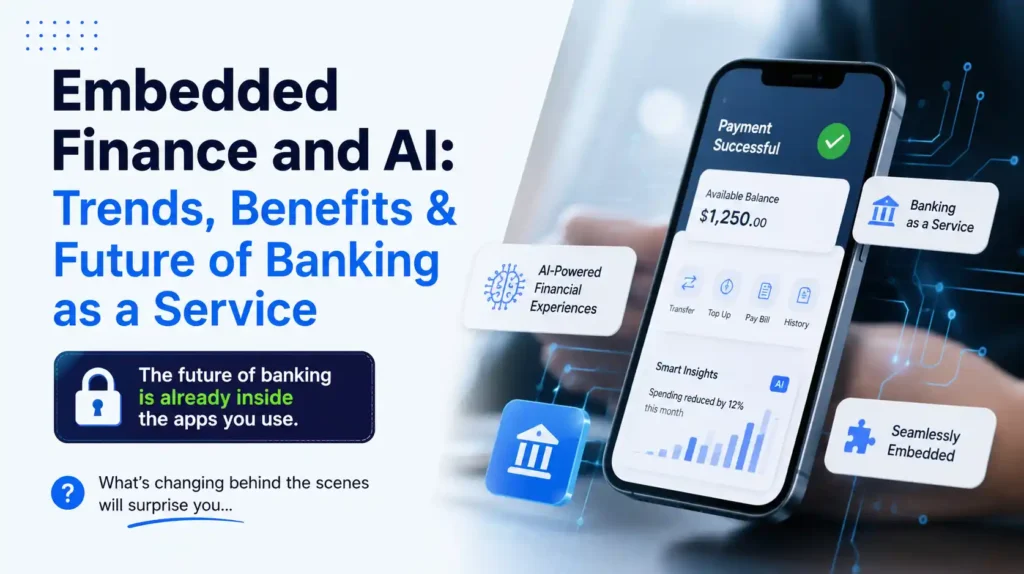
Financial services are no longer confined to banks. Today, you can apply for a loan while shopping online, purchase insurance during checkout, or split a payment into installments without ever visiting a financial institution.
This shift is known as embedded finance, and it’s changing how consumers and businesses interact with money. Instead of requiring people to visit a bank’s website or mobile app, financial services are integrated directly into the platforms they already use.
Artificial intelligence is accelerating this transformation. By combining embedded finance and AI, businesses can offer smarter financial products, personalize customer experiences, automate decisions, and reduce operational costs.
From e-commerce platforms and ride-sharing apps to accounting software and healthcare portals, AI-powered embedded finance is becoming one of the fastest-growing areas of financial technology.
In this guide, you’ll learn how embedded finance works, the role AI plays, the importance of Banking as a Service (BaaS), the latest embedded finance trends, and why this technology is expected to redefine the future of digital commerce.
Table of Contents
What Is Embedded Finance?
Embedded finance is the integration of financial services into non-financial products, applications, or platforms.
Instead of sending customers to a separate bank or financial institution, businesses provide financial services directly within their own platforms.
Examples include:
- Paying with a digital wallet during online checkout
- Applying for financing while buying electronics
- Purchasing travel insurance while booking flights
- Receiving business loans through accounting software
- Paying drivers instantly through ride-sharing platforms
Customers enjoy a smoother experience because they can complete financial tasks without leaving the application they are already using. Learn more about Embedded Finance
What Is Embedded Finance and AI?
Embedded finance becomes even more powerful when combined with artificial intelligence.
Rather than simply offering financial services, AI helps businesses make those services faster, smarter, and more personalized.
AI can analyze customer behavior in real time and determine:
- Which payment method is most suitable
- Whether financing should be offered
- How much credit a customer qualifies for
- Which insurance products are relevant
- How to detect potentially fraudulent transactions
- Which financial recommendations are most likely to help the customer
Instead of delivering the same financial products to everyone, AI creates experiences tailored to each individual user.
How Embedded Finance Works
Most embedded finance solutions rely on partnerships between technology companies and licensed financial institutions.
The process generally follows these steps:
Step 1: Banking Infrastructure
A licensed financial institution provides regulated banking services.
Step 2: Banking as a Service (BaaS)
The bank exposes secure APIs that allow approved companies to integrate financial services into their own platforms.
Step 3: Business Integration
A retailer, marketplace, healthcare provider, or software company integrates those financial services into its application.
Step 4: AI Personalization
Artificial intelligence analyzes customer behavior and delivers personalized financial products or recommendations.
The customer experiences a seamless transaction without realizing how many systems are working behind the scenes.
What Is Banking as a Service (BaaS)?
One of the most important concepts behind embedded finance is Banking as a Service (BaaS).
BaaS allows licensed financial institutions to provide banking infrastructure through secure APIs.
Instead of building an entire bank from scratch, businesses can integrate banking capabilities into their own products.
These capabilities may include:
- Account creation
- Payment processing
- Debit cards
- Digital wallets
- Lending
- Money transfers
- Identity verification
- Savings accounts
This approach allows companies to launch financial services much faster than developing their own banking infrastructure.
Why AI Is Essential for Embedded Finance
Without AI, embedded finance would still be useful.
However, artificial intelligence makes these services significantly more valuable.
Personalized Product Recommendations
AI studies customer behavior and recommends financial products based on individual needs.
For example:
Someone purchasing expensive electronics may receive a financing offer.
Another customer paying with cash may receive no financing suggestion at all.
Smarter Lending Decisions
Traditional lending often depends heavily on credit scores.
AI can evaluate additional information, including:
- Income stability
- Spending habits
- Transaction history
- Business performance
- Cash flow
This allows lenders to make more informed decisions while expanding access to financial services.
Intelligent Fraud Detection
Embedded finance platforms process enormous numbers of transactions.
AI continuously monitors activity and identifies suspicious behavior before fraudulent payments are completed.
Dynamic Pricing
Some financial products adjust pricing based on customer risk profiles.
AI helps determine appropriate pricing using real-time data while maintaining fairness and regulatory compliance.
Real-World Examples of Embedded Finance
Many people already use embedded finance without realizing it.
E-commerce
Online stores offer:
- Buy Now, Pay Later
- Digital wallets
- Instant financing
- Insurance during checkout
Customers complete purchases without leaving the shopping platform.
Ride-Sharing Platforms
Drivers may receive:
- Instant payouts
- Business debit cards
- Fuel discounts
- Vehicle financing
All within the ride-sharing application.
Accounting Software
Business accounting platforms increasingly provide:
- Business loans
- Invoice financing
- Payroll services
- Cash flow management
Financial tools become part of everyday business operations.
Healthcare
Healthcare platforms may offer:
- Payment plans
- Medical financing
- Insurance verification
- Flexible payment options
Patients receive financial services alongside healthcare services.
Embedded Finance Trends Shaping 2026
Several major developments are driving the next generation of embedded finance.
AI-Powered Personalization
Financial offers will become increasingly personalized using machine learning models that continuously adapt to customer behavior.
Invisible Payments
Payments will happen automatically in many situations without requiring customers to manually enter payment details each time.
Embedded Insurance
Insurance products will become more integrated into online purchases.
Instead of shopping separately for insurance, customers will receive relevant coverage during checkout.
Business Financial Platforms
Small businesses increasingly expect accounting, banking, lending, payroll, and payments to exist within a single platform.
Embedded finance makes this possible.
AI Financial Assistants
Future AI assistants may recommend financing options, optimize payment methods, monitor subscriptions, and automate savings directly within consumer applications.
Benefits for Consumers
Greater Convenience
Customers complete financial tasks without switching between multiple applications.
Faster Decisions
Loan approvals, payment verification, and financial recommendations happen much more quickly.
Personalized Experiences
Financial services become tailored to each user’s spending habits, goals, and financial profile.
Better Financial Access
Consumers who previously struggled to obtain financial products may gain access through AI-driven assessment models.
Benefits for Businesses
Businesses also gain significant advantages.
Higher Conversion Rates
Reducing checkout friction often leads to more completed purchases.
New Revenue Streams
Companies can generate additional revenue through financial products integrated into their platforms.
Better Customer Retention
Customers are more likely to remain loyal when they can access multiple services within one application.
Improved Customer Insights
AI helps businesses better understand customer preferences and purchasing behavior.
Challenges of Embedded Finance
Despite its advantages, embedded finance presents several challenges.
Regulatory Compliance
Financial services remain heavily regulated.
Businesses must comply with:
- Consumer protection laws
- Data privacy regulations
- Anti-money laundering requirements
- Know Your Customer (KYC) rules
Cybersecurity
Financial platforms attract cybercriminals.
Strong encryption, authentication, and fraud detection are essential.
Customer Trust
Consumers must feel confident that their financial information is secure.
Transparent privacy policies and strong security practices help build trust.
AI Bias
AI systems should be regularly evaluated to ensure financial decisions remain fair and unbiased.
The Future of Embedded Finance and AI
The combination of AI and embedded finance is still in its early stages.
Future platforms may:
- Predict customer financing needs before purchases occur
- Automatically optimize payment methods
- Provide AI-powered financial coaching
- Recommend personalized insurance products
- Manage subscriptions automatically
- Detect fraud before transactions are initiated
- Coordinate financial services across multiple platforms
Instead of visiting separate banking websites, consumers may access most financial services wherever they already shop, work, travel, or manage their businesses.
The banking experience will become increasingly invisible while remaining secure and highly personalized.
Should Businesses Invest in Embedded Finance?
For many businesses, the answer is increasingly yes.
Companies should evaluate whether embedded financial services align with customer needs and business goals.
Important considerations include:
- Customer demand
- Regulatory requirements
- Technology partners
- Security standards
- AI capabilities
- Long-term business strategy
Organizations that adopt embedded finance thoughtfully can strengthen customer relationships while creating new opportunities for growth.
Conclusion
The combination of embedded finance and AI is transforming the financial industry by bringing banking services directly into the digital experiences people use every day. Instead of forcing customers to leave an application to access financial products, businesses can integrate payments, lending, insurance, and banking into a seamless user journey.
Powered by Banking as a Service and intelligent automation, embedded finance delivers faster decisions, personalized recommendations, stronger fraud protection, and greater convenience for both consumers and businesses.
As embedded finance trends continue evolving throughout 2026 and beyond, organizations that embrace AI responsibly will be better positioned to deliver the secure, personalized, and frictionless financial experiences customers increasingly expect.
Frequently Asked Questions About Embedded Finance and AI
As embedded finance becomes more common across digital platforms, many people are curious about how it works and why artificial intelligence plays such an important role. Here are answers to some of the most frequently asked questions.
What is embedded finance?
Embedded finance is the integration of financial services such as payments, lending, insurance, or banking directly into non-financial platforms. This allows customers to complete financial activities without leaving the app or website they are already using.
How does AI improve embedded finance?
Artificial intelligence analyzes customer data to personalize financial offers, improve fraud detection, automate lending decisions, recommend suitable products, and create faster, more efficient financial experiences for both businesses and consumers.
What is Banking as a Service (BaaS)?
Banking as a Service allows licensed financial institutions to provide banking capabilities through secure APIs. Businesses can then integrate services like payments, accounts, and lending into their own applications without becoming banks themselves.
Is embedded finance safe?
Embedded finance can be very secure when providers implement strong encryption, multi-factor authentication, fraud detection systems, and comply with financial regulations. Consumers should also use trusted platforms and protect their account credentials.
What are the biggest embedded finance trends for 2026?
Some of the most important trends include AI-powered personalization, invisible payments, embedded insurance, smarter lending decisions, integrated business financial platforms, and AI assistants that help users manage financial tasks directly within everyday applications.