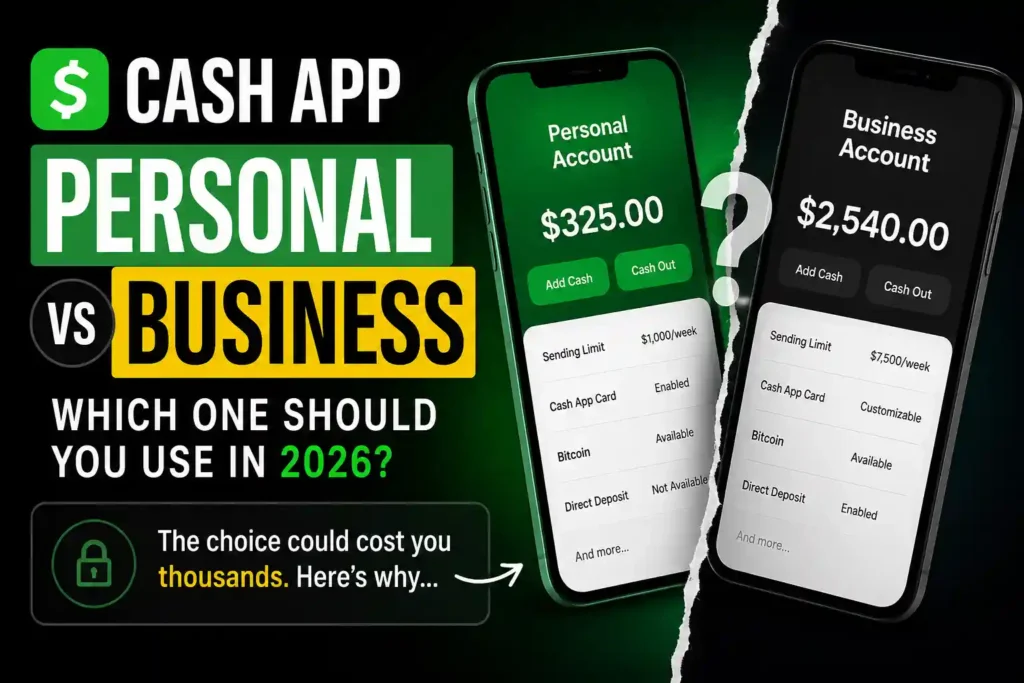
Choosing the wrong Cash App account can be an expensive mistake.
Many people start accepting payments without giving much thought to the account type they’re using. At first, everything seems to work normally. Money comes in, payments go out, and the app does exactly what it’s supposed to do.
Then questions begin to appear.
Should a small business be using a Personal Account?
Can a freelancer accept client payments through Cash App?
Will switching to a Business Account change the fees?
Does Cash App report business income differently?
Can someone switch back to a Personal Account later?
Perhaps the biggest question of all is this:
Which Cash App account is actually the right one?
Unfortunately, many online articles oversimplify the answer. They briefly explain that one account is for personal use and the other is for business, but they don’t explain what that means in real life.
The differences go much deeper.
Choosing the wrong account can affect payment fees, customer experience, bookkeeping, taxes, compliance with Cash App’s terms, and even how easily a growing business manages its finances.
The good news is that selecting the right account isn’t difficult once the differences are clearly understood.
This guide compares Cash App Personal Accounts and Business Accounts side by side. It explains who each account is designed for, how they work, the advantages and disadvantages of each, when it makes sense to switch, and the situations where one account is clearly the better choice.
Whether someone occasionally sends money to friends or operates a growing business that accepts customer payments every day, this guide will help them make an informed decision.
Before diving into the details, here’s the short answer.
Table of Contents
Quick Answer: Cash App Personal Account vs Business Account
The biggest difference is simple.
A Personal Account is intended for everyday personal transactions between individuals.
A Business Account is designed for merchants, freelancers, creators, contractors, and businesses that receive payments for goods or services.
Here’s a quick comparison.
| Feature | Personal Account | Business Account |
|---|---|---|
| Designed for friends and family | ✅ Yes | ❌ No |
| Designed for business payments | ❌ No | ✅ Yes |
| Receive customer payments | Limited to personal use | ✅ Yes |
| Business payment processing | ❌ No | ✅ Yes |
| Business-related fees | Generally not for personal peer-to-peer payments | Business transaction fees may apply |
| Suitable for selling products or services | Not recommended | ✅ Yes |
| Can switch account type later | ✅ Yes | ✅ Yes |
If you’re simply paying roommates, splitting dinner, or sending money to family, a Personal Account is usually the better choice.
If you’re regularly accepting payments from customers, clients, or buyers, a Business Account is generally the more appropriate option.
However, there are several important differences beyond that simple comparison.
Before comparing every feature, it’s helpful to understand what each account type is designed to do.
What Is a Cash App Personal Account?
A Personal Account is the standard account most people create when they first download Cash App.
It’s intended for everyday financial activity between individuals.
Typical uses include:
- Sending money to friends
- Receiving money from family
- Splitting bills
- Paying roommates
- Sharing travel expenses
- Paying someone back after dinner
- Everyday peer-to-peer transfers
For millions of users, this is all they ever need.
Someone who only uses Cash App for personal payments usually doesn’t need the additional functionality associated with a Business Account.
What Is a Cash App Business Account?
A Business Account is intended for receiving payments related to business activities.
Instead of sending money only between friends and family, a Business Account is designed for situations where money is exchanged for products or services.
Examples include:
- Freelancers
- Independent contractors
- Small businesses
- Online sellers
- Consultants
- Tutors
- Personal trainers
- Graphic designers
- Photographers
- Musicians
- Content creators
- Local service providers
In short, if someone is earning income through Cash App, a Business Account is generally the more appropriate choice.
Why Does Cash App Offer Two Different Account Types?
Many users wonder why Cash App doesn’t simply provide one account for everyone.
The reason is straightforward.
Personal payments and commercial transactions have different requirements.
Businesses often need:
- Payment acceptance from customers
- Transaction records for bookkeeping
- Business-related reporting
- Payment processing designed for commercial activity
Meanwhile, personal users generally want a simple way to send and receive money without managing business transactions.
Separating the two helps ensure each account type is better suited to its intended purpose.
Personal Account vs Business Account at a Glance
Here’s a broader comparison.
| Feature | Personal Account | Business Account |
|---|---|---|
| Best for everyday personal use | ✅ | ❌ |
| Best for selling products or services | ❌ | ✅ |
| Friends and family payments | ✅ | Possible, but not its primary purpose |
| Customer payments | Not intended | ✅ |
| Freelance income | Not intended | ✅ |
| Side hustle payments | Not intended | ✅ |
| Business bookkeeping | Limited | Better suited for commercial activity |
| Commercial transactions | Not intended | ✅ |
Although the differences appear simple on paper, choosing the wrong account can create unnecessary complications later.
Who Should Choose a Personal Account?
A Personal Account is usually the best choice for people who aren’t running a business.
Typical users include:
- Students
- Families
- Roommates
- Friends
- Couples
- Individuals sharing expenses
- People making occasional peer-to-peer payments
For these users, a Business Account generally provides little additional benefit.
If the primary purpose is everyday money transfers, a Personal Account usually makes the most sense.
Who Should Choose a Business Account?
A Business Account is typically the better option for anyone accepting money in exchange for goods or services.
Examples include:
- Freelance writers
- Graphic designers
- Web developers
- Social media managers
- Tutors
- Fitness coaches
- Hair stylists
- Landscapers
- Home repair professionals
- Artists
- Online store owners
- Local retailers
- Food vendors
- Photographers
- Consultants
Even someone earning part-time income through a side hustle may benefit from using a Business Account rather than mixing business transactions with personal payments.
Can Freelancers Use a Personal Account?
This is one of the most common questions people ask.
Technically, someone might begin receiving occasional payments through a Personal Account.
However, once payments become business-related or are received in exchange for services or products, a Business Account is generally the more appropriate choice because it’s designed for commercial activity.
For freelancers whose work is becoming more consistent, switching early can make future financial management much easier.
What About Side Hustles?
Today’s economy has created millions of side hustles.
People earn extra income by:
- Selling handmade products
- Offering digital services
- Walking dogs
- Delivering food
- Creating online courses
- Coaching
- Photography
- Selling clothing
- Reselling collectibles
Many side hustles start small.
Even so, if payments are being accepted from customers rather than friends and family, it’s worth considering whether a Business Account better matches the intended use.
Can You Switch Between Personal and Business Accounts?
One reason some people hesitate is the fear of making the wrong decision permanently.
Fortunately, Cash App allows eligible users to change their account type.
This means someone can:
- Start with a Personal Account.
- Begin earning business income later.
- Switch to a Business Account when appropriate.
Likewise, if business activities stop, eligible users may be able to change their account type again, subject to Cash App’s current policies.
That flexibility means choosing a Personal Account today doesn’t necessarily lock someone into that choice forever.
Before Choosing an Account Type
Instead of asking which account is “better,” ask which account matches how Cash App will actually be used.
Mostly Sending Money to Friends?
A Personal Account is usually the right fit.
Accepting Customer Payments?
A Business Account is generally more appropriate.
Running a Growing Side Hustle?
Even if it’s only part-time today, a Business Account may provide a better long-term foundation.
Unsure Which One to Choose?
Think about where most of the money coming into the account will come from.
If it’s family or friends, Personal is usually appropriate.
If it’s customers or clients, Business is generally the better choice.
Furthermore, while the basic differences are easy to understand, choosing between a Personal Account and a Business Account becomes much clearer when each feature is compared individually.
Cash App Personal Account vs Business Account: Feature-by-Feature Comparison
At first glance, both account types look almost identical.
The same app is used.
The same interface is available.
Both allow users to send and receive money.
However, behind the scenes, there are several important differences that affect how each account should be used.
Let’s examine them one by one.
Sending and Receiving Money
This is the feature most people use every day.
Personal Account
A Personal Account is designed primarily for peer-to-peer payments.
Typical examples include:
- Paying a friend back
- Splitting rent
- Sharing vacation expenses
- Sending birthday money
- Paying family members
These are personal transactions rather than commercial ones.
Business Account
A Business Account is designed to receive payments from customers.
Examples include:
- Selling products
- Providing professional services
- Receiving freelance payments
- Accepting client invoices
- Collecting coaching fees
- Selling digital products
Although both account types receive money, the reason for the payment is what matters.
If the payment is for goods or services, a Business Account is generally the more appropriate choice.
Transaction Fees
One of the biggest reasons people compare Personal and Business Accounts is fees.
Personal Account Fees
For eligible peer-to-peer personal payments, users generally don’t pay business processing fees simply because they’re sending money to friends or family.
However, other Cash App services—such as instant transfers or certain optional features—may involve separate fees.
Readers should also review Cash App Fees Explained: Sending, Receiving, Cash Out, ATM, Bitcoin, and More for a complete breakdown.
Business Account Fees
Business Accounts are different.
Because they’re designed for commercial transactions, payments received for goods or services are generally subject to business processing fees according to Cash App’s current pricing.
For many businesses, these fees are simply considered part of the cost of accepting digital payments.
When deciding between account types, choosing a Personal Account solely to avoid business fees isn’t a good idea if the account is actually being used for commercial activity.
Who Pays the Business Transaction Fee?
Another common question is whether the buyer or the business pays the fee.
In general, business processing fees are deducted from the payment received by the business.
That means the customer usually sends the full payment amount, while the business receives the amount after any applicable processing fee has been deducted.
Understanding this helps business owners price their products or services more accurately.
Payment Records and Organization
Keeping financial records becomes increasingly important as income grows.
Personal Account
Personal Accounts work well for everyday transactions.
However, mixing personal transfers with business income can make it harder to:
- Track sales
- Monitor revenue
- Separate personal spending
- Prepare financial records
Over time, this can become confusing.
Business Account
Business Accounts are intended for commercial activity.
Using a separate account type makes it easier to distinguish customer payments from personal transactions.
This is particularly helpful for freelancers and small business owners who receive payments throughout the week.
Professional Appearance
Customers often judge a business based on small details.
Using the correct account type can contribute to a more professional payment experience.
For example, a customer paying a freelance designer expects to pay a business—not simply send money to a friend’s personal account.
Although the payment process may feel similar, using a Business Account better aligns with commercial transactions.
Taxes and Recordkeeping
Taxes are another area where confusion is common.
First, it’s important to understand that choosing a Personal Account or Business Account does not determine whether income is taxable.
Business income may be taxable regardless of how it’s received, depending on local laws and individual circumstances.
Instead, the account type mainly affects how payments are intended to be used and how easily they can be organized.
Personal Account
If business income is mixed together with:
- Family payments
- Shared rent
- Gifts
- Personal reimbursements
…it may become much harder to organize financial records later.
Business Account
A Business Account provides better separation between commercial payments and everyday personal activity.
That separation can simplify bookkeeping and make financial management much easier as a business grows.
Cash App Card
Many users wonder whether choosing a Business Account affects access to the Cash App Card.
The Cash App Card itself is a separate feature.
Eligibility depends on meeting Cash App’s requirements rather than simply choosing one account type over the other.
Readers who want to learn more should continue with Cash App Card Explained: How It Works, Benefits, Fees, and How to Get One.
Direct Deposit
Direct deposit is another feature that often gets confused with account type.
Cash App Direct Deposit is separate from whether an account is Personal or Business.
Eligibility depends on Cash App’s requirements for the feature.
Readers planning to receive payroll deposits should also read Cash App Direct Deposit Explained: Setup, Timing, Limits, and Benefits.
Sending Limits and Receiving Limits
Many users believe Business Accounts automatically receive much higher limits.
That’s not necessarily how Cash App works.
Account limits depend on several factors, including account verification and Cash App’s current policies.
Choosing a Business Account doesn’t automatically remove every limit.
Readers interested in current limits should continue with Cash App Limits Explained: Sending, Receiving, ATM, Card, Bitcoin, and Withdrawal Limits.
Identity Verification
Both Personal and Business Accounts may require identity verification to unlock additional features or higher account capabilities.
Identity verification helps:
- Confirm account ownership
- Improve account security
- Support regulatory compliance
- Enable eligible financial services
Choosing one account type over the other doesn’t eliminate the need for verification when it’s required.
Readers who haven’t completed verification should also read How to Verify Your Identity on Cash App: Requirements, Time, and Common Problems.
Can You Use One Account for Both Personal and Business Payments?
Technically, some people begin this way.
Practically, it’s usually not the best long-term approach.
Imagine a photographer who receives:
- Wedding deposits
- Family birthday money
- Client invoices
- Shared dinner reimbursements
- Equipment refunds
- Holiday gifts
Very quickly, personal and business transactions become mixed together.
Separating them later becomes much more difficult.
Using the account type that matches the purpose of the transactions helps keep everything organized from the beginning.
Which Account Is Better for a Side Hustle?
Side hustles often begin casually.
Someone may:
- Sell handmade crafts on weekends.
- Design logos after work.
- Tutor students online.
- Offer lawn care services.
- Bake cakes for local events.
At first, income may only be occasional.
But once money is regularly being accepted in exchange for products or services, a Business Account generally becomes the better fit because it’s designed specifically for commercial transactions.
Many successful businesses start as side hustles.
Choosing the right account early can make growth much easier.
How to Decide Between a Personal Account and a Business Account
If you’re still unsure which account type is right for you, don’t focus on the name of the account.
Instead, focus on why you’re receiving money.
The purpose of the payment is what usually determines which account is the better fit.
The table below can help simplify the decision.
| If You Mainly… | Best Choice |
|---|---|
| Send money to friends and family | Personal Account |
| Split rent or utility bills | Personal Account |
| Receive birthday or holiday gifts | Personal Account |
| Pay roommates | Personal Account |
| Sell products to customers | Business Account |
| Offer freelance services | Business Account |
| Run an online business | Business Account |
| Accept payments for a side hustle | Business Account |
| Operate a local service business | Business Account |
| Receive client invoices | Business Account |
For many people, the answer becomes obvious once they think about where most of their incoming payments originate.
Real-Life Examples
Sometimes examples make the differences easier to understand.
Example 1: College Student
Sarah uses Cash App to:
- Split rent
- Pay roommates
- Receive money from her parents
- Send money to friends
She doesn’t sell anything or provide paid services.
A Personal Account is the natural choice.
Example 2: Freelance Graphic Designer
James designs logos for small businesses.
His clients regularly pay him through Cash App.
Those payments are business income.
A Business Account is generally the better fit.
Example 3: Weekend Baker
Maria bakes birthday cakes every weekend.
Customers send payments through Cash App.
Although baking isn’t her full-time job, she’s accepting money for products.
A Business Account is usually the more appropriate option.
Example 4: Online Clothing Seller
David resells sneakers and clothing online.
Most of his Cash App payments come from buyers.
Since he’s selling products, a Business Account generally aligns better with how he’s using the platform.
Example 5: Family Use Only
Michael only sends money to:
- His wife
- His children
- His brother
- Close friends
No products.
No services.
No customers.
A Personal Account is typically all he needs.
Can You Change From a Personal Account to a Business Account?
Yes.
One advantage of Cash App is that eligible users aren’t permanently locked into the account type they choose when they first sign up.
Many businesses actually begin as hobbies.
Someone might:
- Sell homemade candles
- Tutor one student
- Photograph a few weddings
- Design a handful of websites
Months later, that hobby becomes a real business.
Instead of opening a brand-new Cash App account, eligible users can generally switch to a Business Account according to Cash App’s current process.
This flexibility allows the account to grow alongside the business.
Can You Switch Back to a Personal Account?
This is another common question.
In some situations, eligible users may also be able to switch back if they stop operating a business and return to using Cash App only for personal payments.
The exact process depends on Cash App’s current policies and account status.
If you’re considering changing account types, review the options available in your account settings before making the switch.
Should You Create Separate Accounts?
Some people wonder whether they should create one Personal Account and another Business Account.
Before doing so, review Cash App’s current policies regarding multiple accounts and account management.
If you’re exploring this option, also read Can You Have More Than One Cash App Account? Everything You Need to Know.
That guide explains what’s generally allowed, how multiple accounts work, and the situations where having more than one account may make sense.
Common Mistakes to Avoid
Choosing the correct account type isn’t the only thing that matters.
Avoid these common mistakes as well.
Mixing Personal and Business Payments
This is probably the biggest mistake people make.
Receiving:
- Customer payments
- Birthday gifts
- Family reimbursements
- Business income
- Shared vacation expenses
…all in the same payment history can quickly become confusing.
Keeping personal and commercial transactions separate makes financial management much easier.
Choosing a Personal Account to Avoid Business Fees
Some people intentionally choose a Personal Account because they believe it will eliminate business processing fees.
However, using an account for purposes outside its intended use isn’t a good long-term strategy.
It’s better to choose the account type that matches how you actually use Cash App.
Waiting Too Long to Switch
Many side hustles grow gradually.
Someone who receives only one customer payment today might receive hundreds next year.
Waiting too long to switch can make recordkeeping more difficult as the business grows.
Ignoring Bookkeeping
Even a small side hustle benefits from organized financial records.
Using the correct account type from the beginning helps create cleaner payment histories.
Cash App Personal Account vs Business Account: Pros and Cons
Personal Account
Pros
- Ideal for everyday peer-to-peer payments
- Simple for friends and family transactions
- Well suited for personal financial activity
- Easy to get started
Cons
- Not intended for receiving customer payments
- Mixing business income with personal transfers can create confusion
- Less suitable for growing businesses
Business Account
Pros
- Designed for commercial transactions
- Better suited for freelancers and businesses
- Makes customer payments more appropriate
- Easier to separate business activity from personal payments
Cons
- Business transaction fees generally apply to eligible commercial payments
- Unnecessary for users who only send money to friends and family
Cash App Personal Account vs Business Account: Myths vs. Facts
| Myth | Fact |
|---|---|
| A Business Account is only for large companies. | False. Freelancers, gig workers, creators, and side hustles may also benefit from a Business Account. |
| A Personal Account can be used for every type of payment forever. | Personal Accounts are intended for personal transactions, while Business Accounts are designed for commercial payments. |
| Business Accounts automatically have unlimited transaction limits. | Account capabilities depend on several factors, including verification and current Cash App policies. |
| Switching account types is impossible. | Eligible users can generally change account types according to Cash App’s current process. |
| A Business Account changes the entire Cash App experience. | The app remains familiar, but certain features and payment handling differ based on the account type. |
Frequently Asked Questions
Is a Cash App Business Account Free?
Creating a Business Account is generally free, but eligible business transactions are typically subject to Cash App’s current processing fees.
Can a Freelancer Use a Personal Account?
Someone may begin with a Personal Account, but if they’re regularly accepting payments for services, a Business Account is generally the more appropriate choice.
Can I Sell Products With a Personal Account?
If you’re consistently selling products or services, a Business Account is usually the better option because it’s designed for commercial activity.
Can I Change My Account Type Later?
Yes.
Eligible users can generally switch between account types according to Cash App’s current policies.
Does a Business Account Affect Taxes?
The account type itself doesn’t determine whether income is taxable.
However, separating business payments from personal transactions can make financial records easier to organize.
Tax obligations depend on applicable laws and individual circumstances.
Can I Have Both a Personal and Business Account?
Depending on Cash App’s current policies, some users may be able to manage more than one account.
If you’re considering this setup, read Can You Have More Than One Cash App Account? Everything You Need to Know.
Which Account Is Better for a Side Hustle?
If you’re receiving money from customers for products or services—even on a part-time basis—a Business Account is generally the better fit.
Final Thoughts
Choosing between a Cash App Personal Account and a Business Account isn’t about selecting the account with the most features—it’s about choosing the one that matches how you actually use Cash App.
If your activity is limited to sending money to friends, splitting bills, paying family members, or handling everyday personal transactions, a Personal Account is usually the right choice. It’s simple, straightforward, and designed specifically for peer-to-peer payments.
On the other hand, if you’re earning money from customers, clients, or buyers—whether through freelancing, consulting, online sales, or a growing side hustle—a Business Account is generally the more appropriate option. It’s built for commercial transactions and helps keep business activity separate from personal finances.
Remember, many successful businesses begin with just a few customers. Choosing the correct account type early can make payment management, bookkeeping, and future growth much easier.
To continue learning how to get the most out of Cash App, explore these guides:
Whether you’re sending money to friends or building the next successful small business, choosing the right Cash App account from the beginning helps create a smoother, more organized, and more professional financial experience.