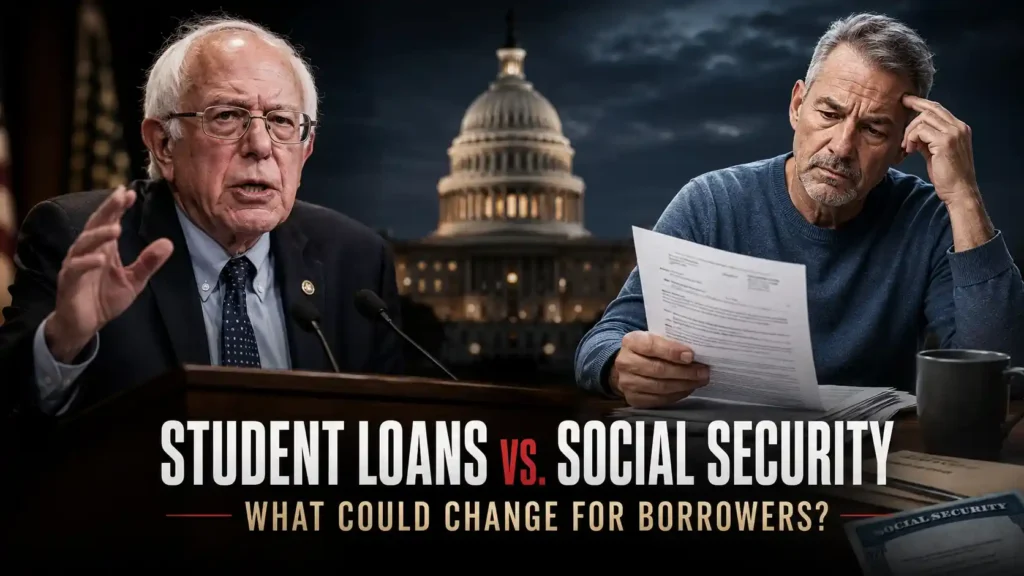
Imagine reaching retirement, depending on your Social Security check for groceries, medication, housing and utilities, only to discover that part of that money could be taken because of a student loan you defaulted on years ago.
That is the situation a new proposal from Senator Bernie Sanders is trying to prevent.
On August 17, 2026, Sanders announced plans to introduce the Stop Social Security Garnishment Act. The proposed legislation would prevent the federal government from withholding Social Security payments to collect defaulted student loan debt.
The announcement has attracted attention because more than nine million Americans are reportedly in default on their student loans. Many older borrowers are especially vulnerable because they live on fixed incomes and may have little room in their budgets for another deduction.
However, one fact must be made clear immediately: the proposed bill has not become law.
Here is what the proposal could change, who might benefit and what borrowers should do while waiting to see whether Congress passes it.
Table of Contents
What Is the Bernie Sanders Student Loan Bill?
The Bernie Sanders student loan bill is a proposed federal law intended to protect Social Security payments from student loan collections.
The proposal is called the Stop Social Security Garnishment Act. Senators Elizabeth Warren and Ed Markey were also named as cosponsors.
The bill focuses on people who receive Social Security while carrying defaulted federal student loan debt. This may include borrowers who took out loans for their own education and parents who borrowed to help their children attend college.
Some of these borrowers have carried student debt for decades. Others entered retirement with Parent PLUS loans they could no longer afford after their employment income disappeared.
Under existing federal collection rules, certain government payments can potentially be withheld when someone defaults on a debt owed to the federal government. The proposed bill would attempt to create permanent protection for Social Security payments when the debt involved is a federal student loan.
Has the Stop Social Security Garnishment Act Become Law?
No. As of August 18, 2026, the Stop Social Security Garnishment Act has not become law.
Sanders announced plans to introduce the legislation, but an announcement is only the beginning of the process.
Before the proposal can become law, it would generally need to:
- Be formally introduced in Congress.
- Be referred to the appropriate committee.
- Receive enough support to advance.
- Pass both the Senate and House of Representatives.
- Be signed by the president or enacted after Congress overrides a veto.
The bill could advance, be changed, remain in committee or fail to receive a final vote.
Be careful with headlines claiming that Sanders has already stopped Social Security garnishment or cancelled student loan debt. Neither statement is accurate.
The proposal seeks to stop one specific collection method. It does not automatically erase anyone’s student loan balance.
Can Social Security Currently Be Garnished for Student Loans?
Federal collection rules allow the government to recover certain defaulted debts through the Treasury Offset Program.
Depending on the debt and the collection status, this system may allow the government to withhold federal tax refunds and reduce certain government payments, including eligible Social Security benefits.
However, involuntary federal student loan collections are currently paused.
In January 2026, the Department of Education temporarily delayed administrative wage garnishment and Treasury offsets while changes to the federal student loan repayment system were being implemented.
No definite date for restarting those collections was announced.
That temporary pause gives borrowers some breathing room, but it does not permanently change the law. A future administrative decision could restart collections.
This is why the proposed bill matters. It is attempting to replace temporary relief with permanent legal protection for Social Security payments.
What Would the Proposed Bill Change?
The Stop Social Security Garnishment Act would prevent Social Security payments from being taken to repay defaulted student loans.
If the legislation passes as announced:
- A borrower could still owe the student loan.
- Interest could continue to accumulate.
- The default could remain on the borrower’s credit history.
- Other lawful collection methods might still apply.
- Social Security payments would be protected from student loan offsets.
The exact rules will depend on the final language of the bill and any amendments made during the legislative process.
For now, the simplest way to understand the proposal is this:
It would protect Social Security income, but it would not automatically eliminate the student loan responsible for the collection.
That is an important difference.
Would the Bill Cancel Student Loan Debt?
No. The proposal is not a student loan cancellation program.
Stopping Social Security garnishment and cancelling student loan debt are two separate actions.
If the bill becomes law, an eligible borrower may continue receiving their protected Social Security payment. However, the underlying loan could remain in default until the borrower resolves it through rehabilitation, consolidation, repayment, forgiveness, discharge or another approved process.
The proposal also should not be confused with earlier plans to cancel large amounts of student debt.
This particular bill addresses Social Security garnishment. It does not promise to wipe out every affected borrower’s balance.
Why Are Older Americans Still Carrying Student Loans?
It is easy to assume that student loans only affect people in their twenties and thirties. The reality is very different.
Some older Americans are still repaying loans they borrowed for their own education. Others took out Parent PLUS loans to help their children or grandchildren attend college.
A person may also carry student debt into retirement because of:
- Years of low or unstable income
- Periods of unemployment
- Medical expenses
- Missed payments
- Interest accumulation
- Unaffordable repayment arrangements
- Borrowing for a child who could not repay the debt
- Confusion about available repayment programs
The number of older student loan borrowers has grown considerably. Approximately 2.7 million people aged 62 and older held student loans in 2023, compared with about 1.7 million in 2017.
An estimated 452,000 borrowers aged 62 and older had defaulted loans and were likely receiving Social Security benefits. Nearly 90,000 borrowers aged 81 and older reportedly carried an average federal student loan balance of approximately $29,000.
For someone living mainly on Social Security, even a modest reduction can create an immediate crisis.
The borrower may be forced to choose between paying rent, buying food, filling a prescription or keeping the electricity on. That is the financial pressure the proposed legislation is designed to address.
Who Could Benefit From the Proposed Protection?
The proposal could benefit Social Security recipients whose federal student loans are already in default or may enter default.
Potentially affected borrowers include:
- Retired people with defaulted federal student loans
- Parents who defaulted on Parent PLUS loans
- Older adults living primarily on Social Security
- Eligible people receiving Social Security disability benefits
- Borrowers whose balances increased after years of financial hardship
- People who co-signed or borrowed for a family member’s education
The exact eligibility rules cannot be confirmed until the complete legislation is available and the proposal moves through Congress.
Do not assume that every pension, retirement payment or disability benefit would be protected. The proposal specifically concerns Social Security payments and student loan collections.
What Happens When a Federal Student Loan Goes Into Default?
A missed payment does not normally place a federal student loan into default immediately.
For many federal loans requiring monthly payments, default generally occurs after the borrower fails to make a scheduled payment for at least 270 days.
Once the loan enters default, the consequences can become serious.
They may include:
- Damage to the borrower’s credit history
- Loss of access to ordinary repayment benefits
- Collection costs
- Federal tax refund offsets
- Administrative wage garnishment
- Reduction of eligible federal benefits
- Difficulty receiving additional federal student aid
Administrative wage garnishment may allow the government to order an employer to withhold up to 15% of a borrower’s disposable pay without first filing a lawsuit.
That does not mean every borrower will automatically lose 15% of their Social Security payment. Wage garnishment and Social Security offsets involve different calculations and protections.
Current involuntary collections are paused, but borrowers should not mistake that pause for debt cancellation. Unless the loan is resolved or discharged, the default remains.
What Should You Do While the Bill Is Being Considered?
Waiting for Congress is not a safe repayment strategy.
Even if you support the proposed legislation, you should review your current loan status and available options now.
1. Confirm the status of your loan
Sign in to your official federal student aid account and check:
- Your outstanding balance
- The type of loan you have
- Whether the loan is current, delinquent or in default
- The name of your loan holder
- Your assigned servicer
- Your available repayment options
Do not rely only on information from a collection call, email or text message. Student loan scammers often create urgency by claiming that immediate payment is required to avoid arrest, lawsuits or permanent loss of benefits.
Verify everything through your official account before sending money or sharing personal information.
2. Contact your loan holder
Call your loan holder or assigned servicer and ask for a written explanation of every option available to you.
If the loan is not yet in default, you may have more repayment choices than you would after default. Acting early could help you avoid collection activity and further damage to your credit.
If the loan is already in default, ask specifically about rehabilitation and consolidation.
3. Consider loan rehabilitation
Loan rehabilitation is one way to remove an eligible federal student loan from default.
For many Direct and eligible FFEL loans, rehabilitation generally requires nine on-time voluntary payments within ten consecutive months.
The payment amount may be calculated using your income and necessary living expenses. If the first proposed payment is unaffordable, ask whether an alternative payment calculation is available.
After successful rehabilitation:
- The loan is removed from default.
- Involuntary collection activity stops.
- You may regain access to federal repayment benefits.
- You may become eligible for federal student aid again.
The record of the default can be removed from your credit history, but earlier missed payments may remain.
Rehabilitation usually can be used only once for a particular loan, so make sure you can continue making payments after completing the program.
4. Compare loan consolidation
Some borrowers can resolve a default by combining eligible federal loans into a new Direct Consolidation Loan.
Consolidation can be faster than rehabilitation, but it is not automatically the better option.
Before choosing it, ask:
- What will my new monthly payment be?
- What interest rate will apply?
- Will unpaid interest be added to the new balance?
- Which repayment plans will remain available?
- Will the previous default stay on my credit reports?
- Could consolidation affect forgiveness progress or other benefits?
Do not accept consolidation simply because a private company promises “instant forgiveness.” Consolidation restructures debt. It does not automatically erase it.
5. Check whether you qualify for disability discharge
If a physical or mental disability severely limits your ability to work now and in the future, you may qualify for a Total and Permanent Disability discharge.
Age alone does not qualify someone for this discharge. Receiving a disability benefit also does not always create automatic approval.
You generally need qualifying documentation or certification from an approved source. Review the official requirements carefully before applying.
6. Review available repayment plans
If your loan is not in default—or after you successfully resolve the default—ask which repayment plans are currently available.
Federal student loan rules have changed significantly. Do not assume that a repayment plan you previously used is still available or that its terms remain the same.
Compare each available plan based on:
- Monthly payment
- Repayment period
- Total expected interest
- Income requirements
- Annual recertification rules
- Eligibility for forgiveness
- Consequences of missing payments
The lowest monthly payment is not always the least expensive option over time.
7. Keep written records
Save copies of every important document, including:
- Payment confirmations
- Rehabilitation agreements
- Consolidation applications
- Servicer messages
- Income documents
- Collection notices
- Disability records
- Dispute letters
- Notes from telephone calls
When you call a servicer, record the date, time, representative’s name and what you were told.
A telephone promise can be difficult to prove. Written records give you evidence if a payment is misapplied or incorrect information appears on your account.
Should You Borrow Money to Pay a Federal Student Loan?
Usually, taking out expensive private debt to pay a federal student loan should not be your first move.
Federal student loans may offer protections that ordinary credit cards and private loans do not provide. Depending on your situation, these could include:
- Income-based payments
- Loan rehabilitation
- Consolidation
- Deferment
- Forbearance
- Disability discharge
- Forgiveness programs
Using a high-interest credit card to make student loan payments could create a more dangerous financial problem.
You might:
- Pay more interest
- Add another monthly payment
- Lose federal borrower protections
- Turn structured debt into revolving debt
- Put personal property at risk if the new account is secured
Before borrowing, contact your federal loan holder and investigate every official option available to you.
What If Another Emergency Expense Hits Your Budget?
Student loan pressure does not prevent other expenses from appearing.
Your car may break down. A medical bill may arrive. Your refrigerator may stop working. You may need to pay for an essential household repair before your next paycheck.
If traditional credit cards are difficult to qualify for, you may consider a secured credit option. But you need to understand exactly what secures the account and what you could lose if you fail to repay it.
Yendo should be considered for a separate, necessary expense after you have reviewed safer and less expensive options. It should not be presented as a student loan forgiveness or government relief program.
How Does the Yendo Credit Card Work?
Yendo is a credit card secured by an eligible vehicle.
Unlike a conventional secured card that requires a cash deposit, Yendo uses the value of your vehicle as collateral. The company places a lien on the vehicle’s title, but you can generally continue driving the car while the account remains open and in good standing.
Yendo currently advertises potential credit limits ranging from $450 to $10,000. Your vehicle’s value and other eligibility factors help determine the amount you may receive.
Checking your offer does not affect your credit score. However, that does not mean everyone will be approved or receive the maximum limit.
Published terms for the vehicle-secured card currently include:
- A $40 annual fee, although other products may have different fees
- Fixed purchase APRs that may range from 24.88% to 35.88%
- A 35.88% APR on cash advances
- A 3% cash-advance fee
- A possible one-time lien-placement fee of up to $25
- The risk of vehicle repossession if you fail to meet your obligations
Terms can change and may vary by offer. Read the cardholder agreement presented to you before accepting the account.
When Yendo might make sense
Yendo may be worth considering when:
- You own an eligible vehicle.
- You have difficulty qualifying for an unsecured credit card.
- You need credit for a necessary expense.
- You have reliable income to make the payments.
- You understand the interest and fees.
- You can repay the balance without putting essential expenses at risk.
- The available alternatives are more expensive or less suitable.
When Yendo may be the wrong choice
Yendo may not be suitable when:
- Losing your vehicle would threaten your employment.
- Your income is unstable.
- Your budget cannot handle another payment.
- You want to finance nonessential purchases.
- You have not compared the APR and fees.
- You are already struggling with several debts.
- You intend to use the card without a repayment plan.
- A federal student loan option can solve the original problem.
A vehicle-secured credit card is not free emergency money. Your vehicle is supporting the debt, which means failure to repay can have serious consequences.
Frequently Asked Questions
Did Bernie Sanders cancel student loan debt in 2026?
No. The Stop Social Security Garnishment Act does not cancel all student loan debt. The proposal seeks to prevent Social Security payments from being withheld to collect defaulted federal student loans.
Has the Stop Social Security Garnishment Act passed?
No. As of August 18, 2026, the proposal has not become law. It must complete the legislative process before it can create permanent protection.
Are Social Security checks currently being garnished for student loans?
Federal student loan involuntary collections, including Treasury offsets and administrative wage garnishment, are temporarily paused. No definite date for restarting these collections has been announced.
Can the government take 15% of Social Security for student loans?
Do not assume the government will automatically take exactly 15% of every affected borrower’s Social Security payment.
Administrative wage garnishment can involve up to 15% of disposable pay. Social Security offsets are handled differently and are subject to separate calculations and protections.
Does student loan debt disappear when you retire?
No. Retirement does not automatically cancel a federal student loan.
The debt continues unless it is repaid, forgiven, discharged or resolved through another approved process.
Can Parent PLUS loans affect Social Security?
Yes, potentially. A Parent PLUS loan belongs to the parent who borrowed the money.
If the loan enters default, the parent borrower may face federal collection measures, including possible offsets of eligible government payments when involuntary collections are active.
Would the proposed bill repair a borrower’s credit?
No. The proposed legislation focuses on protecting Social Security payments.
It would not automatically remove missed payments, erase a default or repair the borrower’s credit history.
Can private student loans garnish Social Security?
Private lenders do not have the same direct federal collection powers available for defaulted federal debts.
A private creditor would generally need to sue the borrower, win the case and obtain a court order before attempting to collect from money in a bank account. Certain directly deposited federal benefits receive legal protection, although the exact protection can depend on how the funds were received and stored.
Can Yendo help you build credit?
Yendo reports account activity to the three major credit bureaus.
Making payments on time and managing the balance responsibly may help strengthen your credit history over time. Late payments, high balances and default can damage your credit instead.
Does Yendo take possession of your car?
Not when you open the account and continue meeting your obligations.
Yendo places a lien on the vehicle’s title, but you generally continue driving the car. If you fail to repay the account as agreed, however, the vehicle could be repossessed.
Does checking a Yendo offer hurt your credit score?
Checking your Yendo offer does not affect your credit score. Accepting an offer and opening the account may become part of your credit history.
Is Yendo guaranteed to approve you for $10,000?
No. The advertised range can reach $10,000, but approval and credit limits vary.
Your vehicle’s value and other eligibility factors influence the offer you receive. Some approved applicants may receive considerably less than the maximum amount.
The Bottom Line
The Bernie Sanders student loan bill addresses a serious fear among older borrowers: losing part of the Social Security income they need for everyday survival because of student debt carried into retirement.
If passed, the Stop Social Security Garnishment Act could replace temporary administrative relief with permanent legal protection for Social Security payments.
But the proposal would not automatically cancel student debt, remove a default or repair damaged credit.
That is why borrowers should not sit back and wait for Congress. Confirm your loan status, contact the official loan holder and compare rehabilitation, consolidation, repayment and discharge options.
If a separate emergency forces you to consider new credit, examine the cost and risk carefully. Yendo may offer an alternative for some eligible vehicle owners, but securing a credit card with your vehicle is a serious commitment.
Protecting your Social Security check matters. Protecting the car you may depend on for work, medical appointments and daily life matters too.
Make both decisions with the full facts—not out of panic.