Elon Musk has built rockets, electric-car factories, satellite networks and enormous computing infrastructure. But his latest industrial ambition could make even some of those projects look small.
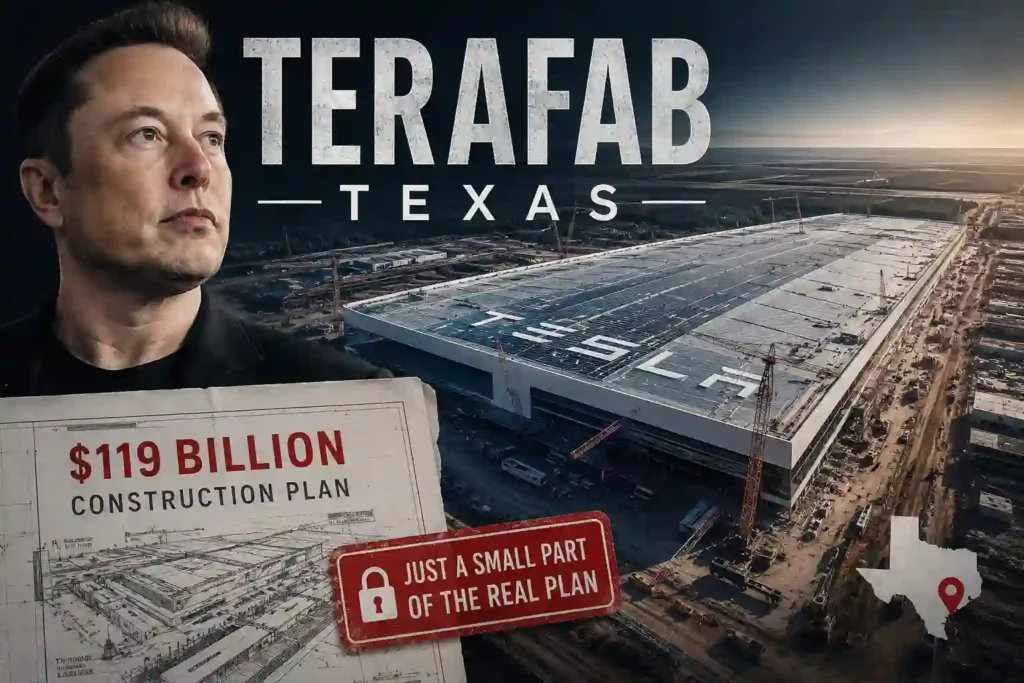
The Elon Musk Terafab construction plan centers on an enormous semiconductor manufacturing complex planned for Texas. If the project reaches its proposed full scale, the facility could eventually cover more than 100 million square feet and involve total investment approaching $119 billion.
That is not simply another factory.
Terafab is being designed around one of the biggest bottlenecks facing the artificial intelligence boom: chips.

Tesla needs increasingly powerful processors for autonomous vehicles and Optimus humanoid robots. SpaceX has its own computing ambitions, including hardware intended for space-based data centers. Meanwhile, the wider AI industry is consuming advanced semiconductor capacity at extraordinary speed.
Musk’s answer is unusually aggressive: instead of depending entirely on existing chip manufacturers, build a gigantic semiconductor ecosystem capable of manufacturing, packaging and testing advanced chips at enormous scale.
The first phase alone is expected to involve approximately $16.8 billion in investment.
And perhaps most surprising of all, the project is not being planned for Silicon Valley.
It is coming to Texas.
Here’s what the Elon Musk Terafab construction plan actually involves, why Musk’s companies believe they need something this large, and the enormous technical, financial and energy challenges standing between the plan and reality.
Table of Contents
What Is Elon Musk’s Terafab?
Terafab is a planned advanced semiconductor manufacturing complex associated with SpaceX and Tesla.
Unlike a conventional factory focused on assembling finished products, the proposed complex would handle critical stages of semiconductor production.
The facility is expected to include manufacturing, packaging and testing of advanced logic and memory devices.
In simple terms, Musk wants to build infrastructure capable of turning semiconductor technology into the computing hardware required by his growing collection of AI-driven businesses.
That makes Terafab important far beyond its physical size.
Terafab Is Really an AI Infrastructure Project
Calling Terafab a “chip factory” is technically correct, but it understates what Musk is attempting.
Modern AI systems depend on enormous amounts of computing power.
That computing power ultimately depends on physical hardware.
No matter how sophisticated an AI model becomes, it cannot operate without processors, memory, electricity, cooling systems, data centers and manufacturing capacity.
Terafab attacks the problem much further down the supply chain.
Instead of asking:
“Where can we buy enough AI chips?”
Musk’s companies are effectively asking:
“How do we manufacture the computing infrastructure ourselves at enormous scale?”
That distinction explains why Terafab could become one of Musk’s most consequential projects.
Why AI companies are racing to secure their own semiconductor supply chains
Where Will Elon Musk’s Terafab Be Built?
The full-scale Terafab project is planned for Grimes County, Texas, roughly northwest of the Houston metropolitan area and east of College Station.
Texas has increasingly become the center of Musk’s American industrial operations.
Tesla already operates Gigafactory Texas near Austin. SpaceX has extensive operations in the state, including Starbase in South Texas and facilities elsewhere.
Terafab would dramatically expand that footprint.
Why Grimes County?
Building a semiconductor complex at this scale requires much more than inexpensive land.
A suitable location needs access to enormous quantities of electricity, water, transportation infrastructure, skilled workers and communications networks.
It also needs enough physical space for future expansion.
The Terafab project is expected to occupy a site connected with the former Gibbons Creek power-generation area, giving developers access to land and infrastructure that could be valuable for an energy-intensive industrial complex.
For a project potentially measured in tens of millions of square feet, those advantages matter.
How Big Will Terafab Be?
This is where the numbers become difficult to visualize.
The proposed Terafab complex could eventually exceed 100 million square feet.
For perspective, that would put the project in an entirely different category from conventional semiconductor plants.
Even many of the world’s largest factories are measured in several million square feet.
Terafab’s proposed footprint would be measured in tens of millions.
Why Does Musk Need Such a Huge Facility?
The answer is not simply “because bigger is better.”
Musk wants to bring multiple semiconductor processes together at extraordinary scale.
Those processes could include:
- advanced chip manufacturing
- memory production
- semiconductor packaging
- testing
- supporting infrastructure
- power generation
- cooling
- logistics
- storage
- potentially additional supplier operations
Combining those capabilities reduces dependence on geographically separated facilities.
It could also shorten the time between manufacturing a chip and integrating it into a finished computing system.
That matters when companies are trying to produce millions of autonomous machines.
How Much Will Elon Musk’s Terafab Cost?
The numbers being discussed require an important distinction.
The initial phase and the possible eventual project are not the same thing.
Phase One: Approximately $16.8 Billion
The first phase is expected to involve an initial investment of roughly $16.8 billion.
That alone would make Terafab a massive industrial investment.
However, the number attracting far more attention is the potential long-term figure.
Full Buildout: Potentially Around $119 Billion
If the project expands through all envisioned phases, total investment could eventually approach $119 billion.
That figure should not be interpreted as $119 billion being spent immediately.
Megaprojects of this scale are normally developed in stages.
Production capacity can be expanded as demand grows, technology changes and earlier phases prove economically viable.
Therefore, the more useful way to understand the Elon Musk Terafab construction plan is:
$16.8 billion represents the initial commitment, while approximately $119 billion represents the potential scale of the fully developed project.
That distinction matters because headlines can easily make the project sound as though a $119 billion check has already been written.
It hasn’t.
What Will Terafab Manufacture?
Terafab is expected to produce advanced logic and memory devices optimized for AI-related applications.
But the intended customers make the project particularly interesting.
Musk already controls companies that could consume enormous quantities of the hardware produced inside the factory.
Chips for Tesla Optimus Robots
Tesla’s Optimus humanoid robot is expected to require sophisticated computing hardware capable of processing information rapidly while operating in the physical world.
A useful humanoid robot needs to interpret cameras and sensors, understand its surroundings, make decisions and control movement with extremely low delays.
That requires significant edge-computing capability.
If Tesla eventually manufactures Optimus robots at massive scale, semiconductor demand could become enormous.
Terafab could provide part of that supply.
How Tesla Optimus could transform manufacturing and the global labor market
Chips for Tesla Cybercabs
Tesla’s autonomous-driving ambitions create another source of semiconductor demand.
Self-driving vehicles must continuously process information coming from cameras and other systems.
Rather than sending every decision to a remote data center, much of that processing must happen inside the vehicle.
That makes powerful inference chips essential.
If Tesla succeeds in deploying Cybercabs at large scale, controlling its own chip supply could become strategically valuable.
Chips for SpaceX
The SpaceX side of the project may be even more ambitious.
The company is developing plans involving computing infrastructure operating beyond conventional terrestrial data centers.
Those systems would require high-performance processors engineered for demanding operating conditions.
Terafab is expected to manufacture high-power chips intended to support SpaceX’s future space-based computing infrastructure.
That connects the factory to a much larger Musk strategy.
Tesla provides vehicles and robots.
SpaceX provides launch infrastructure and satellites.
AI systems provide intelligence.
Terafab would provide some of the physical computing foundation underneath them.
Why Elon Musk Wants His Own Chip Manufacturing Capacity
The semiconductor shortage of the early 2020s taught technology and automobile companies an uncomfortable lesson.
You can design an extraordinary product and still fail to manufacture enough of it if one critical component is unavailable.
AI has made that vulnerability even more serious.
AI Is Creating Extraordinary Chip Demand
Training and operating increasingly powerful AI systems requires huge quantities of computing capacity.
Technology companies are spending billions of dollars building data centers filled with specialized processors.
But factories capable of producing the world’s most advanced chips cannot simply appear overnight.
Semiconductor fabrication facilities are among the most complicated industrial operations humans have ever built.
They require extraordinary precision, specialized machinery, huge amounts of capital and highly trained workers.
Musk appears unwilling to assume existing semiconductor suppliers will expand quickly enough to satisfy the future requirements of Tesla and SpaceX.
Terafab is his attempt to remove that constraint.
Vertical Integration Is the Bigger Strategy
This strategy should sound familiar to anyone who has followed Tesla or SpaceX.
Musk’s companies repeatedly try to bring strategically important capabilities in-house.
SpaceX manufactures much of its rocket technology internally.
Tesla develops vehicles, batteries, software, charging infrastructure and AI hardware.
Terafab takes that philosophy deeper into the semiconductor supply chain.
If successful, Musk’s companies would control more of the path from chip design to manufacturing and eventually deployment inside robots, vehicles and computing infrastructure.
That could provide significant strategic advantages.
However, it also creates enormous execution risk.
When Will Terafab Construction Begin?
The first phase of construction is expected to begin in 2026.
The project has also been associated with an aggressive target of beginning production around 2027.
That is remarkably fast for semiconductor manufacturing.
Building the shell of an enormous factory is only one part of the challenge.
Inside that building must go some of the most sophisticated manufacturing equipment in existence.
Then the equipment must be installed, calibrated, tested and brought to acceptable production yields.
Why The Timeline Matters
Semiconductor manufacturing projects can take years before reaching efficient large-scale production.
Therefore, the important milestone will not simply be when construction crews arrive.
Watch for:
- Site preparation.
- Major construction contracts.
- Power infrastructure.
- Semiconductor equipment orders.
- Supplier agreements.
- Equipment installation.
- Trial wafer production.
- Production yields.
- Commercial-scale output.
Those milestones will tell investors and industry observers far more than architectural renderings.
Terafab Will Need an Extraordinary Amount of Electricity
One of the least glamorous parts of the Terafab story may ultimately be one of the most important.
Electricity.
Advanced semiconductor manufacturing consumes enormous amounts of power.
Terafab’s scale means it cannot simply plug into the local electricity system like an ordinary industrial building.
It needs major dedicated energy infrastructure.
Terafab Is Expected to Use Natural Gas Power
Plans indicate the complex will rely substantially on dedicated natural-gas generation, combined with very large battery systems.
That decision is notable because Musk is also the CEO of Tesla, one of the world’s most recognizable clean-energy companies.
Tesla sells solar technology and large-scale battery storage.
Yet the Terafab strategy illustrates a difficult reality facing AI infrastructure developers: obtaining enormous amounts of dependable electricity quickly can be extremely difficult using intermittent renewable sources alone.
Natural gas can provide continuous power.
Large batteries can help stabilize demand and supply.
For Terafab, reliability may take priority over using solar power as the primary source.
Why Not Just Cover Terafab With Solar Panels?
The enormous roof naturally creates this question.
Could Tesla simply cover the facility in solar panels?
Solar could contribute electricity, but the scale of semiconductor manufacturing means rooftop generation alone would be unlikely to provide everything the complex requires around the clock.
Chip fabs operate continuously.
Cloudy weather does not stop semiconductor manufacturing.
Nighttime certainly does not.
That makes dependable power generation essential.
The decision will likely create debate because Terafab simultaneously represents cutting-edge AI infrastructure and a potentially enormous new source of fossil-fuel energy demand.
How the AI boom is reshaping America’s electricity grid
Water Could Be Another Major Challenge
Power receives most of the attention, but semiconductor manufacturing has another enormous requirement.
Water.
Chip fabrication requires highly purified water during manufacturing.
A project as large as Terafab could therefore place significant demands on local water infrastructure.
The exact long-term requirements will depend on the manufacturing technologies deployed, production levels and recycling systems incorporated into the facility.
Modern fabs increasingly recycle significant quantities of water.
Nevertheless, water availability will remain one of the project’s most important environmental and infrastructure questions.
How Many Jobs Could Terafab Create?
The initial phase is expected to create at least 3,000 jobs.
Many could be highly skilled positions connected with semiconductor manufacturing, engineering, equipment maintenance and advanced industrial operations.
But direct employment tells only part of the story.
Terafab Could Create a Semiconductor Ecosystem
Huge factories attract suppliers.
Those suppliers need warehouses.
Workers need housing.
Construction companies need employees.
Equipment needs maintenance.
Materials need transportation.
Restaurants, retailers and service businesses follow population growth.
As a result, the economic impact could extend well beyond the factory itself.
Grimes County could experience significant development if Terafab reaches anything close to its proposed scale.
That also means local infrastructure may come under pressure.
Roads, housing, schools, utilities and public services could all face increased demand.
Why Texas Keeps Attracting Musk’s Biggest Projects
Terafab is not an isolated move.
Texas has steadily become the geographical center of Musk’s business empire.
Several factors help explain why.
Space
Large industrial projects require large parcels of land.
Texas has them.
Energy
Texas is America’s largest energy-producing state and has enormous natural-gas, wind and solar resources.
For an energy-intensive project, access to multiple forms of generation matters.
Business Environment
Texas actively competes for large corporate investments through tax structures, economic-development programs and incentives.
Existing Musk Operations
Perhaps most importantly, Musk already has extensive operations and employees in Texas.
Every additional project creates more opportunities for the companies to share talent, suppliers, logistics and infrastructure.
Terafab therefore strengthens an industrial network that has already been forming for years.
Why Terafab Matters to America’s Semiconductor Strategy
There is also a national-security dimension.
The United States remains heavily dependent on overseas semiconductor manufacturing, particularly for advanced chips.
Taiwan plays an especially important role in global semiconductor production.
That concentration has worried policymakers and technology companies because disruptions could affect everything from smartphones to military systems.
Building additional semiconductor capacity inside the United States reduces some of that exposure.
Terafab would therefore join a broader American push toward domestic semiconductor manufacturing.
But Musk’s approach differs in one major respect.
The primary motivation appears to be enormous internal demand from his own companies.
Could Terafab Challenge Established Chip Manufacturers?
Not immediately.
This is one area where hype needs to be separated from reality.
Building a giant building does not automatically create a world-class semiconductor company.
The industry’s leaders have accumulated decades of expertise.
Advanced semiconductor manufacturing depends on thousands of highly specialized processes.
A tiny manufacturing defect can ruin a chip.
Therefore, manufacturing yield — the percentage of usable chips produced from each wafer — becomes crucial.
Terafab could possess extraordinary physical scale while still struggling economically if production yields are poor.
Semiconductor Expertise Cannot Simply Be Bought Overnight
Money helps.
Equipment helps.
Buildings help.
But semiconductor manufacturing also depends on institutional knowledge.
Engineers learn through years of production experience.
That is why partnerships with established semiconductor companies and equipment suppliers could prove crucial.
Terafab’s success may depend less on Musk’s ability to construct a huge factory and more on whether his companies can assemble the technical ecosystem required to operate it efficiently.
The Biggest Risks Facing the Elon Musk Terafab Construction Plan
Terafab sounds extraordinary on paper.
Executing it is another matter entirely.
Several obstacles could determine whether the project reaches its promised scale.
1. Construction Complexity
A 100-million-square-foot industrial complex would be an enormous construction challenge even without semiconductor manufacturing equipment inside it.
2. Capital Requirements
The potential $119 billion investment would make Terafab one of the world’s most expensive industrial projects.
Funding expansion over multiple phases will require continued confidence in future chip demand.
3. Semiconductor Equipment
Advanced fabs require extremely specialized equipment produced by a relatively small number of suppliers.
Securing enough machinery could become a bottleneck.
4. Skilled Workers
Terafab will need semiconductor engineers, technicians, construction workers, software specialists and equipment experts.
Recruiting thousands of qualified workers to one location will not be simple.
5. Electricity
The factory could require enormous dedicated generating capacity.
Building that infrastructure quickly and reliably will be essential.
6. Water
Semiconductor manufacturing requires significant water resources and sophisticated purification systems.
7. Production Yield
Manufacturing chips is not enough.
They must be manufactured reliably and economically.
Poor yields could dramatically increase costs.
8. Technology Changes
Semiconductor technology evolves rapidly.
Equipment installed today can become less competitive surprisingly quickly.
A project this large must therefore be designed to evolve rather than remain locked into one manufacturing process.
Could Terafab Really Become the World’s Largest Building?
By floor area, the proposed scale puts Terafab in territory rarely seen in modern industrial construction.
A footprint exceeding 100 million square feet would dwarf many famous buildings.
But there is an important qualifier.
The fully envisioned Terafab does not exist yet.
The project must progress through multiple stages before claims about the world’s largest building become reality.
For now, it is more accurate to describe Terafab as planned to become one of the largest — potentially the largest — buildings ever constructed by floor area if the complete vision is delivered.
That “if” matters.
Musk is famous for setting extremely aggressive targets.
Some eventually become reality.
Others take significantly longer than originally predicted.
The same possibility applies here.
What Terafab Reveals About Elon Musk’s Bigger AI Strategy
The most interesting part of Terafab may not be its size.
It is what the project tells us about Musk’s expectations for AI.
Nobody seriously considers spending tens of billions of dollars on semiconductor manufacturing unless they expect extraordinary future demand.
Musk appears to believe robots, autonomous vehicles and AI computing infrastructure will require vastly more chips than today’s manufacturing system can comfortably provide.
Terafab is essentially a physical bet on that future.
Tesla Could Become More Than an Automaker
Tesla has increasingly described itself through AI, robotics and autonomy rather than simply electric vehicles.
If Optimus succeeds, Tesla could become a major robotics manufacturer.
If autonomous driving succeeds, the company’s business could extend deeper into transportation services.
Both futures require enormous computing capacity.
Terafab would help provide it.
SpaceX Could Become More Than a Rocket Company
SpaceX already operates Starlink, one of the world’s largest satellite networks.
Its longer-term computing ambitions could expand that infrastructure further.
If computing eventually moves into orbit at meaningful scale, specialized semiconductor hardware will be required.
Terafab is being designed with that possibility in mind.
Why Elon Musk believes space-based AI data centers could be the next computing frontier
What Happens Next?
The Elon Musk Terafab construction plan is entering the stage where physical execution matters more than announcements.
Over the coming months and years, several developments will reveal whether the vision is progressing as planned.
Watch construction activity in Grimes County.
Watch power-generation permits.
Watch equipment purchases.
Watch semiconductor partnerships.
Watch hiring.
And eventually, watch production yields.
Those details will determine whether Terafab becomes a transformational American semiconductor complex or simply another industrial megaproject that struggles to match its original ambition.
The proposed numbers are spectacular.
But semiconductor manufacturing does not reward spectacle.
It rewards precision.
FAQs About the Elon Musk Terafab Construction Plan
The scale of Terafab naturally raises questions about its cost, location, construction, power supply and purpose. Here are answers to the most important questions surrounding the project.
1. What is the Elon Musk Terafab construction plan?
The Elon Musk Terafab construction plan involves developing an enormous semiconductor manufacturing complex in Texas designed to produce advanced logic, memory and AI-related chips for businesses including Tesla and SpaceX.
2. Where will Elon Musk’s Terafab be built?
The large-scale Terafab complex is planned for Grimes County, Texas, northwest of Houston and east of College Station.
3. How much will Terafab cost?
The initial phase is expected to involve approximately $16.8 billion in investment. If all planned phases are completed, the project’s total investment could eventually approach $119 billion.
4. Is Elon Musk spending $119 billion immediately on Terafab?
No. The roughly $119 billion figure represents the potential total investment associated with a fully expanded project. The initial investment is considerably smaller.
5. How big will Terafab be?
Plans envision a complex eventually exceeding 100 million square feet if the project reaches its full proposed scale.
6. Will Terafab be the world’s largest building?
If the complete 100-million-plus-square-foot vision is constructed, Terafab could become the world’s largest building by floor area. However, that depends on the full project actually being completed.
7. What will Terafab manufacture?
Terafab is expected to manufacture, package and test advanced logic and memory devices designed for AI and high-performance computing applications.
8. Will Terafab manufacture Tesla chips?
Tesla is expected to be one of the major users of chips produced through the Terafab project.
9. Will Terafab make chips for Tesla Optimus?
Yes. Chips optimized for edge computing and inference are expected to support Tesla’s Optimus humanoid robots.
10. Will Terafab make chips for Cybercabs?
The planned semiconductor output is also intended to support Tesla’s self-driving Cybercab ambitions.
11. Will SpaceX use Terafab chips?
Yes. SpaceX is expected to use high-performance chips associated with the Terafab project for future computing applications, including its ambitious plans for space-based data centers.
12. When will Terafab construction start?
Initial construction activity is expected to begin in 2026, although individual phases and infrastructure projects may follow different schedules.
13. When could Terafab start producing chips?
The project has been associated with a target of beginning initial production around 2027. Reaching large-scale production could take considerably longer.
14. How many jobs will Terafab create?
The first phase is expected to create at least 3,000 jobs, while indirect employment could expand through construction, suppliers and supporting businesses.
15. Why is Elon Musk building Terafab?
Musk’s companies expect their future robots, autonomous vehicles and AI computing infrastructure to require enormous quantities of semiconductor hardware. Terafab is designed to reduce dependence on external manufacturing capacity.
16. Why is Terafab being built in Texas?
Texas offers large amounts of land, significant energy resources, industrial infrastructure, economic incentives and proximity to several existing Musk operations.
17. Will Terafab use solar energy?
Solar power could potentially contribute to the site’s energy mix, but current plans emphasize dedicated natural-gas generation combined with large battery-storage systems.
18. Why would a Tesla-related project use natural gas?
Semiconductor manufacturing requires reliable 24-hour electricity. Natural gas can provide continuous generation, while battery systems can help manage fluctuations and peak demand.
19. How much electricity will Terafab need?
The exact final requirement will depend on how much of the planned complex is constructed and how much semiconductor production is installed. However, the scale of the project means its electricity demand could be enormous.
20. Will Terafab require large amounts of water?
Yes. Semiconductor manufacturing requires highly purified water. Recycling and treatment systems could reduce overall consumption, but water infrastructure will still be an important part of the project.
21. Could Terafab compete with TSMC?
Terafab could eventually become a major semiconductor manufacturing operation, but physical size alone will not make it competitive with established industry leaders. Technology, manufacturing yields, equipment and expertise will determine its competitiveness.
22. What is the biggest challenge facing Terafab?
Execution may be the biggest challenge. Building the facility is only the beginning. Producing advanced chips economically at high yields requires extraordinary technical expertise.
23. Why does Terafab matter for American chip manufacturing?
The project could add significant semiconductor capacity inside the United States at a time when the country is trying to reduce its dependence on overseas chip production.
24. How is Terafab connected to artificial intelligence?
Terafab is being developed largely because AI systems, autonomous vehicles, robots and advanced computing infrastructure require rapidly increasing amounts of semiconductor processing power.
25. Will Elon Musk’s full Terafab plan actually happen?
That remains uncertain. The first phases can proceed without guaranteeing that the entire 100-million-square-foot, potentially $119 billion vision will ultimately be completed. Construction progress, semiconductor demand, financing, power availability and manufacturing performance will determine how far the project expands.
Conclusion
The Elon Musk Terafab construction plan is remarkable not simply because of the proposed 100-million-square-foot building or the possibility of eventually spending around $119 billion.
The bigger story is what Musk believes is coming next.
Tesla is betting on autonomous vehicles and humanoid robots. SpaceX is pursuing increasingly ambitious computing and space infrastructure. All of those technologies require enormous quantities of advanced semiconductor hardware.
Terafab is an attempt to secure that hardware at a scale few companies would even consider.
If the project succeeds, Musk’s companies could gain greater control over one of the most important resources in the AI economy: computing power.
But the gap between announcing a gigantic semiconductor complex and operating one profitably is enormous.
Terafab must secure energy, water, workers, equipment and technical expertise. It must manufacture advanced chips at competitive yields. And it must do all of that while semiconductor technology continues evolving.
That is why the most important number may ultimately not be $119 billion or 100 million square feet.
It will be the number of usable advanced chips Terafab can reliably produce.
Because when the construction headlines disappear, that is what will determine whether Musk’s biggest factory becomes an industrial revolution — or simply a very big building.