For years, hundreds of thousands of federal student loan borrowers have lived with uncertainty. They believed they had been misled by the schools they attended, filed applications asking for relief, and then waited…and waited.
Many expected a decision within months.
Instead, they spent years wondering whether anyone would ever review their claims.
That long period of uncertainty is finally beginning to change.
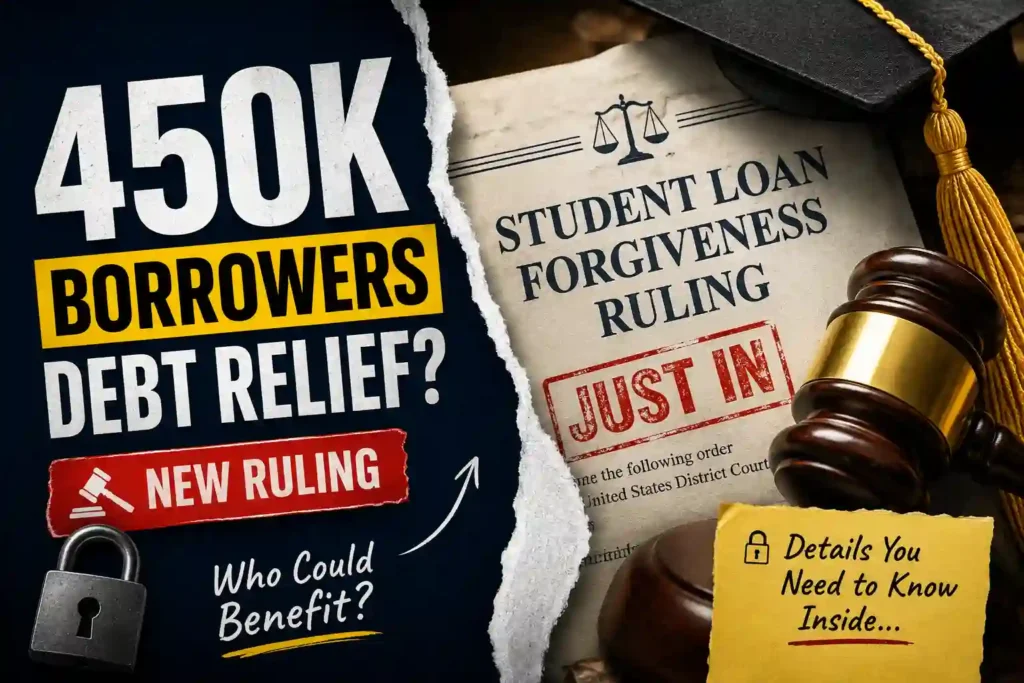
A major legal ruling is now requiring action on approximately 450,000 long-pending borrower defense applications, potentially opening the door for eligible borrowers to receive federal student loan forgiveness after years of delays. While this doesn’t mean every borrower will automatically have their loans erased, it does represent one of the biggest borrower defense developments in recent years.
For many people, this update is about far more than eliminating debt. It is about finally receiving an answer after years of financial uncertainty.
If you’ve seen headlines about 450K borrowers debt relief and are wondering whether you qualify, what happens next, or how this decision could affect your federal student loans, this guide explains everything in plain English.
More importantly, it goes beyond the headlines. You’ll learn how borrower defense actually works, why these applications remained unresolved for so long, who may benefit from the latest ruling, what borrowers should do next, and how this update fits into the broader landscape of student loan forgiveness in 2026.
If you’re still trying to understand the bigger picture, it also helps to read Who Qualifies for Student Loan Forgiveness in 2026, Sweet v. McMahon Explained, Borrower Defense Student Loan Forgiveness, and Student Loan Deferment vs. Forbearance. Together, these guides explain how the latest developments fit into the federal student loan system and can help you make better financial decisions instead of reacting to headlines alone.
Table of Contents
What Is the 450K Borrowers Debt Relief Update?
The phrase 450K borrowers debt relief refers to a significant legal development affecting approximately 450,000 federal student loan borrowers whose borrower defense applications remained undecided long after they were submitted.
These borrowers aren’t receiving relief simply because they have student loans.
Instead, they previously applied for borrower defense because they believed the schools they attended made false or misleading claims that influenced their decision to enroll and borrow federal student loans.
Many applications sat unresolved for years.
Rather than receiving an approval or a denial, borrowers found themselves stuck in administrative limbo. During that time, many continued worrying about their growing balances, their financial future, and whether their applications would ever receive a final review.
The latest ruling changes that.
Instead of allowing these applications to remain in limbo indefinitely, the government must move forward with processing eligible claims under the court’s requirements. That means thousands of borrowers who have spent years waiting may finally receive the answers they have been seeking.
For some borrowers, the outcome could be complete federal student loan discharge. Others may receive different outcomes depending on the facts of their individual cases.
One thing is clear, however: this ruling moves long-delayed applications closer to resolution, bringing certainty to borrowers who have been waiting far too long.
Understanding Borrower Defense to Repayment
To understand why the 450K borrowers debt relief update is making headlines across the United States, it’s important to first understand what Borrower Defense to Repayment actually is.
Unlike broad student loan forgiveness initiatives that target income-driven repayment plans or public service workers, borrower defense is designed to help borrowers who believe they were financially harmed because a school engaged in misconduct.
In simple terms, the program allows eligible borrowers to ask the federal government to cancel their federal student loans if they can show that their college or university violated certain laws or made significant misrepresentations.
The idea behind the program is straightforward.
Students make one of the biggest financial decisions of their lives when they choose a college. If that decision was based on false promises or deceptive information, they should have a way to seek relief.
That doesn’t mean every unhappy graduate qualifies.
Many students graduate and struggle to find jobs for reasons completely unrelated to their school. Borrower defense is intended for situations where there is evidence that the institution itself engaged in conduct that misled prospective students.
For anyone who wants a complete breakdown of eligibility requirements, documentation, timelines, and the application process, Borrower Defense Student Loan Forgiveness explains the program in much greater detail.
Why So Many Borrowers Applied for Borrower Defense
Thousands of borrowers submitted borrower defense applications after believing they had enrolled in schools based on information that later turned out to be inaccurate or misleading.
Although every case is unique, common allegations have included:
Misleading Job Placement Claims
Some borrowers alleged that schools advertised extremely high job placement rates that did not accurately reflect graduates’ real employment outcomes.
For many students, those employment statistics played a major role in deciding whether taking on thousands of dollars in federal student loans would be worthwhile.
Inflated Salary Expectations
Another common complaint involved schools promoting earnings that graduates supposedly achieved after completing their programs.
If those figures were exaggerated or unsupported, students may have made borrowing decisions based on unrealistic expectations.
Misrepresenting Accreditation
Accreditation matters because it can affect:
- Employment opportunities
- Professional licensing
- Credit transfers
- Acceptance into graduate programs
Borrowers have alleged that some institutions gave inaccurate or misleading information regarding accreditation or the value of certain programs.
False or Misleading Advertising
Marketing materials can strongly influence enrollment decisions.
Some borrower defense claims involve allegations that promotional materials overstated program quality, partnerships with employers, internship opportunities, or career outcomes.
Again, every borrower must be evaluated individually based on the facts of their case.
Why Did These Applications Take So Long?
One of the biggest questions surrounding the 450K borrowers debt relief update is why so many applications remained unresolved for years.
The answer isn’t as simple as one delay or one administrative problem.
Instead, several factors combined to create a massive backlog.
First, borrower defense applications increased dramatically over time. As more borrowers learned about the program and submitted claims, the number of pending applications grew much faster than they could be reviewed.
Second, borrower defense policies changed multiple times over the years.
Each policy change affected how applications were processed, what standards were applied, and how quickly decisions could be made. Those changes created additional delays for borrowers who had already been waiting.
Third, ongoing legal disputes complicated the review process.
Court proceedings influenced how certain borrower defense claims would be handled, meaning some applications could not move forward until legal questions were resolved.
The result was a growing backlog affecting hundreds of thousands of borrowers.
For the people involved, this wasn’t merely an administrative inconvenience.
It affected nearly every aspect of their financial lives.
Some postponed buying their first home because of outstanding student debt.
Others delayed getting married or starting a family while waiting to see whether their balances would eventually be forgiven.
Many continued making payments on loans they believed should never have existed in the first place.
Others struggled with damaged financial confidence simply because they had no idea what their future loan balance would be.
After years of uncertainty, the latest ruling represents meaningful progress toward resolving those long-pending cases.
What Does the New Court Decision Actually Do?
One of the biggest misconceptions is that the court ruling automatically cancels student loans for 450,000 borrowers.
That is not what happened.
Instead, the decision requires long-delayed borrower defense applications covered by the litigation to move toward resolution rather than remaining stuck indefinitely.
In practical terms, the ruling reinforces that eligible applications must receive the review and action they have been awaiting for years.
For borrowers whose applications qualify under the court’s orders, possible outcomes may include:
- Complete discharge of eligible federal student loans.
- Partial loan forgiveness where applicable.
- Refunds of qualifying payments, depending on individual circumstances.
- Updates to federal loan records after relief is granted.
Each borrower’s outcome depends on the facts of their application.
Some borrowers may receive full relief.
Others may receive a different decision after their applications are reviewed.
The important point is that borrowers are finally moving closer to receiving an official answer instead of remaining trapped in years of uncertainty.
Does Every Federal Student Loan Borrower Qualify?
No.
This is one of the biggest myths circulating online.
Simply having federal student loans does not make someone eligible for this relief.
Generally speaking, the latest development applies to borrowers whose cases fall within the scope of the court’s ruling involving borrower defense applications.
Eligibility depends on several factors, including:
- Whether a borrower submitted a borrower defense application.
- When that application was filed.
- Whether it remained unresolved under the applicable deadlines.
- Whether the application falls within the group covered by the court’s decision.
That means two people who attended the same school may receive different outcomes based on their individual circumstances.
If you’re exploring other federal forgiveness options beyond borrower defense, Who Qualifies for Student Loan Forgiveness in 2026 explains several programs that may be available depending on your employment, repayment plan, or other eligibility requirements.
What Happens Next for Eligible Borrowers?
For many borrowers, the biggest question is no longer “Will anything happen?” but rather “What happens now?”
The latest legal development moves long-pending borrower defense claims closer to a final resolution, but that doesn’t mean every borrower will wake up tomorrow with a zero loan balance.
The process still involves several important steps.
1. Pending Applications Will Continue Moving Through the Review Process
Borrowers whose applications fall within the scope of the court’s decision should expect their cases to continue moving toward a final determination.
Some borrowers may receive updates sooner than others because applications are not all in the same stage of review.
Several factors can influence processing times, including:
- When the application was submitted.
- The supporting documentation provided.
- The institution involved.
- Administrative processing requirements.
For borrowers who have waited years without any meaningful update, simply having their application move forward represents significant progress.
2. Individual Decisions Will Still Be Made
One of the biggest misunderstandings surrounding the 450K borrowers debt relief update is that every affected borrower will automatically receive loan cancellation.
That isn’t how borrower defense works.
Every application is reviewed individually.
During that review, officials consider the evidence submitted with the application along with other available information.
Possible outcomes include:
- Full approval.
- Partial approval.
- Denial if eligibility requirements are not met.
Because each case is different, borrowers should avoid comparing their situation with someone else’s, even if they attended the same institution.
3. Loan Servicers May Update Borrowers
As cases move toward completion, borrowers may receive updates regarding their federal student loans.
Depending on the outcome, those updates could include:
- Changes to outstanding balances.
- Adjustments to repayment status.
- Loan discharge notifications.
- Information regarding refunds if applicable.
Because communications can occur through multiple channels, borrowers should make sure their contact information is current.
What Borrowers Should Do Right Now
Although the latest ruling is encouraging news for many people, borrowers should avoid making financial decisions based solely on headlines.
Instead, taking a few practical steps can help ensure they don’t miss important updates.
Keep Contact Information Up to Date
If your mailing address, email address, or phone number has changed, update your information through the appropriate federal student aid channels and your loan servicer.
Missing an important notice could delay your ability to respond if additional information is requested.
Save Copies of Your Documents
Even if you submitted your borrower defense application years ago, it’s wise to keep copies of everything related to your claim.
Helpful documents may include:
- Application confirmations.
- Emails regarding your claim.
- Enrollment agreements.
- Financial aid documents.
- Advertising materials.
- Communications from your school.
Keeping organized records can make it much easier to answer questions if they arise later.
Continue Monitoring Your Loan Status
Borrowers should periodically review their federal student loan accounts for updates.
Depending on individual circumstances, borrowers may notice:
- Balance adjustments.
- Status changes.
- New correspondence.
- Updated repayment information.
Checking periodically is helpful, but there’s no need to monitor accounts obsessively every day.
Stay Informed About Student Loan Changes
Student loan policies continue to evolve.
Even borrowers who don’t qualify under this particular ruling may become eligible for other programs in the future.
That’s why it’s helpful to stay informed about developments affecting federal student loans.
You may also find these guides useful:
- How to Get Out of Student Loan Debt Faster
- Income-Driven Repayment Plans Explained
- Student Loan Consolidation Explained
- Student Loan Forgiveness Programs Every Borrower Should Know
Understanding all available repayment and forgiveness options can help borrowers make better long-term financial decisions.
Common Myths About the 450K Borrowers Debt Relief Update
Because this story has attracted widespread attention, several misconceptions have spread online.
Let’s separate fact from fiction.
Myth #1: Every Student Loan Borrower Will Receive Forgiveness
This is false.
The latest ruling does not erase student loans for everyone.
It primarily affects borrowers whose borrower defense applications fall within the scope of the court’s decision.
Myth #2: Private Student Loans Are Included
Borrower defense generally applies to eligible federal student loans.
Private education loans typically follow different rules and are not covered under borrower defense.
Myth #3: Borrowers Need to Submit a Brand-New Application Immediately
Not necessarily.
Many of the borrowers affected by this update already submitted borrower defense applications years ago.
Whether someone needs to file a new application depends entirely on their individual situation.
Myth #4: Everyone Will Receive the Same Amount of Relief
No.
Borrower defense decisions are made on a case-by-case basis.
Some borrowers may qualify for complete discharge.
Others may receive partial relief.
Some applications may ultimately be denied if eligibility requirements are not met.
Myth #5: This Means Student Loan Problems Are Over
Unfortunately, no.
Millions of Americans continue to face challenges with student loan repayment.
While this ruling represents an important victory for many borrowers, it addresses one specific category of claims rather than solving every issue within the federal student loan system.
For that reason, borrowers should continue exploring all available repayment and forgiveness options rather than assuming this update applies to every situation.
How This Ruling Could Affect Borrowers Financially
For borrowers who ultimately receive approval under the borrower defense program, the impact could extend far beyond seeing a lower student loan balance.
Student loan debt influences nearly every major financial decision people make. When that debt is reduced or eliminated, it can create opportunities that may have seemed out of reach for years.
Here are some of the ways eligible borrowers could benefit.
Greater Financial Flexibility
A large monthly student loan payment can consume a significant portion of a household’s budget.
If those payments are reduced or eliminated, borrowers may have more money available to:
- Build an emergency fund.
- Pay off high-interest credit card debt.
- Save for retirement.
- Invest for the future.
- Cover everyday living expenses more comfortably.
For many families, that extra financial flexibility can make a meaningful difference.
Improved Ability to Purchase a Home
Student loan debt is one factor lenders consider when evaluating mortgage applications.
Lower monthly debt obligations may improve a borrower’s debt-to-income ratio, potentially making it easier to qualify for a mortgage or borrow under better terms.
Of course, many other factors—such as income, credit history, and overall financial health—also play an important role.
Reduced Financial Stress
Money worries don’t only affect bank accounts.
They can also affect mental well-being.
Many borrowers have spent years wondering whether they would ever receive a decision on their borrower defense applications.
Finally receiving an answer—whatever that answer may be—allows borrowers to move forward with greater certainty instead of living with years of unanswered questions.
Better Long-Term Financial Planning
Financial planning becomes much easier when borrowers know exactly where they stand.
Instead of making decisions based on uncertainty, borrowers can begin creating realistic plans for:
- Buying a home.
- Starting a business.
- Changing careers.
- Saving for children’s education.
- Preparing for retirement.
Knowing the outcome of a borrower defense application provides clarity that many applicants have lacked for years.
How the 450K Borrowers Debt Relief Update Fits Into the Bigger Student Loan Picture
Although this ruling has attracted significant attention, it’s important to understand that borrower defense is only one part of the federal student loan system.
Different borrowers qualify for different programs depending on their circumstances.
For example, some borrowers may benefit from:
- Income-driven repayment plans.
- Public service loan forgiveness.
- Total and permanent disability discharge.
- Closed school discharge.
- Teacher loan forgiveness.
- Borrower defense to repayment.
Each program has its own eligibility rules, application process, and requirements.
That’s why borrowers shouldn’t assume that missing out on one program means they have no other options.
In many cases, reviewing every available repayment and forgiveness pathway can uncover opportunities that borrowers didn’t realize existed.
If you’re trying to understand all of the programs available today, Who Qualifies for Student Loan Forgiveness in 2026 provides a broader overview of the major federal forgiveness options, while Sweet v. McMahon Explained takes a deeper look at the legal case connected to this latest borrower defense update.
Frequently Asked Questions About 450K Borrowers Debt Relief
What is the 450K borrowers debt relief update?
The 450K borrowers debt relief update refers to a major legal development affecting approximately 450,000 federal student loan borrowers whose borrower defense applications remained unresolved for years. The ruling requires those long-pending applications to move toward a final resolution.
Does every federal student loan borrower qualify?
No. This update does not apply to every federal student loan borrower. It primarily affects borrowers whose borrower defense claims fall within the scope of the court’s ruling.
What is borrower defense to repayment?
Borrower defense to repayment is a federal program that allows eligible borrowers to seek forgiveness of federal student loans if they believe their school engaged in certain types of misconduct or made significant misrepresentations.
Will everyone’s loans be completely forgiven?
No. Each borrower defense application is reviewed individually. Some borrowers may receive full loan discharge, others partial relief, while some claims may not meet the eligibility requirements.
Are private student loans included?
Generally, no. Borrower defense applies to eligible federal student loans rather than private education loans.
Do borrowers need to submit another application?
Not necessarily. Many of the borrowers affected by this ruling already submitted borrower defense applications years ago. Whether a new application is necessary depends on each individual’s circumstances.
How long will it take to receive a decision?
There is no single timeline that applies to every borrower. Processing times may vary depending on the complexity of each case and administrative requirements.
Can borrowers continue making payments while waiting?
Borrowers should follow the repayment instructions applicable to their individual loans unless they receive official guidance indicating otherwise.
Will interest continue to accrue?
That depends on the status of the loan and the borrower’s individual circumstances. Borrowers should review their account information carefully.
Can borrowers receive refunds?
Some borrowers whose loans are discharged may qualify for refunds of certain payments, depending on their individual situation and applicable program rules.
Does this ruling create a new forgiveness program?
No. The ruling concerns existing borrower defense applications rather than creating a brand-new federal student loan forgiveness program.
Can borrowers check the status of their application?
Yes. Borrowers should monitor their federal student loan account and communications for updates regarding their application.
What types of school misconduct may qualify?
Examples can include significant misrepresentations about job placement rates, accreditation, graduate earnings, or other material information that influenced enrollment decisions.
Can attending the same school guarantee approval?
No. Borrower defense claims are evaluated individually, so different borrowers from the same institution may receive different outcomes.
Does this affect income-driven repayment plans?
No. Borrower defense is separate from income-driven repayment programs, although some borrowers may be eligible for both depending on their circumstances.
What if a borrower already paid off the loan?
Eligibility for any additional relief depends on the specific facts of each case and applicable program rules.
Is this related to Public Service Loan Forgiveness?
No. Public Service Loan Forgiveness is a separate federal program with different eligibility requirements.
Will loan servicers automatically notify eligible borrowers?
Borrowers should monitor their accounts and communications, as updates may be provided as cases move forward.
Can borrowers appeal a denial?
Available options depend on the specific circumstances of the application and applicable regulations.
Does borrower defense affect credit reports?
If loans are discharged, related account information may be updated where appropriate.
Why were so many applications delayed?
A combination of administrative backlogs, policy changes, and legal proceedings contributed to years-long delays for many borrower defense applications.
Is this the largest borrower defense action in recent years?
It is among the most significant developments involving borrower defense because it affects hundreds of thousands of long-pending applications.
Can borrowers still apply for borrower defense?
Borrowers who believe they meet the eligibility requirements may still explore whether the borrower defense program applies to their situation.
What should borrowers do right now?
Borrowers should keep their contact information current, save important records, monitor their loan status, and stay informed about future student loan developments.
Where can borrowers learn about other forgiveness programs?
Borrowers should also explore Income-Driven Repayment Plans Explained, Student Loan Consolidation Explained, How to Get Out of Student Loan Debt Faster, and Who Qualifies for Student Loan Forgiveness in 2026 to better understand the full range of repayment and forgiveness options available.
Conclusion
The 450K borrowers debt relief update marks an important step forward for hundreds of thousands of borrowers who have spent years waiting for answers. Rather than introducing a new student loan forgiveness program, the latest ruling helps move long-delayed borrower defense applications toward the decisions borrowers have been seeking for years.
While not every applicant will receive loan cancellation, the ruling reinforces an important principle: borrowers deserve timely decisions on claims that can significantly affect their financial future.
If you’re among the borrowers potentially affected, staying informed, monitoring your loan status, and understanding your rights will be essential in the months ahead. And even if this particular ruling doesn’t apply to your situation, it’s worth exploring other federal repayment and forgiveness programs that could help you reduce or eliminate your student loan debt over time.