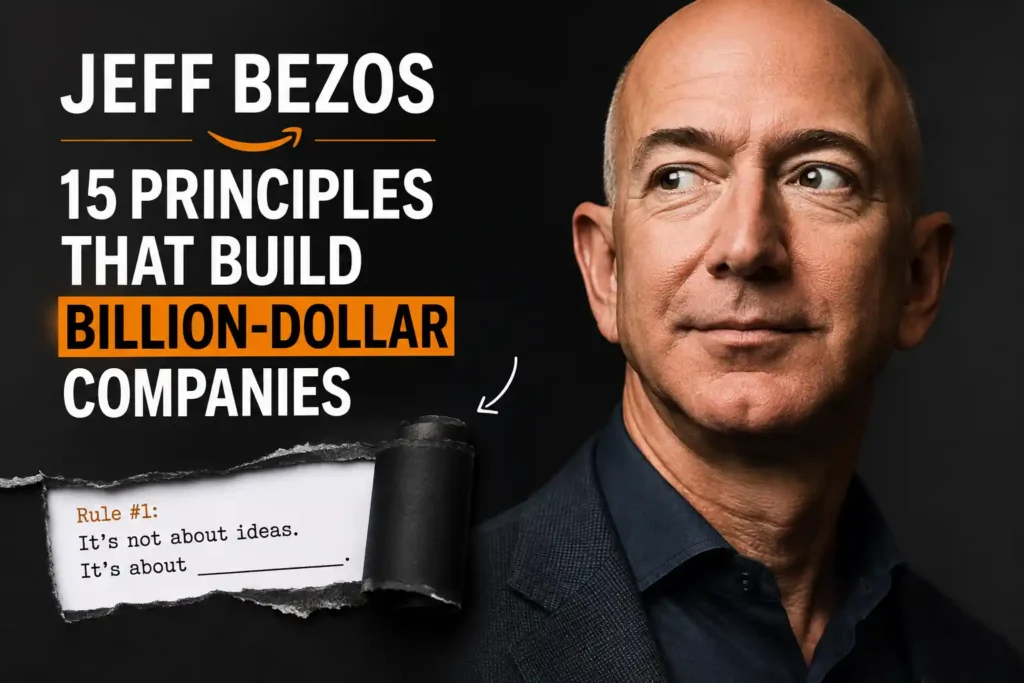
Every entrepreneur dreams of building a successful business.
Some want financial freedom. Others want to solve meaningful problems, create jobs, or leave a lasting legacy. Yet regardless of the goal, every entrepreneur eventually faces the same questions.
How do you build a business that lasts?
How do you make better decisions when the future is uncertain?
How do you keep growing while competitors fight for the same customers?
Few people have explored those questions as deeply as Jeff Bezos.
When he founded Amazon in 1994, online shopping was still a novelty. Many investors doubted consumers would trust the internet with their credit card information, and even fewer believed an online bookstore could become one of the world’s most valuable companies.
More than three decades later, Amazon has transformed global commerce, cloud computing, logistics, digital entertainment, and artificial intelligence. Along the way, Bezos developed a business philosophy that continues to influence entrepreneurs across every industry.
What’s remarkable is that many of his greatest lessons have little to do with Amazon itself.
They are timeless principles that any entrepreneur—whether running a startup, an online business, a consulting firm, or a local company—can apply.
This guide explores the most valuable business lessons every entrepreneur can learn from Jeff Bezos, explains why they matter, and shows how they can help build stronger, more resilient businesses.
Table of Contents
Who Is Jeff Bezos?
Jeff Bezos is an entrepreneur, investor, and the founder of Amazon.
Although he is widely known for creating one of the world’s largest technology companies, his influence extends far beyond e-commerce.
He has built businesses in cloud computing, invested in artificial intelligence, entered the media industry, and pursued private space exploration through Blue Origin.
Throughout his career, one characteristic has remained remarkably consistent.
He thinks differently.
Rather than focusing on quick wins, Bezos often makes decisions based on where he believes the world will be ten or even twenty years into the future.
That long-term perspective is one of the biggest reasons entrepreneurs continue studying his leadership style.
Lesson 1: Obsess Over Customers, Not Competitors
One of Jeff Bezos’ most famous ideas is customer obsession.
Many companies spend enormous amounts of time watching competitors.
They ask questions like:
- What are our competitors doing?
- How can we copy their newest feature?
- How do we beat them?
Bezos approached business differently.
Instead of asking what competitors wanted, he asked what customers wanted.
That shift changes everything.
Customers rarely care who launches a feature first.
They care about receiving better value, better service, lower prices, and better experiences.
Businesses that consistently solve customer problems often outperform businesses focused primarily on reacting to competitors.
How Entrepreneurs Can Apply This
Rather than constantly checking competitors’ websites, spend more time:
- Talking to customers.
- Reading reviews.
- Solving recurring complaints.
- Improving customer experience.
- Making products easier to use.
Happy customers become repeat customers.
Repeat customers become your best marketers.
Lesson 2: Think Long Term
Many entrepreneurs make decisions based on this month.
Bezos often made decisions based on the next decade.
That difference explains much of Amazon’s success.
For years, Amazon reinvested profits instead of maximizing short-term earnings.
Many investors questioned the strategy.
Today, those long-term investments have become some of Amazon’s greatest competitive advantages.
Long-term thinking allows entrepreneurs to:
- Build stronger systems.
- Improve products continuously.
- Invest in innovation.
- Earn customer trust.
- Create sustainable growth.
Ask Yourself
Instead of asking:
“How can I make more money this month?”
Ask:
“What decision will make my business stronger five years from now?”
The answers are often very different.
Lesson 3: Make Decisions With the Regret Minimization Framework
Before leaving his successful Wall Street career, Bezos asked himself one simple question.
“When I’m eighty years old, will I regret trying—or regret never trying?”
That question became his Regret Minimization Framework.
Rather than allowing fear to guide important decisions, he focused on future regret.
Entrepreneurs often delay opportunities because of uncertainty.
While every decision involves risk, avoiding action can sometimes be the greater risk.
The framework doesn’t encourage reckless behavior.
Instead, it encourages thoughtful action based on long-term perspective.
Lesson 4: Embrace Failure as Part of Innovation
Many businesses avoid failure at all costs.
Bezos believed failure and innovation are inseparable.
Amazon has experienced numerous unsuccessful products and projects.
Yet those failures helped the company learn faster than many competitors.
Every failed experiment provided valuable information.
Every lesson improved future decisions.
The Entrepreneur’s Reality
If every project succeeds, you probably aren’t experimenting enough.
Innovation requires calculated risk.
The goal isn’t eliminating failure.
The goal is learning faster than everyone else.
Lesson 5: Build Systems Instead of Chasing Shortcuts
Businesses often struggle because owners become the system.
Everything depends on them.
Amazon scaled because Bezos built repeatable processes rather than relying solely on individuals.
Strong businesses document procedures.
They automate repetitive work.
They improve efficiency continuously.
Entrepreneurs should ask themselves:
“If I disappeared for one month, could my business still operate?”
If the answer is no, stronger systems are needed.
Lesson 6: Stay Curious
Jeff Bezos has never stopped learning.
Even after building Amazon, he continued exploring:
- Artificial intelligence
- Space exploration
- Robotics
- Healthcare
- Biotechnology
- Renewable energy
Curiosity creates opportunity.
Many industries change because someone becomes interested in solving a new problem.
Entrepreneurs who continue learning often discover opportunities competitors never notice.
Lesson 7: Hire Exceptional People
Bezos understood that businesses grow because of people.
Average teams usually produce average results.
Great teams consistently solve difficult problems.
Amazon became known for maintaining high hiring standards.
Although recruiting exceptional talent often requires more effort, the long-term benefits usually outweigh the short-term inconvenience.
One outstanding employee can accomplish what several average employees cannot.
Lesson 8: Simplify Complex Problems
Customers appreciate simplicity.
Businesses often create unnecessary complexity.
Bezos constantly challenged teams to simplify products, services, and processes.
Ask yourself:
Can customers buy faster?
Can they understand your product more easily?
Can support become simpler?
Can your website become clearer?
Small improvements in simplicity often produce significant business results.
Lesson 9: Protect Your Reputation
Jeff Bezos has repeatedly emphasized that trust is difficult to earn and easy to lose.
A business can spend years building credibility.
One careless decision can destroy it.
Entrepreneurs should protect their reputation by:
- Delivering what they promise.
- Being transparent.
- Correcting mistakes quickly.
- Communicating honestly.
- Putting customers first.
Trust compounds over time.
So does distrust.
Lesson 10: Focus on Cash Flow, Not Just Revenue
High sales do not always mean a healthy business.
Many companies generate impressive revenue while struggling financially.
Successful entrepreneurs monitor:
- Profit margins.
- Operating expenses.
- Cash flow.
- Customer acquisition costs.
- Lifetime customer value.
Growing revenue without understanding financial health can create serious problems.
Smart growth is better than fast growth.
Lesson 11: Innovate Before You’re Forced To
Many companies wait until competition forces change.
Bezos believed businesses should innovate while they’re already successful.
Amazon continuously introduced new products even when existing ones performed well.
That proactive mindset helped prevent stagnation.
Entrepreneurs should regularly ask:
“What will disrupt my business if I don’t improve?”
Then solve that problem before someone else does.
Lesson 12: Measure What Matters
Bezos valued data.
He encouraged decisions supported by evidence rather than assumptions.
Entrepreneurs should track metrics that genuinely influence business performance.
Examples include:
- Customer retention
- Conversion rates
- Customer satisfaction
- Profit margins
- Website traffic quality
- Repeat purchases
Measuring the right numbers helps businesses improve intelligently instead of guessing.
Lesson 13: Stay Adaptable
Markets change.
Technology evolves.
Customer expectations shift.
Businesses that refuse to adapt eventually fall behind.
Amazon constantly evolved from:
- Books
- Retail
- Cloud computing
- Streaming
- Artificial intelligence
- Smart devices
- Healthcare
Entrepreneurs should remain flexible enough to recognize new opportunities without abandoning their core strengths.
Lesson 14: Build a Business Bigger Than Yourself
Jeff Bezos never built Amazon around his personal brand.
He built systems, culture, technology, and leadership capable of thriving beyond any one individual.
That approach allowed Amazon to continue growing after he stepped down as CEO.
Entrepreneurs should aim to create businesses that can succeed independently.
A business dependent on one person is often difficult to scale.
Lesson 15: Never Stop Thinking About the Future
Perhaps Bezos’ greatest strength is his ability to think decades ahead.
While others focused on today’s profits, he invested in tomorrow’s opportunities.
Cloud computing.
Artificial intelligence.
Automation.
Space exploration.
Each reflected a willingness to prepare for the future long before it became obvious.
Entrepreneurs don’t need to predict every trend.
They simply need to remain curious enough to recognize opportunities before everyone else.
If you’d like to understand how Amazon became one of the world’s most valuable companies, read How Amazon Web Services (AWS) Changed the Internet Forever, where you’ll discover why cloud computing became Amazon’s most profitable business.
Interested in long-term business strategy? Explore How Long-Term Thinking Creates Businesses That Last to learn why sustainable growth often beats chasing quick profits.
Want to become a better leader? Don’t miss The Leadership Habits of the World’s Most Successful Entrepreneurs, which explores practical habits shared by top business founders.
Curious about innovation? Read How to Build a Business That Customers Truly Love to discover why customer obsession remains one of the strongest competitive advantages any entrepreneur can develop.
Frequently Asked Questions About Jeff Bezos’ Business Lessons
What is Jeff Bezos’ biggest business lesson?
Customer obsession is widely considered his most important principle because it guides product development, innovation, and long-term growth.
Why does Jeff Bezos focus on customers instead of competitors?
He believes competitors eventually copy products, but businesses that consistently delight customers build stronger loyalty.
What is the Regret Minimization Framework?
It is a decision-making approach that asks whether you would regret not taking an opportunity when looking back years later.
Why is long-term thinking important in business?
Long-term thinking encourages sustainable growth, stronger customer relationships, and better strategic decisions.
How did Jeff Bezos use innovation?
He encouraged constant experimentation, accepting that some projects would fail while others would transform entire industries.
Why does Jeff Bezos accept failure?
He views failure as an essential part of discovering successful innovations.
What leadership style is Jeff Bezos known for?
He is known for customer obsession, data-driven decision-making, high standards, experimentation, and long-term vision.
Why are systems important in business?
Systems improve consistency, efficiency, scalability, and reduce dependence on individual employees.
What can small businesses learn from Amazon?
Small businesses can adopt customer focus, continuous improvement, data analysis, and long-term planning regardless of their size.
Why is curiosity valuable for entrepreneurs?
Curiosity helps identify emerging opportunities, solve problems creatively, and encourage innovation.
Does Jeff Bezos believe in taking risks?
Yes, but he advocates calculated risks supported by careful thinking rather than reckless decisions.
Why is reputation important?
Customer trust takes years to build but can be lost quickly, making reputation one of a company’s most valuable assets.
What role does data play in Jeff Bezos’ decisions?
Data helps reduce assumptions and improves the quality of business decisions.
Why does Amazon experiment so much?
Continuous experimentation helps discover better products, services, and customer experiences.
How can entrepreneurs apply Bezos’ principles?
By focusing on customers, building systems, embracing learning, thinking long term, and continuously improving.
What industries has Jeff Bezos influenced?
He has transformed e-commerce, cloud computing, logistics, artificial intelligence, media, and commercial space exploration.
Why is customer trust so important?
Trust encourages repeat purchases, referrals, stronger relationships, and long-term business success.
What is Amazon’s culture known for?
High standards, innovation, customer obsession, operational excellence, and long-term thinking.
Can entrepreneurs use these lessons outside technology?
Absolutely. These principles apply to virtually every industry.
What makes Jeff Bezos different from many entrepreneurs?
His willingness to invest patiently while focusing on future opportunities instead of immediate rewards.
Should entrepreneurs copy Amazon?
They should learn from Amazon’s principles rather than copying its exact business model.
How important is adaptability?
Adaptability allows businesses to respond to changing markets and emerging technologies.
Why should entrepreneurs measure business performance?
Tracking meaningful metrics helps identify problems early and improve decision-making.
Is long-term thinking practical for small businesses?
Yes. Even small businesses benefit from investing in customer relationships, systems, and sustainable growth.
What is the greatest lesson entrepreneurs can learn from Jeff Bezos?
Building a business that creates lasting value for customers while continuously innovating is often more important than chasing short-term profits.
Conclusion
Jeff Bezos didn’t build Amazon by following conventional business wisdom. He questioned assumptions, embraced experimentation, prioritized customers, and made decisions with a horizon measured in years rather than months.
Not every entrepreneur will build the next Amazon—and that’s not the point. The real value lies in adopting the principles that made Amazon possible: thinking long term, solving meaningful customer problems, building reliable systems, learning from failure, and remaining adaptable as markets evolve.
Business success rarely comes from one brilliant idea alone. More often, it comes from making consistently good decisions over a long period of time. Jeff Bezos’ career demonstrates that patience, curiosity, discipline, and relentless customer focus can compound into extraordinary results.
Whether you’re launching your first venture or growing an established business, these lessons provide a practical framework for building something that not only survives today’s challenges but is also prepared for tomorrow’s opportunities.
x
Every entrepreneur dreams of building a successful business.
Some want financial freedom. Others want to solve meaningful problems, create jobs, or leave a lasting legacy. Yet regardless of the goal, every entrepreneur eventually faces the same questions.
How do you build a business that lasts?
How do you make better decisions when the future is uncertain?
How do you keep growing while competitors fight for the same customers?
Few people have explored those questions as deeply as Jeff Bezos.
When he founded Amazon in 1994, online shopping was still a novelty. Many investors doubted consumers would trust the internet with their credit card information, and even fewer believed an online bookstore could become one of the world’s most valuable companies.
More than three decades later, Amazon has transformed global commerce, cloud computing, logistics, digital entertainment, and artificial intelligence. Along the way, Bezos developed a business philosophy that continues to influence entrepreneurs across every industry.
What’s remarkable is that many of his greatest lessons have little to do with Amazon itself.
They are timeless principles that any entrepreneur—whether running a startup, an online business, a consulting firm, or a local company—can apply.
This guide explores the most valuable business lessons every entrepreneur can learn from Jeff Bezos, explains why they matter, and shows how they can help build stronger, more resilient businesses.
Who Is Jeff Bezos?
Jeff Bezos is an entrepreneur, investor, and the founder of Amazon.
Although he is widely known for creating one of the world’s largest technology companies, his influence extends far beyond e-commerce.
He has built businesses in cloud computing, invested in artificial intelligence, entered the media industry, and pursued private space exploration through Blue Origin.
Throughout his career, one characteristic has remained remarkably consistent.
He thinks differently.
Rather than focusing on quick wins, Bezos often makes decisions based on where he believes the world will be ten or even twenty years into the future.
That long-term perspective is one of the biggest reasons entrepreneurs continue studying his leadership style.
Lesson 1: Obsess Over Customers, Not Competitors
One of Jeff Bezos’ most famous ideas is customer obsession.
Many companies spend enormous amounts of time watching competitors.
They ask questions like:
- What are our competitors doing?
- How can we copy their newest feature?
- How do we beat them?
Bezos approached business differently.
Instead of asking what competitors wanted, he asked what customers wanted.
That shift changes everything.
Customers rarely care who launches a feature first.
They care about receiving better value, better service, lower prices, and better experiences.
Businesses that consistently solve customer problems often outperform businesses focused primarily on reacting to competitors.
How Entrepreneurs Can Apply This
Rather than constantly checking competitors’ websites, spend more time:
- Talking to customers.
- Reading reviews.
- Solving recurring complaints.
- Improving customer experience.
- Making products easier to use.
Happy customers become repeat customers.
Repeat customers become your best marketers.
Lesson 2: Think Long Term
Many entrepreneurs make decisions based on this month.
Bezos often made decisions based on the next decade.
That difference explains much of Amazon’s success.
For years, Amazon reinvested profits instead of maximizing short-term earnings.
Many investors questioned the strategy.
Today, those long-term investments have become some of Amazon’s greatest competitive advantages.
Long-term thinking allows entrepreneurs to:
- Build stronger systems.
- Improve products continuously.
- Invest in innovation.
- Earn customer trust.
- Create sustainable growth.
Ask Yourself
Instead of asking:
“How can I make more money this month?”
Ask:
“What decision will make my business stronger five years from now?”
The answers are often very different.
Lesson 3: Make Decisions With the Regret Minimization Framework
Before leaving his successful Wall Street career, Bezos asked himself one simple question.
“When I’m eighty years old, will I regret trying—or regret never trying?”
That question became his Regret Minimization Framework.
Rather than allowing fear to guide important decisions, he focused on future regret.
Entrepreneurs often delay opportunities because of uncertainty.
While every decision involves risk, avoiding action can sometimes be the greater risk.
The framework doesn’t encourage reckless behavior.
Instead, it encourages thoughtful action based on long-term perspective.
Lesson 4: Embrace Failure as Part of Innovation
Many businesses avoid failure at all costs.
Bezos believed failure and innovation are inseparable.
Amazon has experienced numerous unsuccessful products and projects.
Yet those failures helped the company learn faster than many competitors.
Every failed experiment provided valuable information.
Every lesson improved future decisions.
The Entrepreneur’s Reality
If every project succeeds, you probably aren’t experimenting enough.
Innovation requires calculated risk.
The goal isn’t eliminating failure.
The goal is learning faster than everyone else.
Lesson 5: Build Systems Instead of Chasing Shortcuts
Businesses often struggle because owners become the system.
Everything depends on them.
Amazon scaled because Bezos built repeatable processes rather than relying solely on individuals.
Strong businesses document procedures.
They automate repetitive work.
They improve efficiency continuously.
Entrepreneurs should ask themselves:
“If I disappeared for one month, could my business still operate?”
If the answer is no, stronger systems are needed.
Lesson 6: Stay Curious
Jeff Bezos has never stopped learning.
Even after building Amazon, he continued exploring:
- Artificial intelligence
- Space exploration
- Robotics
- Healthcare
- Biotechnology
- Renewable energy
Curiosity creates opportunity.
Many industries change because someone becomes interested in solving a new problem.
Entrepreneurs who continue learning often discover opportunities competitors never notice.
Lesson 7: Hire Exceptional People
Bezos understood that businesses grow because of people.
Average teams usually produce average results.
Great teams consistently solve difficult problems.
Amazon became known for maintaining high hiring standards.
Although recruiting exceptional talent often requires more effort, the long-term benefits usually outweigh the short-term inconvenience.
One outstanding employee can accomplish what several average employees cannot.
Lesson 8: Simplify Complex Problems
Customers appreciate simplicity.
Businesses often create unnecessary complexity.
Bezos constantly challenged teams to simplify products, services, and processes.
Ask yourself:
Can customers buy faster?
Can they understand your product more easily?
Can support become simpler?
Can your website become clearer?
Small improvements in simplicity often produce significant business results.
Lesson 9: Protect Your Reputation
Jeff Bezos has repeatedly emphasized that trust is difficult to earn and easy to lose.
A business can spend years building credibility.
One careless decision can destroy it.
Entrepreneurs should protect their reputation by:
- Delivering what they promise.
- Being transparent.
- Correcting mistakes quickly.
- Communicating honestly.
- Putting customers first.
Trust compounds over time.
So does distrust.
Lesson 10: Focus on Cash Flow, Not Just Revenue
High sales do not always mean a healthy business.
Many companies generate impressive revenue while struggling financially.
Successful entrepreneurs monitor:
- Profit margins.
- Operating expenses.
- Cash flow.
- Customer acquisition costs.
- Lifetime customer value.
Growing revenue without understanding financial health can create serious problems.
Smart growth is better than fast growth.
Lesson 11: Innovate Before You’re Forced To
Many companies wait until competition forces change.
Bezos believed businesses should innovate while they’re already successful.
Amazon continuously introduced new products even when existing ones performed well.
That proactive mindset helped prevent stagnation.
Entrepreneurs should regularly ask:
“What will disrupt my business if I don’t improve?”
Then solve that problem before someone else does.
Lesson 12: Measure What Matters
Bezos valued data.
He encouraged decisions supported by evidence rather than assumptions.
Entrepreneurs should track metrics that genuinely influence business performance.
Examples include:
- Customer retention
- Conversion rates
- Customer satisfaction
- Profit margins
- Website traffic quality
- Repeat purchases
Measuring the right numbers helps businesses improve intelligently instead of guessing.
Lesson 13: Stay Adaptable
Markets change.
Technology evolves.
Customer expectations shift.
Businesses that refuse to adapt eventually fall behind.
Amazon constantly evolved from:
- Books
- Retail
- Cloud computing
- Streaming
- Artificial intelligence
- Smart devices
- Healthcare
Entrepreneurs should remain flexible enough to recognize new opportunities without abandoning their core strengths.
Lesson 14: Build a Business Bigger Than Yourself
Jeff Bezos never built Amazon around his personal brand.
He built systems, culture, technology, and leadership capable of thriving beyond any one individual.
That approach allowed Amazon to continue growing after he stepped down as CEO.
Entrepreneurs should aim to create businesses that can succeed independently.
A business dependent on one person is often difficult to scale.
Lesson 15: Never Stop Thinking About the Future
Perhaps Bezos’ greatest strength is his ability to think decades ahead.
While others focused on today’s profits, he invested in tomorrow’s opportunities.
Cloud computing.
Artificial intelligence.
Automation.
Space exploration.
Each reflected a willingness to prepare for the future long before it became obvious.
Entrepreneurs don’t need to predict every trend.
They simply need to remain curious enough to recognize opportunities before everyone else.
If you’d like to understand how Amazon became one of the world’s most valuable companies, read How Amazon Web Services (AWS) Changed the Internet Forever, where you’ll discover why cloud computing became Amazon’s most profitable business.
Interested in long-term business strategy? Explore How Long-Term Thinking Creates Businesses That Last to learn why sustainable growth often beats chasing quick profits.
Want to become a better leader? Don’t miss The Leadership Habits of the World’s Most Successful Entrepreneurs, which explores practical habits shared by top business founders.
Curious about innovation? Read How to Build a Business That Customers Truly Love to discover why customer obsession remains one of the strongest competitive advantages any entrepreneur can develop.
Frequently Asked Questions About Jeff Bezos’ Business Lessons
What is Jeff Bezos’ biggest business lesson?
Customer obsession is widely considered his most important principle because it guides product development, innovation, and long-term growth.
Why does Jeff Bezos focus on customers instead of competitors?
He believes competitors eventually copy products, but businesses that consistently delight customers build stronger loyalty.
What is the Regret Minimization Framework?
It is a decision-making approach that asks whether you would regret not taking an opportunity when looking back years later.
Why is long-term thinking important in business?
Long-term thinking encourages sustainable growth, stronger customer relationships, and better strategic decisions.
How did Jeff Bezos use innovation?
He encouraged constant experimentation, accepting that some projects would fail while others would transform entire industries.
Why does Jeff Bezos accept failure?
He views failure as an essential part of discovering successful innovations.
What leadership style is Jeff Bezos known for?
He is known for customer obsession, data-driven decision-making, high standards, experimentation, and long-term vision.
Why are systems important in business?
Systems improve consistency, efficiency, scalability, and reduce dependence on individual employees.
What can small businesses learn from Amazon?
Small businesses can adopt customer focus, continuous improvement, data analysis, and long-term planning regardless of their size.
Why is curiosity valuable for entrepreneurs?
Curiosity helps identify emerging opportunities, solve problems creatively, and encourage innovation.
Does Jeff Bezos believe in taking risks?
Yes, but he advocates calculated risks supported by careful thinking rather than reckless decisions.
Why is reputation important?
Customer trust takes years to build but can be lost quickly, making reputation one of a company’s most valuable assets.
What role does data play in Jeff Bezos’ decisions?
Data helps reduce assumptions and improves the quality of business decisions.
Why does Amazon experiment so much?
Continuous experimentation helps discover better products, services, and customer experiences.
How can entrepreneurs apply Bezos’ principles?
By focusing on customers, building systems, embracing learning, thinking long term, and continuously improving.
What industries has Jeff Bezos influenced?
He has transformed e-commerce, cloud computing, logistics, artificial intelligence, media, and commercial space exploration.
Why is customer trust so important?
Trust encourages repeat purchases, referrals, stronger relationships, and long-term business success.
What is Amazon’s culture known for?
High standards, innovation, customer obsession, operational excellence, and long-term thinking.
Can entrepreneurs use these lessons outside technology?
Absolutely. These principles apply to virtually every industry.
What makes Jeff Bezos different from many entrepreneurs?
His willingness to invest patiently while focusing on future opportunities instead of immediate rewards.
Should entrepreneurs copy Amazon?
They should learn from Amazon’s principles rather than copying its exact business model.
How important is adaptability?
Adaptability allows businesses to respond to changing markets and emerging technologies.
Why should entrepreneurs measure business performance?
Tracking meaningful metrics helps identify problems early and improve decision-making.
Is long-term thinking practical for small businesses?
Yes. Even small businesses benefit from investing in customer relationships, systems, and sustainable growth.
What is the greatest lesson entrepreneurs can learn from Jeff Bezos?
Building a business that creates lasting value for customers while continuously innovating is often more important than chasing short-term profits.
Conclusion
Jeff Bezos didn’t build Amazon by following conventional business wisdom. He questioned assumptions, embraced experimentation, prioritized customers, and made decisions with a horizon measured in years rather than months.
Not every entrepreneur will build the next Amazon—and that’s not the point. The real value lies in adopting the principles that made Amazon possible: thinking long term, solving meaningful customer problems, building reliable systems, learning from failure, and remaining adaptable as markets evolve.
Business success rarely comes from one brilliant idea alone. More often, it comes from making consistently good decisions over a long period of time. Jeff Bezos’ career demonstrates that patience, curiosity, discipline, and relentless customer focus can compound into extraordinary results.
Whether you’re launching your first venture or growing an established business, these lessons provide a practical framework for building something that not only survives today’s challenges but is also prepared for tomorrow’s opportunities.