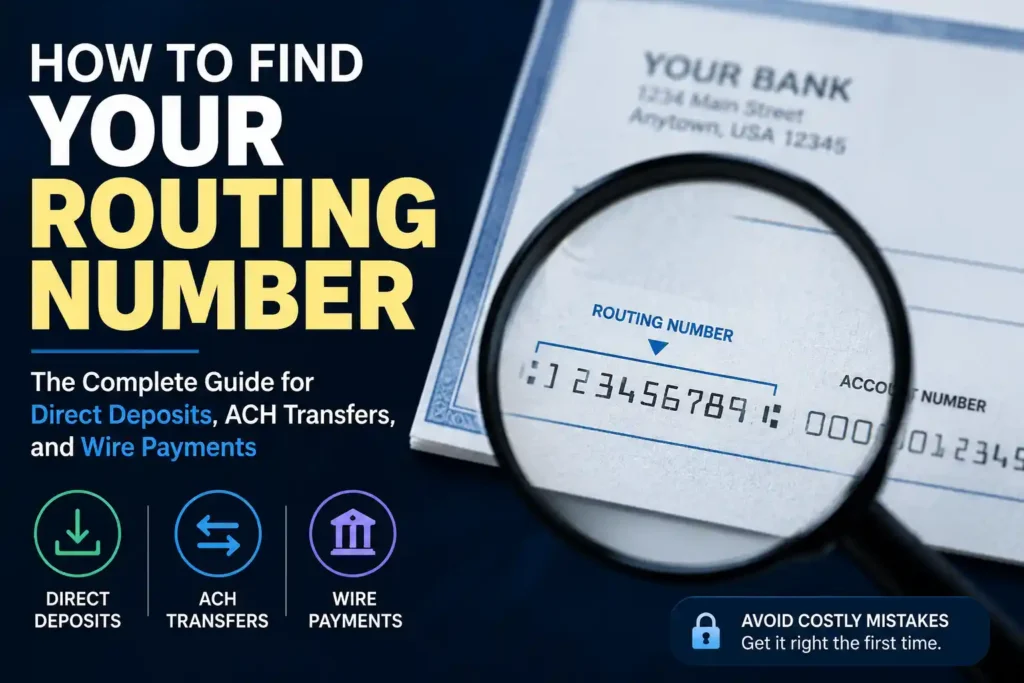
Have you ever been asked for your routing number while setting up direct deposit, linking a bank account, or sending money online, only to realize you have no idea where to find it?
You’re not alone.
Millions of people search for their routing number every year because it’s required for many everyday banking tasks. Yet many still confuse it with their account number or assume every customer at the same bank has the same routing number.
The good news is that finding your routing number is usually simple once you know where to look.
In this guide, you’ll learn exactly what a routing number is, where to find it, which routing number to use for different types of transactions, common mistakes to avoid, and how to verify that you’re using the correct one.
Whether you’re setting up payroll, receiving a tax refund, sending an ACH payment, or completing a wire transfer, this guide will help you find the right routing number with confidence.
Remember to check out 121000248 Routing Number
Table of Contents
Quick Answer: Where Can I Find My Routing Number?
If you’re in a hurry, here are the fastest ways to locate your routing number.
- Look at the bottom-left corner of a personal paper check.
- Sign in to your online banking account.
- Open your bank’s mobile app and view your account details.
- Review a recent bank statement if your bank includes it.
- Contact your bank’s customer service.
- Visit your local branch.
- Check your direct deposit paperwork.
- Use your bank’s official routing number lookup tool if available.
Important: Some banks use different routing numbers depending on where you opened your account or the type of transaction you’re making. Always verify that you’re using the correct routing number for your specific payment.
What Is a Routing Number?
A routing number is a nine-digit number used to identify a financial institution in the United States.
It tells banks where electronic payments should be sent and where checks should be processed.
You may also hear it called:
- ABA Routing Number
- Routing Transit Number (RTN)
- Bank Routing Number
Think of it this way.
Your routing number identifies the bank.
Your account number identifies your individual account at that bank.
Both numbers work together to ensure your money reaches the correct destination.
Why Is a Routing Number Important?
Without the correct routing number, many banking transactions simply can’t be processed correctly.
You’ll usually need your routing number when:
- Setting up direct deposit
- Receiving your paycheck
- Receiving Social Security benefits
- Receiving tax refunds
- Sending or receiving ACH transfers
- Paying bills electronically
- Linking external bank accounts
- Sending domestic wire transfers
- Ordering checks
- Making automatic loan payments
Using the wrong routing number may delay or reject the payment.
Which Routing Number Do You Need?
Not every banking transaction uses the same routing information.
The following table can help you determine which routing number is typically required.
| If You Are… | You Usually Need… |
|---|---|
| Setting up direct deposit | ACH routing number |
| Receiving your salary | ACH routing number |
| Receiving Social Security | ACH routing number |
| Receiving a tax refund | ACH routing number |
| Paying bills automatically | ACH routing number |
| Linking two bank accounts | ACH routing number |
| Receiving a domestic wire transfer | Domestic wire routing number (if different) |
| Receiving an international wire transfer | SWIFT code and other required banking details |
If you’re unsure which routing number applies to your situation, contact your bank before submitting the payment information.
How to Find Your Routing Number
There are several reliable ways to locate your routing number.
Some methods take only a few seconds.
1. Look at the Bottom of Your Paper Checks
If you have a personal check, this is often the easiest method.
At the bottom of the check, you’ll usually see three groups of numbers.
The first group of nine digits is generally your routing number.
The second group is your account number.
The final group identifies the individual check.
Think of the order like this:
Routing Number → Account Number → Check Number
Always use a personal check rather than a deposit slip, since deposit slips may display different processing numbers.
2. Sign In to Online Banking
Most banks display your routing number inside your secure online banking account.
After signing in:
- Select your account.
- Open the account details.
- Locate the routing number.
Some banks also identify whether the number applies to ACH transfers, direct deposits, or wire transfers.
3. Use Your Bank’s Mobile App
Nearly every major bank allows customers to view routing numbers through its mobile app.
Generally, you’ll need to:
- Open the app.
- Sign in.
- Select your account.
- Tap Account Details or Account Information.
This is often the quickest option if you’re away from home.
4. Check Your Bank Statement
Many banks include routing numbers on printed or electronic account statements.
Review the account information section to see whether your routing number is listed.
Not every bank displays it, but many do.
5. Contact Customer Service
If you’re unsure which routing number applies to your account, your bank’s customer service department can verify it.
A representative can also explain whether:
- Different routing numbers exist.
- Separate numbers are used for wire transfers.
- Your routing number changed because of a bank merger.
6. Visit Your Local Branch
A banker can confirm your routing number in person.
This option is especially useful if:
- You recently opened your account.
- Your bank merged with another institution.
- You’re unsure which routing number to use.
Bring a government-issued photo ID if you visit a branch.
7. Review Your Direct Deposit Form
If you’ve previously completed payroll paperwork, your routing number may already be listed there.
Many employers also allow employees to review their payroll information through employee self-service portals.
8. Check Your Bank’s Account Information
Some banks provide routing number lookup tools within online banking or account services.
These tools often display the routing number associated specifically with your account, reducing the risk of using the wrong one.
Routing Number vs. Account Number
One of the most common banking mistakes is confusing your routing number with your account number.
Although both appear together on checks and are often requested at the same time, they serve completely different purposes.
| Feature | Routing Number | Account Number |
|---|---|---|
| Purpose | Identifies your financial institution | Identifies your individual bank account |
| Length | Always 9 digits | Usually 8–17 digits, depending on the bank |
| Assigned By | Your bank | Your bank |
| Used For | Direct deposits, ACH transfers, wire transfers, bill payments, check processing | Identifying the account that will send or receive the money |
| Same for Every Customer? | Many customers may share the same routing number | Every account has its own unique account number |
Think of it this way:
- The routing number tells the payment where the bank is.
- The account number tells the bank exactly whose account should receive or send the money.
Both numbers are usually required for ACH transfers and direct deposits.
Routing Number vs. Debit Card Number
Another common mistake is trying to use a debit card number instead of a routing number.
These numbers are not interchangeable.
| Feature | Routing Number | Debit Card Number |
|---|---|---|
| Identifies | Bank | Debit card |
| Length | 9 digits | Usually 16 digits |
| Used For | ACH transfers, direct deposits, checks | Card purchases and ATM transactions |
| Printed On | Checks and bank account information | Front of the debit card |
Your debit card number cannot be used in place of a routing number for payroll or ACH transfers.
Why Do Some Banks Have Multiple Routing Numbers?
Many people assume every bank has only one routing number.
That’s true for some smaller banks and credit unions, but many large national banks use several routing numbers.
A bank may assign different routing numbers based on:
- The state where the account was opened
- The region served by the bank
- Bank mergers or acquisitions
- The type of transaction
- Internal payment processing systems
For example, two customers may both have checking accounts with the same bank but different routing numbers because they opened their accounts in different states.
This is completely normal.
Does Moving to Another State Change Your Routing Number?
Usually, no.
Your routing number is generally linked to where your account was opened, not where you currently live.
Example
Michael opened his checking account in Georgia.
Five years later, he moved to Colorado.
Although his mailing address changed, his routing number generally remained the one assigned to his Georgia account.
Changing your address alone does not usually change your routing number.
Can Your Routing Number Ever Change?
Yes, but it doesn’t happen often.
Situations where a routing number may change include:
Your Bank Merges With Another Bank
Bank mergers sometimes result in new routing numbers.
Customers are usually notified well before the change takes effect.
Your Account Is Transferred
In some cases, your account may be moved to another banking region or processing system.
Your Financial Institution Updates Its Systems
Although uncommon, banks occasionally reorganize their payment processing, which can affect routing numbers.
If your routing number changes, update any automatic payments and direct deposit instructions to avoid interruptions.
Can Checking and Savings Accounts Have Different Routing Numbers?
At many banks, checking and savings accounts use the same routing number if they were opened in the same state.
However, some financial institutions have different routing numbers depending on:
- Account type
- Banking division
- Region
- Transaction type
If you’re unsure, verify the routing number associated with your specific account.
Is the Routing Number the Same for ACH and Wire Transfers?
Not always.
Many people assume one routing number works for every type of transaction, but that’s not always true.
Some banks use:
- One routing number for ACH transfers and direct deposits.
- Another routing number for domestic wire transfers.
International wire transfers may also require:
- A SWIFT code
- Additional beneficiary information
- The receiving bank’s address
Using the wrong routing number can delay or reject the payment.
Always confirm which routing number applies before sending or receiving money.
Why Can’t I Find My Routing Number?
If you’ve searched everywhere and still can’t locate it, one of these situations may apply.
You’re Looking at a Deposit Slip
Deposit slips sometimes contain internal processing numbers that differ from the routing number printed on personal checks.
You’re Looking at an Old Check
If your bank merged with another institution, an older checkbook may display a routing number that is no longer used.
Your Bank Uses Multiple Routing Numbers
Large national banks often assign routing numbers based on the state where the account was opened.
Looking up the wrong state’s routing number can create confusion.
Your Account Is New
If you’ve recently opened your account, your checks may not have arrived yet.
Until then, online banking or your mobile app is usually the fastest place to verify your routing number.
You’re Looking in the Wrong Place
Many people accidentally copy:
- Their account number
- Their debit card number
- Their customer ID
instead of the routing number.
Common Mistakes People Make
Even experienced bank customers occasionally make routing number mistakes.
Here are the most common ones.
Confusing the Routing Number With the Account Number
This is by far the most common error.
Always double-check which number you’re entering.
Using the Wire Routing Number for ACH Transfers
If your bank uses separate routing numbers for wire transfers, using the wrong one may delay or reject the transaction.
Using Someone Else’s Routing Number
Just because a friend banks with the same institution doesn’t mean your routing numbers match.
Large banks often use multiple routing numbers.
Using an Old Routing Number
If your bank changed routing numbers after a merger, older payment instructions may no longer work.
Entering One Incorrect Digit
Routing numbers contain only nine digits.
One incorrect digit is enough to prevent the payment from processing correctly.
Real-World Examples
Understanding routing numbers becomes easier when you see how they’re used in everyday situations.
Example 1: Starting a New Job
Jessica accepts a new position and completes her employer’s direct deposit form.
She accidentally enters her account number where the routing number belongs.
Payroll cannot process her direct deposit, and her first paycheck is delayed until the information is corrected.
Example 2: Moving to Another State
David moves from North Carolina to Arizona but keeps the same checking account.
When updating his payroll information, he assumes he needs Arizona’s routing number.
In reality, he generally continues using the routing number associated with the state where he originally opened the account.
Example 3: Sending a Wire Transfer
Carlos receives instructions for a domestic wire transfer.
Instead of using the wire routing number, he enters the ACH routing number.
The payment is delayed while the bank corrects the routing information.
These examples show why taking a few extra moments to verify your routing number can prevent unnecessary delays.
How to Verify You Have the Correct Routing Number
Before submitting payroll forms or initiating an electronic payment, take a few moments to verify your banking information.
Use this checklist:
✔ Confirm the routing number belongs to your bank.
✔ Verify that it matches the state where your account was opened, if applicable.
✔ Make sure you’re using the correct routing number for the type of transaction.
✔ Double-check your account number.
✔ Confirm your name matches your bank account.
✔ Review every digit before submitting the payment.
Spending less than a minute verifying your information can save days of delays and frustration.
What Happens If You Use the Wrong Routing Number?
Using the wrong routing number doesn’t always mean your money is lost, but it can create delays and complications.
What happens next depends on whether the routing number belongs to another financial institution and whether the account information matches.
Here are the most common outcomes.
The Payment Is Rejected
In many cases, the receiving bank cannot match the routing number with the transaction.
The payment is rejected and returned to the sender.
Although this is inconvenient, it’s usually the safest outcome because the money doesn’t leave the banking system permanently.
The Payment Is Delayed
Sometimes the bank places the transaction on hold while it investigates the routing information.
This may add several business days to the processing time.
The Payment Is Returned
If the routing number is invalid or no longer active, the transaction is generally returned to the sending bank.
Depending on the type of payment, you may need to submit a new transfer using the correct routing number.
The Payment Requires Manual Review
Banks occasionally perform manual reviews when payment instructions don’t match their records.
Although uncommon, this can delay payroll deposits, ACH transfers, or wire transfers.
What Should You Do If You Entered the Wrong Routing Number?
If you realize you’ve entered the wrong routing number, act as quickly as possible.
Contact Your Bank Immediately
The sooner your bank is notified, the greater the chance of stopping or correcting the transaction before it is fully processed.
Contact the Sender
If the payment hasn’t been submitted yet, ask the sender to update the routing number before processing begins.
For example, if you’re setting up direct deposit with a new employer, notify the payroll department immediately.
Verify All Banking Information
Don’t just correct the routing number.
Also verify:
- Account number
- Account type
- Account holder’s name
Correcting only one piece of incorrect information may not resolve the issue.
Monitor Your Account
Continue checking your account until the payment is either received or returned.
If several business days pass without an update, contact your bank again.
Routing Number Safety Tips
Although routing numbers are not secret in the same way as passwords or PINs, they should still be handled carefully.
Follow these best practices.
Verify Before You Submit
Always review every digit before completing a payment form.
Most payment delays happen because of simple typing mistakes.
Protect Your Complete Banking Information
While a routing number alone generally cannot be used to access your money, your routing number combined with your account number should only be shared with trusted organizations for legitimate banking purposes.
Be Cautious of Phishing Scams
Scammers sometimes impersonate employers, banks, or government agencies to obtain banking information.
Before sharing your routing and account numbers:
- Confirm the request is legitimate.
- Verify the website or email sender.
- Contact the organization directly if something seems suspicious.
Update Payment Information Promptly
If your bank changes your routing number after a merger or account update, revise your direct deposit and automatic payment information as soon as possible.
Frequently Asked Questions About Finding Your Routing Number
Finding the correct routing number is usually straightforward, but many people still have questions about how routing numbers work. Here are answers to some of the most common ones.
What Is a Routing Number?
A routing number is a nine-digit number that identifies a financial institution for electronic payments and check processing.
How Do I Find My Routing Number?
You can usually find it on your checks, through online banking, in your bank’s mobile app, on certain account statements, or by contacting your bank.
Is the Routing Number the Same as the Account Number?
No. The routing number identifies your bank, while the account number identifies your individual account.
Can Two People Have the Same Routing Number?
Yes. Thousands or even millions of customers at the same bank may share the same routing number. Their account numbers are what make each account unique.
Can Two Banks Have the Same Routing Number?
No. Each routing number is assigned to a specific financial institution or banking region.
Does Every Bank Have Only One Routing Number?
No. Many large banks use multiple routing numbers based on the state where the account was opened or the type of transaction.
Can My Routing Number Change?
Yes. Although uncommon, routing numbers can change because of bank mergers, system updates, or account transfers.
Will My Routing Number Change If I Move?
Usually not. Your routing number is generally tied to where your account was opened rather than your current address.
Is My Routing Number Printed on My Debit Card?
No. Debit cards display the card number, expiration date, and security features—not your routing number.
Can I Find My Routing Number Without a Check?
Yes. Online banking, mobile banking apps, account statements, customer service, and bank branches are all common ways to find it.
Do Savings Accounts Have Routing Numbers?
Yes. Savings accounts use routing numbers just like checking accounts.
Do Credit Unions Have Routing Numbers?
Yes. Credit unions are assigned routing numbers for processing electronic payments.
Is the Routing Number the Same for Direct Deposit and ACH Transfers?
In many cases, yes. However, some banks may use different routing numbers for certain transaction types.
Is the Routing Number the Same for Wire Transfers?
Not always. Some banks use a separate routing number for domestic wire transfers.
What Is a SWIFT Code?
A SWIFT code identifies banks during international wire transfers. It serves a different purpose than a routing number.
What Happens If I Use the Wrong Routing Number?
The payment may be delayed, rejected, returned, or require additional review before processing.
Can I Receive Money With Only a Routing Number?
No. Most electronic deposits also require your account number.
Is It Safe to Share My Routing Number?
Sharing your routing number with trusted employers, banks, and legitimate businesses is generally part of normal banking activities. However, you should protect your complete banking information and only provide it when necessary.
Can Routing Numbers Start With Zero?
Yes. Many valid routing numbers begin with one or more zeros.
Can Routing Numbers Expire?
Routing numbers themselves do not “expire,” but banks may retire or replace them after mergers or operational changes.
Why Does My Bank Have More Than One Routing Number?
Large banks often use multiple routing numbers based on geographic regions, account history, or payment processing requirements.
Why Is My Routing Number Different From Someone Else’s at the Same Bank?
Your accounts may have been opened in different states or under different banking divisions.
Do Online Banks Have Routing Numbers?
Yes. Online banks use routing numbers just like traditional banks.
Can I Use a Deposit Slip to Find My Routing Number?
It’s better to use a personal check, online banking, or your bank’s account information because deposit slips may include additional processing numbers.
Should I Verify My Routing Number Before Setting Up Direct Deposit?
Yes. Verifying your routing number before submitting payroll forms can help prevent delays and rejected payments.
Can Incorrect Routing Numbers Delay My Tax Refund?
Yes. If the routing number or other banking information is incorrect, your refund may be delayed or returned.
Do Automatic Bill Payments Require a Routing Number?
Yes. ACH bill payments typically require both your routing number and account number.
Can I Change My Routing Number?
Individuals generally cannot request a new routing number. Routing numbers are assigned by the bank and may only change under specific circumstances.
How Many Digits Does a Routing Number Have?
Every U.S. routing number contains exactly nine digits.
What’s the Fastest Way to Find My Routing Number?
For most people, signing in to online banking or using the bank’s mobile app is the quickest and most reliable method.
Related Articles
To learn more about electronic banking and payments, you may also find these guides helpful:
- What Is an ABA Routing Number?
- How Direct Deposit Works
- What Is the ACH Network?
- ACH Transfer vs. Wire Transfer
- Why Was My ACH Transfer Delayed or Rejected?
- How Long Do ACH Transfers Take?
- What Is an ACH Credit?
- What Is an ACH Debit?
Conclusion
Your routing number is one of the most important pieces of banking information you’ll use. Whether you’re setting up direct deposit, paying bills online, linking bank accounts, or receiving a tax refund, using the correct routing number helps ensure your money reaches the right destination without unnecessary delays.
Fortunately, finding your routing number is usually quick and easy. You can locate it on a personal check, through online banking, in your bank’s mobile app, on certain account statements, or by contacting your financial institution directly. If your bank uses multiple routing numbers, always verify that you’re using the one associated with your account and the type of transaction you’re making.
Taking a few moments to confirm your routing number before submitting payment instructions can save you from rejected transfers, delayed deposits, and avoidable banking headaches.
Remember to check out 121000248 Routing Number

