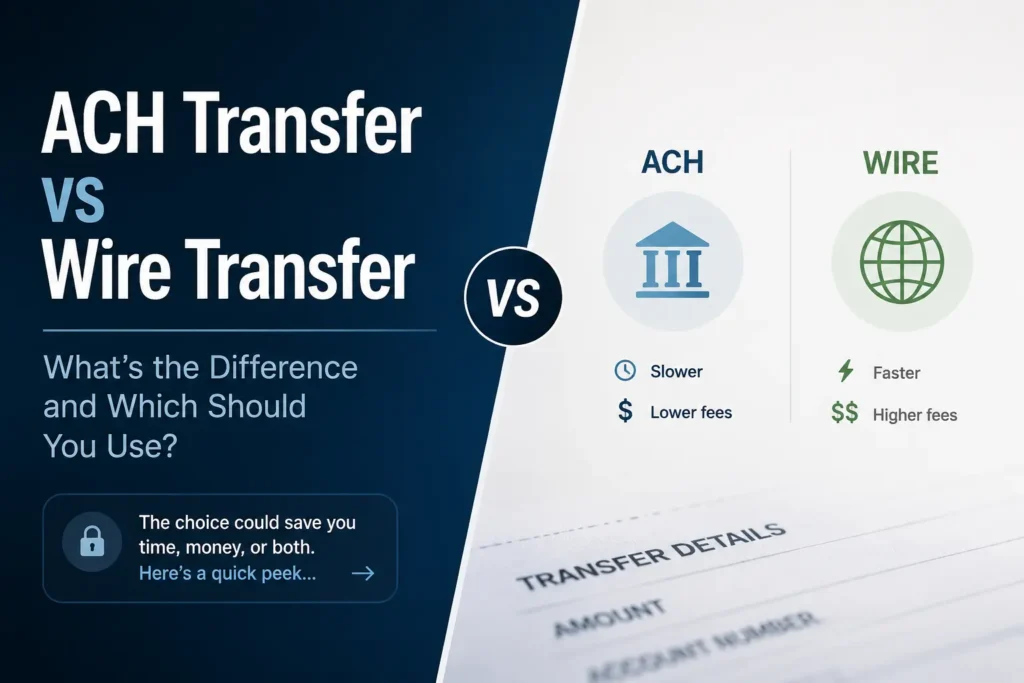
Have you ever needed to send money quickly and then found yourself staring at two options—ACH transfer and wire transfer—without knowing which one to choose?
At first glance, they seem almost identical. Both move money electronically from one bank account to another. Both are offered by banks, credit unions, and many financial apps. Yet choosing the wrong one can cost you more than just a transfer fee.
Imagine you’re buying your first home. The seller expects payment before the closing deadline. You decide to use an ACH transfer because it’s free. Hours later, you discover the payment won’t arrive until the next business day, putting the entire transaction at risk.
Now imagine a different situation. Your employer asks for your banking information so they can pay your salary through direct deposit. Instead of using the appropriate payment method, you request a wire transfer every payday and end up paying unnecessary fees month after month.
These situations happen more often than most people realize.
The truth is that ACH transfers and wire transfers are designed for different purposes. Understanding how each one works can help you avoid delays, unnecessary costs, and frustrating banking mistakes.
In this guide, you’ll learn the key differences between ACH transfers and wire transfers, how each payment method works, their costs, processing times, security features, and when each option makes the most sense. By the end, you’ll know exactly which one to use for payroll, direct deposits, business payments, large purchases, and everyday banking.
Table of Contents
Quick Answer
An ACH transfer moves money through the Automated Clearing House network and is typically used for payroll, direct deposits, recurring bill payments, and other everyday transactions. It usually costs little or nothing but may take one to three business days to complete.
A wire transfer sends money directly between financial institutions through a wire network. It is generally much faster, often arriving the same business day, but usually comes with a higher fee. Wire transfers are commonly used when speed is more important than cost.
If you don’t need the money to arrive immediately, an ACH transfer is usually the better choice. If timing is critical, a wire transfer is often worth the additional cost.
ACH Transfer vs Wire Transfer at a Glance
Before we dive deeper, here’s a quick comparison of the two payment methods.
| Feature | ACH Transfer | Wire Transfer |
|---|---|---|
| Speed | Usually 1–3 business days | Often same business day |
| Cost | Usually free or low cost | Often includes a transfer fee |
| Best For | Payroll, direct deposits, recurring payments, bill payments | Urgent payments, large purchases, real estate transactions |
| Processing | Batch processing | Individual processing |
| International Payments | Limited | Widely available |
| Recurring Payments | Excellent | Rarely used |
| Typical Amount | Everyday transfers | High-value transfers |
This table provides a useful overview, but there’s much more to consider before deciding which option is right for your situation.
What Is an ACH Transfer?
An ACH transfer is an electronic payment that moves money between bank accounts through the Automated Clearing House (ACH) Network. Rather than processing each payment individually, the network groups transactions together and processes them in scheduled batches throughout the day.
This system has become one of the most widely used payment networks in the United States because it is reliable, efficient, and inexpensive.
If you’ve ever received your paycheck through direct deposit, there’s a good chance it arrived through an ACH transfer.
Many everyday financial activities also rely on the ACH network, including:
- Payroll deposits
- Direct deposits from employers
- Social Security payments
- IRS tax refunds
- Pension payments
- Mortgage payments
- Utility bills
- Insurance premiums
- Subscription services
- Automatic savings transfers
- Business-to-business payments
One reason ACH transfers are so popular is that they require very little effort after setup. Once you authorize a recurring payment, future transactions are usually processed automatically.
How Does an ACH Transfer Work?
Although an ACH transfer may seem instant from the customer’s perspective, several steps take place behind the scenes before the money reaches its destination.
A typical ACH transfer follows this process:
- The sender authorizes the payment.
- The sending bank collects the payment request.
- The transaction enters the ACH network.
- The network verifies and sorts the payment.
- The receiving bank accepts the transaction.
- The funds are deposited into the recipient’s account.
Because ACH payments are processed in batches instead of individually, they generally take longer than wire transfers. However, this same process also helps keep transaction costs low.
Advantages of ACH Transfers
ACH transfers are the preferred choice for millions of consumers and businesses because they offer several important benefits.
They are generally:
- Affordable
- Easy to automate
- Secure
- Reliable
- Ideal for recurring payments
- Suitable for both personal and business banking
For most routine financial activities, ACH transfers provide an excellent balance between convenience and cost.
Potential Drawbacks
Despite their advantages, ACH transfers are not perfect.
Depending on the bank and the type of payment, you may experience:
- Processing delays during weekends and holidays
- Daily transfer limits
- Longer settlement times
- Limited availability for certain international payments
This is where many people make a mistake. They assume every electronic payment works like a debit card transaction, only to discover later that ACH transfers follow scheduled processing windows.
If your payment absolutely must arrive today, an ACH transfer may not be the best choice.
What Is a Wire Transfer?
A wire transfer is an electronic transfer that sends money directly from one financial institution to another through specialized payment networks. Unlike ACH transfers, each wire transfer is processed individually rather than grouped with other payments.
That individual processing is one of the biggest reasons wire transfers are typically much faster.
Banks commonly recommend wire transfers for transactions where speed is essential or where large amounts of money are involved.
Examples include:
- Buying a home
- Paying a property closing agent
- Sending emergency funds
- Paying an international supplier
- Business acquisitions
- High-value purchases
- Investment transactions
Because every wire transfer receives individual attention during processing, banks often charge a fee for the service.
How Does a Wire Transfer Work?
Although sending a wire transfer may only take a few minutes from your perspective, several verification steps occur before the money leaves your account.
A typical wire transfer usually follows these steps:
- The sender requests the transfer.
- The bank verifies the sender’s identity.
- Banking instructions are reviewed.
- The payment is transmitted through the appropriate wire network.
- The receiving bank credits the recipient’s account.
Unlike ACH transfers, which wait for scheduled processing cycles, wire transfers usually begin moving through the banking system almost immediately after approval.
This is why they are commonly chosen when timing matters.
Advantages of Wire Transfers
Wire transfers offer several advantages that make them the preferred option in certain situations.
These include:
- Faster processing
- Same-day delivery for many domestic transfers
- Suitable for large payments
- Widely accepted for international transfers
- Trusted for time-sensitive transactions
If missing a payment deadline could have serious financial consequences, a wire transfer is often the safer choice.
Potential Drawbacks
Speed comes at a price.
Wire transfers usually cost more than ACH transfers and, once completed, they are often much more difficult to reverse.
Other potential disadvantages include:
- Higher transfer fees
- Limited cancellation options
- Greater risk if incorrect banking details are entered
- Additional charges for some international transfers
Before approving a wire transfer, take a few extra minutes to verify every detail. A simple typing mistake can create a complicated problem that’s much harder to fix than with many other types of electronic payments.
Why Understanding the Difference Matters
At this point, you might be wondering whether choosing between ACH and wire transfers really makes that much difference.
In many cases, it does.
Selecting the right payment method can help you:
- Avoid unnecessary transfer fees.
- Receive your money faster when timing matters.
- Prevent rejected payments.
- Reduce the risk of payment delays.
- Choose the most cost-effective option for your situation.
More importantly, understanding these differences helps you make informed financial decisions instead of simply selecting whichever option appears first on your banking screen.
Key Differences Between ACH Transfers and Wire Transfers
Now that you understand how each payment method works, let’s compare them side by side.
Although ACH transfers and wire transfers both move money electronically, they are designed for different situations. One prioritizes affordability and convenience, while the other focuses on speed and urgency.
Understanding these differences can help you avoid unnecessary fees, prevent delays, and choose the right payment method every time.
Processing Speed
If getting money to the recipient as quickly as possible is your priority, a wire transfer usually has the advantage.
ACH transfers are processed in batches at scheduled intervals throughout the business day. Because of this batching process, they typically take one to three business days to reach the recipient, although some banks now support eligible same-day ACH payments.
Wire transfers work differently. Instead of waiting in a processing queue, each payment is handled individually. Once approved, the transfer begins moving through the banking system almost immediately, allowing many domestic wire transfers to arrive on the same business day.
Here’s a simple comparison.
| Transfer Type | Typical Delivery Time |
|---|---|
| Standard ACH Transfer | 1–3 business days |
| Same-Day ACH | Same business day (eligible transfers only) |
| Domestic Wire Transfer | Usually within hours or the same business day |
| International Wire Transfer | Usually 1–5 business days |
However, there’s one detail many people overlook.
Banks have daily cut-off times.
If you submit either an ACH transfer or a wire transfer after your bank’s cut-off time, processing may not begin until the next business day. Weekends and federal holidays can also delay both types of transfers.
For that reason, it’s always a good idea to send important payments as early in the day as possible.
Processing Method
The biggest difference between ACH transfers and wire transfers isn’t speed—it’s how they move through the banking system.
ACH payments are grouped together with thousands of other transactions before being processed.
Think of it like a bus that waits until enough passengers have boarded before leaving.
Wire transfers are more like a private taxi.
Instead of waiting for other transactions, each payment is processed individually and sent directly to the receiving financial institution.
This difference explains why wire transfers are usually faster but also more expensive.
Cost
For everyday banking, ACH transfers are almost always the more affordable option.
Many banks allow customers to send ACH payments free of charge, while others charge only a small fee.
Wire transfers, on the other hand, often include service charges because of the additional resources required to process them individually.
Although fees vary from one financial institution to another, the comparison generally looks like this.
| Transfer Type | Typical Fee |
|---|---|
| ACH Transfer | Free to about $5 |
| Incoming Domestic Wire | Often free to $15 |
| Outgoing Domestic Wire | About $15–$35 |
| Outgoing International Wire | About $30–$50 or more |
Let’s look at a practical example.
Imagine you pay your freelance graphic designer $2,000 every month.
If you send that payment using a $30 wire transfer every month, you’ll spend around $360 each year in transfer fees.
If your bank offers free ACH transfers, you’ll save that entire amount without changing the payment itself.
Unless speed is essential, ACH transfers are usually the more economical choice.
Transaction Limits
Another important difference involves how much money you can send.
Many banks place daily or monthly limits on ACH transfers to reduce fraud and manage risk.
Wire transfers may also have limits, but they are often much higher because they are commonly used for large financial transactions.
If you’re sending:
- a house down payment,
- funds for a business acquisition,
- an investment transfer,
- or another high-value payment,
your bank may recommend using a wire transfer instead of ACH.
Always check your bank’s transfer limits before initiating a large payment.
Availability
ACH transfers are designed primarily for domestic transactions within the United States.
Wire transfers can be used for both domestic and international payments, making them the preferred choice when money needs to cross national borders.
If you’re sending money overseas, your bank will usually request additional information, including the recipient bank’s SWIFT or BIC code.
This is one reason international transfers often require more preparation than domestic payments.
Cancellation and Reversals
One of the biggest misconceptions about electronic payments is that they can all be cancelled with a simple phone call.
That’s not always true.
ACH transfers may sometimes be stopped or reversed, depending on when the request is made and whether the transaction has already been processed.
Wire transfers are much less forgiving.
Once a wire transfer has been completed, reversing it can be extremely difficult and, in some cases, impossible without the recipient’s cooperation.
That’s why banks encourage customers to review every detail carefully before approving a wire transfer.
A single incorrect account number or routing number can create significant problems.
Security
Both ACH transfers and wire transfers are highly secure payment methods used by financial institutions across the United States.
However, the biggest security risk isn’t the payment network itself.
It’s human error.
Fraudsters often target people who are making urgent wire transfers because they know the sender has little time to verify the information.
For example, a scammer might send a fake email pretending to be a real estate agent, attorney, or contractor and provide fraudulent banking instructions.
If the money is wired to the wrong account, recovering it can be extremely difficult.
To reduce your risk, always:
- Verify the recipient’s banking information.
- Call the recipient using a trusted phone number before sending large payments.
- Never rely solely on banking instructions received by email or text message.
- Double-check every account number and routing number before approving the transaction.
Taking two extra minutes to verify payment details can prevent weeks of stress later.
Which Is Faster?
If your only concern is speed, wire transfers are usually the better choice.
Because each payment is processed individually, domestic wire transfers often arrive within a few hours, provided they’re submitted before the bank’s daily cut-off time.
ACH transfers are generally slower because they move through scheduled processing windows.
However, slower doesn’t necessarily mean worse.
For many common transactions, including payroll, bill payments, and direct deposits, receiving the money a day or two later makes little practical difference.
In those situations, paying extra for a wire transfer often provides no meaningful benefit.
A simple rule to remember is this:
- If the payment can wait, choose ACH.
- If the payment absolutely cannot wait, choose a wire transfer.
Which Costs Less?
For most consumers and businesses, ACH transfers offer the best value.
They are widely available, inexpensive, and ideal for recurring payments.
Wire transfers are best reserved for situations where speed justifies the additional cost.
Consider these common examples.
| Situation | Better Choice |
|---|---|
| Receiving your paycheck | ACH Transfer |
| Paying monthly rent | ACH Transfer |
| Paying your mortgage | ACH Transfer |
| Buying a house | Wire Transfer |
| Sending emergency financial assistance | Wire Transfer |
| Paying an overseas supplier | Wire Transfer |
| Sending money to a family member within the U.S. | Depends on urgency |
Before selecting a payment method, ask yourself one simple question:
Would paying an extra $30 actually improve this transaction?
If the answer is no, ACH is probably the smarter option.
Which Is Safer?
Both ACH transfers and wire transfers use secure banking systems, encryption, authentication procedures, and fraud monitoring.
Neither system is inherently unsafe.
Instead, the safest option depends on your situation.
ACH transfers are an excellent choice for routine financial activities such as:
- Payroll
- Direct deposits
- Monthly bills
- Subscription payments
- Mortgage payments
- Automatic savings
Wire transfers are often preferred when you’re sending a large amount of money that must arrive quickly.
Regardless of which payment method you choose, following good banking practices is far more important than the payment network itself.
Before sending money, always verify:
- The recipient’s full name.
- The account number.
- The routing number.
- The amount being transferred.
- The purpose of the payment.
Most costly banking mistakes happen because someone rushes through these simple checks.
When Should You Use an ACH Transfer?
ACH transfers are the best choice for most everyday banking activities because they combine affordability, convenience, and reliability.
They’re especially useful when you’re making payments that occur regularly or don’t require immediate delivery.
Common situations where ACH transfers make sense include:
- Receiving your salary through direct deposit
- Paying monthly utility bills
- Paying your mortgage
- Paying credit card bills
- Receiving IRS tax refunds
- Receiving Social Security benefits
- Sending money between your own bank accounts
- Paying insurance premiums
- Funding your savings account
- Paying recurring business expenses
If you don’t need the money to arrive within hours, an ACH transfer is usually the most practical and cost-effective option.
When Should You Use a Wire Transfer?
Wire transfers are designed for situations where speed matters more than cost. Although they usually come with higher fees than ACH transfers, they can be the best choice when a payment must reach the recipient quickly or when you’re transferring a large amount of money.
Unlike ACH transfers, which are processed in batches, wire transfers are handled individually. This allows many domestic wire transfers to arrive on the same business day if they’re submitted before the bank’s cut-off time.
If delaying a payment could create financial or legal problems, paying a wire transfer fee is often worthwhile.
Wire transfers are commonly used for:
- Buying a home
- Paying a real estate closing agent
- Sending emergency financial assistance
- Paying an international supplier
- Completing large business transactions
- Making investment deposits
- Purchasing expensive vehicles or equipment
- Time-sensitive legal settlements
For example, imagine you’re buying a house and the seller requires payment before 3:00 p.m. on closing day. Waiting one or two business days for an ACH transfer could delay the closing and affect the entire transaction. In that situation, a wire transfer is usually the better option because the funds can often arrive within hours.
The same principle applies to businesses. If a company must pay an overseas supplier before goods are shipped, speed may be far more valuable than saving a small transfer fee.
Before sending a wire transfer, always verify the recipient’s banking information carefully. Because wire transfers are difficult to reverse after processing, correcting a mistake can be much more complicated than with other payment methods.
Domestic vs. International Transfers
Many people assume ACH transfers and wire transfers can both be used anywhere in the world.
That isn’t the case.
The type of payment you should use often depends on where the money is going.
Domestic Transfers
A domestic transfer moves money between financial institutions within the United States.
For domestic payments, both ACH transfers and domestic wire transfers are widely used.
Here’s a simple comparison.
| Payment Type | Domestic Use |
|---|---|
| ACH Transfer | Excellent for everyday banking |
| Domestic Wire Transfer | Best for urgent or high-value payments |
If you’re paying rent, receiving your salary, or paying your electricity bill, an ACH transfer is usually the most practical option.
If you’re sending a six-figure payment to complete a property purchase, a domestic wire transfer is generally the preferred choice.
International Transfers
International transfers involve sending money to a financial institution outside the United States.
This is where ACH transfers become much less common.
Most international payments are completed using wire transfers because they can move money through global banking networks.
In addition to the recipient’s account information, banks often require:
- SWIFT or BIC code
- Recipient bank name
- Recipient bank address
- Account number or IBAN (depending on the country)
- Recipient’s full legal name
Because international banking regulations vary from country to country, processing times are usually longer than domestic transfers.
If you’re sending money overseas, contact your bank before initiating the transfer to confirm the information required.
ACH Transfer vs. Wire Transfer for Payroll
Payroll is one of the most common reasons people encounter electronic bank transfers.
Whether you’re an employee receiving your salary or a business paying staff, choosing the right payment method can save both time and money.
For payroll, ACH transfers are almost always the preferred option.
Why?
Because payroll isn’t usually an emergency.
Employers process hundreds or even thousands of employee payments at the same time. Using ACH allows those payments to be sent efficiently while keeping banking costs under control.
Imagine a company with 300 employees.
If the employer paid a $25 wire transfer fee for every salary payment, payroll fees alone could become extremely expensive.
Instead, businesses use ACH because it was designed specifically for recurring electronic payments such as:
- Employee salaries
- Bonuses
- Commissions
- Expense reimbursements
- Retirement contributions
For most employees, direct deposit through the ACH network is fast, reliable, and convenient.
ACH Transfer vs. Wire Transfer for Direct Deposit
Direct deposit has become the standard way employers and government agencies send money.
If you’ve ever received:
- A paycheck
- A tax refund
- Social Security benefits
- Veterans benefits
- Pension payments
there’s a good chance the payment arrived through the ACH network.
This surprises many people because they assume all electronic payments are wire transfers.
In reality, direct deposit and ACH transfers are closely connected.
Wire transfers are generally reserved for urgent payments rather than recurring deposits.
So if you’re completing a direct deposit form, you’ll usually be asked for your:
- Bank routing number
- Account number
- Account type
Your employer then uses the ACH network to send your salary electronically.
This process is inexpensive, reliable, and ideal for recurring payments.
ACH Transfer vs. Wire Transfer for Business Payments
Businesses move money every day.
Some payments happen on a regular schedule, while others must be completed immediately.
Choosing the right payment method depends largely on the nature of the transaction.
ACH transfers are commonly used for:
- Payroll
- Vendor invoices
- Subscription services
- Insurance payments
- Utility bills
- Monthly supplier payments
- Internal account transfers
Wire transfers are more appropriate when businesses need to:
- Purchase expensive equipment
- Complete mergers or acquisitions
- Pay international suppliers
- Meet urgent contractual deadlines
- Send large one-time payments
For example, a retail company ordering inventory every month may use ACH because the payment schedule is predictable.
However, if the same company must secure a last-minute shipment before inventory runs out, a wire transfer may be the better option.
The key is balancing cost against urgency.
ACH Transfer vs. Wire Transfer When Buying a Home
Buying a home is one of the few situations where many people use their first wire transfer.
Real estate transactions often involve large sums of money that must arrive before a specific deadline.
Because of this, title companies, escrow agents, and attorneys frequently request payment by wire transfer.
Why?
Speed.
Waiting several business days for an ACH payment could delay closing and create legal or financial complications.
However, this is also one of the situations where fraud is most common.
Scammers sometimes impersonate real estate professionals and send fake banking instructions shortly before closing.
To protect yourself:
- Never rely solely on emailed wiring instructions.
- Call the title company using a trusted phone number.
- Verify every banking detail before sending funds.
- Confirm the recipient’s account information one final time before approving the transfer.
Those few extra minutes of verification can protect one of the largest financial transactions of your life.
Common Reasons ACH Transfers Fail
Most ACH transfers are completed without any problems. However, when an ACH payment fails, it’s usually because of a preventable mistake rather than a problem with the banking system itself.
Knowing what can go wrong can save you from delayed payroll, rejected bill payments, and unnecessary stress.
Here are the most common reasons ACH transfers fail.
Incorrect Routing Number
The routing number tells the ACH network which financial institution should receive the payment.
If even one digit is entered incorrectly, the transaction may be rejected before it reaches the recipient’s bank.
Always verify the routing number directly from your bank statement, online banking portal, mobile banking app, or official bank documentation.
Incorrect Account Number
Even if the routing number is correct, entering the wrong account number can prevent the payment from reaching the intended recipient.
Some banks reject invalid account numbers immediately, while others may accept the transaction only for it to be returned later.
Before submitting any payment, compare every digit with your bank records.
Insufficient Funds
If your account doesn’t contain enough money to cover the payment, the ACH transfer may be declined.
This often happens with:
- Automatic bill payments
- Subscription renewals
- Loan repayments
- Scheduled transfers
Keeping a small buffer in your account can help prevent failed payments caused by unexpected withdrawals.
Incorrect Account Type
Many payment forms ask whether you’re using a checking account or a savings account.
Selecting the wrong option may cause the transaction to fail, even if the routing number and account number are correct.
Take a moment to confirm the account type before authorizing the payment.
Bank Account Restrictions
Banks sometimes place temporary restrictions on accounts because of:
- Suspected fraud
- Security reviews
- Recent account changes
- Legal holds
- Compliance requirements
If your payment is rejected and you can’t identify the cause, contacting your bank should be your next step.
Payment Submitted After the Cut-Off Time
Many people don’t realize that banks process ACH transactions according to daily schedules.
If you submit your payment after your bank’s processing deadline, it may not begin moving until the next business day.
Weekends and federal holidays can extend processing times even further.
Planning ahead is one of the easiest ways to avoid unnecessary delays.
Common Reasons Wire Transfers Are Delayed
Although wire transfers are known for their speed, they aren’t always instant.
Several factors can delay processing, especially when large amounts of money are involved.
Incorrect Banking Information
The most common cause of wire transfer delays is inaccurate banking information.
Examples include:
- Incorrect account number
- Incorrect routing number
- Incorrect SWIFT code
- Misspelled recipient name
- Wrong bank name
Even a small mistake can require additional verification before the payment continues.
Additional Security Verification
Banks closely monitor wire transfers because they are frequently targeted by fraudsters.
Large or unusual transactions may trigger additional identity verification before the transfer is approved.
While this extra review may delay the payment slightly, it helps protect both the sender and the recipient.
International Compliance Checks
International wire transfers often undergo additional compliance screening.
Depending on the countries involved, banks may review the transaction to comply with anti-money laundering regulations and international sanctions.
These checks are designed to protect the global financial system but can sometimes increase processing times.
Banking Holidays
Wire transfers are generally processed only on business days.
If either the sending bank or the receiving bank is closed because of a weekend or public holiday, the transfer may not move until banking operations resume.
This is especially important to remember when sending international payments across different time zones.
ACH vs. Wire Transfer: Real-Life Banking Scenarios
It’s one thing to understand the theory.
It’s another to know which payment method to choose in everyday situations.
Let’s look at some practical examples.
Scenario 1: Receiving Your Salary
Maria starts a new job.
Her employer asks her to complete a direct deposit form before her first payday.
Best choice: ACH transfer.
Payroll systems are designed around the ACH network because it’s reliable, cost-effective, and ideal for recurring payments.
Scenario 2: Buying a House
James is scheduled to close on his first home tomorrow morning.
His attorney tells him the closing funds must arrive before 2:00 p.m.
Best choice: Wire transfer.
The payment is urgent, involves a large amount of money, and must reach the recipient quickly.
Scenario 3: Paying Monthly Bills
Angela pays her electricity, internet, insurance, and mortgage every month.
None of these payments are urgent because she schedules them several days before the due date.
Best choice: ACH transfer.
Recurring payments are one of the biggest strengths of the ACH network.
Scenario 4: Sending Emergency Money
David’s daughter is studying abroad and urgently needs money after losing her wallet.
Waiting several business days isn’t an option.
Best choice: Wire transfer.
The additional fee is small compared to the importance of getting the money there quickly.
Scenario 5: Paying an Overseas Supplier
A small business in Texas imports products from Germany.
Payment must be completed before the supplier ships the order.
Best choice: International wire transfer.
ACH transfers generally aren’t suitable for this type of international business payment.
Before You Send Money: A Simple Checklist
No matter which payment method you choose, spending a few extra minutes reviewing the details can help you avoid expensive mistakes.
Before approving any transfer, confirm the following:
✔ The recipient’s full legal name.
✔ The account number.
✔ The routing number or SWIFT code, if applicable.
✔ The amount being sent.
✔ The purpose of the payment.
✔ Whether the payment should be sent by ACH or wire transfer.
✔ The bank’s daily cut-off time.
✔ Any transfer fees that may apply.
Many payment problems can be prevented simply by slowing down and reviewing this checklist.
Decision Tree: Should You Choose an ACH Transfer or a Wire Transfer?
If you’re still unsure which option fits your situation, use this quick decision guide.
Do you need the money to arrive today?
- Yes: Choose a wire transfer.
- No: Continue to the next question.
Is the payment recurring, such as payroll or monthly bills?
- Yes: Choose an ACH transfer.
- No: Continue.
Is the payment for a real estate closing, legal settlement, or another high-value transaction?
- Yes: A wire transfer is usually the better choice.
- No: Continue.
Would paying an extra transfer fee provide any real benefit?
- Yes: Consider a wire transfer.
- No: An ACH transfer is probably the smarter option.
By asking these simple questions before initiating a payment, you’ll choose the right transfer method in most situations.
Common Mistakes to Avoid
Even experienced bank customers occasionally make mistakes when sending money electronically.
Avoid these common errors.
Assuming Faster Is Always Better
Many people automatically choose a wire transfer because they think faster is always preferable.
In reality, most everyday payments don’t require same-day delivery.
If your payment isn’t urgent, an ACH transfer can often save you money without creating any inconvenience.
Ignoring Bank Cut-Off Times
Submitting a payment just minutes after your bank’s processing deadline can delay the transaction until the next business day.
Whenever possible, initiate important payments early in the day.
Skipping Verification
Rushing through a payment is one of the easiest ways to make an expensive mistake.
Always verify:
- Routing number
- Account number
- Recipient name
- Payment amount
before selecting Submit.
Trusting Unverified Banking Instructions
Never send money based solely on banking details received in an unexpected email or text message.
Instead, verify the information by contacting the recipient through a trusted phone number or another secure communication method.
This simple habit can protect you from one of the most common forms of payment fraud.
Final Verdict
ACH transfers and wire transfers both play an important role in modern banking, but they’re designed for different situations.
If you’re receiving your salary, paying monthly bills, scheduling recurring payments, or moving money between your own accounts, an ACH transfer is usually the best choice. It’s affordable, reliable, and ideal for everyday financial activities.
If you’re buying a home, making an urgent payment, sending a large amount of money, or completing an international transaction, a wire transfer is often the better option because speed becomes the priority.
The most important takeaway isn’t that one payment method is better than the other.
It’s knowing when each one makes the most sense.
Understanding that difference can help you avoid unnecessary fees, prevent payment delays, and make more informed banking decisions every time you send money.
Before initiating any electronic transfer, verify your banking information with your financial institution and confirm that you’ve selected the payment method that best fits your specific situation.
Frequently Asked Questions About ACH Transfers vs. Wire Transfers
Choosing between an ACH transfer and a wire transfer can be confusing, especially if you don’t send money often. Below are answers to some of the most common questions people ask before making electronic bank transfers.
Is an ACH transfer the same as a wire transfer?
No. Although both move money electronically between bank accounts, they work differently. ACH transfers are processed through the Automated Clearing House network in scheduled batches, making them ideal for payroll, direct deposits, and recurring payments. Wire transfers are processed individually, allowing money to arrive much faster but usually at a higher cost. Understanding this difference can help you choose the right payment method for your specific situation.
Which is faster, an ACH transfer or a wire transfer?
A wire transfer is generally faster than an ACH transfer. Many domestic wire transfers arrive on the same business day if submitted before the bank’s cut-off time. Standard ACH transfers usually take one to three business days, although eligible same-day ACH payments are becoming more common. If timing is critical, a wire transfer is usually the better choice.
Which is cheaper?
ACH transfers are usually much less expensive. Many banks allow customers to send ACH payments free of charge, while wire transfers often involve fees ranging from $15 to $50 or more, depending on the bank and whether the transfer is domestic or international. For recurring or everyday payments, ACH is often the more economical option.
Which payment method is safer?
Both ACH transfers and wire transfers use secure banking systems and are considered safe when used correctly. The biggest risk usually comes from entering incorrect banking information or falling victim to fraud. Before sending money, always verify the recipient’s details and confirm banking instructions through a trusted source, especially for large payments.
Can I cancel an ACH transfer?
Sometimes. Whether an ACH transfer can be cancelled depends on when you make the request and whether the payment has already been processed. If you notice a mistake, contact your bank immediately. Acting quickly improves the chances of stopping or correcting the transaction before it settles.
Can I cancel a wire transfer?
Wire transfers are much more difficult to cancel. Once the receiving bank accepts the funds, reversing the payment may not be possible without the recipient’s cooperation. That’s why banks strongly recommend reviewing all payment details before authorizing a wire transfer.
Can I use an ACH transfer to buy a house?
Most home purchases require wire transfers because closing funds often need to arrive on a specific day and within strict deadlines. While ACH transfers may work in certain situations, many title companies, escrow agents, and attorneys prefer wire transfers for real estate transactions because of their speed and reliability.
Can I receive my paycheck through a wire transfer?
Most employers use ACH direct deposit rather than wire transfers to pay employees. The ACH network was designed for recurring payments like salaries, making it the standard method for payroll in the United States. Receiving every paycheck by wire transfer would usually result in unnecessary fees.
Is direct deposit an ACH transfer?
Yes. In most cases, direct deposits are processed through the ACH network. This includes payroll deposits, government benefits, pension payments, and many tax refunds. Because ACH transfers are inexpensive and reliable, they have become the preferred method for recurring electronic deposits.
Are ACH transfers available on weekends?
ACH transfers may be initiated during the weekend through online banking or mobile banking, but processing usually begins on the next business day because the ACH network primarily operates on business days. Weekends and federal holidays can therefore affect when funds become available.
Can I send money internationally with an ACH transfer?
ACH transfers are primarily designed for domestic payments within the United States. If you need to send money to another country, your bank will usually recommend an international wire transfer, which often requires additional information such as a SWIFT or BIC code.
What information do I need to send an ACH transfer?
Most ACH transfers require:
- Recipient’s name
- Bank routing number
- Account number
- Account type (checking or savings)
- Transfer amount
Always review these details carefully before confirming the payment.
What information do I need to send a wire transfer?
A wire transfer generally requires more information than an ACH transfer. Depending on the payment, you may need:
- Recipient’s full name
- Bank name
- Routing number
- Account number
- SWIFT or BIC code (for international transfers)
- Recipient’s address
- Purpose of the payment
Your bank may request additional information for large or international transactions.
Can businesses use ACH transfers?
Absolutely. Businesses rely heavily on ACH transfers for payroll, vendor payments, recurring invoices, tax payments, insurance premiums, and many other routine financial transactions. Because ACH transfers are affordable and easy to automate, they are widely used by companies of all sizes.
Should I always choose the fastest payment method?
Not necessarily. Faster isn’t always better. If your payment doesn’t need to arrive immediately, paying extra for a wire transfer may provide little benefit. Choosing the payment method that best matches your situation is usually more important than simply selecting the fastest option.
Can I use an ACH transfer for Zelle?
Not usually. Although both ACH transfers and Zelle move money electronically, they operate differently. Zelle uses its own real-time payment network to transfer money directly between participating U.S. bank accounts, often within minutes. ACH transfers, on the other hand, are processed through the Automated Clearing House network and generally take longer. If you need to send money to friends or family quickly, Zelle is often the better option, while ACH transfers are more suitable for recurring payments and direct deposits.
Can I use an ACH transfer with PayPal?
Yes. PayPal allows users to link eligible U.S. bank accounts for funding payments, transferring money, and withdrawing balances. Once your bank account is verified, PayPal typically uses the ACH network to move money between your bank account and your PayPal balance. Processing times may vary depending on the transaction type and your bank.
Does Cash App use ACH transfers?
Yes, in many situations. Cash App relies on the ACH network for several banking functions, including adding money from linked bank accounts and transferring funds back to your bank. However, instant withdrawals use a different payment system and usually involve an additional fee. If you choose the standard withdrawal option, the transfer generally follows the ACH process.
Does Venmo use ACH transfers?
Yes. Venmo commonly uses ACH transfers when moving money between your Venmo balance and a linked bank account. Standard bank transfers usually take one to three business days, while instant transfers are processed differently and may include a fee. Understanding this difference can help you choose the transfer option that best matches your needs.
Can I receive an IRS tax refund through an ACH transfer?
Yes. The Internal Revenue Service (IRS) typically sends tax refunds through the ACH network when you choose direct deposit. This is usually the fastest and safest way to receive your refund. To avoid delays, make sure you provide the correct routing number, account number, and account type when filing your tax return.
Are Social Security benefits paid through ACH?
Yes. Most Social Security benefits are delivered through ACH direct deposit. This allows beneficiaries to receive their payments securely without waiting for paper checks. The Social Security Administration encourages direct deposit because it reduces delays, lowers the risk of lost checks, and provides faster access to funds.
Can I receive unemployment benefits through ACH?
Yes. Many state unemployment agencies send benefits through ACH direct deposit. After your bank account information has been verified, future payments are usually deposited automatically according to your state’s payment schedule. Using direct deposit is generally faster than waiting for mailed checks.
What happens if I enter the wrong routing number?
The outcome depends on the error. In many cases, the payment is rejected before processing because the routing number doesn’t match a valid financial institution. In other situations, the transaction may be delayed while the bank investigates the issue. If you realize you’ve entered an incorrect routing number, contact your bank immediately to discuss your options.
What happens if I enter the wrong account number?
An incorrect account number can cause the payment to be rejected or delayed. In rare cases, if the account number belongs to another customer and the payment passes validation, recovering the funds may require assistance from the banks involved. This is why reviewing every digit before submitting a transfer is so important.
Can I transfer money between my own bank accounts using ACH?
Yes. Many people use ACH transfers to move money between checking and savings accounts held at different financial institutions. These transfers are often free and can usually be scheduled through online banking or mobile banking. If the transfer isn’t urgent, ACH is typically the most practical option.
Is there a limit on how much money I can send through ACH?
Yes. Many banks set daily, weekly, or monthly limits on ACH transfers to help reduce fraud and manage risk. These limits vary by financial institution and account type. If you need to transfer a larger amount than your bank allows through ACH, ask whether a higher limit is available or whether a wire transfer would be more appropriate.
Do wire transfers have limits?
They can. Although wire transfer limits are often much higher than ACH limits, each bank establishes its own policies. Some banks allow customers to send very large wire transfers after additional identity verification. If you’re planning to transfer a substantial amount of money, contact your bank in advance to confirm any applicable limits.
Which payment method is better for businesses?
It depends on the transaction. ACH transfers are ideal for recurring expenses such as payroll, supplier invoices, insurance premiums, and tax payments because they’re affordable and easy to automate. Wire transfers are better suited for urgent, high-value, or international transactions where timing is critical. Many businesses use both payment methods depending on the circumstances.
Can banks delay an ACH or wire transfer?
Yes. Financial institutions may delay either type of transfer if additional verification is required, fraud is suspected, banking information appears incorrect, or the payment is submitted after the daily processing deadline. International transfers may also take longer because of regulatory and compliance reviews.
How do I choose between an ACH transfer and a wire transfer?
Start by asking yourself three simple questions:
- Does the money need to arrive today?
- Is paying a transfer fee worth the faster delivery?
- Is this a recurring payment or a one-time urgent transaction?
If the payment isn’t urgent, ACH is usually the better choice because it’s affordable and reliable. If the payment must arrive as quickly as possible or involves a major financial transaction, a wire transfer is often the smarter option.
Related Banking Guides You May Find Helpful
Understanding ACH transfers and wire transfers is just one part of managing your money wisely. If you’d like to build a stronger understanding of everyday banking, these guides can help you avoid common mistakes and make more informed financial decisions.
- What Is an ABA Routing Number?
- Routing Number vs. Account Number: What’s the Difference?
- Routing Number vs. SWIFT Code Explained
- How Long Do ACH Transfers Take?
- Why Was My ACH Transfer Delayed or Rejected?
- How to Find Your Bank’s Routing Number
- Direct Deposit Explained: How It Works and How to Set It Up
- Wells Fargo Routing Numbers by State
These articles will help readers continue learning while naturally increasing internal page views across your banking content hub on EffectiveStuffs.

