Artificial intelligence is evolving at an incredible pace. Just a few years ago, AI tools amazed us by writing articles, generating images, answering questions, and even creating software code from simple prompts. Today, a new generation of AI is emerging—one that doesn’t just generate content but can plan, make decisions, use tools, and complete complex tasks with minimal human involvement.
This evolution has introduced a new term into the AI landscape: Agentic AI.
Because both technologies are powered by advanced AI models, many people assume Agentic AI and Generative AI are the same thing. They aren’t.
While Generative AI excels at creating content, Agentic AI goes much further by taking actions, solving multi-step problems, and working toward specific goals. Understanding this distinction is becoming increasingly important as businesses, developers, and professionals adopt AI to automate workflows and improve productivity.
In this guide, you’ll learn the key differences between Agentic AI and Generative AI, how each technology works, where they are used, their strengths and weaknesses, and how they can work together.
Table of Contents
What Is Generative AI?
Before comparing the two, it’s important to understand what Generative AI actually is.
Generative AI is a type of artificial intelligence designed to create new content based on patterns learned from large amounts of data.
Depending on the model, it can generate:
- Text
- Images
- Videos
- Music
- Audio
- Computer code
- Presentations
- Reports
You provide a prompt, and the AI generates a response.
For example:
“Write a professional email requesting a meeting.”
Within seconds, a Generative AI model produces the email.
Likewise, if you ask it to summarize a document or explain a complex topic, it generates an answer based on the information it has learned.
Its primary strength is content generation, not autonomous task execution.
What Is Agentic AI?
Agentic AI is an artificial intelligence system capable of planning, reasoning, making decisions, using external tools, and executing multiple actions to achieve a defined goal.
Instead of responding to one prompt at a time, Agentic AI continuously evaluates what needs to happen next until the objective is completed.
For example, if you ask:
“Organize my company’s annual conference.”
An Agentic AI system could:
- Research venues
- Compare prices
- Build a budget
- Contact vendors
- Schedule meetings
- Track deadlines
- Generate reports
- Recommend improvements
Rather than simply answering questions, it actively manages the workflow.
If you’re new to the concept, our guide on What Is Agentic AI? Definition, Key Concepts, How It Works & Real-World Examples provides a complete introduction.
Why People Confuse Agentic AI And Generative AI
The confusion is understandable because modern Agentic AI systems often use Generative AI as one of their core components.
Think of it this way:
- Generative AI is the engine that creates content.
- Agentic AI is the intelligent manager that decides what content to create, when to create it, what tools to use, and what action should happen next.
In other words, many Agentic AI systems include Generative AI—but they also add planning, reasoning, memory, decision-making, and automation.
Agentic AI Vs Generative AI: Key Differences
Although both technologies rely on advanced machine learning models, they serve different purposes.
| Feature | Agentic AI | Generative AI |
|---|---|---|
| Primary purpose | Complete goals | Generate content |
| Planning | Yes | Limited |
| Decision-making | Yes | Minimal |
| Multi-step reasoning | Yes | Usually prompt by prompt |
| Tool usage | Extensive | Limited or user-directed |
| Workflow execution | Yes | No |
| Memory | Often persistent | Usually conversation-based |
| Autonomy | High | Low |
| Human supervision | Lower | Higher |
| Best for | Automation | Content creation |
The biggest difference is that Agentic AI focuses on getting work done, while Generative AI focuses on creating information.
How Generative AI Works
To appreciate the differences, let’s briefly examine how Generative AI operates.
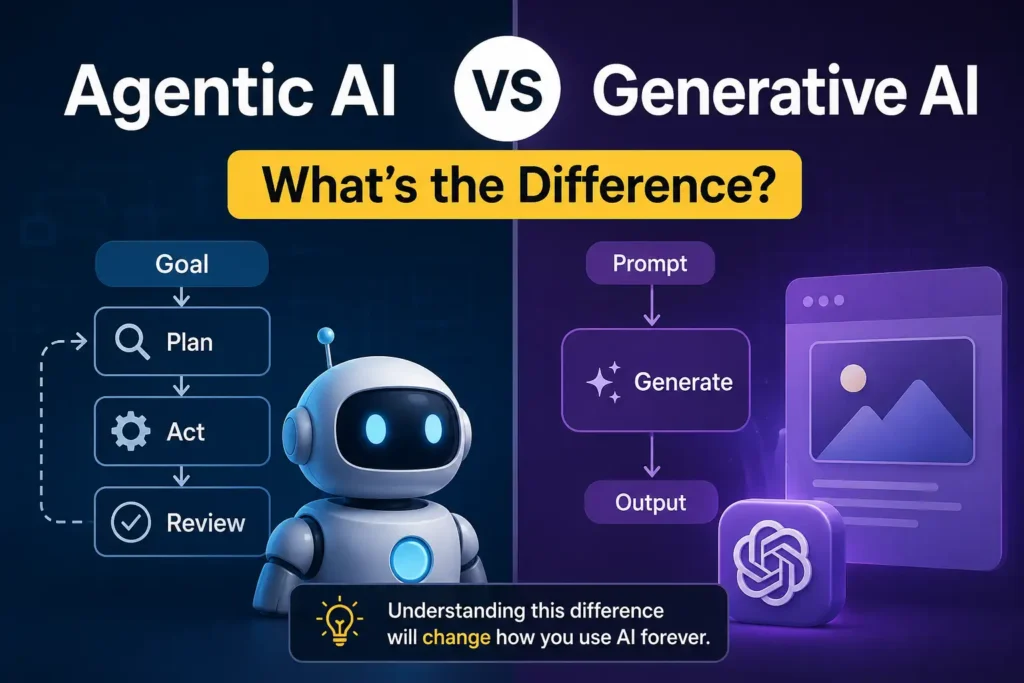
After receiving a prompt, the AI:
- Understands the request
- Predicts the most appropriate response
- Generates text, images, code, or other content
- Returns the output
Once it provides the answer, its task is essentially complete.
If another step is required, the user usually needs to issue another prompt.
For example:
Prompt 1:
“Write a blog outline.”
Prompt 2:
“Expand section two.”
Prompt 3:
“Create a conclusion.”
The AI depends heavily on user guidance.
How Agentic AI Works
Agentic AI follows a much more dynamic process.
Instead of waiting for instructions after every step, it continuously works toward the overall objective.
A simplified workflow looks like this:
- Receive a goal.
- Analyze the objective.
- Create a plan.
- Break the work into smaller tasks.
- Choose the right tools.
- Complete each task.
- Evaluate results.
- Adjust the plan if necessary.
- Continue until the goal is achieved.
This continuous feedback loop is what makes Agentic AI so powerful.
For a deeper explanation, see our article on How Does Agentic AI Work?.
Decision-Making: The Biggest Difference
Perhaps the most important distinction lies in decision-making.
Generative AI
Generative AI generally waits for user instructions.
It answers the question you ask.
If you don’t provide another prompt, it stops working.
Agentic AI
Agentic AI decides what should happen next based on the current objective.
For example:
Goal:
Increase online sales by 20%.
Instead of asking what to do after every step, Agentic AI might:
- Analyze website traffic
- Identify weak-performing pages
- Recommend SEO improvements
- Generate marketing content
- Launch email campaigns
- Measure conversion rates
- Adjust the strategy based on performance
It behaves much more like a project manager than a chatbot.
Planning And Reasoning
Another major difference is planning.
Generative AI typically solves one problem at a time.
Agentic AI plans an entire sequence of actions before it begins.
For example:
Objective:
Launch a new product.
Agentic AI may automatically plan to:
- Conduct market research
- Analyze competitors
- Estimate demand
- Develop marketing materials
- Create landing pages
- Schedule advertisements
- Monitor campaign results
Each task contributes to the final objective.
Autonomy
Generative AI has relatively limited autonomy.
It creates outputs but rarely acts independently.
Agentic AI operates with much greater independence.
Within predefined boundaries, it can:
- Make decisions
- Prioritize tasks
- Choose tools
- Revise plans
- Continue working without constant supervision
This autonomy makes Agentic AI especially valuable for complex business workflows.
Tool Usage
Generative AI may be able to access certain tools when enabled, but it generally uses them only in response to explicit user requests.
Agentic AI actively selects the most appropriate tools based on the task at hand.
These may include:
- Search engines
- Databases
- Calendars
- Email platforms
- CRM systems
- Cloud storage
- APIs
- Project management software
- Analytics platforms
Rather than simply suggesting actions, Agentic AI can often carry them out.
Memory
Memory is another area where the two technologies differ.
Generative AI usually relies on the current conversation, with some systems offering limited persistent memory.
Agentic AI often maintains broader working memory throughout an entire project.
This enables it to remember:
- Previous decisions
- Task status
- Project goals
- User preferences
- Past interactions
As a result, it can make more informed decisions over extended workflows.
Real-World Examples
Understanding the differences becomes easier when looking at practical examples.
Writing A Blog Article
Generative AI
- Writes the article
- Suggests headlines
- Generates FAQs
- Creates a meta description
Agentic AI
- Researches keywords
- Analyzes competitors
- Creates an outline
- Writes the article
- Optimizes for SEO
- Generates images
- Publishes the content
- Tracks search rankings
- Suggests updates over time
Customer Service
Generative AI
Answers customer questions.
Agentic AI
- Answers questions
- Verifies customer accounts
- Updates support tickets
- Issues refunds
- Schedules follow-ups
- Escalates complex cases
Software Development
Generative AI
Generates code snippets.
Agentic AI
- Designs the application
- Writes the code
- Runs tests
- Fixes bugs
- Updates documentation
- Deploys software
- Monitors performance
When Should You Use Generative AI?
Generative AI is often the better choice when your primary objective is creating content.
Common use cases include:
- Writing articles
- Drafting emails
- Creating presentations
- Designing marketing copy
- Generating images
- Writing code snippets
- Brainstorming ideas
- Summarizing documents
These tasks benefit from fast, high-quality content generation.
When Should You Use Agentic AI?
Agentic AI is more suitable when a task involves multiple steps, decision-making, and automation.
Examples include:
- Managing business workflows
- Conducting market research
- Automating customer support
- Coordinating software development
- Running marketing campaigns
- Scheduling projects
- Financial analysis
- Supply chain optimization
The more complex the workflow, the greater the advantage of Agentic AI.
Can Agentic AI And Generative AI Work Together?
Absolutely. In fact, this is where much of the excitement around modern AI comes from.
A typical Agentic AI system often relies on Generative AI to create content during different stages of a workflow.
For example, while managing a product launch, an Agentic AI system might ask a Generative AI model to:
- Write product descriptions
- Generate social media posts
- Draft email campaigns
- Create presentation slides
- Summarize customer feedback
The Agentic AI oversees the entire process, while the Generative AI handles specific creative tasks. Together, they deliver a more complete solution than either could on its own.
Frequently Asked Questions About Agentic AI Vs Generative AI
Choosing between these technologies depends on your goals. The following questions address some of the most common points of confusion.
Is Agentic AI Better Than Generative AI?
Not necessarily. Agentic AI is better for automating complex workflows and achieving multi-step goals, while Generative AI is better for creating text, images, code, and other content. The right choice depends on the problem you’re trying to solve.
Can Generative AI Become Agentic AI?
Yes. By adding planning, memory, reasoning, decision-making, and tool integration, developers can build Agentic AI systems on top of Generative AI models. This combination enables AI to move beyond content creation into autonomous task execution.
Does Agentic AI Replace Generative AI?
No. Agentic AI complements rather than replaces Generative AI. Most advanced Agentic AI systems still rely on Generative AI to generate content while handling planning, coordination, and execution independently.
Which Industries Benefit Most From Agentic AI?
Industries such as healthcare, finance, software development, e-commerce, customer service, logistics, education, and marketing can benefit significantly because Agentic AI excels at managing complex workflows and repetitive operational tasks.
Will Most AI Systems Become Agentic In The Future?
Many experts believe future AI applications will become increasingly agentic, combining powerful content generation with planning, reasoning, memory, and autonomous decision-making. However, human oversight will remain essential for sensitive or high-risk tasks.
Conclusion
While Agentic AI and Generative AI are closely related, they solve different problems.
Generative AI specializes in creating content from prompts, making it ideal for writing, coding, design, and brainstorming. Agentic AI builds on those capabilities by adding planning, reasoning, memory, tool use, and autonomous decision-making to complete entire workflows with minimal human intervention.
Rather than competing technologies, they are complementary. Generative AI provides the creative intelligence, while Agentic AI orchestrates the steps needed to achieve meaningful outcomes. As organizations continue to automate more complex processes, understanding how these technologies work together will become increasingly valuable.
To deepen your knowledge, explore our related guides on How Does Agentic AI Work?, Agentic AI Examples, Agentic Workflows Explained, How to Build Agentic AI, Agentic Automation Explained, Agentic RAG Explained, and Best Agentic AI Tools. Together, these resources will help you build a complete understanding of the rapidly evolving world of Agentic AI.