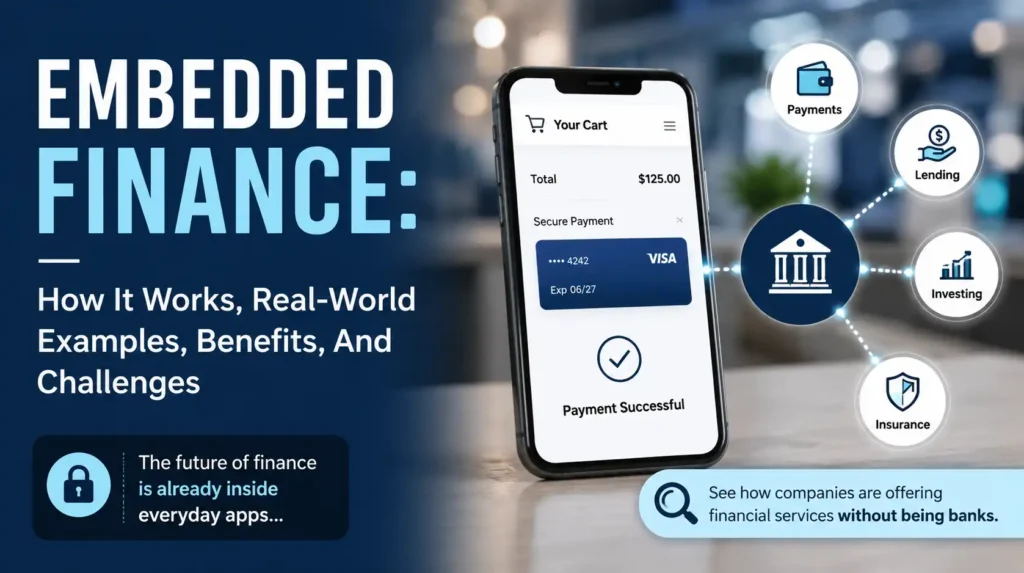
Embedded finance is quietly transforming how people pay, borrow, insure, and invest. Instead of visiting a bank’s website or downloading a separate financial app, consumers can now access financial services directly inside the apps and platforms they already use.
Whether you’re buying products online, booking a ride, ordering food, or using accounting software, there’s a good chance you’ve already used embedded finance without realizing it.
Businesses love it because it creates better customer experiences and new revenue streams. Customers benefit because financial services become faster, simpler, and more convenient.
In this guide, you’ll learn exactly what embedded finance is, how it works, the different types of embedded financial services, examples from leading companies, benefits, risks, future trends, and why many experts believe it represents the future of banking.
Table of Contents
What Is Embedded Finance?
Embedded finance is the integration of financial services into non-financial products, apps, websites, or platforms.
Instead of sending customers to a traditional bank or financial institution, businesses provide financial products directly within their own digital experience.
These services may include:
- Payments
- Lending
- Insurance
- Banking
- Investments
- Buy Now, Pay Later (BNPL)
- Business financing
- Digital wallets
The customer often doesn’t even notice that another financial institution is providing the service behind the scenes.
For example, when you choose “Pay in 4” during online checkout instead of paying the full amount upfront, you’re using embedded finance.
How Embedded Finance Works
Behind every embedded finance solution are several companies working together.
Here’s the typical process.
Step 1: A Customer Uses a Digital Platform
This could be:
- An online store
- A ride-sharing app
- A food delivery app
- Accounting software
- A healthcare platform
- A travel booking website
Step 2: The Platform Offers a Financial Service
Instead of asking customers to leave the platform, it provides options such as:
- Instant loans
- Insurance
- Installment payments
- Bank accounts
- Digital wallets
Step 3: APIs Connect Everything
Application Programming Interfaces (APIs) allow the platform to securely connect with licensed banks, payment processors, and financial service providers.
The customer experiences one seamless transaction.
Step 4: The Financial Institution Handles the Backend
Although the customer interacts with the platform, regulated financial institutions manage:
- Compliance
- Risk assessment
- Payment processing
- Lending decisions
- Regulatory reporting
This allows businesses to offer sophisticated financial products without becoming banks themselves.
Why Embedded Finance Is Growing So Fast
Several factors are driving rapid adoption.
Customers Want Convenience
Modern consumers dislike switching between multiple apps.
If they can finance a purchase or insure a product without leaving checkout, they’re far more likely to complete the transaction.
Digital Commerce Is Expanding
As online shopping continues growing worldwide, businesses seek ways to reduce friction during purchases.
Embedded finance removes unnecessary steps.
APIs Have Become More Powerful
Financial technology companies now offer plug-and-play APIs that allow businesses to integrate financial services much faster than in the past.
Banking-as-a-Service Has Matured
Banking-as-a-Service (BaaS) providers allow companies to offer banking products without building banking infrastructure from scratch.
This has dramatically lowered the barrier to entry.
Types of Embedded Finance
Embedded finance covers much more than online payments.
Let’s explore the major categories.
Embedded Payments
This is the most common form.
Customers complete payments directly inside an app or website.
Examples include:
- One-click checkout
- Mobile wallets
- In-app purchases
- Subscription billing
- QR code payments
Examples:
- Uber
- Amazon
- Shopify stores
- Apple Pay integration
Embedded Lending
Businesses offer financing directly during the purchase process.
Examples include:
- Consumer loans
- Installment payments
- Merchant financing
- Small business loans
Instead of visiting a bank, customers receive financing instantly.
Embedded Insurance
Insurance is offered exactly when customers need it.
Examples include:
- Travel insurance during flight booking
- Device insurance when buying smartphones
- Car insurance while purchasing vehicles
- Shipping insurance during online checkout
This increases convenience while improving insurance adoption.
Embedded Banking
Some platforms now offer banking services directly.
Examples include:
- Checking accounts
- Debit cards
- Savings accounts
- Expense management
Many fintech platforms provide these features using licensed banking partners.
Embedded Investing
Investment services can also be integrated into existing platforms.
Examples include:
- Automatic investing
- Fractional shares
- Cryptocurrency purchases
- Retirement savings
Users invest without opening separate brokerage accounts.
Real-World Examples of Embedded Finance
Embedded finance is already everywhere.
Ride-Sharing Apps
Ride-sharing apps automatically process payments.
Drivers may also receive:
- Instant payouts
- Fuel cards
- Business loans
- Insurance products
Everything happens inside one platform.
E-Commerce Websites
Online stores frequently offer:
- Buy Now, Pay Later
- Instant refunds
- Embedded insurance
- Financing
Customers complete purchases without leaving checkout.
Accounting Software
Many accounting platforms now provide:
- Business bank accounts
- Invoice financing
- Payroll services
- Business credit cards
Businesses manage both accounting and banking from one dashboard.
Healthcare Platforms
Healthcare providers increasingly integrate:
- Payment plans
- Medical financing
- Health insurance verification
Patients receive financial options during appointment scheduling.
Travel Platforms
Booking platforms often include:
- Travel insurance
- Installment payments
- Currency conversion
- Airport lounge access
Customers arrange everything in one booking process.
Industries Benefiting From Embedded Finance
Embedded finance is expanding into nearly every industry.
These include:
Retail
Retailers improve checkout experiences while increasing average order values.
Healthcare
Patients gain flexible payment options for medical expenses.
Education
Schools and online learning platforms offer tuition financing.
Transportation
Ride-sharing and logistics companies streamline driver payments.
Hospitality
Hotels integrate payment processing, insurance, and financing.
Real Estate
Property platforms provide mortgage prequalification and payment services.
Agriculture
Farmers access financing, insurance, and digital payments through agricultural platforms.
Benefits of Embedded Finance for Businesses
Businesses gain significant advantages.
Higher Sales
Flexible payment options encourage customers to complete purchases.
Large purchases become more affordable through installment plans.
Better Customer Experience
Customers appreciate staying within one platform instead of visiting multiple websites.
This reduces friction.
Increased Customer Loyalty
Convenience encourages repeat purchases.
Customers become more likely to continue using platforms that simplify financial transactions.
New Revenue Streams
Businesses often earn commissions from financial partners.
Revenue sources may include:
- Loan referrals
- Insurance commissions
- Payment processing
- Card interchange fees
Valuable Customer Insights
Financial interactions generate useful data that helps companies personalize products and improve customer experiences.
Benefits for Consumers
Customers also benefit.
Convenience
Everything happens within one familiar platform.
No additional accounts are necessary in many cases.
Faster Decisions
Loan approvals, insurance quotes, and payment processing occur within minutes.
Better Accessibility
Consumers gain access to financial services even if traditional banking is inconvenient.
Improved User Experience
There are fewer forms to complete and fewer websites to visit.
The entire process feels simpler.
The Technology Behind Embedded Finance
Several technologies make embedded finance possible.
APIs
APIs allow different software systems to communicate securely.
Without APIs, embedded finance would be extremely difficult.
Cloud Computing
Cloud infrastructure enables rapid scaling.
Financial services remain available even during high transaction volumes.
Artificial Intelligence
AI helps:
- Detect fraud
- Assess credit risk
- Personalize financial offers
- Improve customer support
Machine Learning
Machine learning continuously improves:
- Risk models
- Fraud prevention
- Customer recommendations
- Lending decisions
Secure Payment Infrastructure
Encryption, tokenization, and multi-factor authentication protect customer information during transactions.
Challenges of Embedded Finance
Despite its advantages, embedded finance presents challenges.
Regulatory Compliance
Financial services are heavily regulated.
Businesses must comply with:
- Anti-money laundering (AML) requirements
- Know Your Customer (KYC) rules
- Data privacy laws
- Consumer protection regulations
Cybersecurity Risks
More financial data creates larger attack surfaces.
Businesses must invest heavily in cybersecurity.
Customer Trust
Customers need confidence that their financial information is secure.
Poor security or unclear communication can reduce trust.
Integration Complexity
Building reliable integrations requires technical expertise.
Although APIs simplify development, implementation still requires careful planning.
Operational Risk
Businesses rely on multiple partners.
Problems affecting one provider can impact the customer experience.
Embedded Finance vs Traditional Banking
Although both provide financial services, they operate differently.
| Embedded Finance | Traditional Banking |
|---|---|
| Available within other platforms | Separate banking channels |
| Seamless user experience | Multiple steps required |
| Contextual financial products | General financial services |
| API-driven | Branch and online banking systems |
| Often invisible to customers | Bank is the primary relationship |
Rather than replacing banks, embedded finance often allows banks to reach customers through new digital channels.
Embedded Finance vs Fintech
These terms are related but not identical.
Fintech refers to technology companies building financial products.
Embedded finance describes how those financial products are integrated into non-financial platforms.
Many fintech companies actually power embedded finance behind the scenes.
Future Trends in Embedded Finance
The market continues evolving rapidly.
Several trends are likely to shape the coming years.
Personalized Financial Products
AI will recommend financial products based on customer behavior.
Expansion Into New Industries
Manufacturing, healthcare, education, agriculture, and government services will increasingly adopt embedded financial solutions.
More Real-Time Payments
Instant payment networks will continue reducing transaction delays.
Better Cross-Border Transactions
International commerce will become smoother through embedded foreign exchange and international payment services.
Greater Financial Inclusion
People with limited access to traditional banks may gain financial services through digital platforms they already use.
Best Practices for Businesses Adopting Embedded Finance
Organizations considering embedded finance should follow several best practices.
Choose experienced financial partners with strong regulatory credentials.
Prioritize security from the beginning rather than adding it later.
Maintain transparent pricing so customers understand fees and terms.
Design financial experiences that genuinely solve customer problems instead of overwhelming users with unnecessary offers.
Regularly monitor performance, fraud, customer satisfaction, and regulatory compliance.
Finally, focus on creating seamless experiences. Customers should feel that financial services naturally belong within the platform rather than appearing as unrelated add-ons.
Frequently Asked Questions About Embedded Finance
Many businesses and consumers are still learning about embedded finance. The following answers address some of the most common questions.
What is embedded finance in simple terms?
Embedded finance means offering financial services such as payments, loans, insurance, or bank accounts directly inside a non-financial app or website. Instead of visiting a separate bank, users access these services while using a platform they already trust.
Is embedded finance the same as Banking-as-a-Service?
No. Banking-as-a-Service provides the infrastructure that allows companies to offer banking products. Embedded finance is the customer-facing experience that integrates those financial products into non-financial platforms. Banking-as-a-Service often powers embedded finance behind the scenes.
Why are companies investing in embedded finance?
Businesses use embedded finance to improve customer experiences, increase sales, generate additional revenue, strengthen customer loyalty, and reduce friction during purchases. Customers also benefit from faster, more convenient financial services without switching between multiple apps.
Is embedded finance secure?
It can be very secure when businesses partner with licensed financial institutions and implement strong cybersecurity measures such as encryption, tokenization, fraud detection, and multi-factor authentication. However, organizations must continually invest in security and regulatory compliance to protect customer data.
What is the future of embedded finance?
Embedded finance is expected to become increasingly common across industries including retail, healthcare, education, transportation, and business software. Advances in artificial intelligence, open banking, real-time payments, and Banking-as-a-Service will likely make financial services even more personalized, accessible, and seamlessly integrated into everyday digital experiences.
Conclusion
Embedded finance is changing how financial services are delivered by bringing banking, payments, lending, insurance, and investing directly into the digital experiences people use every day. Instead of forcing customers to leave an app or website, businesses can provide these services at the exact moment they are needed, creating faster, smoother, and more convenient interactions.
For businesses, embedded finance offers opportunities to increase revenue, improve customer loyalty, and differentiate their products. For consumers, it simplifies access to financial services while reducing friction and saving time. Although challenges such as regulatory compliance, cybersecurity, and partner management remain important, advances in APIs, Banking-as-a-Service, cloud computing, and artificial intelligence continue to accelerate adoption.
As digital commerce expands and customer expectations evolve, embedded finance is likely to become a standard feature rather than a competitive advantage. Organizations that implement it thoughtfully and securely will be well positioned to meet the growing demand for seamless, integrated financial experiences.

