California drivers who have been waiting for electric vehicles to become more affordable finally have a new reason to look again.
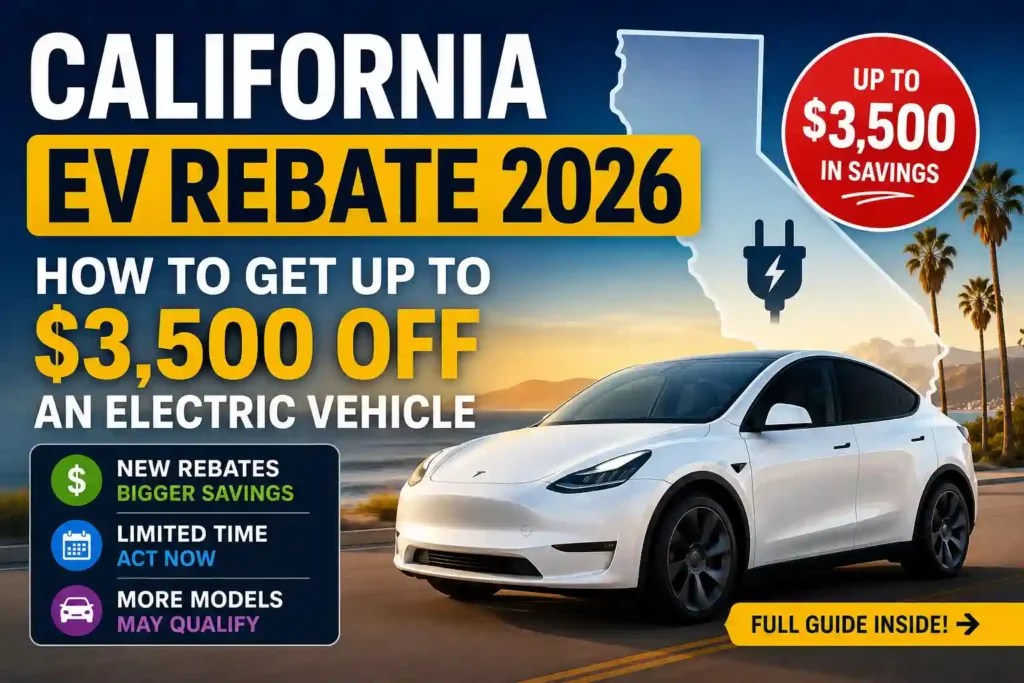
The California EV rebate 2026 is no longer just a proposal or something expected “later this year.” The state’s new MyFirstEV program has begun rolling out, giving eligible first-time zero-emission vehicle buyers an instant discount of up to $3,500 on a new vehicle or $1,750 on an eligible used vehicle.
And “instant” is the important word.
Unlike incentives that force buyers to pay the full price and wait months for a tax return or reimbursement, MyFirstEV is designed to reduce the vehicle price at the point of sale. For a family already calculating a down payment, monthly payment, insurance, charging costs and every other expense that comes with changing cars, that difference matters.

But there are catches.
Not every California resident qualifies. Not every electric vehicle qualifies. Automakers are joining the program on different dates. Plug-in hybrids are excluded. Used EVs come with additional rules. And buying a vehicle even a few days before its manufacturer activates the program could mean losing the rebate completely.
This guide explains exactly how the California EV rebate works in 2026, who qualifies, which manufacturers are participating, which vehicles are excluded, how the used EV rebate works, whether other California incentives can be combined with it, and the mistakes buyers should avoid before signing a purchase or lease agreement.
Most importantly, it explains what shoppers should confirm at the dealership before assuming $3,500 will automatically disappear from the price.
First, here is the number most shoppers came to find.
Table of Contents
How Much Is the California EV Rebate in 2026?
California’s MyFirstEV program offers two main incentive amounts:
- $3,500 for an eligible new zero-emission vehicle
- $1,750 for an eligible used zero-emission vehicle
The discount is provided at the point of sale, meaning an eligible buyer does not have to purchase the vehicle first and then wait to claim the money later.
For most manufacturers, a new vehicle must have an MSRP of $50,000 or less, while an eligible used vehicle generally must have a purchase price of $25,000 or less.
The program is backed by a one-time $135.5 million California allocation, with participating manufacturers matching the state’s contribution. That effectively doubles the pool of money available through the program. State officials estimate the program could support more than 73,000 zero-emission vehicles.
That sounds straightforward. The eligibility rules are where things become more important.
Who Qualifies for the California EV Rebate 2026?
The biggest requirement is simple: MyFirstEV is designed for Californians buying or leasing their first zero-emission vehicle.
In other words, this is not a general EV rebate available every time someone trades one electric car for another.
California residency is required
The program is specifically for California residents.
Vehicles purchased using the incentive cannot be delivered or registered to an address outside California.
That prevents shoppers from another state from traveling to California simply to claim the rebate.
It must be the buyer’s first ZEV
A participant must be buying or leasing a zero-emission vehicle for the first time.
That includes previous leases.
Someone who previously leased an EV cannot simply argue that this is their first EV “purchase.” The program treats a previous ZEV lease as previous participation in electric vehicle ownership.
Buyers must confirm their eligibility through a self-attestation process. The declaration is signed under penalty of perjury.
The safest approach is simple: anyone who previously purchased or leased a battery-electric or qualifying zero-emission vehicle should not assume eligibility.
Each person gets only one MyFirstEV incentive
The program limits each individual to one incentive over the lifetime of MyFirstEV.
That matters for households with multiple drivers. The limit applies to individuals rather than providing a recurring rebate every time a household buys another EV.
One detail will surprise many shoppers.
There Is No MyFirstEV Income Limit
Some California clean-vehicle programs are heavily income-based.
MyFirstEV is different.
The program is open to eligible California residents buying or leasing their first qualifying ZEV, and the rebate amount does not increase or decrease based on household income.
That means a buyer does not need to fall below a particular income threshold simply to receive the basic $3,500 or $1,750 MyFirstEV incentive.
However, income can become extremely important when other California vehicle assistance programs are added to the picture.
More on that shortly.
Before looking at additional savings, shoppers need to understand what counts as an eligible vehicle.
Which Vehicles Qualify for California’s $3,500 EV Rebate?
Calling MyFirstEV an “EV rebate” is convenient, but the program technically applies to eligible zero-emission vehicles, or ZEVs.
Qualifying categories include:
- Battery-electric vehicles
- Hydrogen fuel-cell electric vehicles
Plug-in hybrid electric vehicles are not eligible because they still contain gasoline engines that produce tailpipe emissions.
This distinction matters because many shoppers use terms such as EV, electric car, hybrid and plug-in hybrid interchangeably.
They are not interchangeable under this program.
Someone shopping for a plug-in hybrid should not count on receiving the MyFirstEV rebate simply because the vehicle can travel part of the time using electricity.
For consumers still comparing technologies, electric cars vs. hybrid cars: the real cost difference is worth understanding before choosing a vehicle based only on the advertised purchase price.
There is another major rule: price.
The $50,000 Price Cap for New EVs
For most participating manufacturers that are not covered by California’s special manufacturer exception, a qualifying new ZEV must have an MSRP of $50,000 or less.
That immediately makes vehicle configuration important.
A model might appear to qualify because its entry-level version costs less than $50,000, while a higher trim or different configuration could push the MSRP above the program limit.
That means shoppers should not ask only:
“Does this model qualify?”
A better question is:
“Does this exact model, trim and configuration qualify for MyFirstEV?”
It is a small distinction that could determine whether the buyer receives $3,500 or nothing.
However, California created an unusual exception.
Some California-Based EV Manufacturers Get Special Treatment
California-headquartered companies that meet the program’s definition of a qualifying zero-emission vehicle manufacturer are exempt from the normal MSRP and sales-price caps.
That makes the rules different depending on the manufacturer.
It is one reason shoppers should avoid building their entire budget around a simple online list of EVs priced below $50,000.
Manufacturer location, vehicle configuration, launch date and program participation can all affect eligibility.
The exception has particularly important implications for California-headquartered electric-vehicle companies whose vehicles can exceed the normal $50,000 ceiling.
Meanwhile, a manufacturer that does not qualify for the California-headquarters exception remains subject to the regular price limit.
Now comes the question many Tesla shoppers are asking.
Does Tesla Qualify for the California EV Rebate 2026?
Yes, Tesla is participating in MyFirstEV.
As of the program’s August rollout, Tesla was one of the first three manufacturers offering the instant rebate in California, alongside Hyundai and Lucid.
However, Tesla does not receive the California-headquartered manufacturer price-cap exception because its corporate headquarters are no longer in California.
Therefore, shoppers should not assume every Tesla configuration qualifies.
The normal vehicle pricing requirements can still matter.
This is especially important because options, trims and vehicle pricing can change. Shoppers should verify the eligibility of the exact Tesla they intend to purchase before finalizing the transaction.
The same principle applies to every manufacturer: a brand’s participation does not necessarily mean every vehicle it sells qualifies.
And participation itself is still rolling out.
Which Automakers Are Participating in MyFirstEV?
The California EV rebate 2026 is being introduced in stages rather than becoming available across every participating manufacturer on exactly the same day.
When the instant incentives became available in early August, the first active manufacturers included:
- Hyundai
- Lucid
- Tesla
Additional manufacturers were scheduled to join during August, September and later in the year.
Current program information lists participating or upcoming manufacturers including:
- Chevrolet
- Ford
- Honda
- Hyundai
- Kia
- Lexus
- Lucid
- Mitsubishi
- Nissan
- Rivian
- Subaru
- Tesla
- Toyota
- Volvo
Expected rollout schedule
Current published timing shows:
August 2026: Chevrolet, Ford, Hyundai, Kia, Lucid and Tesla, with additional August rollout activity depending on the manufacturer.
September 2026: Honda, Lexus, Subaru and Toyota.
November 2026: Mitsubishi.
Coming soon or timing still being finalized: Nissan, Rivian and Volvo, depending on the latest manufacturer rollout information.
There is an important warning attached to this schedule.
Vehicles ordered or purchased before the participating manufacturer makes the incentive available are not eligible retroactively.
That makes timing far more important than many shoppers realize.
A buyer who purchases on Monday cannot necessarily return on Friday and ask for $3,500 because the automaker joined the program later that week.
So before buying, confirm availability first.
The used-car rules deserve their own explanation.
How Does the California Used EV Rebate Work in 2026?
MyFirstEV isn’t limited to new cars.
Eligible first-time ZEV buyers can receive $1,750 off a qualifying used zero-emission vehicle.
But used EV eligibility is more restrictive than simply finding an electric car advertised for $24,999.
The current program rules state that qualifying used vehicles generally must:
- Cost $25,000 or less unless a qualifying manufacturer exemption applies
- Be purchased through a participating manufacturer’s certified pre-owned program
- Meet the applicable model-year requirements
- Come from a participating manufacturer
- Be purchased by an eligible first-time ZEV buyer
Private-party sales do not qualify.
And ordinary independent used-car dealerships should not automatically be assumed eligible merely because they sell electric vehicles.
One used-EV detail shoppers should verify carefully
There is an important technical point in the currently published program guidance.
The FAQ states that vehicles must be model year 2026 or newer, but it also says used vehicles must be at least two model years older than the year in which they are purchased.
Those statements can appear inconsistent when read together for a used vehicle purchased in 2026.
Rather than guessing, a used-EV buyer should confirm the eligible model year directly with the participating manufacturer before paying a deposit or signing a purchase agreement.
That five-minute check could prevent an expensive misunderstanding.
This is one of the biggest reasons buyers should treat advertised rebate amounts as potential savings until the exact vehicle is verified.
Next comes another valuable question.
Can the California EV Rebate Be Combined With Other Incentives?
Yes.
MyFirstEV can be stacked with other eligible California vehicle-incentive programs.
That could make the total savings substantially more valuable for some households.
Programs that may be relevant include California’s Driving Clean Assistance Program and regional Clean Cars 4 All programs.
Eligibility rules are separate, however.
Qualifying for MyFirstEV does not automatically mean a buyer qualifies for every other clean-vehicle program.
For example, some additional assistance programs use household-income requirements, geographic restrictions, vehicle-retirement requirements or other conditions that MyFirstEV itself does not impose.
For households that qualify, combining programs can dramatically change the financial calculation.
One California program may provide assistance toward a qualifying cleaner vehicle, while MyFirstEV can provide another point-of-sale reduction.
This is why buyers focused only on the headline $3,500 number may actually be leaving money on the table.
Researching California programs that help families reduce transportation costs before visiting the dealership could uncover additional assistance.
Still, rebates are only one part of EV affordability.
Does the California EV Rebate Really Make an EV Cheaper?
It makes the purchase price lower.
That does not automatically make a particular EV affordable.
This is where buyers should slow down.
Suppose an eligible new EV costs $42,000.
A $3,500 point-of-sale reduction could bring the effective vehicle price down to roughly $38,500 before taxes, fees, optional equipment, financing costs and other charges are considered.
That is meaningful.
But the real monthly cost depends on far more than the sticker price.
Financing
A lower purchase price can reduce the amount that needs to be financed, but the interest rate and loan term still matter enormously.
Stretching a vehicle loan over a long period can make the monthly payment look comfortable while increasing the total amount paid.
Insurance
Electric vehicles can have very different insurance costs depending on the model, location, driver and insurer.
A $3,500 purchase discount can be partly erased over time if insurance premiums are significantly higher than expected.
Charging
Home charging can be convenient, but installation costs vary.
A household may need an electrical-panel upgrade or Level 2 charging equipment. Renters and apartment residents may rely much more heavily on public charging.
Registration and taxes
Rebates do not eliminate every cost associated with purchasing and registering a vehicle.
The number that matters is not simply “$3,500 off.”
The better calculation is:
vehicle price after incentives + financing + insurance + charging + registration + expected ownership costs.
That gives buyers a far more realistic picture.
For anyone financing a vehicle, understanding how car loan interest affects the real cost of a vehicle can matter almost as much as finding the rebate itself.
Fortunately, claiming MyFirstEV is simpler than many previous incentive programs.
How to Claim the California EV Rebate in 2026
There is no traditional rebate process where an eligible buyer pays the full vehicle price, submits paperwork and waits months for reimbursement.
The program is designed around point-of-sale savings.
Step 1: Confirm first-time ZEV eligibility
The buyer must be a California resident purchasing or leasing a zero-emission vehicle for the first time.
Previous EV purchases or leases can affect eligibility.
Step 2: Choose a participating manufacturer
Do not assume every automaker has already activated MyFirstEV.
Program availability varies by manufacturer and dealership.
Step 3: Verify the exact vehicle
Confirm that the model, model year, trim, price and vehicle type meet current program requirements.
Do this before paying a nonrefundable deposit.
Step 4: Ask whether funds are still available
The program has limited funding.
The incentive remains available only while funds allocated through participating manufacturers remain available.
Step 5: Complete the required eligibility declaration
Participants must attest that they meet the first-time ZEV requirement.
Step 6: Make sure the discount appears in the transaction
The rebate should reduce the price at the point of sale rather than requiring the buyer to wait for a later tax filing or reimbursement.
Before signing, check the purchase or lease paperwork carefully.
A salesperson saying “you qualify” is not enough. The numbers on the contract should reflect the expected incentive.
That leads to the mistakes most likely to cost shoppers money.
7 California EV Rebate Mistakes to Avoid
The program is simple compared with many older incentives, but several mistakes can still destroy eligibility.
1. Buying before the manufacturer launches
This is probably the easiest mistake to make.
An automaker may be listed as participating while its rebate has not yet become available.
Purchases made before activation do not qualify retroactively.
2. Assuming every “electric” vehicle qualifies
Plug-in hybrids do not qualify for MyFirstEV.
The program is aimed at zero-emission vehicles.
3. Ignoring the price cap
For most non-exempt manufacturers, a new ZEV above the $50,000 MSRP limit will not qualify.
Higher trims can therefore matter.
4. Forgetting about a previous EV lease
The requirement applies to first-time ZEV buyers or lessees.
A previous lease can make a person ineligible.
5. Buying an ordinary used EV and expecting $1,750
Used-vehicle eligibility is tied to manufacturer certified pre-owned channels and additional program requirements.
A random private-party used EV is not enough.
6. Assuming funding cannot run out
The program is funded with a fixed appropriation and manufacturer matching.
Availability is not unlimited.
7. Negotiating only around the rebate
A $3,500 discount can look impressive while the buyer gets a poor financing rate, expensive add-ons or an unfavorable trade-in value.
The rebate should be treated as one part of the transaction, not permission to stop negotiating.
There is also a bigger reason this particular incentive matters in 2026.
Why California Created a New EV Rebate in 2026
The timing is not accidental.
Federal EV purchase incentives that previously provided substantial tax benefits for qualifying new and used electric vehicles have ended, changing the affordability equation for American EV shoppers. California responded by creating its own first-time-buyer incentive rather than simply reviving its previous rebate system in exactly the same form.
The state is putting $135.5 million into MyFirstEV, and participating automakers match that money, bringing the combined potential consumer savings pool to roughly $271 million.
California also has a major economic reason to keep EV adoption moving.
Transportation remains a large source of the state’s air pollution and greenhouse-gas emissions, while California continues to have one of the country’s largest zero-emission vehicle markets.
The new rebate therefore serves several purposes at once:
It reduces upfront costs for first-time buyers.
It gives automakers an incentive to contribute their own money.
It supports California’s clean-transportation strategy.
And it attempts to keep EV demand moving after the loss of larger federal incentives.
But consumers still need to make the decision based on their own finances.
So, is this the right moment to buy?
Should Buyers Rush to Use the California EV Rebate?
There is a difference between acting quickly and rushing.
Because the incentive is funded with a limited pool of money, waiting indefinitely carries the risk that funds for a particular participating manufacturer could eventually be exhausted.
But buying a $40,000 or $50,000 vehicle solely because $3,500 is available would be poor financial logic.
A rebate does not make an unaffordable car affordable.
The strongest candidates for MyFirstEV are shoppers who were already seriously considering an eligible zero-emission vehicle and can comfortably handle the remaining ownership costs.
Before purchasing, compare:
- Total vehicle price after incentives
- Interest rate
- Monthly payment
- Loan length
- Insurance quote
- Home or public charging costs
- Expected annual mileage
- Maintenance
- Trade-in value
- Other rebates that may stack with MyFirstEV
Then compare that total with the cost of keeping the current vehicle or buying a comparable gasoline or hybrid model.
That is how the $3,500 rebate becomes a financial tool rather than a marketing trigger.
Finally, here is the shortest version of everything that matters.
Frequently Asked Questions About the California EV Rebate 2026
The new program has created plenty of questions, particularly because eligibility can depend on the buyer, vehicle, manufacturer and timing. Here are answers to the most important questions shoppers are asking about the California EV rebate 2026.
What is the California EV rebate 2026?
California’s 2026 EV incentive is called MyFirstEV. It is designed to help eligible California residents buying or leasing their first zero-emission vehicle by providing an incentive at the point of sale.
How much is the California EV rebate in 2026?
Eligible buyers can receive $3,500 toward a qualifying new zero-emission vehicle or $1,750 toward an eligible used zero-emission vehicle.
Unlike a traditional rebate that arrives weeks or months later, MyFirstEV is structured as an upfront incentive.
Is the $3,500 California EV rebate available now?
Yes, but availability depends on the manufacturer. MyFirstEV launched in stages, so participating automakers do not necessarily begin offering the incentive on the same date.
Buyers should confirm that their chosen manufacturer’s participation is active before completing the transaction.
Who qualifies for the California EV rebate 2026?
The program is intended for California residents purchasing or leasing their first zero-emission vehicle. Previous ownership or leasing of a ZEV can affect eligibility.
Participants must also meet the program’s vehicle and transaction requirements.
Is there an income limit for the California EV rebate?
MyFirstEV itself does not impose an income limit on buyers.
This is an important difference from some other California clean-vehicle assistance programs, which may use household-income limits or provide additional benefits to lower-income households.
Do previous EV owners qualify for MyFirstEV?
Generally, no. MyFirstEV is specifically designed for people acquiring their first ZEV.
Someone who previously purchased a qualifying zero-emission vehicle should not expect to receive the incentive again.
Does a previous EV lease make someone ineligible?
Yes, a previous qualifying ZEV lease can matter.
MyFirstEV applies to first-time ZEV buyers and lessees, so leasing an electric vehicle previously should not be ignored when determining eligibility.
Does Tesla qualify for the California EV rebate 2026?
Tesla participates in MyFirstEV, but buyers still need to verify that their specific vehicle and transaction meet the current requirements.
A manufacturer’s participation should never be interpreted as automatic eligibility for every model, trim or transaction.
Which automakers participate in California’s MyFirstEV program?
California has announced participation from manufacturers including Tesla, Hyundai, Lucid, Chevrolet, Ford, Honda, Kia, Lexus, Mitsubishi, Nissan, Rivian, Subaru, Toyota and Volvo.
However, activation dates vary. Some manufacturers launched earlier than others, while additional launches were scheduled for later in 2026.
Buyers should therefore check the latest manufacturer participation status before ordering a vehicle.
Do all electric cars qualify for the $3,500 California rebate?
No.
The vehicle must satisfy MyFirstEV’s eligibility requirements. The exact manufacturer, vehicle type, price, model year and transaction can matter.
Simply seeing “electric” in a vehicle advertisement does not guarantee a $3,500 discount.
Do plug-in hybrids qualify for the California EV rebate?
No. Plug-in hybrid electric vehicles are not eligible for MyFirstEV because they still use an internal-combustion engine.
The program focuses on qualifying zero-emission vehicles such as battery-electric and hydrogen fuel-cell vehicles.
Do hydrogen fuel-cell vehicles qualify?
Yes. Eligible hydrogen fuel-cell electric vehicles can qualify because they fall within the program’s zero-emission vehicle categories.
That means the California EV rebate 2026 is not restricted exclusively to battery-powered cars.
What is the maximum vehicle price for the California EV rebate?
Vehicle price restrictions can depend on the manufacturer and applicable program rules.
Shoppers should verify the current price ceiling for their exact vehicle rather than relying on an old article, advertisement or social-media post. California’s rules also contain special provisions that can affect qualifying California-based manufacturers.
This is particularly important for higher-priced trims and configurations.
Can a used electric vehicle qualify for a California rebate in 2026?
Yes. MyFirstEV includes an incentive of $1,750 for qualifying used zero-emission vehicles.
However, used vehicles face additional eligibility requirements. A used EV being inexpensive does not automatically make it eligible.
Can someone get the $1,750 rebate when buying a used EV from a private seller?
No. The program’s used-vehicle requirements do not make ordinary private-party transactions eligible.
Buyers interested in the used EV incentive should verify that the vehicle is being sold through an eligible participating manufacturer’s certified pre-owned channel and meets the remaining program rules.
Can the California EV rebate be used for a lease?
Yes. Eligible first-time ZEV lessees can participate in MyFirstEV, provided the vehicle, manufacturer and transaction satisfy the applicable requirements.
Consumers considering a lease should still compare the complete lease terms rather than evaluating the deal solely on the $3,500 incentive.
Is the California EV rebate a tax credit?
No. MyFirstEV is fundamentally different from a traditional tax credit.
The incentive is designed to be applied at the point of sale, which can reduce the amount an eligible consumer pays during the vehicle transaction instead of requiring that person to wait until filing taxes.
Do buyers have to wait for a rebate check?
No. That is one of the biggest advantages of MyFirstEV.
Eligible consumers receive the incentive as part of the vehicle transaction rather than purchasing the vehicle at full price and waiting for California to mail a rebate check later.
Can MyFirstEV be combined with other California EV incentives?
Potentially, yes.
MyFirstEV can be combined with other qualifying incentive programs when the buyer independently meets their requirements.
That can be particularly important for lower-income households that may qualify for programs offering additional assistance.
However, each program has its own eligibility rules, so qualifying for MyFirstEV does not automatically qualify someone for another California incentive.
Can buyers combine the California rebate with manufacturer discounts?
Manufacturer pricing, promotions and incentives can change frequently.
Consumers should ask the participating manufacturer or dealer which current incentives can be combined with MyFirstEV and then compare the final transaction price, not simply the advertised discount.
This also helps prevent a rebate from disguising an otherwise expensive financing or purchase agreement.
Can the California EV rebate run out of money?
Yes.
MyFirstEV has a defined funding pool rather than an unlimited promise to every future EV buyer. California provided substantial funding, which participating manufacturers match, but availability can still depend on remaining funds.
That makes checking current availability before purchasing important.
What happens if an EV is purchased before the manufacturer’s MyFirstEV launch date?
The buyer should not expect the incentive to be added retroactively.
This is one of the most important California EV rebate 2026 rules to understand.
A manufacturer may be announced as a program participant while its actual incentive start date is later. Buying before that activation date could mean missing the rebate.
Should buyers purchase an EV just because they can get $3,500 off?
Not necessarily.
A $3,500 discount is valuable, but it should not turn an unaffordable vehicle into a supposedly affordable one.
Buyers should calculate the total cost, including financing, insurance, registration, charging and expected ownership expenses. A vehicle with a lower sticker price and smaller incentive could ultimately cost less than a more expensive EV carrying the full rebate.
How can buyers check whether a vehicle qualifies for the California EV rebate 2026?
The safest approach is to check the latest MyFirstEV information from the California Air Resources Board and confirm eligibility with the participating manufacturer before purchasing.
Do not rely solely on a salesperson saying a vehicle “should qualify.”
Verify:
- Manufacturer participation is active
- Exact vehicle eligibility
- Applicable vehicle-price requirements
- First-time ZEV eligibility
- Remaining incentive availability
- How the $3,500 or $1,750 appears on the final transaction
The program has evolved from earlier proposals, making current rules more reliable than preliminary information published before launch.
Is the California EV rebate 2026 worth it?
For an eligible California resident who was already planning to purchase or lease a qualifying zero-emission vehicle, $3,500 in upfront savings can be significant.
The rebate becomes much more valuable when the vehicle itself fits the household budget, financing is reasonable, insurance is affordable and additional incentives can legitimately be combined.
But the rebate should never be the only reason to buy.
The smartest approach is to use the California EV rebate 2026 to reduce the cost of a vehicle that already makes financial sense—not to justify spending thousands more simply because an incentive is available.
That distinction could ultimately save far more than $3,500.
California EV Rebate 2026: The Bottom Line
The California EV rebate 2026, officially offered through MyFirstEV, can reduce the upfront cost of an eligible zero-emission vehicle by $3,500 for a new model or $1,750 for a qualifying used model.
The incentive is available to eligible California residents purchasing or leasing their first ZEV, and it is applied at the point of sale rather than requiring buyers to wait for a later reimbursement.
For most participating manufacturers, new vehicles face a $50,000 MSRP limit, while used vehicles generally face a $25,000 purchase-price ceiling. California-headquartered qualifying ZEV manufacturers can receive an exception from those price caps.
Battery-electric and hydrogen fuel-cell vehicles can qualify. Plug-in hybrids do not.
Most importantly, participation is rolling out manufacturer by manufacturer. A brand appearing on the program list does not guarantee the incentive was available on the day a vehicle was ordered or purchased.
So the smartest move before buying is simple:
Confirm that the manufacturer has launched, confirm the exact vehicle qualifies, confirm funding is still available, and confirm the rebate appears in the final transaction before signing.
For a qualifying California driver who was already planning to make the switch, $3,500 off immediately can be meaningful.
But the best deal is not automatically the EV with the biggest rebate.
It is the vehicle whose total cost still makes sense after the excitement of the incentive disappears.
Disclosure: This article contains affiliate links. If you choose to use a provider through one of these links, we may earn a commission at no additional cost to you. These commissions help support the ongoing maintenance and operation of our website so we can continue providing helpful, up-to-date content.