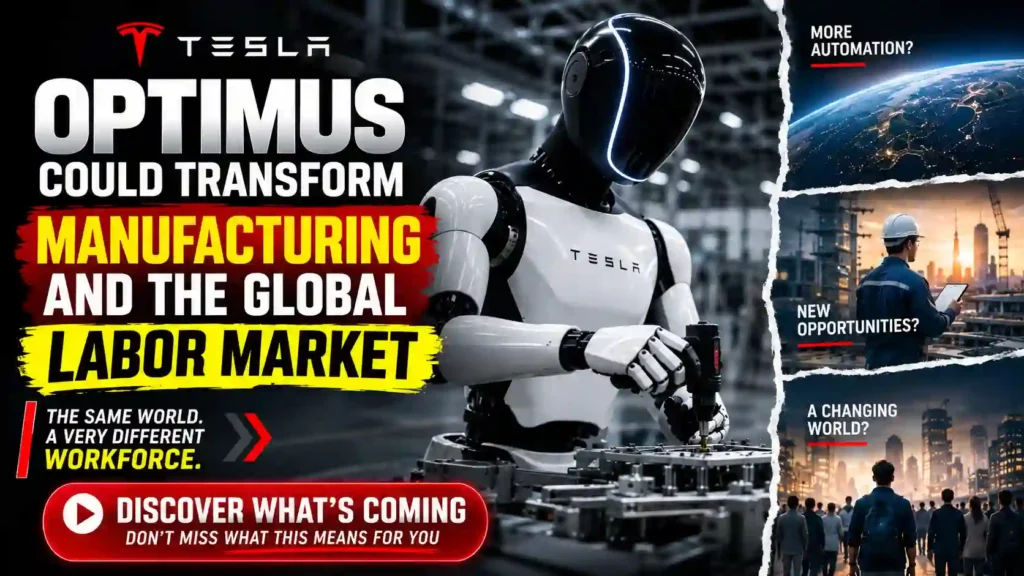
Tesla Optimus could become far more important than another impressive robot walking across a stage.
If Tesla succeeds in making humanoid robots capable, reliable and inexpensive enough for large-scale commercial use, Optimus could change how factories operate, which jobs humans perform, where companies manufacture products and even how businesses think about the cost of labor.
That is a massive “if.”
Humanoid robots have been promised for decades, while genuinely useful general-purpose machines remain extraordinarily difficult to build. Robots must understand unpredictable environments, manipulate ordinary objects, maintain balance, learn new tasks and perform them safely around humans.
However, artificial intelligence is changing what may be possible.
Tesla’s approach combines AI, cameras, batteries, electric motors, software and manufacturing experience in an attempt to create a humanoid robot that can eventually perform useful physical work.
And the implications could extend far beyond Tesla’s factories.
Understanding how Tesla Optimus could transform manufacturing and the global labor market requires looking past futuristic demonstrations and asking a more practical question:
What happens when physical labor starts becoming programmable?
Table of Contents
What Is Tesla Optimus?
Tesla Optimus, also called Tesla Bot, is a general-purpose humanoid robot being developed by Tesla.
Unlike industrial robots designed around one highly specialized task, Optimus is intended to resemble the basic physical structure of a human.
It has two arms.
Two legs.
Hands.
Cameras and sensors.
An onboard computer.
And artificial intelligence designed to help it understand and interact with the physical world.
The humanoid shape is not simply about making the robot look futuristic.
There is an important economic reason behind it.
Why AI Companies Are Racing to Secure Their Own Semiconductor Supply Chains
The World Was Built for Humans
Factories, warehouses, offices and homes were designed around the human body.
Doors are positioned for people.
Stairs are built for human legs.
Shelves are designed for human arms.
Tools are made for human hands.
If companies want robots to operate inside those environments without completely redesigning them, a human-like machine has obvious advantages.
A sufficiently capable humanoid robot could theoretically enter a workplace built for people and use much of the same infrastructure.
That is the bigger Optimus vision.
Why Tesla Is Building Humanoid Robots
Tesla’s long-term ambition for Optimus goes far beyond creating a sophisticated demonstration robot.
The company wants to develop machines capable of performing useful physical tasks.
Manufacturing is an obvious starting point.
Factories contain thousands of repetitive activities that could potentially be automated.
However, conventional factory automation has limitations.
Traditional Industrial Robots Are Extremely Good but Specialized
Walk into a highly automated automobile factory and you will already find robots.
Some weld.
Others paint.
Some move components.
Others perform highly repetitive assembly operations.
These machines can be extraordinarily fast and precise.
But many are designed around a narrow task.
Move them to a different part of the factory and they may be useless without substantial reprogramming or physical modifications.
Humanoid robots promise something different.
Instead of designing a new machine for every task, companies could potentially develop one physical robot capable of learning many tasks.
That is why general-purpose robotics could become such a big deal.
Tesla Optimus Could Make Physical Labor Programmable
Software transformed office work partly because the same computer could perform thousands of different functions.
One minute, a laptop is an accounting system.
The next minute, it is a video-editing machine.
Then it becomes a communications tool.
You do not replace the computer every time the task changes.
You change the software.
Humanoid robotics is attempting to bring a similar idea into physical work.
One Robot Could Potentially Learn Multiple Jobs
Imagine an Optimus robot working inside a factory.
During one shift, it moves components.
Later, it sorts materials.
Then it loads a machine.
After that, it performs basic inspection tasks.
The physical machine remains the same.
Its instructions change.
If robotics reaches that level of flexibility, businesses would gain something they have rarely had before:
general-purpose physical automation.
That could fundamentally change manufacturing economics.
How humanoid robots could make physical labor programmable
Tesla Could Be Optimus’ First Major Customer
Tesla has one advantage that many robotics startups do not have.
Factories.
Rather than developing a robot and immediately trying to convince outside businesses to use it, Tesla can potentially test Optimus inside its own manufacturing operations.
That creates a valuable development environment.
Tesla Factories Could Become Real-World Robotics Laboratories
A factory provides thousands of potential tasks.
Engineers can observe where Optimus fails.
Software can be updated.
Hardware can be modified.
Tasks can become progressively more difficult.
The company can also measure something that ultimately matters more than flashy demonstrations:
economics.
Does Optimus perform useful work?
How often does it fail?
How much supervision does it require?
How long can it operate?
How expensive is maintenance?
How quickly can it learn another task?
How much productive work does it complete per hour?
Those questions will determine whether humanoid robots become economically important.
Optimus Could Change the Economics of Factory Automation
Traditional automation often requires businesses to redesign production processes around machines.
That can be expensive.
A flexible humanoid robot could potentially reduce some of those costs.
Instead of rebuilding the workplace around automation, companies could introduce robots into environments already designed for human workers.
Smaller Manufacturers Could Eventually Automate More Tasks
Large automobile manufacturers can afford sophisticated industrial automation.
A smaller manufacturer may not.
Installing a specialized robotic system for one particular task can be difficult to justify economically.
General-purpose humanoid robots could change that calculation if their prices eventually fall sufficiently.
A company might purchase the same type of robot for several different tasks.
That would spread the investment across more productive activities.
The result could push automation deeper into industries that currently depend heavily on manual labor.
The Biggest Change Could Be 24-Hour Production
Humans need rest.
Machines do not need sleep.
That simple difference could have enormous economic consequences.
A sufficiently reliable humanoid robot could potentially operate for long periods, stopping mainly for charging, maintenance or task changes.
Factories could therefore increase production without increasing human staffing proportionally.
Imagine Manufacturing Across Three Shifts
A conventional factory may require different teams for morning, evening and overnight shifts.
Now imagine robots performing a larger percentage of repetitive work overnight.
Human technicians, supervisors and specialized workers could oversee the process while fewer people perform routine physical tasks.
This could increase the productive capacity of existing factories.
Businesses might manufacture more goods without building proportionally more facilities.
That could improve productivity dramatically.
Optimus Could Reduce the Importance of Cheap Labor
For decades, labor costs have influenced where products are manufactured.
Companies moved production from expensive labor markets toward countries where workers could perform the same jobs for lower wages.
Humanoid robots could eventually weaken that economic advantage.
Suppose a robot costs roughly the same to operate in the United States, Germany, Mexico or Vietnam.
Suddenly, labor costs become a smaller part of deciding where to manufacture something.
Other factors become more important.
Companies might prioritize:
proximity to customers,
energy prices,
transportation costs,
taxes,
political stability,
supplier networks,
infrastructure,
and access to raw materials.
That could reshape global manufacturing.
Could Tesla Optimus Bring Manufacturing Back to Wealthier Countries?
Potentially.
Automation already allows high-wage countries to remain competitive in industries that would otherwise face enormous labor-cost disadvantages.
General-purpose humanoid robots could accelerate that trend.
A highly automated factory located close to American consumers may sometimes make more economic sense than a labor-intensive factory thousands of miles away.
Reshoring Could Accelerate
Reshoring means moving manufacturing back into a company’s home country.
Humanoid robots could make reshoring more attractive by reducing the amount of human labor required for production.
That does not mean manufacturing would suddenly leave developing countries.
Supply chains are far more complicated than labor costs alone.
Countries develop specialized suppliers, logistics networks, skills and industrial clusters over decades.
Those advantages will not disappear because humanoid robots arrive.
However, the calculation behind new factory locations could gradually change.
How humanoid robots could accelerate the reshoring of manufacturing
Tesla Optimus Could Help Address Labor Shortages
Not every automation story is about eliminating jobs.
Many countries are facing a different problem:
not enough workers.
Aging populations are creating labor shortages in manufacturing, logistics, healthcare, agriculture and other industries.
Japan, South Korea, China and many European countries face significant demographic challenges.
As populations age, fewer working-age people may be available to support larger elderly populations.
Humanoid robots could potentially fill some of that gap.
Robots Could Take Jobs Employers Struggle to Fill
Some factory positions involve repetitive, physically exhausting or undesirable work.
Employers may struggle to recruit people for these roles.
Robots could increasingly perform tasks involving:
heavy lifting,
repetitive movement,
material transportation,
overnight work,
hazardous environments,
and monotonous production processes.
That could allow human workers to move toward jobs requiring judgment, communication, troubleshooting and technical expertise.
But Some Human Jobs Would Almost Certainly Disappear
It would be unrealistic to discuss humanoid robots without acknowledging job displacement.
If a robot can perform a job reliably for less money than a human worker, companies have a strong financial incentive to automate that position.
This has happened repeatedly throughout industrial history.
Humanoid robots could expand the range of jobs vulnerable to automation.
Routine Physical Jobs Would Face the Greatest Pressure
Jobs involving predictable, repetitive physical activities are likely to be among the first affected.
Potential examples include:
material handling,
basic assembly,
warehouse movement,
sorting,
machine loading,
simple packaging,
and repetitive inspection.
These jobs will not necessarily disappear immediately.
Automation normally happens gradually.
But if humanoid robots improve quickly, the transition could accelerate.
The Real Question Is Whether Optimus Becomes Cheaper Than Human Labor
Businesses do not automate simply because robots look impressive.
They automate when the economics make sense.
Suppose a worker costs a company $50,000 annually after wages, benefits, insurance, training and other expenses.
Now suppose a robot costs $100,000 but can perform useful work for several years.
The comparison becomes interesting.
However, purchase price is only one variable.
The True Cost of a Humanoid Robot Includes More Than the Robot
Companies must consider:
purchase price,
financing,
electricity,
maintenance,
repairs,
software,
supervision,
downtime,
insurance,
and useful operating life.
A $30,000 robot that constantly breaks down could be more expensive than a $100,000 robot that operates reliably.
Therefore, the number businesses will eventually care about is cost per productive hour.
If humanoid robots push that figure substantially below human labor costs for certain tasks, adoption could accelerate quickly.
Robots Could Become Capital Instead of Labor
This could create an unusual shift in business economics.
Traditionally, companies hire workers to increase production.
Humanoid robotics could increasingly allow companies to purchase productive capacity as equipment.
Instead of asking:
“How many workers should we hire?”
Companies might ask:
“How many robots should we deploy?”
That shifts spending from labor toward capital.
Businesses Could Scale Production Differently
Imagine a company suddenly receives twice as many orders.
Today, it may need to recruit and train additional workers.
In a robot-heavy factory, management might purchase additional machines, copy existing workflows and expand production.
If deployment becomes simple enough, businesses could potentially scale physical operations more like cloud computing.
Need additional capacity?
Add machines.
That could make manufacturing more responsive to demand.
AI Is What Makes This Generation of Humanoid Robots Different
Humanoid robots themselves are not new.
Researchers have built them for decades.
What has changed is artificial intelligence.
Traditional robots depend heavily on carefully programmed instructions.
Modern AI systems are becoming better at interpreting images, understanding language and learning patterns.
Combining these capabilities with robotics could produce machines capable of handling less structured environments.
Robots Could Learn From Demonstration
One potentially powerful approach involves teaching robots by showing them what to do.
Instead of engineers manually programming every movement, a human could demonstrate a task.
The robot observes.
AI systems interpret the movements.
The machine practices.
Performance improves.
If this process becomes reliable, deploying robots to new jobs could become dramatically easier.
Tesla’s Autonomous Driving Work Could Help Optimus
Tesla’s experience developing autonomous vehicles may provide useful technology for Optimus.
Cars and humanoid robots face different physical challenges, but both need to interpret the world through sensors and make decisions based on what they perceive.
A robot walking through a factory needs to identify objects, people, obstacles and pathways.
It needs to understand where things are.
Then it must determine what action to take.
This is essentially an AI perception and decision-making problem.
Tesla has spent years working on similar problems for vehicles.
The company hopes some of that expertise can transfer into robotics.
Tesla’s Manufacturing Experience Could Be an Even Bigger Advantage
Building one impressive humanoid robot is very different from manufacturing one million.
This is where Tesla could have another advantage.
The company already manufactures complex products at large scale.
It understands:
supply chains,
battery production,
electric motors,
power electronics,
factory automation,
quality control,
and high-volume manufacturing.
That experience could become crucial if humanoid robotics moves from prototypes to mass production.
The Winner May Not Build the Smartest Robot
The eventual humanoid robotics leader may need more than extraordinary AI.
It must manufacture robots cheaply.
At scale.
With consistent quality.
Then it must repair them.
Supply replacement parts.
Update their software.
Train customers.
And maintain a large installed fleet.
The robotics race will therefore be partly an AI competition and partly a manufacturing competition.
Optimus Could Create Huge Demand for AI Chips
Every intelligent robot needs computing power.
A humanoid robot operating independently cannot depend entirely on a distant data center.
It needs onboard processing to make rapid decisions.
If companies eventually manufacture millions of humanoid robots, semiconductor demand could rise substantially.
That helps explain why AI companies are becoming increasingly interested in controlling their hardware supply chains.
Tesla’s robotics ambitions, autonomous vehicles and AI infrastructure could eventually require enormous quantities of processors.
Why AI companies are racing to secure their own semiconductor supply chains
Humanoid Robots Could Transform Warehouses
Manufacturing may only be the beginning.
Warehouses are another obvious market.
Modern logistics operations already use significant automation.
But many warehouse activities still depend on humans because they require flexibility.
Workers pick up differently shaped objects.
They open containers.
They move around unpredictable environments.
They respond when something goes wrong.
Humanoid robots could potentially automate more of these tasks.
A robot capable of using existing warehouse infrastructure could become extremely valuable.
Construction Could Eventually Be Affected
Construction is harder to automate because job sites constantly change.
That is precisely why flexible robots could eventually matter.
Future humanoid robots might carry materials, move equipment or perform repetitive tasks under human supervision.
However, construction also illustrates the limitations facing robotics.
A controlled factory is far easier for a robot than a muddy, unpredictable construction site.
This means humanoid automation will probably spread unevenly.
Structured environments will likely come first.
Healthcare and Elder Care Could Become Enormous Markets
Aging populations could eventually create another major opportunity.
Healthcare systems already struggle with staffing shortages.
Robots could potentially assist with physical tasks such as moving supplies, delivering equipment and supporting routine logistics.
Eventually, more advanced robots might assist elderly people with daily activities.
However, healthcare creates much higher safety requirements.
A robot carrying boxes is one thing.
A robot physically assisting a vulnerable patient is another.
Reliability must improve enormously before humanoid robots can safely perform many healthcare tasks.
Optimus Could Eventually Enter Homes
Tesla has discussed broader uses for humanoid robots beyond factories.
A sufficiently advanced Optimus could theoretically perform household tasks.
Cleaning.
Carrying objects.
Organizing items.
Basic food preparation.
Assisting elderly family members.
However, homes may actually be more difficult environments than factories.
Factories can be standardized.
Homes are chaotic.
Children move unexpectedly.
Pets run around.
Objects appear in unusual places.
Stairs differ.
Furniture changes.
That means household robotics could require substantially more intelligence and reliability than repetitive factory work.
What Happens to Wages If Humanoid Robots Become Common?
This question could become politically explosive.
Automation does not affect every worker equally.
Workers performing tasks that robots can easily replicate could face wage pressure.
Meanwhile, people with skills required to design, maintain, supervise and integrate robots could become more valuable.
The labor market could split.
Some Skills Could Become More Valuable
Demand could increase for:
robotics technicians,
AI engineers,
maintenance specialists,
automation consultants,
safety engineers,
manufacturing systems experts,
and robot trainers.
Workers capable of managing fleets of automated machines could become extremely productive.
Some Skills Could Lose Economic Value
Meanwhile, repetitive physical labor may become less valuable if companies can purchase machines capable of performing it continuously.
That does not mean those workers suddenly become unnecessary to society.
It means the market price of certain tasks could decline.
The distinction matters.
One Worker Could Eventually Manage Many Robots
The future workplace may not simply be humans versus robots.
A more realistic scenario is humans working through robots.
Imagine one experienced manufacturing worker supervising ten humanoid machines.
The worker handles unusual situations.
Robots perform repetitive physical work.
When something fails, the human intervenes.
Over time, AI handles more routine exceptions.
One worker’s productive output could therefore multiply dramatically.
This could produce enormous productivity gains.
Productivity Growth Could Make Goods Cheaper
Automation is economically attractive because it can increase the amount produced from the same resources.
If humanoid robots dramatically increase manufacturing productivity, production costs could fall.
That could eventually reduce prices for certain goods.
Imagine factories operating longer hours with fewer interruptions.
Manufacturing capacity rises.
Unit costs fall.
Competition pushes some savings toward consumers.
This is one reason technological automation can improve living standards even while disrupting particular jobs.
The benefits, however, are not automatically distributed equally.
The Biggest Risk Is a Painful Transition
Technological revolutions often create new jobs.
But that does not mean workers losing old jobs smoothly transition into new ones.
A 52-year-old warehouse worker whose position is automated cannot instantly become a robotics engineer.
Retraining requires time.
New jobs may appear in different cities.
They may require different qualifications.
They may pay differently.
This transition problem could become one of the biggest political challenges associated with humanoid robotics.
Developing Countries Could Face a Different Challenge
Humanoid robots could have particularly complicated consequences for developing economies.
Many countries have historically used manufacturing as a path toward economic development.
The model is relatively straightforward.
Low labor costs attract factories.
Factories create jobs.
Workers gain skills.
Exports increase.
Income rises.
The economy gradually develops more sophisticated industries.
But what happens if cheap human labor becomes less important?
Automation Could Weaken a Traditional Development Strategy
If companies can operate highly automated factories close to wealthy consumers, there may be less incentive to move manufacturing to lower-wage countries.
That could make industrialization harder for some developing economies.
Countries may need to compete through other advantages:
cheap energy,
natural resources,
large consumer markets,
logistics,
specialized skills,
and business-friendly infrastructure.
This could become one of the most important global consequences of humanoid robotics.
How AI and robotics could reshape jobs in developing economies
Governments May Eventually Tax Robots Differently
If robots replace significant amounts of human labor, governments could face a fiscal problem.
Workers pay income taxes.
Businesses pay payroll-related taxes.
Employees contribute to social insurance systems.
Machines do not.
If employment patterns change dramatically, governments may reconsider how automation is taxed.
Proposals could include robot taxes, higher corporate taxes or entirely different ways of funding social programs.
These debates would likely become intense if automation starts displacing large numbers of workers.
Could Humanoid Robots Lead to Universal Basic Income?
Large-scale automation has already revived interest in universal basic income.
The idea is straightforward: citizens receive a regular payment regardless of employment status.
Supporters argue that increasingly productive automated economies could generate enough wealth to support such systems.
Critics worry about costs, work incentives and government dependence.
Humanoid robots would not automatically make universal basic income necessary.
But if physical automation significantly reduces demand for human labor, political pressure for new income-distribution systems could grow.
Why Optimus Still Has a Lot to Prove
It is easy to jump from impressive robot demonstrations to predictions about millions of machines replacing workers.
Reality is harder.
Optimus still needs to demonstrate that humanoid robots can perform valuable work reliably, safely and economically at scale.
The critical questions are practical.
Can Optimus Work for Hours Without Constant Intervention?
A factory robot that requires a human to rescue it every few minutes provides limited economic value.
Can It Handle Unexpected Situations?
Real workplaces are messy.
Objects move.
Equipment breaks.
People make mistakes.
A useful general-purpose robot needs to adapt.
Can Tesla Manufacture It Cheaply?
A brilliant robot costing hundreds of thousands of dollars may have limited applications.
Mass adoption requires compelling economics.
Can It Be Maintained Easily?
Robots contain motors, actuators, sensors, computers and mechanical components.
Parts wear out.
Repair costs matter.
Can It Work Safely Beside Humans?
This may be the most important requirement.
A powerful machine operating near people must behave predictably and safely.
One serious accident could create regulatory and reputational consequences for the entire industry.
The Optimus Timeline Should Be Treated Carefully
Elon Musk is famous for aggressive timelines.
That has advantages.
Ambitious deadlines can push engineering teams to move faster.
But public predictions do not always match eventual deployment dates.
Therefore, forecasts about millions or billions of humanoid robots should not be treated as guaranteed outcomes.
The better approach is to watch measurable progress.
Look for robots completing useful tasks without human assistance.
Look for deployment inside real factories.
Look for reliability data.
Look for production numbers.
Look for external customers willing to pay.
Most importantly, look for evidence that robots save businesses money.
That is when the technology moves from impressive demonstration to economic disruption.
Tesla Is Not Alone in the Humanoid Robot Race
Optimus receives enormous attention because Tesla and Elon Musk attract attention.
But the humanoid robotics industry is becoming increasingly competitive.
Startups and established technology companies are developing machines intended for factories, warehouses and other workplaces.
Competition is important.
It increases the chances that useful humanoid robotics develops even if one company’s approach fails.
It also creates pressure to improve performance while reducing costs.
The ultimate winner may not necessarily be Tesla.
The larger trend matters more than any single robot.
What Manufacturing Could Look Like in 10 to 20 Years
Imagine entering a factory where humans remain responsible for engineering, supervision, troubleshooting and strategic decisions.
Humanoid robots move materials.
Specialized industrial robots handle extremely precise operations.
Autonomous vehicles transport components.
AI systems monitor production.
Computer vision detects defects.
Predictive maintenance systems identify machines likely to fail.
Factories operate nearly continuously.
Humans intervene primarily when machines encounter unfamiliar situations.
This scenario does not require robots to become conscious or achieve science-fiction intelligence.
They simply need to become useful enough, reliable enough and cheap enough.
That threshold could matter more than spectacular demonstrations.
The Global Labor Market Could Be Reorganized Around Human Advantages
If robots become excellent at repetitive physical work, humans will need to compete less through physical repetition and more through abilities machines struggle to replicate.
Those may include:
leadership,
empathy,
negotiation,
creativity,
complex judgment,
relationship building,
entrepreneurship,
and responsibility.
Jobs themselves could change.
Instead of physically performing every task, workers may increasingly manage automated systems that perform them.
This has happened before.
Farm machinery dramatically reduced the number of people required to produce food.
Computers transformed clerical work.
Industrial robots changed automobile manufacturing.
Humanoid robots could extend automation into a much broader range of physical activities.
FAQs About Tesla Optimus, Manufacturing and Jobs
Tesla Optimus raises major questions about automation, wages, factories and the future of human work. Here are answers to some of the most important ones.
1. What is Tesla Optimus?
Tesla Optimus is a general-purpose humanoid robot being developed by Tesla to perform physical tasks in environments originally designed for humans.
2. Why is Tesla building Optimus?
Tesla sees humanoid robots as a potential way to automate repetitive, dangerous or undesirable physical work while creating a potentially enormous new business.
3. How could Tesla Optimus transform manufacturing?
Optimus could allow factories to automate tasks that are difficult to automate using traditional specialized machinery, particularly activities currently performed by human workers.
4. Will Tesla Optimus replace factory workers?
Some jobs could eventually be displaced if Optimus becomes capable and economical enough. However, robots could also create jobs involving maintenance, supervision, programming and automation management.
5. What factory jobs could Optimus perform?
Potential applications include material movement, machine loading, sorting, basic assembly, packaging and other repetitive physical tasks.
6. Why make Optimus humanoid?
A humanoid shape allows the robot to potentially use environments, tools and infrastructure already designed for humans.
7. Can Tesla Optimus work 24 hours a day?
Robots do not require sleep, but they still need charging, maintenance and repairs. Actual operating time will depend on battery life, reliability and the task being performed.
8. Could Optimus make factories more productive?
Potentially. Robots capable of operating for long periods and performing multiple tasks could increase output while reducing some labor-related production constraints.
9. Could Optimus reduce manufacturing costs?
Yes, if its total cost per productive hour becomes lower than alternative labor or automation systems. However, reliability and maintenance will heavily influence the economics.
10. Could Optimus bring manufacturing jobs back to America?
Humanoid robots could make domestic manufacturing more competitive by reducing dependence on low-cost labor, potentially encouraging some reshoring.
11. Could humanoid robots hurt developing economies?
Potentially. Countries relying heavily on low-cost manufacturing labor could lose part of that competitive advantage if automation becomes significantly cheaper.
12. Will humanoid robots create new jobs?
Yes. Wider adoption could increase demand for robotics technicians, engineers, maintenance workers, automation specialists and other supporting occupations.
13. What jobs are most vulnerable to humanoid robots?
Repetitive and predictable physical jobs are likely to face the greatest automation pressure initially.
14. Could Tesla Optimus work in warehouses?
Yes. Warehouses are a potentially attractive environment because many operations involve repetitive movement, sorting and material-handling tasks.
15. Could Optimus work in construction?
Possibly, although construction sites are less predictable than factories and therefore present greater technical and safety challenges.
16. Could Optimus work in healthcare?
Humanoid robots could eventually assist with logistics and physical support tasks, but direct patient care would require exceptionally high levels of safety and reliability.
17. Could people eventually buy Optimus for their homes?
That is part of the broader humanoid robotics vision, but household environments are highly unpredictable and may be considerably harder to automate than structured factories.
18. How could Optimus affect wages?
Wages for highly repetitive physical work could face pressure if robots become cheaper substitutes, while demand could increase for workers with robotics, engineering and automation skills.
19. Could one person supervise multiple Optimus robots?
Potentially. Human workers may eventually supervise fleets of robots, handling exceptions while machines perform routine physical tasks.
20. Does Optimus use artificial intelligence?
Yes. AI is essential for allowing humanoid robots to perceive their surroundings, understand tasks, make decisions and control their movements.
21. Why does Optimus need powerful computer chips?
The robot must process information from cameras and other sensors rapidly enough to understand its environment and act safely in real time.
22. Could Tesla manufacture millions of Optimus robots?
Tesla has large-scale manufacturing experience, but producing millions of reliable humanoid robots would still be an enormous engineering and manufacturing challenge.
23. Is Tesla guaranteed to dominate humanoid robotics?
No. Tesla faces competition from several robotics companies, and the industry is still developing. Leadership will depend on capability, reliability, manufacturing cost and real-world usefulness.
24. When will humanoid robots seriously affect the labor market?
There is no reliable date. The impact will depend on how quickly robots become capable, affordable and dependable enough for widespread commercial deployment.
25. Is Tesla Optimus really a threat to human jobs?
It could threaten certain jobs if it becomes commercially successful, particularly repetitive physical roles. But the larger effect is likely to involve both job displacement and job creation as businesses reorganize around automation.
Conclusion
The biggest idea behind Tesla Optimus is not a robot that walks like a person.
It is a machine that could potentially work like one.
If Tesla or its competitors make humanoid robots reliable, intelligent and inexpensive enough for mass deployment, the consequences could spread across factories, warehouses, supply chains and eventually households.
Manufacturing could become more automated.
Factories could operate for longer hours.
Labor shortages could become easier to manage.
Some production could move closer to consumers.
Companies could become less dependent on low-cost human labor.
Productivity could rise.
But disruption would come with those benefits.
Some repetitive jobs would disappear. Workers would need different skills. Developing economies dependent on cheap manufacturing labor could face new challenges. Governments might need to reconsider taxation, education and worker support.
None of this is guaranteed.
Tesla Optimus still has to cross the enormous gap between technological promise and economically useful mass deployment.
That is the threshold worth watching.
If humanoid robots become cheaper than human labor for a meaningful range of physical tasks, the debate will no longer be about whether robots can walk, dance or fold an object during a demonstration.
The question will become much bigger:
What happens to the global economy when physical labor itself becomes something businesses can buy, program, copy and scale?