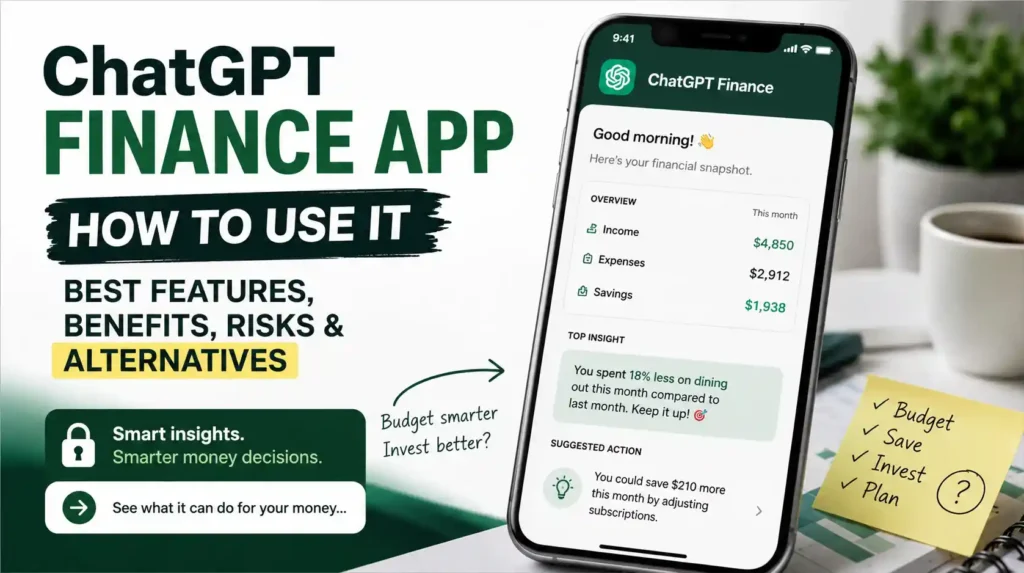
Managing money has never been easy. Between rising living costs, multiple subscriptions, credit card bills, savings goals, and investment decisions, many people feel overwhelmed trying to stay on top of their finances. Traditional budgeting apps can help organize numbers, but they often fall short when you need personalized explanations, financial planning ideas, or guidance tailored to your situation.
That’s where the ChatGPT finance app concept comes in.
Although ChatGPT is not a dedicated finance app, millions of people now use it as a powerful financial assistant. From creating realistic budgets and tracking expenses to comparing investment options, building debt repayment strategies, and understanding complex financial concepts, ChatGPT can make money management much easier.
If you’ve been wondering whether there is an official ChatGPT finance app, how it works, whether it’s safe to use, or how to get the most out of it, this guide covers everything you need to know. You’ll also discover practical ways to use ChatGPT for your daily finances, important limitations to understand, and alternatives that may better suit your financial goals.
Table of Contents
What Is a ChatGPT Finance App?
The term “ChatGPT finance app” usually refers to using ChatGPT as an AI-powered financial assistant rather than a standalone banking or budgeting application.
Instead of simply recording transactions like a traditional budgeting app, ChatGPT helps you understand your financial situation, answer money-related questions, explain financial concepts, and generate customized plans based on the information you provide.
For example, you can ask ChatGPT to:
- Create a monthly budget.
- Reduce unnecessary spending.
- Build a savings plan.
- Explain investment strategies.
- Compare financial products.
- Develop a debt payoff strategy.
- Prepare for major financial goals like buying a house or retiring.
The biggest advantage is that conversations feel natural. Rather than clicking through complicated menus, you simply describe your financial situation and ask questions as you would with a knowledgeable assistant.
Is There an Official ChatGPT Finance App?
No.
There is currently no official ChatGPT finance app developed specifically for budgeting, banking, or investing.
Instead, ChatGPT is available through the official ChatGPT app and website, where users can ask financial questions and receive AI-generated responses.
Several third-party financial applications have also integrated ChatGPT or similar AI models to enhance their services. These integrations may provide features such as:
- Personalized budgeting advice
- Spending analysis
- Investment education
- Financial planning
- Expense categorization
- Savings recommendations
However, each app works differently. Some connect directly to your financial accounts, while others simply use AI to analyze information you manually provide.
If an app claims to be an official “ChatGPT Finance App,” always verify the developer before entering any personal or banking information.
How Does ChatGPT Help With Personal Finance?
Unlike traditional financial software that mainly stores numbers, ChatGPT focuses on helping you understand those numbers.
You can think of it as an intelligent financial coach available whenever you need assistance.
For example, instead of simply showing that you spent $850 last month on groceries, ChatGPT can help answer questions such as:
- Why is my grocery budget increasing?
- How can I reduce food expenses?
- What percentage of my income should go toward groceries?
- How much could I save over one year by reducing this expense?
Because responses are conversational, many users find financial planning less intimidating.
Ways to Use ChatGPT for Budgeting
Budgeting is one of the most popular uses for ChatGPT.
Instead of starting with a blank spreadsheet, you can simply describe your financial situation.
For example:
“I earn $4,500 per month after taxes. My rent is $1,300. I spend about $700 on food, $350 on transportation, and want to save $800 each month. Can you create a realistic monthly budget?”
Within seconds, ChatGPT can organize your income and expenses into a clear spending plan.
It can also help you:
- Adjust your budget after a salary increase.
- Prepare for seasonal expenses.
- Build emergency savings.
- Plan vacation budgets.
- Reduce unnecessary subscriptions.
- Allocate money toward debt repayment.
If your financial situation changes, you simply update the numbers and ask for a revised plan.
For readers who want to learn more about AI-powered budgeting, see our guide on ChatGPT Finance.
Expense Tracking With ChatGPT
Although ChatGPT doesn’t automatically monitor your spending like a banking app, it can analyze expense data you provide.
For example, you can paste a month’s worth of transactions and ask questions like:
- Where am I overspending?
- Which expenses should I reduce first?
- How much am I spending on entertainment?
- Can you categorize these expenses?
ChatGPT can quickly organize purchases into categories such as:
- Housing
- Transportation
- Groceries
- Dining
- Entertainment
- Utilities
- Insurance
- Healthcare
- Savings
- Miscellaneous
It can also identify spending habits that may not be immediately obvious.
For example, frequent small purchases such as coffee, food delivery, or online subscriptions may add up to hundreds of dollars each month.
Using ChatGPT to Save More Money
Saving money isn’t always about earning more.
Often, it’s about identifying inefficient spending habits.
ChatGPT can suggest practical saving strategies based on your income, expenses, and financial goals.
For example, you might ask:
- How can I save $10,000 in two years?
- How much should I save each week?
- Which expenses should I cut first?
- Can you build a savings challenge for me?
It can even recommend different savings methods depending on your personality.
For example:
- The 50/30/20 budget
- Zero-based budgeting
- Pay-yourself-first budgeting
- Weekly savings challenges
- Round-up savings strategies
Rather than recommending a single approach for everyone, ChatGPT can explain the advantages and disadvantages of each method.
Can ChatGPT Help With Investing?
Yes—but with important limitations.
ChatGPT can help you understand investing, but it should not replace professional financial advice or your own research.
It can explain topics such as:
- Stocks
- ETFs
- Mutual funds
- Bonds
- Dividend investing
- Index funds
- Asset allocation
- Risk tolerance
- Dollar-cost averaging
- Portfolio diversification
For example, you could ask:
“Explain the difference between index funds and actively managed mutual funds in simple language.”
Or:
“What are the advantages and disadvantages of dividend investing?”
These educational explanations help you make more informed decisions before investing real money.
However, ChatGPT should not be relied upon to predict future stock prices or guarantee investment returns.
Readers interested in using AI for investing can also explore our guide on ChatGPT Finance for additional practical strategies.
Debt Repayment Planning
Paying off debt becomes much easier when you have a structured plan.
ChatGPT can compare different repayment strategies based on your financial situation.
For example, it can explain:
Debt Snowball Method
This strategy focuses on paying off your smallest debt first while making minimum payments on all others.
The quick wins can provide motivation to continue.
Debt Avalanche Method
This method prioritizes debts with the highest interest rates first.
Although progress may feel slower initially, it usually saves more money in total interest.
ChatGPT can also calculate approximate repayment timelines based on:
- Monthly payment amount
- Interest rates
- Outstanding balances
- Additional payments
This helps you understand how increasing monthly payments—even slightly—can shorten your repayment period.
Financial Goal Planning
Whether your goal is buying your first home, paying for college, starting a business, or retiring comfortably, ChatGPT can help break large financial goals into manageable steps.
For example, instead of asking:
“How do I save $50,000?”
You could ask:
“I want to save $50,000 in five years. I currently have $8,000 saved and can invest $700 each month. Can you create a realistic savings roadmap?”
ChatGPT can estimate how much you may need to save monthly, identify potential gaps, and suggest adjustments based on your assumptions. It can also help you prioritize multiple goals if you’re balancing debt repayment, emergency savings, and long-term investing at the same time.
Tax Planning Assistance
While ChatGPT is not a substitute for a qualified tax professional, it can make tax topics much easier to understand.
It can explain concepts such as:
- Tax brackets
- Tax deductions
- Tax credits
- Capital gains tax
- Retirement account tax advantages
- Self-employment taxes
- Business expense deductions
For freelancers, small business owners, and side hustlers, ChatGPT can also help create checklists for organizing receipts, tracking deductible expenses, and preparing questions to ask a tax advisor.
Always verify tax advice against the latest laws in your country, as tax regulations change regularly.
Best Features of Using ChatGPT for Finance
While traditional finance apps focus on recording financial data, ChatGPT offers features centered on understanding, planning, and decision-making.
Some of its strongest features include:
Personalized Financial Conversations
Instead of reading generic articles, you receive answers tailored to your specific financial situation, goals, and questions.
Budget Creation
ChatGPT can build customized monthly, weekly, or annual budgets based on your income and expenses.
Easy-to-Understand Explanations
Financial jargon can be confusing. ChatGPT simplifies complex topics like investing, inflation, mortgages, insurance, and retirement planning into plain language.
Financial Scenario Planning
You can ask “what if” questions, such as:
- What happens if I increase my savings by $200 each month?
- How quickly could I pay off my credit card if I doubled my monthly payment?
- How much should I invest to reach a specific retirement goal?
This flexibility makes ChatGPT a valuable tool for exploring different financial strategies before making important decisions.
Benefits of Using a ChatGPT Finance App
ChatGPT isn’t designed to replace your bank, financial advisor, or accounting software. Instead, it complements them by helping you make better financial decisions.
Here are some of its biggest advantages.
1. Available Anytime
Unlike scheduling an appointment with a financial advisor, ChatGPT is available 24/7. Whether you’re reviewing your budget at midnight or researching investments during your lunch break, you can get immediate answers.
2. Personalized Guidance
Most finance articles provide general advice. ChatGPT can tailor its responses based on your income, expenses, debt, savings goals, and financial priorities.
For example, instead of explaining budgeting in general, it can recommend a budget that matches your actual monthly cash flow.
3. Saves Time
Creating spreadsheets, calculating budgets, or comparing financial options manually can take hours.
ChatGPT can complete many of these tasks within seconds, allowing you to spend more time acting on your financial plan instead of creating it.
4. Improves Financial Knowledge
Many people avoid managing money because financial topics seem intimidating.
ChatGPT explains concepts in plain English, making it easier to understand topics like:
- Inflation
- Compound interest
- Credit scores
- Mortgages
- Retirement accounts
- Investing
- Insurance
As your understanding grows, you’re likely to become more confident when making financial decisions.
5. Encourages Better Financial Habits
Good financial habits are easier to maintain when you have regular guidance.
ChatGPT can help you:
- Review your monthly budget.
- Track financial goals.
- Stay motivated while paying off debt.
- Identify unnecessary spending.
- Build healthier saving habits.
Using it consistently can make personal finance feel less overwhelming.
Risks and Limitations
Despite its capabilities, ChatGPT has limitations that every user should understand.
It Can Make Mistakes
ChatGPT generates responses based on patterns in data. Although many answers are accurate, it can sometimes provide outdated, incomplete, or incorrect financial information.
Always verify important financial decisions using trusted sources before taking action.
It Isn’t a Licensed Financial Advisor
ChatGPT provides educational information—not personalized financial, legal, tax, or investment advice.
Major financial decisions should be made with appropriate professional guidance when necessary.
It Doesn’t Know Your Complete Financial Situation
Unless you provide detailed information, ChatGPT cannot fully understand:
- Your complete financial history
- Your investment portfolio
- Tax circumstances
- Insurance coverage
- Future income changes
The quality of its recommendations depends heavily on the information you share.
Market Conditions Change
Investment markets change daily.
Even if ChatGPT explains investing correctly, economic conditions, interest rates, inflation, and company performance may change after the response is generated.
Always conduct current research before investing.
Privacy Concerns
Avoid sharing highly sensitive financial information.
Never include:
- Bank account numbers
- Credit card numbers
- Passwords
- PINs
- Social Security numbers
- Tax identification numbers
- Authentication codes
When asking budgeting questions, general figures are usually enough.
For example, instead of sharing your bank account details, simply say:
“My monthly income is approximately $5,200 and my monthly expenses are around $3,900.”
That provides enough context without exposing sensitive information.
Is It Safe to Use ChatGPT for Finance?
Yes, provided you use it responsibly.
ChatGPT is generally safe for:
- Learning about personal finance
- Building budgets
- Understanding investments
- Planning savings goals
- Comparing financial concepts
- Organizing financial information
However, you should never rely on ChatGPT alone when making significant financial decisions.
Use it as an educational assistant rather than the final authority.
You should also avoid uploading confidential financial documents unless you understand how the service handles your data and are comfortable doing so.
For more information on using AI with financial accounts, read our guide on ChatGPT To Connect A Bank Account.
Best ChatGPT Finance Apps and Integrations
Although there isn’t an official ChatGPT finance app, several financial platforms have started incorporating AI-powered assistants into their products.
Examples include apps that offer:
- AI budgeting assistance
- Automated spending insights
- Investment education
- Financial coaching
- Expense categorization
- Savings recommendations
Some budgeting platforms also allow users to export financial data, which can then be analyzed with ChatGPT to identify spending patterns, suggest savings opportunities, and build customized financial plans.
When choosing a finance app with AI features, look for:
- Strong security measures
- Transparent privacy policies
- Reliable customer support
- Automatic transaction categorization
- Budget planning tools
- Goal tracking
- Regular software updates
ChatGPT vs Traditional Budgeting Apps
Both ChatGPT and traditional budgeting apps have strengths.
| Feature | ChatGPT | Traditional Budget App |
|---|---|---|
| Personalized conversations | ✔ | Limited |
| Budget creation | ✔ | ✔ |
| Automatic bank syncing | Usually No | Yes |
| Expense tracking | Manual | Automatic |
| Financial education | Excellent | Basic |
| Investment explanations | Excellent | Limited |
| AI-powered recommendations | Excellent | Varies |
| Transaction categorization | Manual unless integrated | Automatic |
Many people use both together.
A budgeting app tracks transactions automatically, while ChatGPT helps interpret the data and suggests improvements.
Best Prompts to Use With ChatGPT for Finance
The quality of ChatGPT’s responses depends largely on the prompts you provide.
Here are some examples.
Budgeting
Create a realistic monthly budget for someone earning $4,000 per month with $1,200 rent and a goal of saving 20% of their income.
Saving Money
Identify five areas where I can reduce monthly spending without significantly affecting my lifestyle.
Debt Repayment
Compare the debt snowball and debt avalanche methods based on these balances and interest rates.
Investing
Explain index fund investing in simple language for a beginner with a long-term investment horizon.
Retirement Planning
Estimate how much I should save monthly to retire with $1 million in 30 years.
Expense Analysis
Analyze these monthly expenses and identify opportunities to save money.
The more specific your prompt, the more useful the response is likely to be.
Who Should Use a ChatGPT Finance App?
ChatGPT can be useful for many different types of users, including:
- Students learning personal finance
- Families creating household budgets
- Freelancers managing irregular income
- Small business owners planning expenses
- Investors researching financial concepts
- People paying off debt
- Anyone looking to improve their financial literacy
Even experienced investors can use ChatGPT to simplify research, brainstorm financial strategies, or better understand unfamiliar concepts.
Frequently Asked Questions About ChatGPT Finance App
Before deciding whether ChatGPT fits into your financial workflow, it’s helpful to answer some of the most common questions users have.
Is ChatGPT a finance app?
No. ChatGPT is an AI assistant, not a dedicated finance app. However, it can help with budgeting, expense analysis, financial education, savings plans, debt repayment strategies, and many other personal finance tasks.
Can ChatGPT replace budgeting software?
Not completely. ChatGPT is excellent for creating budgets and explaining financial concepts, but most budgeting apps automatically import bank transactions and track spending, features ChatGPT does not provide on its own.
Can ChatGPT manage my investments?
No. ChatGPT can explain investing concepts, discuss strategies, and help you understand financial products, but it does not actively manage investment portfolios or execute trades.
Can ChatGPT connect directly to my bank account?
Not by itself. ChatGPT does not automatically connect to your bank account. Some third-party applications integrate AI with banking services, but you should verify their security and privacy practices before linking financial accounts.
Is ChatGPT good for beginners?
Yes. One of ChatGPT’s greatest strengths is making complex financial topics easy to understand. Beginners can learn budgeting, saving, investing, debt management, and many other financial concepts through simple conversations.
Final Thoughts
The idea of a ChatGPT finance app represents a new way of managing money. Instead of relying solely on spreadsheets and traditional budgeting tools, you can use AI to better understand your finances, create personalized plans, learn investing, organize expenses, and work toward long-term financial goals.
That said, ChatGPT works best as a financial assistant—not a replacement for professional advice or secure financial software. It cannot predict markets, guarantee investment success, or automatically manage your accounts. Its real value lies in helping you make more informed decisions, ask better questions, and build stronger financial habits.
When combined with responsible money management, trusted financial tools, and careful judgment, ChatGPT can become a valuable part of your personal finance toolkit.
If you’re just getting started, begin with a simple budgeting conversation, explore your spending habits, and gradually use ChatGPT to support bigger financial goals such as saving for a home, paying off debt, or planning for retirement. Over time, those small, informed decisions can have a meaningful impact on your financial future.

