You send money expecting it to arrive smoothly… then it doesn’t.
No clear update. No instant confirmation. Just a pending status that drags on longer than expected. That’s when most people start questioning ACH transfers. They’re used everywhere in the U.S., yet very few people actually understand how they work until something goes wrong.
Now that you’re here, you’ll understand exactly how ACH transfers work, why they fail, how long they take, and how to avoid delays that slow your money down.
Table of Contents
What Are ACH Transfers?
ACH transfers are electronic bank-to-bank payments that move money through a centralized network.
Instead of processing each payment instantly, the system groups transactions together and processes them in batches. That’s why ACH transfers behave differently from instant payment methods.
Here’s what defines ACH transfers:
- They are not instant
- They are low-cost or free in most cases
- They are widely used for everyday payments
- They are processed in batches
ACH transfers are used for:
- Direct deposit (salary or benefits)
- Bill payments
- Bank-to-bank transfers
- Subscription payments
If you’ve ever received your paycheck directly into your account, you’ve already used ACH transfers.
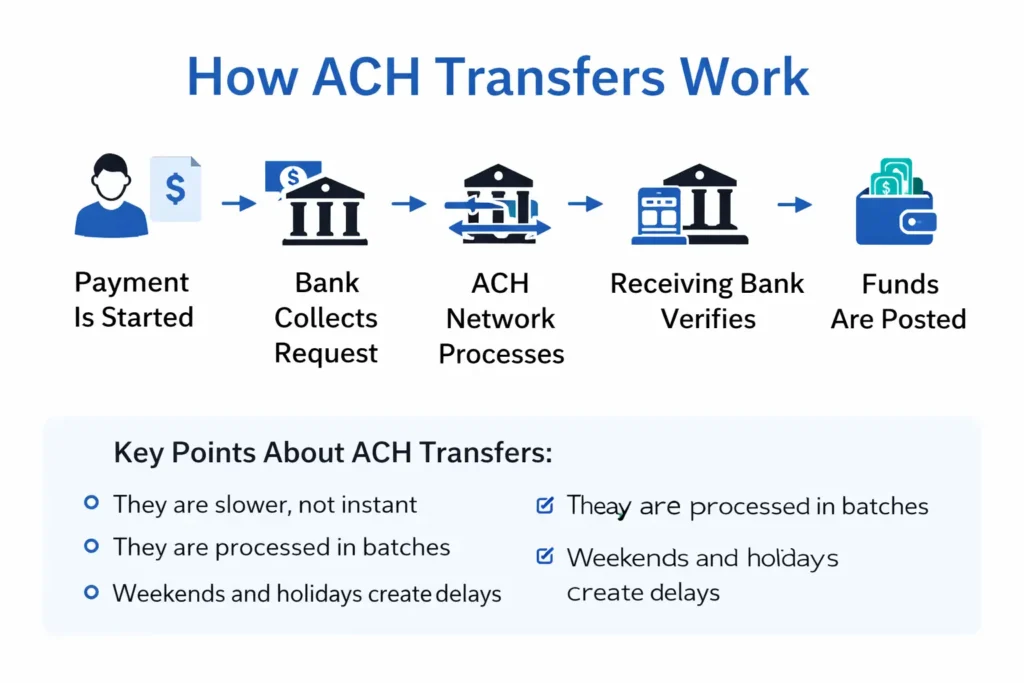
How ACH Transfers Work
Now that you understand what they are, let’s break down how ACH transfers actually move your money.
Step 1: The Transfer Is Initiated
A payment begins when you, a company, or a bank starts a transaction.
This could be:
- Sending money to another account
- Paying a bill
- Receiving a salary
- Authorizing a subscription payment
Step 2: The Bank Collects The Request
Your bank does not always send the transfer immediately. Instead, it gathers multiple transactions and prepares them for batch processing.
This is one of the main reasons ACH transfers are not instant.
Step 3: The Network Processes The Transfer
The system sorts the transactions and routes them to the correct receiving banks.
This step happens at specific intervals, not continuously.
Step 4: The Receiving Bank Verifies The Details
The receiving bank checks the account details and validates the transaction.
If everything is correct, the transfer moves forward.
If something is wrong, the transfer may be delayed or rejected.
Step 5: The Funds Are Posted
Once approved, the funds are credited to the receiving account.
This entire process is why ACH transfers typically take time.
What Is The Difference Between ACH Credit And ACH Debit?
Not all ACH transfers work the same way.
There are two main types:
ACH Credit
Money is pushed from one account to another.
Examples:
- Direct deposit
- Sending money to another account
ACH Debit
Money is pulled from your account.
Examples:
- Utility bills
- Subscription payments
- Loan repayments
The difference is simple:
- Credit sends money out
- Debit pulls money in
How Long Do ACH Transfers Take?
Timing is where most people get frustrated.
Here’s the realistic breakdown:
- Same-day ACH → usually within one business day
- Standard ACH → typically 1 to 3 business days
However, timing depends on:
- When the transfer is submitted
- Bank processing schedules
- Weekends and holidays
- Verification checks
ACH transfers are not designed for speed. They are designed for consistency and low cost.
What Time Do ACH Transfers Go Through?
There is no fixed universal time when ACH transfers are completed.
Banks process ACH transfers in batches, and each bank has its own cut-off times. This means:
- Transfers sent earlier in the day may process sooner
- Late submissions may move to the next business day
- The receiving bank may take additional time to post funds
This is why two transfers sent at different times can arrive at different speeds.
Are ACH Transfers Instant?
No, ACH transfers are usually not instant.
Even when same-day processing is available, it still depends on timing, cut-off windows, and bank policies.
If you need immediate delivery, ACH is not the right option.
Do ACH Transfers Go Through On Saturdays?
In most cases, ACH transfers do not process on weekends.
That means:
- Transfers started on Saturday or Sunday usually begin processing on the next business day
- Weekend submissions create delays
- Holidays can extend the waiting time even further
This is one of the most common reasons people think their money is missing when it is simply delayed.
Why Do ACH Transfers Take So Long?
ACH transfers feel slow because of how the system is designed.
Here are the main reasons:
- Batch processing instead of real-time processing
- Bank cut-off times
- Weekends and holidays
- Fraud checks and verification
- Incorrect or incomplete details
The system prioritizes efficiency and cost over speed.
Why ACH Transfers Fail
ACH transfers do not fail randomly. There is always a reason, and most of the time it is avoidable.
Incorrect Routing Number
If the routing number is wrong, the transfer may be rejected or delayed.
Even one incorrect digit can stop the transaction.
Wrong Account Number
A correct routing number does not help if the account number is wrong. The transfer will fail.
Insufficient Funds
If there is not enough money in the account, the transfer will not go through and may trigger a fee.
Account Restrictions
Banks may block or review transactions due to:
- Suspicious activity
- Security checks
- Account limitations
Closed Or Invalid Account
If the receiving account is inactive or closed, the transfer cannot be completed.
Exceeded Transfer Limits
Some banks and financial apps limit how much money can be sent through ACH.
Verification Issues
If the account details do not match exactly, the transfer may be delayed or rejected.
What Happens When ACH Transfers Fail?
When an ACH transfer fails, the money does not disappear.
Here’s what usually happens:
- The transaction is rejected
- The funds are returned to the sender
- The process may take several business days
In some cases, additional fees may apply.
The key point is simple: failures can be fixed, but they cost time.
Are ACH Transfers Safe?
Yes, ACH transfers are generally safe.
They are widely used for payroll, billing, and bank transfers. The system is secure when the correct details are used.
However, problems can occur if:
- Incorrect information is entered
- Unauthorized payments are allowed
- Accounts are flagged for review
Accuracy is what keeps ACH transfers safe.
Are ACH Transfers Free?
Many ACH transfers are free, but not always.
Some banks may charge for:
- Same-day processing
- Business transactions
- Returned payments
- Insufficient funds
Always check your bank’s fee structure.
Is There A Limit On ACH Transfers?
Yes, most banks apply limits.
These limits may include:
- Per transaction limits
- Daily limits
- Monthly limits
Limits depend on the bank and account type.
Can ACH Transfers Be Reversed?
Sometimes, but not always.
Reversals may be possible if:
- The transaction was incorrect
- It was unauthorized
- It was duplicated
Once fully processed, reversing an ACH transfer can be difficult.
ACH Transfers Vs Wire Transfers
These two are often confused, but they are very different.
ACH Transfers
- Slower (1–3 business days)
- Lower cost
- Ideal for everyday transactions
Wire Transfers
- Faster (often same day)
- Higher fees
- Used for urgent payments
If speed matters, wire transfers are better.
If cost matters, ACH transfers are more practical.
When Should You Use ACH Transfers?
ACH transfers are best when:
- You do not need immediate delivery
- You want low or no fees
- You are handling recurring payments
- You are receiving direct deposit
They are not suitable for urgent transactions.
How To Avoid ACH Transfer Problems
Most ACH issues are preventable.
Use these simple steps:
- Double-check routing numbers
- Verify account numbers
- Ensure sufficient funds
- Confirm account status
- Avoid sending transfers before weekends
- Check transfer limits
- Submit payments earlier in the day
Small details make a big difference.
Frequently Asked Questions
Now that you understand ACH transfers, here are the most common questions people ask.
What Are ACH Transfers?
ACH transfers are electronic bank payments processed through a centralized network.
What Is ACH Transfers?
It refers to bank-to-bank electronic payments within the U.S.
How Do ACH Transfers Work?
They move money in batches through a processing network between banks.
How Long Do ACH Transfers Take?
Usually 1 to 3 business days.
What Time Do ACH Transfers Go Through?
There is no fixed time. It depends on bank processing schedules.
When Do ACH Transfers Process?
They are processed on business days.
Do ACH Transfers Go Through On Saturdays?
No, they typically wait until the next business day.
Are ACH Transfers Instant?
No, they are usually not instant.
Why Do ACH Transfers Take So Long?
Because they are processed in batches and reviewed by banks.
Why Are ACH Transfers Slow?
The system prioritizes cost and structure over speed.
Are ACH And Wire Transfers The Same?
No, they differ in speed, cost, and use cases.
Are ACH Transfers Safe?
Yes, when correct details are used.
Are ACH Transfers Free?
Often yes, but some banks charge fees.
Is There A Fee For ACH Transfers?
Sometimes, depending on the bank.
Do Banks Charge For ACH Transfers?
Some do, especially for faster processing.
Is There A Limit On ACH Transfers?
Yes, most banks set limits.
Can ACH Transfers Be Reversed?
Sometimes, depending on the situation.
Can ACH Transfers Fail?
Yes, due to incorrect details or insufficient funds.
Why Did My ACH Transfer Fail?
Usually due to errors in account details or account issues.
What Happens When ACH Transfers Fail?
The payment is rejected or returned.
Can A Wrong Routing Number Cause Failure?
Yes, it is a common cause.
Can A Wrong Account Number Cause Failure?
Yes, the transfer will not go through.
Can Insufficient Funds Cause Failure?
Yes, and it may result in fees.
Do ACH Transfers Work On Weekends?
No, they process on business days.
Do Holidays Delay ACH Transfers?
Yes, they can extend processing time.
Can ACH Transfers Be Delayed?
Yes, due to timing or verification.
Can I Cancel An ACH Transfer?
Sometimes, depending on processing status.
Can ACH Transfers Be Used Internationally?
No, they are mainly domestic.
What Is ACH Credit?
Money sent from one account to another.
What Is ACH Debit?
Money pulled from your account.
Can Businesses Use ACH Transfers?
Yes, for payroll and payments.
What Should I Check Before Sending ACH?
Routing number, account number, and balance.
How Can I Avoid ACH Problems?
Verify details and avoid timing mistakes.
Are ACH Transfers Reliable?
Yes, when used correctly.
What Is The Biggest Cause Of ACH Failure?
Incorrect account or routing details.
Final Thoughts
ACH transfers are simple once you understand how they work.
They are not built for speed. They are built for efficiency, scale, and cost.
But when something goes wrong, it is usually because of small mistakes that could have been avoided.
Now that you understand how ACH transfers work and why they fail, you are no longer guessing.
And in banking, that is the difference between smooth transactions and frustrating delays.

